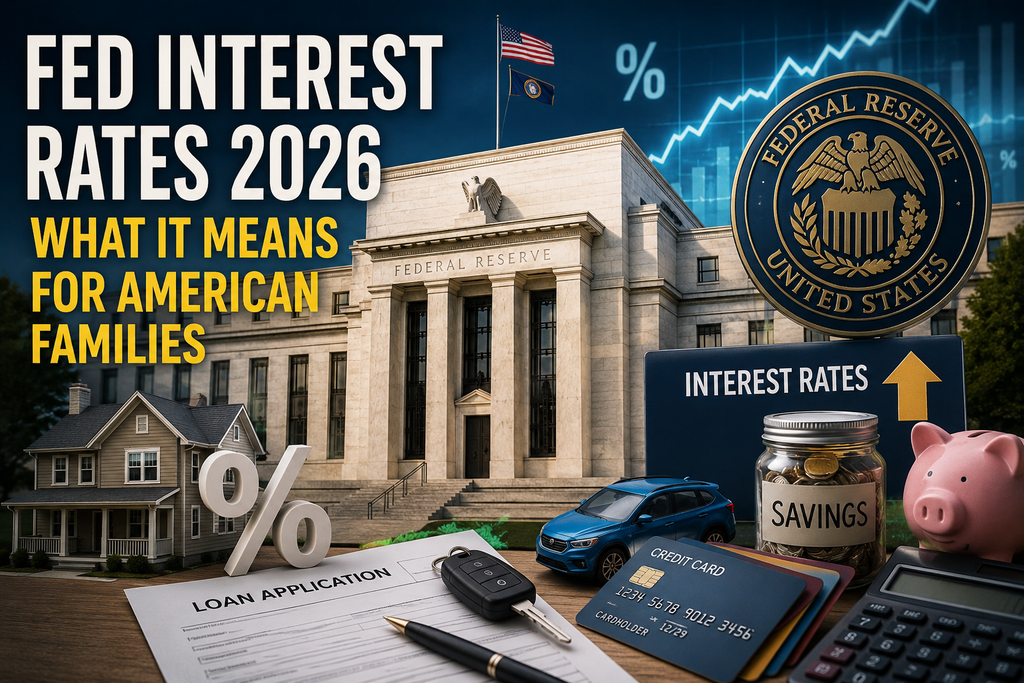
Fed Interest Rates 2026 have suddenly become one of the most important financial issues for American households.
Table of Contents
The Federal Reserve kept its target federal funds rate at 3.50% to 3.75% at its July 28–29 meeting. However, the outlook changed significantly after Federal Reserve Chair Kevin Warsh spoke at the Jackson Hole economic symposium on August 28.
Warsh indicated that policymakers could have more work to do if they do not become confident that inflation is returning toward the Federal Reserve’s 2% goal.
For ordinary Americans, this debate is about much more than Wall Street.
Federal Reserve policy can eventually influence mortgage rates, credit-card interest, auto financing, business borrowing, savings yields, employment decisions, and the amount of money families have available each month.
At the same time, inflation remains a concern. The Consumer Price Index was 3.4% higher in July 2026 than a year earlier, according to the U.S. Bureau of Labor Statistics.
So what would another interest-rate increase actually mean for your household?
Here are seven important ways Fed Interest Rates 2026 could affect everyday American families.
1. Why Fed Interest Rates 2026 Matter Right Now
The Federal Reserve has two major economic objectives: maximum employment and stable prices.
Interest rates are one of its most powerful tools for pursuing those goals.
When inflation becomes too persistent, the Fed can maintain or raise interest rates to make borrowing more expensive. Higher borrowing costs can reduce demand throughout the economy.
Consumers may finance fewer large purchases. Businesses may postpone expansion. Housing activity can slow.
Over time, weaker demand can reduce some inflationary pressure.
But higher rates also have consequences.
Borrowing becomes more expensive for households and businesses, and economic activity can slow.
That is why the current debate is so important.
The Fed maintained its federal funds target range at 3.50% to 3.75% in July 2026. But inflation has remained above its 2% objective, increasing uncertainty about what policymakers will do next.
The next decisions will depend heavily on incoming inflation, employment, and economic-growth data.
Consumers should therefore avoid assuming either that a rate increase is guaranteed or that rates will soon fall.
2. Mortgage Rates Could Remain Painful for Homebuyers
Housing is one of the first areas consumers think about when interest rates rise.
The Federal Reserve does not directly set 30-year mortgage rates. Mortgage rates are influenced by Treasury yields, inflation expectations, investor demand, economic conditions, and expectations about future monetary policy.
Nevertheless, Fed policy can strongly influence the broader interest-rate environment.
For someone purchasing a home, even a relatively small difference in the mortgage rate can substantially change the monthly payment.
Consider two buyers purchasing identical homes.
If one receives a significantly lower mortgage rate, that household may pay hundreds of dollars less each month depending on the loan amount.
Over decades, the difference can become enormous.
This creates difficult choices for prospective homeowners.
Some may:
- Purchase a less expensive home
- Increase their down payment
- Wait longer before buying
- Choose a different neighborhood
- Continue renting
- Consider an adjustable-rate mortgage
- Buy now and hope to refinance later
None of these decisions is automatically right for everyone.
The important lesson is that homebuyers should evaluate affordability using today’s payment rather than assuming that refinancing will definitely become cheaper later.
What Existing Homeowners Should Know
Homeowners with fixed-rate mortgages generally do not see their existing mortgage interest rate change when the Fed raises rates.
That is one of the advantages of a fixed-rate loan.
However, homeowners using adjustable-rate mortgages, home-equity lines of credit, or other variable-rate borrowing may be more exposed to changes in the interest-rate environment.
3. Credit Card Debt Could Become Even More Expensive
Credit cards are another major reason Fed Interest Rates 2026 matter to families.
Many credit cards have variable annual percentage rates.
When benchmark rates remain high or increase, borrowing costs on revolving credit can remain extremely expensive.
This matters because credit-card interest compounds.
A household carrying a large balance may make payments every month while seeing only a portion of those payments reduce the principal.
Minimum payments can make the problem especially difficult.
Suppose a family experiences an unexpected car repair, medical expense, or home repair and puts it on a credit card.
If that balance cannot be paid quickly, interest charges can turn a temporary emergency into a long-term monthly expense.
What Families Can Do
Consumers carrying balances can consider several strategies:
- Pay more than the minimum whenever possible
- Prioritize the highest-interest balances
- Avoid adding new discretionary purchases to revolving debt
- Compare balance-transfer offers carefully
- Ask issuers whether a lower rate is available
- Consider whether a lower-cost consolidation option actually reduces total interest
The important consideration is the total cost of borrowing, not simply the monthly payment.
4. Car Loans May Put More Pressure on Monthly Budgets
Americans often depend on vehicles for commuting, childcare, shopping, healthcare, and daily life.
That makes auto financing another important part of the interest-rate story.
A car’s sticker price is only one component of its true cost.
Drivers also pay for:
- Financing
- Insurance
- Gasoline
- Registration
- Maintenance
- Tires
- Repairs
- Parking
- Tolls in some areas
Higher financing costs can therefore arrive on top of several other vehicle-related expenses.
For consumers shopping for a vehicle, focusing exclusively on the advertised monthly payment can be misleading.
A longer loan can reduce the monthly payment while increasing the total amount of interest paid.
Buyers should compare the vehicle price, APR, loan term, down payment, and total financing cost together.
A less expensive vehicle with a shorter financing period can sometimes be financially stronger than a more expensive vehicle stretched across a very long loan.
5. Higher Rates Can Be Good News for Savers
Higher interest rates are not negative for everyone.
Savers can sometimes benefit.
When rates are elevated, banks and other financial institutions may offer more attractive yields on certain savings products.
These can include:
- High-yield savings accounts
- Certificates of deposit
- Money-market accounts
- Treasury securities
This creates an interesting contrast.
A household carrying expensive variable-rate debt may dislike higher rates, while a household with substantial cash savings may earn more interest.
Emergency Savings Matter
For families, one useful application of higher savings yields is the emergency fund.
An emergency fund can help cover expenses such as:
- Car repairs
- Home repairs
- Temporary income loss
- Unexpected travel
- Insurance deductibles
- Other urgent bills
Keeping emergency money accessible while earning a competitive yield can help households make better use of cash reserves.
However, consumers should consider withdrawal restrictions, account requirements, deposit insurance, and liquidity before choosing where to keep emergency savings.
6. Fed Interest Rates 2026 Could Affect Jobs and Wages
Interest rates can eventually affect the labor market as well.
When borrowing becomes more expensive, companies may become more cautious about expansion.
A business considering a new factory, office, restaurant, equipment purchase, or technology investment has to evaluate financing costs.
Higher costs can cause some businesses to delay investments.
That can influence hiring.
Companies may:
- Slow recruitment
- Leave positions unfilled
- Reduce expansion plans
- Become more selective when hiring
- Limit wage increases
- Reduce overtime
This does not mean every interest-rate increase automatically causes unemployment.
The economy is much more complicated than that.
Employment conditions depend on consumer demand, productivity, government policy, global economic conditions, technology, industry-specific trends, and many other factors.
But interest rates are one important piece of the equation.
That is why the Federal Reserve watches both inflation and employment conditions when making monetary-policy decisions.
7. Household Spending Could Slow
Another effect of higher interest rates can appear in everyday consumer behavior.
When mortgage payments, credit-card bills, auto loans, insurance, groceries, utilities, and other expenses consume more household income, families often become more selective.
They may postpone:
- Vacations
- Furniture purchases
- Electronics
- Home improvements
- Vehicle replacements
- Restaurant meals
- Entertainment spending
One household cutting back does not change the national economy.
Millions of households making similar decisions can.
Consumer spending is an important part of U.S. economic activity.
That means the effect of Fed Interest Rates 2026 can eventually move from household budgets into business revenues, hiring plans, and economic growth.
Why Inflation Is Still Central to the Fed’s Decision
To understand what the Federal Reserve might do next, Americans need to watch inflation.
According to the Bureau of Labor Statistics, the Consumer Price Index increased 0.1% in July 2026 on a seasonally adjusted basis and was 3.4% higher than a year earlier.
Food prices were 3.0% higher than a year earlier.
Shelter also remained an important contributor to the monthly CPI increase.
These numbers matter because inflation affects purchasing power.
If wages rise 2% while a household’s important expenses rise substantially faster, that family can lose purchasing power even though its paycheck is larger.
The Federal Reserve’s challenge is therefore delicate.
If policy is too loose while inflation remains persistent, price pressures could continue.
If policy becomes unnecessarily restrictive, borrowing and economic activity could weaken too much.
There is no perfect setting that immediately solves both problems.
What Another Fed Rate Increase Could Mean for Your Family
The effect depends heavily on a household’s financial situation.
If You Carry Credit Card Debt
Higher or persistently high rates can make revolving balances more expensive.
Reducing high-interest debt can therefore become especially valuable.
If You Are Buying a Home
Do not base affordability on the assumption that mortgage rates will fall soon.
Calculate whether the home works with the financing actually available today.
If You Are Buying a Car
Compare APRs from multiple lenders and examine the total financing cost.
If You Have Cash Savings
Compare the yield on your current account with competitive alternatives while considering liquidity and deposit protection.
If You Own a Business
Pay close attention to borrowing costs, cash flow, and the return expected from new investments.
If You Are Looking for Work
Watch hiring trends in your industry rather than relying only on national unemployment headlines.
Different industries can behave very differently during the same economic environment.
How Families Can Prepare Before the Next Fed Decision
Nobody can know with certainty what policymakers will decide before the economic evidence is available.
Families therefore do not need to make dramatic financial decisions based on predictions.
A stronger approach is to prepare for several possibilities.
1. Review Variable-Rate Debt
Identify credit cards, adjustable loans, and other balances whose interest costs can change.
2. Check Your Credit
A stronger credit profile can help borrowers qualify for better terms.
3. Compare Rates Before Borrowing
Do not assume the first financing offer is the best one.
4. Strengthen Emergency Savings
Even small regular contributions can gradually create a financial buffer.
5. Avoid Lifestyle Inflation
When income increases, consider directing part of the increase toward savings or debt reduction before increasing recurring expenses.
6. Review Large Purchases Carefully
When financing is expensive, the total cost of a purchase deserves more attention than the monthly payment alone.
7. Follow Official Economic Data
Major financial decisions should not be based solely on social-media predictions about what the Fed will do.
What Should Americans Watch Next?
Three areas deserve particular attention.
Inflation
Persistent inflation would strengthen the argument for maintaining tighter monetary policy.
The U.S. Bureau of Labor Statistics publishes the Consumer Price Index, one of the most widely followed measures of consumer inflation.
Employment
A significant deterioration in the labor market could complicate the Fed’s decisions.
Federal Reserve Statements
The wording of FOMC statements and comments from Federal Reserve officials can provide information about how policymakers see inflation, employment, and financial conditions.
Consumers do not need to follow every market movement.
But understanding these three areas can make financial headlines much easier to interpret.
The Bigger Picture: Interest Rates and the Cost of Living
Interest rates should not be viewed separately from the cost of living.
A family may simultaneously face higher housing costs, expensive groceries, increased insurance premiums, transportation expenses, and costly borrowing.
That combination can create financial pressure even when the household remains employed.
For more context on the broader household-budget problem, read TIPVERO’s article about How Rising U.S. Living Costs Are Affecting Everyday American Families.
INTERNAL LINK:
Link the bold article title above to the TIPVERO article you just published:
How Rising U.S. Living Costs Are Affecting Everyday American Families
Do not link the words “click here.” Use the descriptive article title as the anchor text.
Frequently Asked Questions
Will the Federal Reserve definitely raise interest rates in 2026?
No. Future decisions depend on incoming inflation, employment, and other economic data. Recent comments from Fed officials have increased attention on the possibility of further tightening, but a future rate decision should not be treated as guaranteed before the FOMC announces it.
What is the federal funds rate right now?
Following the July 2026 FOMC meeting, the Federal Reserve maintained a target range of 3.50% to 3.75%.
Does the Fed directly set mortgage rates?
No. Mortgage rates are influenced by several factors, including Treasury yields, inflation expectations, financial-market conditions, and expectations about Federal Reserve policy.
Why do Fed interest rates affect credit cards?
Many credit cards have variable rates tied directly or indirectly to benchmark interest rates. Changes in the broader rate environment can therefore influence consumers’ borrowing costs.
Are higher interest rates good for savings?
They can be. Higher-rate environments may allow banks, money-market accounts, CDs, and other savings products to offer more attractive yields.
What should families do before the next Fed meeting?
Families can review variable-rate debt, compare borrowing rates, strengthen emergency savings, check their credit, and avoid making major financial decisions based solely on predictions about the next Fed move.
Final Thoughts
Fed Interest Rates 2026 could become one of the most important financial stories for American households during the remainder of the year.
The Federal Reserve’s decisions can eventually influence mortgages, credit cards, car loans, savings returns, business investment, employment, and household spending.
But families should avoid trying to predict every move by the central bank.
Instead, they can concentrate on the financial decisions they control.
Reducing expensive debt, maintaining emergency savings, comparing borrowing costs, carefully evaluating large purchases, and following reliable economic information can make a household more resilient whether interest rates rise, remain unchanged, or eventually fall.
The next Federal Reserve decision will matter.
For most families, however, the more important question is not simply “What will the Fed do?”
It is:
“Is my household financially prepared for whatever the Fed does next?”
Featured Image SEO
File Name:fed-interest-rates-2026-american-families.jpg
Alt Text:Fed Interest Rates 2026 impact on American families
Image Title:Fed Interest Rates 2026 and American Families
Image Description:Editorial illustration showing how Fed Interest Rates 2026 can affect mortgages, credit cards, auto loans, savings and household budgets.
Excerpt
Fed Interest Rates 2026 could affect mortgages, credit cards, car loans, savings, employment and household budgets. Learn what another Federal Reserve rate change could mean for American families and how households can prepare.
External Links to Add
Federal Reserve — Monetary Policy:
Use the official Federal Reserve monetary-policy page in the section explaining the Fed.
U.S. Bureau of Labor Statistics — Consumer Price Index:
Use the official BLS CPI page in the inflation section.
Use descriptive anchor text rather than displaying long URLs.
Final Rank Math Checklist
Before publishing, confirm:
Focus Keyword: Fed Interest Rates 2026
SEO Title: Fed Interest Rates 2026: 7 Powerful Effects on Families
Slug: fed-interest-rates-2026
Meta Description: Contains exact Focus Keyword
First Paragraph: Contains exact Focus Keyword
H2/H3: Exact Focus Keyword appears in headings
Keyword Density: Keyword appears naturally throughout article
Rank Math TOC: Insert actual Rank Math TOC block
Featured Image ALT: Contains Focus Keyword
External Link: Federal Reserve
External Link: BLS
Internal Link: Rising U.S. Living Costs TIPVERO article
FAQ: Included
Excerpt: Included
Category: U.S. News & Everyday Life
Tags: Included