Semiconductors have become one of the most strategically important products in the global economy.
They power smartphones, computers, automobiles, artificial intelligence systems, data centers, telecommunications equipment, medical devices, and advanced defense systems.
That is why U.S. semiconductor tariffs are about much more than the price of computer chips.
They are increasingly connected to national security, artificial intelligence leadership, manufacturing investment, and the economic relationship between the United States and major semiconductor-producing countries such as South Korea.
For South Korea, the issue is particularly important because Samsung Electronics and SK Hynix are two of the world’s most influential memory-chip manufacturers.
The rapid expansion of artificial intelligence has made advanced memory products, including high-bandwidth memory, increasingly valuable.
The central question is therefore straightforward:
Could U.S. semiconductor tariffs hurt Samsung and SK Hynix, or could their massive investments in America actually turn the policy into an opportunity?
The answer is more complicated than simply saying tariffs are good or bad.
How Semiconductor Tariffs Work in the United States
On January 14, 2026, the White House announced action under Section 232 of the Trade Expansion Act concerning semiconductor imports.
The administration imposed a 25% tariff on a narrow category of certain advanced computing chips and derivative products, effective January 15, 2026.
However, there are important exceptions.
For example, covered chips imported for certain U.S. data centers, research and development, startups, consumer applications, civil industrial applications, public-sector uses, and other purposes that strengthen the U.S. technology supply chain may be excluded from the tariff.
The policy therefore should not be interpreted as a blanket 25% tariff on every semiconductor entering the United States.
More importantly, the administration described a potential second phase.
After trade negotiations, the United States could impose broader semiconductor tariffs while providing preferential treatment or tariff offsets for companies investing in U.S. semiconductor production.
That distinction could become extremely important for Samsung Electronics and SK Hynix.
Why Is America Using Semiconductor Tariffs?
The U.S. government wants to reduce America’s dependence on overseas semiconductor manufacturing.
For decades, semiconductor supply chains became increasingly global.
A chip might be designed in the United States, manufactured in Asia, packaged in another country, incorporated into a server somewhere else, and finally installed in an American data center.
This system can be efficient, but Washington increasingly views excessive dependence on foreign production as a national-security vulnerability.
The growth of artificial intelligence has made the issue even more urgent.
Advanced AI systems require enormous numbers of processors and memory chips. As American companies invest heavily in AI infrastructure, reliable access to semiconductors has become strategically important.
Tariffs can therefore serve another purpose beyond collecting revenue.
They can encourage manufacturers to build factories in the United States.
In simple terms, the policy creates an incentive:
Produce and invest in America, and your company may receive better access to the U.S. market.
Why Samsung Electronics Matters
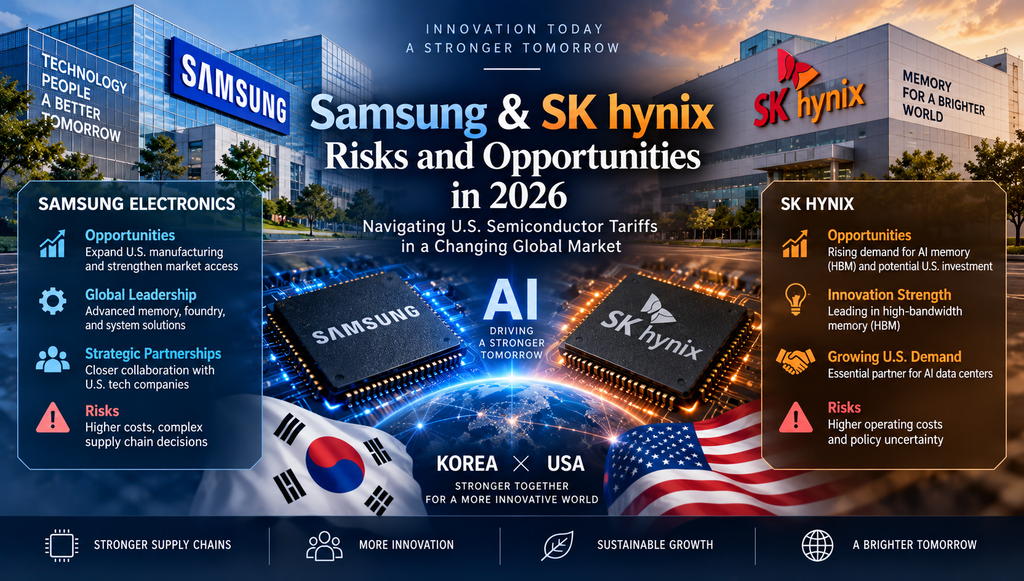
Samsung Electronics is one of the most important semiconductor manufacturers in the world.
Its business extends across memory chips, semiconductor manufacturing, smartphones, displays, and consumer electronics.
Samsung also has a significant manufacturing presence in the United States.
That matters because the emerging American semiconductor policy appears increasingly focused on rewarding companies that contribute to domestic manufacturing.
If future tariff rules provide preferential treatment to companies making substantial U.S. investments, Samsung’s American manufacturing strategy could become an important competitive advantage.
However, there is an important distinction.
Having a factory in America does not automatically mean every semiconductor Samsung produces outside the United States will receive tariff-free treatment.
The details of future rules will matter enormously.
Washington will have to determine what level of U.S. investment, production capacity, or supply-chain contribution qualifies a company for favorable treatment.
How Could U.S. Semiconductor Tariffs Affect Samsung?
There are several possible effects.
1. Greater Incentive to Expand U.S. Production
Samsung may have an even stronger economic reason to expand manufacturing and semiconductor investment in America.
Producing closer to American customers could reduce some trade-policy risks.
2. Higher Capital Costs
Semiconductor fabrication plants are extraordinarily expensive.
Moving or expanding production in the United States requires billions of dollars in factories, equipment, infrastructure, and skilled workers.
Therefore, avoiding tariffs does not necessarily mean production becomes cheaper.
3. Stronger Access to American Customers
Samsung serves a huge technology market in the United States.
A larger American manufacturing footprint could strengthen relationships with U.S. technology companies while reducing supply-chain uncertainty.
4. More Complex Global Production Decisions
Samsung cannot simply move its entire semiconductor manufacturing system to America.
Its Korean production network remains enormously important.
The company will therefore need to balance Korean manufacturing, American investment, global customers, labor costs, subsidies, tariffs, and technology security.
Why SK Hynix Is Equally Important
SK Hynix has become especially important during the artificial intelligence boom.
One major reason is high-bandwidth memory, or HBM.
HBM is designed to move enormous amounts of data quickly between processors and memory.
That makes it particularly valuable for advanced AI computing.
As AI data centers expand, demand for advanced memory has increased dramatically.
This creates an interesting challenge for U.S. trade policy.
Washington wants more semiconductor production inside America.
But American AI companies also need reliable supplies of advanced memory.
Policies that make those chips significantly more expensive could increase costs for the very AI infrastructure the United States wants to expand.
How Could the Policy Affect SK Hynix?
SK Hynix faces both risks and opportunities.
Increased U.S. Investment
Tariff incentives could encourage SK Hynix to deepen its American manufacturing and technology investments.
Strong AI Demand
The extraordinary demand for AI memory gives SK Hynix strategic importance.
This could strengthen the company’s position in negotiations and investment decisions.
Higher Operating Costs
Building semiconductor infrastructure in the United States can be expensive.
Labor, construction, equipment, energy, and compliance expenses all influence the final economics of a project.
Long-Term Strategic Opportunity
If American semiconductor policy rewards domestic investment, companies that establish their manufacturing footprint early could gain an advantage over competitors that remain more dependent on imports.
The Latest U.S.–South Korea Negotiations Matter
This issue became particularly important again on September 4, 2026.
South Korea and the United States are discussing semiconductor investment as part of broader bilateral negotiations while concerns continue over possible U.S. chip tariffs.
The existing framework is particularly important for Samsung and SK Hynix because South Korea has sought to ensure that its chipmakers receive tariff treatment at least as favorable as major competing semiconductor exporters.
The negotiations therefore could influence billions of dollars in future investment.
The biggest question is no longer simply:
Will America impose semiconductor tariffs?
A more important question may be:
How much U.S. investment will semiconductor companies need to make to receive favorable tariff treatment?
What Could This Mean for South Korea’s Economy?
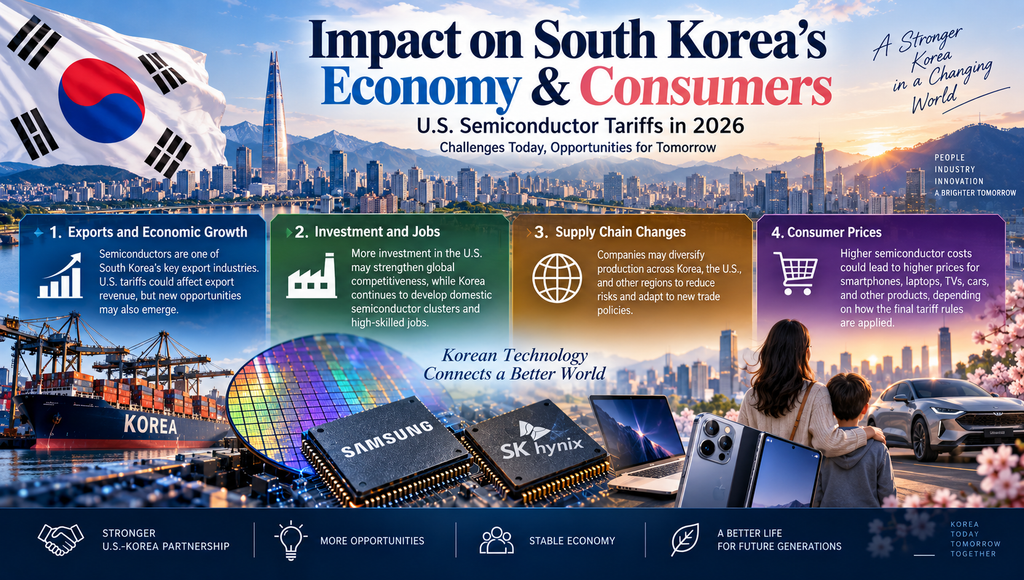
Semiconductors are one of South Korea’s most important industries.
Changes in American trade policy can therefore have effects far beyond Samsung and SK Hynix.
Korean Exports
If tariffs significantly increase the cost of Korean-made chips entering the United States, exporters could face pressure.
However, exemptions, investment incentives, and negotiated tariff treatment could substantially change the outcome.
Investment Moving to America
More Korean semiconductor investment may move toward the United States.
That could help Korean companies remain globally competitive while simultaneously raising concerns about whether some future manufacturing investment and employment will shift away from Korea.
Domestic Semiconductor Investment
South Korea also has strong reasons to continue investing in domestic semiconductor clusters, infrastructure, research, and skilled workers.
The result could therefore be investment expansion in both countries rather than a simple transfer of factories from Korea to America.
Korean Jobs
The employment impact is similarly complicated.
U.S. investment creates American jobs, but successful global expansion by Samsung and SK Hynix can also support engineering, research, equipment, materials, and management jobs in South Korea.
Could Semiconductor Tariffs Raise Consumer Prices?
Potentially, yes—but the effect is not automatic.
Semiconductors are embedded in an enormous range of products, including:
- Smartphones
- Laptops
- Televisions
- Automobiles
- Gaming systems
- Servers
- Networking equipment
- AI infrastructure
- Industrial machinery
If tariffs substantially increase semiconductor costs, some of those expenses can eventually move through the supply chain.
Companies have several choices.
They can absorb the cost, negotiate lower supplier prices, reorganize production, increase U.S. manufacturing, or pass part of the expense to customers.
The final consumer impact will depend on how future tariff rules are structured.
AI Makes the Situation Different
The artificial intelligence boom has changed semiconductor economics.
Memory chips were once viewed by many consumers as relatively ordinary components.
Today, high-performance memory is an essential part of the AI infrastructure race.
American technology companies are spending enormous amounts on data centers and computing capacity.
That means the United States simultaneously wants two things:
- More semiconductor production inside America.
- Abundant and affordable access to advanced chips.
Those goals can sometimes conflict.
Extremely aggressive tariffs could encourage domestic manufacturing, but they could also increase costs for American technology companies.
This tension helps explain why exemptions, negotiated agreements, and investment incentives are likely to remain important.
Is This a Crisis or an Opportunity for Korean Chipmakers?
It could be both.
Tariffs create uncertainty and potentially increase costs.
But Samsung and SK Hynix are not ordinary foreign exporters.
They possess technologies and manufacturing capabilities that are strategically important to the global technology economy.
They are also capable of investing billions of dollars in American manufacturing.
That gives them options.
Instead of simply paying tariffs, they can modify supply chains, expand U.S. investment, negotiate incentives, diversify production, and use their technological importance to strengthen relationships with American customers.
For smaller semiconductor companies without those resources, adapting could be much more difficult.
What Should Investors and Consumers Watch Next?
Several developments deserve attention during the remainder of 2026.
First, watch for details of any broader U.S. semiconductor tariff program.
Second, watch how the U.S. government defines companies that qualify for preferential tariff treatment because of American investment.
Third, monitor new U.S. investment announcements from Samsung and SK Hynix.
Fourth, follow AI-related memory demand.
Finally, pay attention to U.S.–South Korea negotiations.
A negotiated framework that gives Korean semiconductor companies treatment comparable to major competitors could substantially reduce the downside risk.
Final Thoughts
U.S. semiconductor tariffs represent much more than another trade dispute.
They are part of a larger transformation in the global technology economy.
The United States wants more semiconductor manufacturing at home. South Korea wants to protect one of its most valuable industries. Samsung Electronics and SK Hynix want continued access to American customers while maintaining globally competitive production networks.
Meanwhile, the AI boom is making advanced semiconductors more strategically important than ever.
For Samsung and SK Hynix, the coming changes could increase costs and force difficult investment decisions.
But they could also create an opportunity.
Companies capable of manufacturing advanced chips, investing heavily in the United States, and maintaining strong production networks in South Korea may become even more valuable as governments compete to secure semiconductor supply chains.
For consumers, investors, and policymakers, the most important development to watch is not simply the headline tariff rate.
It is who receives exemptions, what qualifies as U.S. investment, and how Samsung and SK Hynix restructure their global production strategies in response.
Frequently Asked Questions
Are all semiconductors imported into the U.S. subject to a 25% tariff?
No. The January 2026 action applies a 25% tariff to a narrow category of certain advanced computing chips and derivative products, with several important exclusions. A broader second-stage tariff regime has been contemplated, but its ultimate structure is a separate issue.
Will Samsung Electronics be hurt by U.S. semiconductor tariffs?
Samsung could face higher costs on some imports depending on future rules, but its substantial U.S. manufacturing investment could also help it qualify for favorable treatment.
Could SK Hynix benefit from the AI boom despite tariffs?
Yes. Strong demand for advanced memory, particularly HBM used in AI computing, increases SK Hynix’s strategic importance. Tariffs nevertheless create additional supply-chain and investment considerations.
Will semiconductor tariffs make smartphones and computers more expensive?
They could contribute to higher costs if tariffs materially raise semiconductor input prices and manufacturers pass those costs to customers. Exemptions, supply-chain adjustments, and domestic production could limit the impact.
Why are the United States and South Korea negotiating over semiconductors?
Both countries have major economic interests at stake. The United States wants more domestic semiconductor investment, while South Korea wants Samsung and SK Hynix to remain competitive and avoid unfavorable treatment compared with major rivals.
Official White House semiconductor tariff proclamation
Reuters — latest U.S.–South Korea semiconductor talks