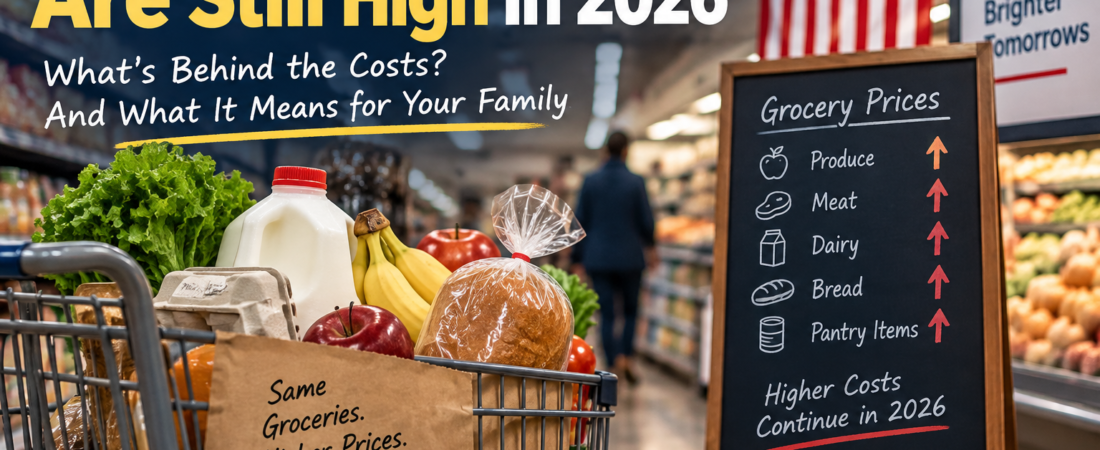
Grocery prices 2026 remain a major concern for American households, even as overall inflation has cooled from its earlier peaks.
Even when economists say inflation is slowing, many shoppers walk through a supermarket and wonder why their grocery bill still seems so expensive.
There is an important reason for this apparent contradiction.
Slower inflation does not necessarily mean prices are falling. It usually means prices are increasing more slowly than before. Once the price of a product has risen significantly, a lower inflation rate does not automatically return that product to its old price.
The latest available national Consumer Price Index data from the U.S. Bureau of Labor Statistics illustrates the point. In July 2026, overall consumer prices were 3.4% higher than a year earlier, while the index for food purchased for consumption at home was 2.7% higher.
Some individual grocery categories increased much faster. Coffee prices, for example, were up 10.3% from July 2025, while candy and chewing gum were up 9.6%.
At the same time, some food categories became cheaper.
That uneven pattern helps explain why the grocery inflation story in 2026 is more complicated than simply saying “food prices are going up” or “inflation is coming down.”
For families trying to manage a monthly budget, the more useful question is:
Why are grocery prices still high, and what does that mean for everyday life?
Table of Contents
- Grocery Inflation Is Slower, but Prices Remain Elevated
- Why Lower Inflation Does Not Mean Lower Grocery Prices
- Which Grocery Categories Are Still Rising?
- Why Coffee Is So Expensive
- Meat and Beef Remain an Important Pressure Point
- Energy and Transportation Costs Affect Food Prices
- Weather and Agricultural Conditions Matter
- Labor Costs Do Not Disappear
- Packaging, Processing, and Distribution Add to the Bill
- Tariffs and Global Trade Can Affect Grocery Costs
- Why Grocery Inflation Feels Worse Than the Statistics
- Grocery Prices and Restaurant Prices Are Different
- How Higher Grocery Prices Affect American Families
- Practical Ways Households Can Control Grocery Spending
- Will Grocery Prices Come Down in 2027?
- What Consumers Should Watch Next
- Frequently Asked Questions
Grocery Inflation Is Slower, but Prices Remain Elevated
The first thing consumers need to understand about U.S. grocery prices in 2026 is the difference between the level of prices and the rate of inflation.
According to the latest available BLS data as of September 5, 2026, the Consumer Price Index increased 3.4% over the 12 months ending in July.
Food prices increased 3.0%.
More specifically, food purchased for consumption at home—the category that most closely represents supermarket groceries—was 2.7% more expensive than it was a year earlier.
Interestingly, food-at-home prices actually declined 0.1% on a seasonally adjusted basis from June to July.
That is good news.
But it does not mean grocery prices have returned to levels consumers remember from several years ago.
This distinction is essential for understanding the frustration many shoppers feel.
Why Lower Inflation Does Not Mean Lower Grocery Prices
Imagine a grocery item costs $5.
If its price rises 10%, it becomes $5.50.
If inflation then slows dramatically and the price increases only 2% the following year, the product does not return to $5.
It becomes approximately $5.61.
Inflation has slowed from 10% to 2%, but the item is still substantially more expensive than it was before the original increase.
This is one of the biggest reasons consumers can hear positive news about declining inflation while simultaneously feeling that their household budget has not improved very much.
For grocery prices to return to earlier levels, widespread food-price deflation would have to occur.
That is very different from simply experiencing slower inflation.
Grocery Prices 2026: Why Are Food Costs Still High?
Grocery prices 2026 continue to put pressure on household budgets across the United States.
The national grocery number also hides significant differences among products.
According to July 2026 BLS data, several categories experienced noticeable year-over-year increases.
Cereals and bakery products were up 2.7%. Rice was up 6.2%. Bread was up 3.7%.
Beverage materials including coffee and tea were up 6.7%.
Coffee itself increased 10.3%.
Sugar and sweets increased 7.4%, while candy and chewing gum increased 9.6%.
Meanwhile, some categories moved in the opposite direction. Butter prices were down 8.1% from a year earlier.
This matters because no two families purchase exactly the same grocery basket.
A household that buys large amounts of coffee, meat, bread, snacks, and certain beverages can experience a very different personal inflation rate from a household whose shopping habits are concentrated in categories with stable or declining prices.
In other words, the national food-at-home inflation rate is an average.
Your grocery bill is personal.
Why Coffee Is So Expensive
Coffee provides an excellent example of why food inflation cannot be explained by one factor.
Americans consume enormous quantities of coffee, but most coffee is grown outside the continental United States.
That means the price American consumers pay can be affected by international agricultural production, weather, shipping, currency movements, global commodity markets, transportation costs, and trade policy.
The July CPI data showed coffee prices 10.3% above their level a year earlier.
Instant coffee was even more striking, with prices 15.8% higher.
When a product relies heavily on global supply chains, events thousands of miles away can eventually appear on an American supermarket receipt.
Coffee is therefore a useful reminder that the U.S. grocery system is deeply connected to the global economy.
Meat and Beef Remain an Important Pressure Point
Meat is another grocery category worth watching closely.
Beef prices have become a particularly important economic and political issue in 2026.
On September 4, President Donald Trump signed executive orders aimed at supporting cattle ranchers and expanding meat-processing capacity amid historically tight cattle supplies and high beef prices.
U.S. cattle numbers have fallen to their lowest level in roughly 75 years, with drought and wildfires among the pressures that have affected herds.
The administration has also expanded access to lower-tariff lean beef imports in an effort to increase supply.
But cattle production cannot be expanded instantly.
Raising cattle takes time. When ranchers begin rebuilding herds, they may retain animals for breeding rather than sending them immediately to slaughter.
That can keep beef supplies tight in the near term even when the industry is trying to expand production.
For shoppers, this means beef prices can remain elevated longer than many other grocery products.
Energy and Transportation Costs Affect Food Prices
Food does not magically appear on supermarket shelves.
A tomato may be grown hundreds or thousands of miles from the consumer.
Milk must be collected and refrigerated.
Frozen food must remain cold throughout much of its journey.
Meat requires processing, refrigeration, storage, and transportation.
All of these activities consume energy.
That is especially important in September 2026 because global energy markets are again under pressure.
Renewed U.S.-Iran military strikes and concerns about Middle Eastern oil supplies pushed oil prices sharply higher in early September. Brent crude ended September 4 at about $92.68 per barrel, while U.S. West Texas Intermediate crude reached about $91.48.
Diesel prices have also surged.
That matters to the food system because diesel powers much of the trucking and agricultural equipment used to move and produce food.
Higher transportation costs do not necessarily appear in grocery prices immediately.
But if elevated fuel costs persist, farmers, processors, distributors, and retailers eventually face decisions about how much of those costs they can absorb and how much must be passed along.
Weather and Agricultural Conditions Matter
Food production depends on nature in a way that many other industries do not.
Drought can reduce crop yields.
Flooding can destroy fields.
Excessive heat can stress livestock.
Wildfires can damage grazing land.
Storms can disrupt transportation and agricultural infrastructure.
Plant diseases and animal diseases can also reduce supply.
This makes food prices unusually sensitive to unexpected supply shocks.
A technology company can sometimes increase production by adding manufacturing capacity.
A farmer cannot instantly replace a growing season lost to drought.
A rancher cannot produce a mature herd in a few weeks.
When agricultural supply falls unexpectedly, prices can rise rapidly—and recovery may take months or years.
Labor Costs Do Not Disappear
Labor is another important part of the grocery-price equation.
Workers are needed throughout the food supply chain.
They plant and harvest crops.
They operate processing facilities.
They drive trucks.
They work in warehouses.
They stock supermarket shelves.
They operate checkout counters.
They maintain refrigeration equipment and distribution centers.
When labor costs rise, companies may become more productive, accept lower margins, automate some tasks, or raise prices.
Usually, the result is some combination of all four.
This is another reason food prices can remain elevated even after the original inflation shock begins to fade.
Many business costs reset at a higher level and do not automatically fall back.
Packaging, Processing, and Distribution Add to the Bill
The cost of the food itself is only part of the final retail price.
Consider a simple packaged product.
Its price may include the agricultural commodity, processing, labor, plastic or paper packaging, printing, machinery, electricity, refrigeration, warehouse space, trucking, insurance, retail labor, and the supermarket’s operating costs.
Changes in any of these inputs can influence the final shelf price.
This is why commodity prices and supermarket prices do not always move together.
Even if the underlying agricultural commodity becomes cheaper, other expenses can remain high enough to prevent the final product from falling by the same amount.
Tariffs and Global Trade Can Affect Grocery Costs
Trade policy is another factor consumers should watch.
The United States imports many foods directly, but international trade also affects agricultural inputs, packaging materials, machinery, fertilizer, and other goods used throughout the food industry.
Tariffs can increase the cost of imported products.
Whether consumers ultimately pay more depends on how businesses respond.
An importer might absorb some of the cost.
A supplier may negotiate a lower price.
A retailer might accept a smaller margin.
Companies may change suppliers.
Or some of the additional cost may eventually be passed to consumers.
For this reason, it is too simplistic to say every tariff produces an identical increase at the supermarket.
But trade policy can clearly become one part of the overall cost structure.
Why Grocery Inflation Feels Worse Than the Statistics
For many families, grocery prices 2026 are especially noticeable when buying meat, dairy products, eggs, and fresh produce.
There is another reason food inflation has an unusually powerful psychological effect.
People buy groceries constantly.
A household may purchase a television once every several years.
A family might replace a car every five or ten years.
But people see milk, bread, eggs, meat, fruit, coffee, cereal, and vegetables every week.
That repeated exposure makes price changes extremely visible.
A family that spends $200 at the supermarket sees that bill immediately.
If the same basket eventually costs $230 or $250, consumers remember the difference.
Food is also difficult to eliminate from a budget.
A household can delay buying furniture or a new smartphone.
It cannot indefinitely delay buying food.
That makes grocery inflation particularly painful for lower- and middle-income households.
Grocery Prices and Restaurant Prices Are Different
Understanding grocery prices 2026 can help consumers see why food bills remain elevated even when overall inflation begins to cool.
Eating at home is not the only food expense facing American households.
BLS reported that food away from home prices were 3.4% higher in July 2026 than a year earlier.
Full-service meals and snacks increased 3.4%, while limited-service meals increased 3.3%.
That means consumers trying to escape high grocery bills by eating out may not find much relief.
Restaurants face many of the same costs as supermarkets—including food, wages, utilities, rent, insurance, and transportation—plus the labor-intensive cost of preparing and serving meals.
For many households, this creates pressure on both sides of the food budget.
How Higher Grocery Prices Affect American Families
Persistent grocery inflation changes household behavior.
Families may switch from national brands to store brands.
They may purchase less expensive cuts of meat.
Some households reduce restaurant visits.
Others shop at multiple stores to find promotions.
Consumers may buy larger quantities when staple products are discounted.
Families can also substitute between categories.
If beef becomes particularly expensive, some consumers may buy more chicken, pork, beans, or other proteins.
These decisions may appear small individually, but across millions of households they can significantly alter consumer demand.
Persistent food inflation can also reduce spending elsewhere.
Every additional dollar spent at the grocery store is a dollar that cannot simultaneously be spent on entertainment, clothing, travel, savings, or debt repayment.
That is why grocery inflation is not merely a food-industry issue.
It affects the broader consumer economy.
You may also want to read our guide on how rising U.S. living costs affect everyday American households.
Practical Ways Households Can Control Grocery Spending
Consumers cannot control commodity markets, weather, energy prices, or international trade.
They can, however, control part of their household food budget.
The first step is to stop thinking only about individual product prices and start tracking the total weekly or monthly grocery bill.
A household may save more by changing five regular purchasing habits than by chasing dozens of small coupons.
Meal planning can reduce food waste.
Comparing unit prices can reveal whether the largest package is actually the best value.
Store brands can provide meaningful savings on products where brand preference is not important.
Freezing meat purchased during promotions can reduce exposure to short-term price spikes.
Choosing seasonal produce may also lower costs.
Households should also be careful with warehouse-size purchases.
Buying in bulk saves money only if the product is actually consumed.
Throwing away unused food eliminates the benefit of a lower unit price.
The most effective grocery strategy is therefore not simply “buy the cheapest food.”
It is:
Plan what you will eat, compare the real unit cost, reduce waste, and substitute when one category becomes unusually expensive.
Will Grocery Prices Come Down in 2027?
No one can know with certainty.
USDA’s Economic Research Service updates its Food Price Outlook regularly and currently provides forecasts extending into 2027.
The outlook incorporates BLS consumer-price data and producer-price information.
However, forecasts can change.
Weather events, energy markets, geopolitical conflict, disease outbreaks, trade policies, transportation disruptions, and agricultural production can all alter the outlook.
Consumers should therefore distinguish between a forecast and a guarantee.
The more realistic expectation is that individual grocery categories will continue moving differently.
Some products may become cheaper.
Others may remain relatively stable.
And categories hit by supply problems could rise significantly.
What Consumers Should Watch Next
One important piece of information is still missing as of the publication date of this article.
The BLS has not yet released the August 2026 Consumer Price Index.
That report is scheduled for September 11, 2026 at 8:30 a.m. Eastern Time.
Therefore, articles claiming to provide official August 2026 national CPI grocery inflation figures before that release should be treated cautiously.
The July CPI remains the latest official national reading available as of September 5.
Consumers should also watch energy prices.
The sharp increase in oil and diesel prices in early September creates a new potential source of pressure for transportation-intensive industries, including agriculture and food distribution.
Whether that pressure becomes a meaningful supermarket-price increase will depend partly on how long elevated energy costs persist.
The Bigger Picture: Grocery Prices Are About More Than Inflation
The grocery-price story illustrates something important about the American economy.
There is rarely one explanation for the price consumers see on a shelf.
The final price reflects a chain stretching from farms and global commodity markets to factories, packaging companies, truckers, warehouses, retailers, workers, energy markets, government policy, and ultimately consumer demand.
That is why food prices can remain stubbornly high even when one part of the inflation problem improves.
It is also why a single month’s CPI number should not be interpreted as the entire story.
For American families, the most important issue is purchasing power.
If food prices rise faster than household income, families feel poorer.
If wages and income rise faster than grocery costs, the burden becomes easier to manage even when prices themselves remain high.
Ultimately, the question is not simply:
“Are grocery prices rising?”
It is:
“How much of the household budget does food consume, and is household income keeping up?”
That is the number that matters most at the kitchen table.
Frequently Asked Questions
Are U.S. grocery prices still rising in 2026?
Yes, on a year-over-year basis. The latest available BLS data show that food-at-home prices were 2.7% higher in July 2026 than in July 2025. However, prices declined 0.1% from June to July on a seasonally adjusted basis, demonstrating that monthly and annual trends can move differently.
Why do groceries still feel expensive if inflation has slowed?
Because slower inflation does not mean prices return to previous levels. It means the rate at which prices are increasing has slowed. Many products remain substantially more expensive than they were several years ago.
Which grocery products are rising particularly fast?
The July 2026 CPI showed substantial differences among categories. Coffee was 10.3% more expensive than a year earlier, while sugar and sweets rose 7.4%. Other products were stable or cheaper, illustrating why household experiences can differ.
Is a 2.7% grocery inflation rate good news?
It is better than a much higher rate of inflation, but consumers can still face a high overall price level. Whether it feels like improvement depends on household income, shopping habits, and which products a family buys.
Can energy prices make groceries more expensive?
Yes. Agriculture, food processing, refrigeration, warehousing, and trucking all require energy. Persistent increases in diesel and other energy costs can eventually add pressure to retail food prices.
Will U.S. grocery prices fall soon?
Some individual products may fall, but a broad return to old price levels should not be assumed. Food prices depend on agricultural supply, weather, energy, labor, trade, transportation, and consumer demand.
When is the next major U.S. inflation report?
The Bureau of Labor Statistics is scheduled to release the August 2026 Consumer Price Index on September 11, 2026.
Final Takeaway
U.S. grocery prices in 2026 remain high because today’s supermarket bill reflects years of accumulated price increases as well as current pressures from agriculture, labor, transportation, energy, global supply chains, and trade.
The latest data do contain some encouraging signs. Food-at-home prices declined slightly from June to July.
But that does not erase previous increases.
For American households, the best approach is to watch the longer trend rather than a single monthly number, understand which categories are driving their personal grocery bill, and adjust purchasing habits where practical.
And for policymakers, retailers, and food producers, the challenge remains the same:
Keeping food affordable requires more than reducing one inflation statistic. It requires a resilient food supply chain capable of absorbing shocks without repeatedly passing large increases to American consumers.
Suggested Internal Links for TIPVERO
Add links naturally inside the article to your existing related TIPVERO posts:
How Rising U.S. Living Costs Affect Everyday Americans
Use after the section explaining why inflation feels worse to households.
How the Iran Situation Can Affect Global Oil Prices
Use in the energy and transportation section.
How U.S. Interest Rates Affect Everyday Life
Use near the section discussing household purchasing power.
If one of these articles is not yet published, do not insert a fake URL. Add the internal link after that TIPVERO article is live.
Official External Links to Add
U.S. Bureau of Labor Statistics — Consumer Price Index
Use this source for the latest official U.S. inflation data.
USDA Economic Research Service — Food Price Outlook
Use this source when discussing food-price forecasts and longer-term trends.