Korean BBQ for beginners can look surprisingly complicated the first time you sit down at the table.
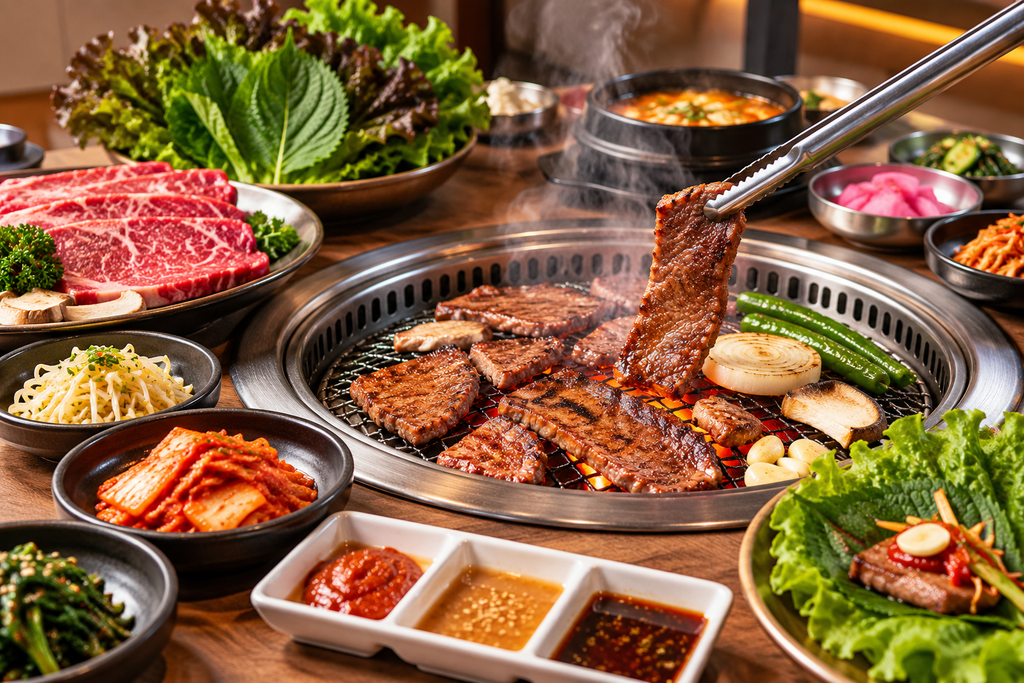
There may be a grill in front of you, several plates of raw meat, bowls of sauces, lettuce, garlic, kimchi, and half a dozen small side dishes you did not order. Then someone brings tongs and kitchen scissors.
What are you supposed to cook first? Are those side dishes free? Do you eat the meat by itself? Should you put everything inside a lettuce leaf? And are you expected to cook the meat yourself?
The good news is that Korean BBQ is much easier than it looks.
Once you understand a few basics, it becomes one of the most enjoyable ways to experience Korean food. Korean BBQ is not simply about eating grilled meat. It is a shared meal built around cooking, tasting, wrapping, talking, and trying different combinations of flavors.
This Korean BBQ for beginners guide explains exactly what you need to know before your first visit—from choosing meat and understanding banchan to making your first ssam.
Table of Contents
- What Is Korean BBQ?
- Why Is Korean BBQ Different?
- What Should Beginners Order?
- Bulgogi
- Galbi
- Samgyeopsal
- What Is Banchan?
- Understanding Korean BBQ Sauces
- How to Cook Korean BBQ
- How to Eat Korean BBQ
- How to Make Ssam
- What Should You Eat With the Meat?
- Korean BBQ Etiquette
- What Should Beginners Avoid?
- Is Korean BBQ Spicy?
- Is Korean BBQ Expensive?
- What Should Two People Order?
- Food Safety at the Grill
- Korean BBQ Beginner Checklist
- Frequently Asked Questions
What Is Korean BBQ?
Korean BBQ generally refers to Korean-style meat cooked on a grill, often directly at the dining table.
Instead of receiving a completely finished entrée from the kitchen, diners may participate in cooking beef, pork, or chicken over a gas, charcoal, or electric grill built into or placed on the table.
That makes dinner interactive.
At some restaurants, employees cook the meat for you. At others, customers do most of the grilling themselves. Korea’s official Korea.net describes Korean grilled-meat dining as a social experience in which diners may arrange, flip, cut and share meat together around the table. Korea.net
That communal experience is an important part of the appeal.
You are not simply ordering a steak.
You are building an entire meal around the grill.
Why Is Korean BBQ Different From American BBQ?
The word “BBQ” can be confusing for Americans because Korean BBQ is quite different from traditional American barbecue.
American barbecue often involves meat cooked slowly using smoke and low heat. Brisket, pulled pork and ribs may cook for hours before arriving at the table.
Korean BBQ usually involves smaller or thinner pieces of meat cooked relatively quickly over high heat.
The flavor also comes from everything surrounding the meat.
A single bite might contain:
- grilled pork belly,
- lettuce,
- rice,
- fermented soybean paste,
- sliced garlic,
- kimchi,
- and green onion salad.
Another bite might be nothing more than galbi dipped lightly in sauce.
There isn’t one required combination.
Experimenting is part of the experience.
What Should You Order at Korean BBQ for the First Time?
For Korean BBQ for beginners, choosing just two or three popular meats makes the first dining experience much easier
A Korean BBQ menu can be intimidating because restaurants may offer many cuts of beef and pork with Korean names.
For your first visit, keep things simple.
Three excellent beginner choices are:
Bulgogi
Galbi
Samgyeopsal
You don’t need to order all three.
If two people are visiting for the first time, choosing one marinated meat and one unmarinated meat gives you a useful introduction to two different Korean BBQ styles.
Let’s look at each.
1. Bulgogi: One of the Easiest Korean BBQ Choices for Beginners
Bulgogi is an excellent introduction to Korean grilled beef.
The name is commonly translated as “fire meat.”
It typically consists of thinly sliced beef marinated with ingredients that may include soy sauce, garlic, sugar or another sweetener, sesame oil and other seasonings.
Recipes differ by restaurant and household.
Because the beef is sliced thinly, it cooks quickly.
The flavor tends to be savory and slightly sweet rather than intensely spicy, which makes bulgogi approachable for people who are nervous about Korean food being too hot.
Bulgogi is often one of the easiest choices for Korean BBQ for beginners.
What does bulgogi taste like?
Think:
savory + slightly sweet + garlicky + grilled beef
It can be eaten with rice, wrapped in lettuce, or enjoyed by itself.
For many first-time diners, bulgogi is the safest place to begin.
2. Galbi: Korean Marinated Ribs
Galbi means “ribs,” and Korean BBQ restaurants often serve beef short ribs or pork ribs prepared in different styles.
Marinated galbi commonly has a sweet-savory flavor.
Korea.net notes that galbi and bulgogi are among the broad varieties of Korean grilled meats and describes marinades that commonly combine sweet, garlic and soy-based flavors. Korea.net
Depending on the restaurant, you may also see unmarinated versions.
Why beginners often like galbi
Galbi has several familiar characteristics for American diners:
- beefy flavor,
- caramelization from grilling,
- sweet-savory marinade,
- and a satisfying texture.
If you enjoy grilled steak or ribs, galbi is an excellent first Korean BBQ order.
3. Samgyeopsal: Korean Pork Belly
Samgyeopsal is thick-cut pork belly and one of the classic Korean grilled-meat experiences.
Unlike bulgogi, samgyeopsal is often served without a heavy marinade.
That means the pork itself is the focus.
After grilling, a piece can be dipped in sauce or wrapped in lettuce with garlic, vegetables and other condiments.
What does samgyeopsal taste like?
It is rich, savory and fatty.
If you’ve eaten pork belly before, the flavor will feel familiar, but the Korean way of combining it with fresh lettuce, fermented sauces and banchan creates a very different meal.
Try samgyeopsal after bulgogi if you want to experience the contrast between marinated and unmarinated Korean BBQ.
What Is Banchan?
One of the first surprises at a Korean restaurant may happen before the meat reaches the grill.
Several small dishes suddenly appear on the table.
These are called banchan, or Korean side dishes.
Depending on the restaurant, you might receive:
- kimchi,
- seasoned bean sprouts,
- pickled radish,
- cucumber,
- seasoned spinach,
- fish cake,
- potato dishes,
- or other rotating side dishes.
The selection varies widely.
Banchan are not merely decoration. They allow you to change the flavor and texture of every bite.
Try a bite of grilled meat with kimchi.
Then try another with pickled radish.
Then make a lettuce wrap.
The same piece of meat can taste completely different depending on what accompanies it.
Do you have to eat every banchan?
No.
Taste what interests you.
If you discover something you love, many restaurants will refill certain banchan when asked, although policies vary by restaurant.
Understanding Korean BBQ Sauces
Your table may contain several sauces or condiments.
Don’t worry about memorizing them all.
One especially common condiment is ssamjang, a thick Korean dipping or wrapping sauce commonly associated with grilled meat.
It usually has a deep savory flavor and may contain fermented soybean paste, chili paste and other seasonings.
Use a small amount at first because the flavor can be strong.
You may also encounter:
Sesame oil with salt — simple and particularly good with unmarinated meat.
Soy-based dipping sauce — often lighter and slightly sweet or tangy.
Gochujang-based sauce — potentially sweeter and spicier.
Restaurants create their own variations, so sauces will not taste identical everywhere.
How to Cook Korean BBQ
Here is where many beginners become nervous.
You don’t need to be.
First, determine whether the restaurant expects you or the staff to handle the grill.
If an employee begins cooking the meat, let them do it.
At many restaurants, staff members control the grill because they know the ideal cooking time and heat level for their particular cuts.
If the restaurant expects customers to grill, use the provided tongs.
Basic grilling sequence
1. Place a manageable amount of meat on the grill.
Don’t cover every inch of the cooking surface.
2. Allow the meat to cook before constantly moving it.
This helps develop browning.
3. Turn the pieces as necessary.
4. Use kitchen scissors if provided.
Large pieces of meat are often cut into bite-size portions directly over the grill.
5. Keep raw-meat tools separate from eating utensils.
This is especially important for food safety.
6. Eat cooked pieces while they’re hot.
Then grill another batch.
Korean BBQ works best as a continuous meal rather than cooking everything at once.
How to Eat Korean BBQ
One of the best things about Korean BBQ for beginners is that there is no single correct way to enjoy the meal.
Now comes the fun part.
There is no single mandatory way to eat Korean BBQ.
You can eat grilled meat:
- by itself,
- dipped in sauce,
- with rice,
- with kimchi,
- with banchan,
- or wrapped in lettuce.
For a first visit, try the same meat several ways.
Bite #1: Meat alone
Taste the meat first.
This helps you understand its marinade and texture.
Bite #2: Meat + dipping sauce
Try a small amount of ssamjang or another provided sauce.
Bite #3: Meat + kimchi
The acidity and fermentation of kimchi can balance rich meat particularly well.
Bite #4: Make a ssam
This is where Korean BBQ becomes especially interesting.
How to Make a Korean BBQ Ssam
Ssam essentially refers to food wrapped in a leafy vegetable.
You may receive lettuce, perilla leaves, or both.
Take one leaf in your hand.
Then add a small combination such as:
lettuce → meat → a little rice → ssamjang → garlic → kimchi
Fold the leaf around the ingredients.
Then eat the wrap.
Traditionally, ssam is often eaten as a single bite, but if yours becomes enormous, you have simply discovered one of the classic beginner mistakes: putting too much inside.
Start small.
The perfect beginner ssam
Try:
- one lettuce leaf,
- one piece of grilled meat,
- a small spoonful of rice,
- a tiny amount of ssamjang,
- and one small piece of kimchi.
That’s enough.
Later you can experiment with garlic, peppers and other banchan.
Should You Grill the Garlic and Kimchi?
Often, yes—but follow the restaurant’s setup and staff guidance.
Garlic can become sweeter and softer when grilled.
Kimchi can also change dramatically when heated. Grilled kimchi becomes softer, richer and slightly caramelized.
Both pair particularly well with fatty pork belly.
If you’re unsure whether something belongs on the grill, ask the server rather than putting every banchan onto it.
Korean BBQ Etiquette for Beginners
You don’t need an extensive knowledge of Korean etiquette to enjoy dinner.
A few simple habits will make the experience smoother.
Share the grill
Korean BBQ is communal.
Avoid treating the entire grill as your personal plate.
Don’t double-dip
Use your own portion or follow the restaurant’s serving setup.
Use serving utensils when provided
Especially when handling raw meat.
Don’t fight the server for control of the grill
If staff members are cooking your meat, they likely have a reason.
Let them manage it.
Don’t waste large amounts of food
This is particularly important at all-you-can-eat restaurants, which may have rules or fees concerning excessive leftovers.
Ask questions
If you don’t recognize a sauce or side dish, asking “What is this?” is completely normal.
Korean BBQ restaurants regularly serve first-time diners.
What Should Korean BBQ Beginners Avoid?
Several mistakes can make a first meal unnecessarily complicated.
Ordering too much meat immediately
Start with a smaller selection.
You can usually add more.
Mixing every sauce together
Taste sauces separately first.
Filling a lettuce wrap with everything on the table
A ssam doesn’t need ten ingredients.
Assuming all Korean food is spicy
It isn’t.
Cooking everything simultaneously
This can overcrowd the grill and leave you with a pile of cooling meat.
Using the same utensils for raw and cooked meat
This is the mistake that actually matters for safety.
The FDA specifically advises against using the same utensil to place raw meat on a grill and then remove cooked meat unless the utensil has been properly washed, because doing so can cause cross-contamination. U.S. Food and Drug Administration
Is Korean BBQ Spicy?
Not necessarily.
This is one of the biggest misconceptions about Korean food.
Bulgogi is generally not a particularly spicy dish.
Unmarinated samgyeopsal isn’t inherently spicy either.
Galbi marinades are commonly sweet and savory.
The heat often comes from particular sauces, kimchi, peppers or spicy marinades rather than from Korean BBQ as a category.
If you don’t enjoy spicy food, tell your server.
You can still have an excellent Korean BBQ meal.
What Should Two Beginners Order?
For two adults visiting a Korean BBQ restaurant for the first time, I would keep the order simple.
Start with:
1 marinated beef: Bulgogi or galbi
1 pork option: Samgyeopsal
Rice
Banchan provided by the restaurant
If you want something additional, consider a shared soup or stew.
This combination lets you experience:
sweet and savory marinated beef → rich unmarinated pork → banchan → lettuce wraps → sauces.
That’s already a complete introduction to Korean BBQ.
There’s no need to order seven different meats on your first visit.
Is Korean BBQ Expensive?
It can be inexpensive, moderate or premium depending on the restaurant.
Several factors affect the bill:
- type and grade of meat,
- portion size,
- à la carte versus all-you-can-eat service,
- location,
- premium beef selections,
- drinks,
- soups and additional dishes.
All-you-can-eat Korean BBQ may look like the best value, but a traditional à la carte restaurant can sometimes be a better first experience because you can concentrate on a few specific cuts.
If the menu lists a minimum number of orders or a time limit, check those rules before ordering.
Korean BBQ Food Safety: One Rule Beginners Should Know
Because Korean BBQ may involve handling raw meat at the table, food safety deserves special attention.
Keep utensils that touch raw meat away from cooked meat and ready-to-eat foods.
The FDA recommends avoiding reuse of plates or utensils that have contacted raw meat unless they are properly washed. U.S. Food and Drug Administration
For home Korean BBQ, USDA guidance says whole cuts of beef and pork should reach at least 145°F (62.8°C) followed by a three-minute rest; ground beef and pork should reach 160°F (71.1°C), and poultry should reach 165°F (73.9°C). Appearance alone isn’t a reliable safety test, so a food thermometer is the better method. Ask USDA
At a restaurant, follow staff instructions and don’t hesitate to ask them to check meat if you’re uncertain.
A Simple Korean BBQ Beginner Checklist
Before your first Korean BBQ dinner, remember these basics:
- Start with bulgogi, galbi or samgyeopsal.
- Don’t order too much immediately.
- Try the meat by itself first.
- Taste the banchan.
- Try a little ssamjang.
- Make at least one lettuce wrap.
- Keep raw-meat utensils separate.
- Let restaurant staff cook if they take control of the grill.
- Don’t assume everything will be spicy.
- Take your time.
Most importantly, Korean BBQ is supposed to be social.
There is no prize for knowing every Korean word on the menu.
Why Korean BBQ Is More Than Grilled Meat
What makes Korean BBQ memorable isn’t simply the quality of the beef or pork.
It is the way the meal unfolds.
A grill sits in the center rather than disappearing into a restaurant kitchen. Everyone watches the food cook. Someone flips the meat. Someone cuts it. Another person passes the lettuce. People compare sauces and discover which banchan they like.
The meal constantly changes.
One minute you’re eating sweet marinated beef.
The next you’re wrapping pork belly with kimchi and ssamjang.
Then you’re trying a side dish you didn’t recognize five minutes earlier.
That is why Korean BBQ can be such a good introduction to Korean food.
Instead of presenting one unfamiliar dish, it lets beginners explore many flavors at their own pace.
Final Thoughts: Your First Korean BBQ Doesn’t Need to Be Complicated
If you’re approaching Korean BBQ for beginners, remember three names:
Bulgogi. Galbi. Samgyeopsal.
Choose one or two.
Try the banchan.
Taste the meat on its own before covering it in sauce.
Make a simple lettuce wrap.
And don’t worry about doing everything perfectly.
Korean BBQ is designed around sharing food and enjoying the experience together.
By the end of your first dinner, the grill, scissors, lettuce leaves and dozens of little bowls that seemed confusing when you sat down will probably make much more sense.
And chances are you’ll already know what you want to order next time.
Korean BBQ for beginners becomes much easier once you understand the basic meats, banchan, sauces, and lettuce wraps.
Frequently Asked Questions About Korean BBQ for Beginners
What is the best Korean BBQ meat for beginners?
Bulgogi is one of the easiest choices because its thinly sliced beef and sweet-savory marinade are approachable. Galbi is another excellent option. If you enjoy pork belly, try samgyeopsal.
Do you cook Korean BBQ yourself?
It depends on the restaurant. Some restaurants expect diners to grill their own meat, while at others the staff handles most or all of the cooking. Korea.net notes that both styles exist. Korea.net
Is Korean BBQ always spicy?
No. Bulgogi, plain samgyeopsal and many versions of galbi are not inherently spicy. Spiciness often comes from sauces, kimchi, peppers or specially seasoned meats.
What are all the little dishes at Korean BBQ?
They are generally called banchan, meaning Korean side dishes. They may include kimchi, pickled vegetables, seasoned bean sprouts and many other dishes.
What is ssam?
Ssam is a wrap commonly made by placing grilled meat and small amounts of rice, sauce or other ingredients inside lettuce or another leafy vegetable.
Do I need to eat Korean BBQ with chopsticks?
Chopsticks are commonly used, but beginners shouldn’t let chopstick technique stop them from enjoying the meal. Restaurants may provide other utensils when requested.
What should I order for my first Korean BBQ?
A very easy starting combination is bulgogi or galbi plus samgyeopsal. This gives you both marinated beef and a classic pork option.
Official External Sources to Link in WordPress
For the food-safety paragraph, link USDA Food Safety and Inspection Service:
USDA safe cooking temperature guidance
For restaurant food-safety information, use:
FDA Food Code
For Korean BBQ cultural background, use:
Korea.net Korean grilled ribs and BBQ guide
Internal Links to Add
Don’t invent URLs for these yet. As the Korean Food series is published, add links naturally to:
What Is Banchan? A Beginner’s Guide to Korean Side Dishes
Kimchi for Beginners: What Does It Taste Like?
What Is Bulgogi? Taste, Ingredients, and How to Eat It
10 Korean Foods to Try If You Don’t Like Spicy Food
This creates a Korean Food content cluster around the first Korean BBQ article.