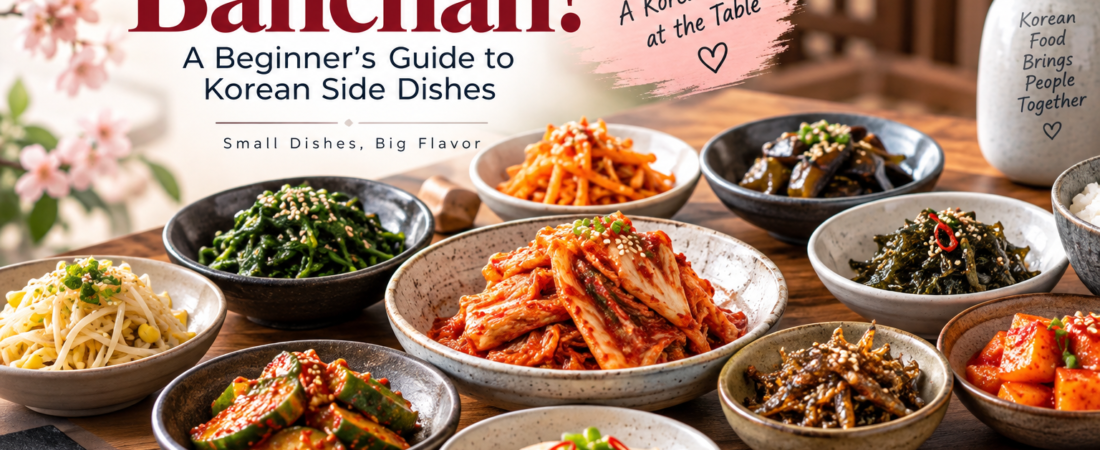
If you have ever walked into a Korean restaurant and wondered, “What is banchan?”, you are not alone.
You may order Korean BBQ, bibimbap, or a bowl of stew, only to have the server suddenly cover your table with small dishes you never ordered.
One bowl contains kimchi. Another might have seasoned spinach. There may be bean sprouts, cucumber, radish, fish cake, potatoes, seaweed, or something you cannot immediately identify.
For someone experiencing Korean food for the first time, it can be confusing.
Are these appetizers?
Do they cost extra?
Should you eat them before the main dish?
Are you supposed to mix them with your rice?
Can you ask for more?
The answer is that these little dishes are one of the most important parts of Korean dining culture.
They are called banchan, commonly translated into English as Korean side dishes.
But describing banchan simply as “side dishes” does not completely explain their role at a Korean table.
Banchan provide contrast, variety, texture, color, and balance throughout the meal. One bite may be spicy and fermented, the next crisp and refreshing, and another savory or slightly sweet.
In this beginner’s guide, we’ll answer what is banchan, explore popular types of Korean side dishes, explain how they are served and eaten, and cover what you should know before your first Korean restaurant visit.
Table of Contents
- What Is Banchan?
- Why Is Banchan Important in Korean Food?
- Is Banchan an Appetizer?
- Popular Types of Banchan
- Kimchi
- Namul
- Pickled Banchan
- Stir-Fried and Braised Banchan
- Protein-Based Banchan
- How Many Banchan Are Served?
- Is Banchan Free?
- Can You Ask for Refills?
- How Do You Eat Banchan?
- Banchan and Korean BBQ
- Is Banchan Spicy?
- Is Banchan Healthy?
- Banchan Etiquette for Beginners
- Can You Make Banchan at Home?
- What Should Beginners Try First?
- Frequently Asked Questions
What Is Banchan?
What is banchan? The simplest definition is a collection of small Korean dishes served alongside rice and the main components of a meal.
The Korean word is written 반찬.
There isn’t just one food called banchan. Instead, the term covers an enormous range of side dishes.
Kimchi can be banchan.
Seasoned spinach can be banchan.
Bean sprouts can be banchan.
Braised potatoes can be banchan.
Pickled radish, cucumber, seaweed, tofu, egg and small fish can all appear as banchan.
That variety is one reason Korean meals can feel so different from many typical American restaurant meals.
In a conventional American restaurant, you might order a steak accompanied by mashed potatoes and vegetables selected as part of the entrée.
At a Korean table, several shared dishes may surround the rice and main dish, allowing everyone to create different flavor combinations throughout the meal.
The Korean Cultural Center New York describes Korean cuisine as traditionally built around rice with soup and numerous side dishes, with fermented foods playing an important role.
Banchan therefore isn’t simply an optional decoration.
It is part of the structure of a Korean meal.
Why Is Banchan Important in Korean Food?
To understand what is banchan, it helps to stop thinking of a meal as one large entrée surrounded by optional extras.
Traditional Korean dining often emphasizes multiple dishes eaten together.
Imagine eating a spoonful of warm rice.
Next, you take a bite of kimchi.
Then perhaps some seasoned spinach.
After that, you eat grilled meat with pickled radish.
Each dish changes the experience of the food around it.
This creates variety without requiring every individual dish to be complicated.
Banchan adds contrast
A rich Korean BBQ meal can be balanced by crisp pickled vegetables.
A hot stew can be followed by a cool cucumber side dish.
Plain rice can be paired with something salty, fermented, or spicy.
This constant contrast is part of what makes Korean meals interesting.
Banchan encourages sharing
Many banchan are placed in the middle of the table rather than served individually.
Everyone shares them.
This communal arrangement reflects the social nature of many Korean meals.
Banchan makes every meal different
Restaurants and households don’t necessarily serve exactly the same banchan every day.
Season, ingredients, region, family preferences, and the main dish can influence what appears.
That’s why visiting different Korean restaurants can introduce you to completely different side dishes.
Is Banchan an Appetizer?
This is one of the most common misunderstandings among first-time diners.
Banchan may arrive before your Korean BBQ or main entrée, but they are generally not meant to function like Western appetizers.
You don’t need to finish them before the main food arrives.
Instead, leave them on the table.
Eat them throughout your meal.
Think of banchan as companions to the entire meal rather than a first course.
For example:
Take a bite of rice with kimchi.
Then eat some meat.
Try a piece of pickled radish.
Return to your rice.
Taste the bean sprouts.
That’s the basic rhythm.
There is no requirement to eat the dishes in a specific order.
Popular Types of Korean Banchan
One reason answering “What is banchan?” can be difficult is that there are so many varieties.
However, beginners can understand most banchan by learning several broad groups.
1. Kimchi
Kimchi is probably the world’s best-known Korean side dish.
Although napa cabbage kimchi may be the version most Americans recognize, kimchi is not limited to cabbage.
There are many types made with different vegetables and preparation methods.
Common examples include:
Baechu kimchi — napa cabbage kimchi
Kkakdugi — cubed radish kimchi
Oi kimchi — cucumber kimchi
Yeolmu kimchi — young radish greens kimchi
Fermentation gives many kimchi varieties their distinctive tangy, savory flavor.
Some are spicy.
Some are relatively mild.
Some are fresh rather than deeply fermented.
Kimchi is so culturally significant that UNESCO added the Korean tradition of kimjang—the making and sharing of kimchi—to its Representative List of the Intangible Cultural Heritage of Humanity in 2013.
For a beginner, cabbage kimchi is an excellent place to start.
2. Namul: Seasoned Vegetables
Another major banchan category is namul.
Namul generally refers to seasoned vegetable dishes.
Vegetables may be blanched, steamed, stir-fried, or otherwise prepared before being seasoned.
Common examples include:
Sigeumchi namul — seasoned spinach
Kongnamul — seasoned soybean sprouts
Sukjunamul — seasoned mung bean sprouts
Seasonings vary but may include sesame oil, garlic, sesame seeds, scallions and salt or soy-based seasoning.
These dishes are often less intense than kimchi, which makes them particularly approachable for beginners.
If you are worried that all Korean food is spicy, namul is a good reminder that it isn’t.
3. Pickled Banchan
Pickled vegetables provide acidity and crunch.
You may encounter:
- pickled radish,
- cucumber,
- garlic,
- onion,
- peppers,
- or other vegetables.
Pickled radish is especially useful with rich or fried foods.
Why?
Acidity can refresh your palate after a fatty bite.
This is why something as simple as pickled radish can feel surprisingly satisfying next to Korean fried chicken or grilled meat.
4. Stir-Fried Banchan
Not every banchan is raw, fermented, or pickled.
Some are stir-fried.
You may encounter vegetables, fish cakes, anchovies or other ingredients prepared with savory or sweet-savory seasonings.
A familiar example in Korean restaurants is eomuk bokkeum, stir-fried fish cake.
Another is myeolchi bokkeum, small dried anchovies often prepared with a sweet-savory glaze.
The flavor and preparation can differ considerably between restaurants and households.
5. Braised Banchan
Braised dishes form another broad category.
One beginner-friendly example is Korean-style braised potatoes, often known as gamja jorim.
Small pieces of potato are cooked in a savory-sweet sauce until tender.
Depending on the preparation, the sauce may include soy sauce and sweetening ingredients.
These dishes can be comforting and familiar even to someone who has never eaten Korean food before.
6. Egg-Based Banchan
Eggs appear in several Korean side dishes.
One simple example is rolled egg, commonly called gyeran mari.
The egg is rolled into layers and sliced.
Vegetables or other ingredients may be added.
Because the flavor is usually mild, this is another excellent choice for children or adults who are uncertain about spicy Korean dishes.
How Many Banchan Should You Expect?
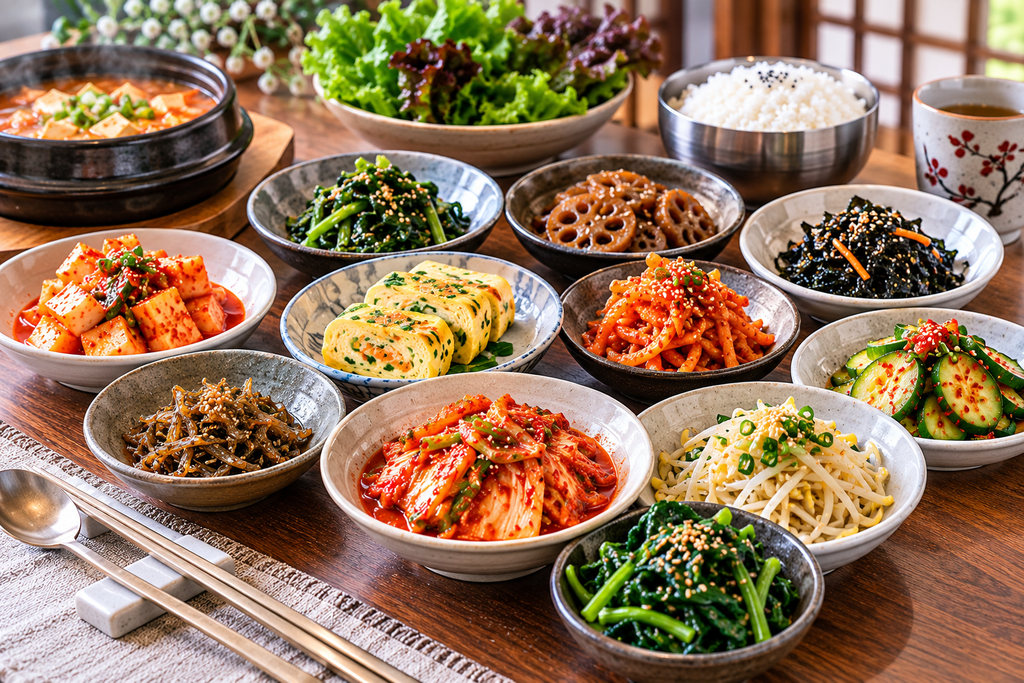
There is no universal number.
You might receive three or four dishes at one restaurant and many more at another.
The number can depend on:
- restaurant style,
- main dish,
- price level,
- region,
- season,
- and the restaurant’s own traditions.
Therefore, don’t judge a Korean restaurant solely by how many small dishes appear.
Quality and how well the banchan complement the meal matter more than sheer quantity.
Is Banchan Free at Korean Restaurants?
In many Korean restaurants in the United States, a selection of banchan is included with the meal rather than ordered individually.
But you should not assume that every banchan at every restaurant is unlimited and free.
Restaurant policies vary.
Some side dishes may be included.
Others may be menu items with an additional charge.
Premium or specialty banchan may also be treated differently.
If you’re unsure, simply ask:
“Are the banchan included?”
That’s a completely normal question.
Can You Ask for Banchan Refills?
Often, yes.
Many Korean restaurants will refill at least some of their standard banchan.
But again, this isn’t a universal rule.
The restaurant may limit refills or charge for particular items.
A polite way to ask is:
“Could we have a little more kimchi, please?”
There is also no reason to request every dish again simply because refills are available.
Ask for more of the ones you are actually eating.
This reduces food waste and makes the meal more considerate.
How Do You Eat Banchan?
There is no complicated technique.
Banchan is typically shared at the table and eaten alongside rice, soup, stew, noodles, grilled meat or another main dish.
For your first Korean meal, try this simple approach.
Step 1: Taste each dish separately
Try a small bite.
This lets you discover what you actually like.
Step 2: Pair it with rice
Many strongly flavored banchan make more sense alongside plain rice.
Step 3: Pair it with your main dish
Try kimchi with grilled pork.
Try pickled radish after something rich.
Try seasoned vegetables with rice.
Step 4: Experiment
There is no need to create a perfect combination.
Part of the fun is discovering your own preferences.
Banchan and Korean BBQ
If you read our Korean BBQ for Beginners: What to Order and How to Eat It guide, you already know that banchan becomes especially useful around a Korean BBQ grill.
This is where your first TIPVERO Korean Food internal link should go:
Korean BBQ for Beginners: What to Order and How to Eat It
Link that text to your already-published Korean BBQ article.
This is important both for readers and for Rank Math.
With Korean BBQ, try combinations such as:
samgyeopsal + kimchi
galbi + pickled radish
bulgogi + seasoned vegetables
or:
lettuce + grilled meat + rice + ssamjang + banchan
Each combination creates a different bite.
This is one reason a table full of little bowls is not excessive decoration.
The banchan are actively changing how you experience the grilled meat.
Is Banchan Always Spicy?
No.
This deserves emphasis because many American beginners associate Korean food almost entirely with red chili.
Some banchan are spicy, but many are not.
Mild options may include:
- seasoned spinach,
- bean sprouts,
- rolled egg,
- braised potatoes,
- certain pickled vegetables,
- tofu,
- and other vegetable dishes.
Even dishes that look red may vary dramatically in heat.
If you’re sensitive to spicy food, ask which dishes are mild.
You can have an excellent Korean meal without eating intensely spicy foods.
Is Banchan Healthy?
The answer depends on the particular banchan and your overall diet.
The category includes vegetables, fermented foods, protein-rich ingredients, fried foods, salty dishes and sweetened dishes, so it would be misleading to call every banchan automatically “healthy.”
However, a Korean table containing several vegetable-based banchan can provide variety.
For example, one meal might include spinach, bean sprouts, cucumber, radish and cabbage prepared in different ways.
That can make vegetables feel less repetitive.
At the same time, people watching sodium intake should remember that some kimchi, pickled foods, soy-based dishes and fermented condiments can contain substantial sodium.
The better question isn’t:
“Is banchan healthy?”
It is:
“Which banchan am I eating, and how does it fit into my overall meal?”
Banchan Etiquette for Beginners
You don’t need to memorize Korean etiquette before entering a restaurant.
A few simple habits are enough.
Share the dishes
Banchan is often communal.
Don’t move every bowl to your side of the table.
Take reasonable portions
Start with a little.
You can always take more.
Use serving utensils when provided
If communal serving utensils are available, use them.
Don’t waste refills
Only request more of dishes you plan to eat.
Don’t worry about knowing every dish
Asking the server:
“What is this?”
is completely fine.
In fact, it’s one of the best ways to learn about Korean food.
Can You Make Banchan at Home?
Absolutely.
In fact, banchan is particularly well suited to home cooking because some varieties can be prepared ahead and served across multiple meals.
A beginner does not need to prepare ten dishes.
Start with three.
For example:
Seasoned spinach
Bean sprouts
Cucumber salad
Add purchased or homemade kimchi, rice, and a simple main dish.
Suddenly you have the beginnings of a Korean-style table.
As you become more comfortable, you can explore braised potatoes, fish cake, rolled egg and other dishes.
This is also where TIPVERO can eventually develop separate guides such as:
5 Easy Korean Banchan for Beginners
or:
How to Build a Korean Pantry at Home
Those future articles can link back to this guide.
What Banchan Should Beginners Try First?
If you’re entering a Korean restaurant for the first time, don’t try to memorize dozens of Korean names.
Start with five easy categories.
1. Kimchi
The classic starting point.
Try a small amount with rice.
2. Seasoned spinach
Mild, savory and approachable.
3. Bean sprouts
Fresh and lightly seasoned.
4. Pickled radish
Crunchy and refreshing, particularly with rich foods.
5. Rolled egg
Soft and familiar for diners who prefer mild flavors.
After those, explore whatever the restaurant serves.
You may discover that your favorite banchan is something you had never heard of before walking through the door.
Why Banchan Makes Korean Dining Different
There is a deeper reason what is banchan is worth understanding.
Banchan changes the structure of the meal.
Instead of thinking:
one person → one plate → one entrée
the table becomes shared.
Several dishes sit in the center.
People reach for different foods.
Someone discovers a favorite kimchi.
Another person prefers the bean sprouts.
Someone combines grilled meat with pickled radish.
Another creates a lettuce wrap.
The meal becomes interactive.
That’s one reason Korean BBQ and other Korean meals can feel so social.
The food encourages people to share not only the table but also the experience.
Banchan vs. Side Dishes: Are They Really the Same?
Translating banchan as “side dishes” is useful, but it can create the wrong impression.
In American English, a side dish often feels secondary.
You might order a burger with fries or steak with vegetables.
The main dish clearly dominates the plate.
Banchan works differently.
Several dishes can play equally important supporting roles throughout the meal.
Kimchi might provide acidity.
Namul may provide freshness.
Pickled radish adds crunch.
Rice softens strong flavors.
Soup adds warmth.
Grilled meat adds richness.
Rather than thinking of banchan as unimportant extras, it may be more useful to think of them as small components that help build the complete Korean meal.
Do You Need to Finish Every Banchan?
No.
Taste them.
Enjoy the ones you like.
Leave the ones you don’t.
There is no requirement to clean every small bowl simply because it was placed on the table.
However, avoid ordering repeated refills that you don’t intend to eat.
Trying unfamiliar food is part of the experience.
Wasting large amounts of it doesn’t need to be.
What If You Don’t Like Kimchi?
You can still enjoy banchan.
Kimchi is enormously important to Korean cuisine, but banchan is far broader than kimchi.
Try:
seasoned spinach, bean sprouts, egg dishes, potatoes, tofu, cucumber, seaweed, pickled radish or other restaurant specialties.
Korean cuisine contains a much wider range of flavors than the spicy fermented dishes that often receive the most attention internationally.
What Is Banchan? The Simple Answer
After all of this, the easiest explanation is still the best:
Banchan are small Korean dishes served alongside the main components of a meal and shared around the table.
But now you know why that simple definition doesn’t tell the entire story.
Banchan can be:
fermented,
fresh,
seasoned,
pickled,
braised,
stir-fried,
mild,
spicy,
crunchy,
soft,
hot,
or cold.
Together they make a Korean meal more varied and interactive.
The next time a server fills your table with small bowls, you won’t need to wonder why they are there.
Taste them one at a time.
Pair them with rice.
Try them with Korean BBQ.
And discover which ones you want to ask for again.
Frequently Asked Questions About Banchan
What is banchan in Korean food?
Banchan refers to small Korean side dishes served alongside rice and other parts of a meal. The category includes kimchi, seasoned vegetables, pickled foods, braised dishes and many other preparations.
Is kimchi a banchan?
Yes. Kimchi is one of the most recognizable types of banchan, although banchan includes many dishes beyond kimchi.
Is banchan free?
Many Korean restaurants include standard banchan with a meal, but policies vary. Specialty dishes or additional servings may sometimes cost extra, so ask the restaurant when you’re uncertain.
Can I ask for more banchan?
Many restaurants refill certain standard banchan, but refill policies differ. Ask politely for more of the specific dish you would like.
Is all banchan spicy?
No. Seasoned spinach, bean sprouts, egg dishes, some potato dishes and many other banchan can be mild.
Do I eat banchan before my main meal?
Usually you eat banchan throughout the meal rather than treating it as a separate appetizer course.
How many banchan are served?
There is no fixed number. The selection depends on the restaurant, meal, season and other factors.
What is the best banchan for beginners?
Kimchi, seasoned spinach, bean sprouts, pickled radish and rolled egg provide a useful range of flavors and textures for someone new to Korean food.