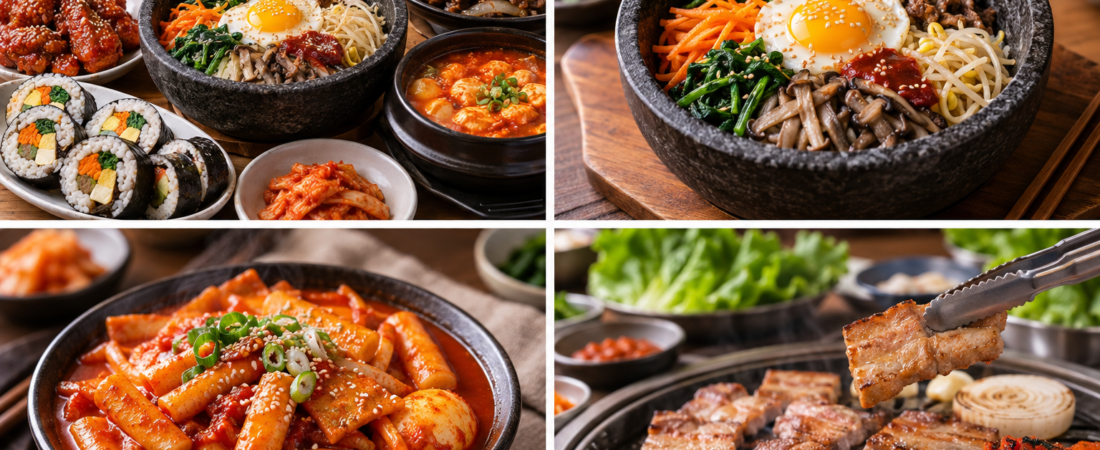
If you are trying Korean food for the first time, the table itself can feel like an adventure.
A bubbling stone pot arrives at your table. Bright red soup is still boiling. A plate of unfamiliar vegetables appears beside it. Someone brings out a sizzling pan covered with meat, noodles, mushrooms, and sauce.
You may immediately wonder:
“Am I really supposed to eat this?”
The good news is that many beginner friendly Korean foods look far more intimidating than they actually taste.
Korean cuisine is famous for bold colors, fermented ingredients, bubbling stews, spicy-looking sauces, and dishes that may be completely unfamiliar to someone who grew up eating mostly Western food.
But appearance can be misleading.
A bright red dish is not always extremely spicy. Fermented food does not necessarily have an overpowering flavor. A sizzling stone bowl can contain some of the most comforting ingredients imaginable.
And many Korean foods are built around flavors Americans already know and enjoy: grilled beef, rice, eggs, noodles, dumplings, vegetables, savory pancakes, and barbecue.
So if you are curious about Korean cuisine but do not know where to begin, these 12 dishes make excellent starting points.
Table of Contents
- Bibimbap
- Bulgogi
- Japchae
- Mandu
- Tteokbokki
- Kimchi Jeon
- Samgyeopsal
- Sundubu Jjigae
- Gimbap
- Korean Fried Chicken
- Doenjang Jjigae
- Bossam
- How to Order Korean Food as a Beginner
- Frequently Asked Questions
1. Bibimbap — The Colorful Bowl That Is Easier Than It Looks
2
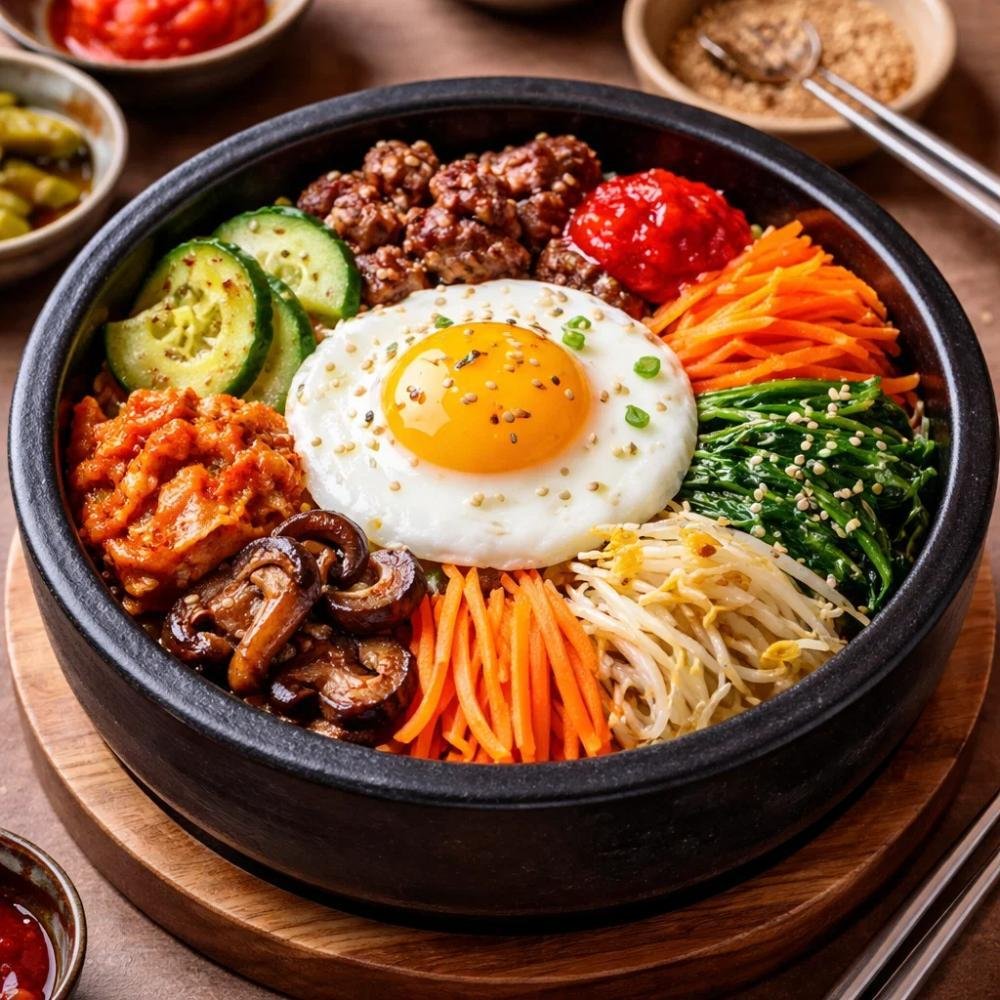
Bibimbap can look complicated when it first arrives.
A bowl may contain rice, carrots, spinach, mushrooms, bean sprouts, zucchini, beef, an egg, and a spoonful of red gochujang sauce—all carefully arranged in separate sections.
It almost looks too beautiful to disturb.
But the name gives away what you are supposed to do. “Bibim” refers to mixing, and “bap” means rice.
You simply mix everything together.
Once mixed, bibimbap becomes a warm, savory rice bowl filled with different textures.
For beginners, one important trick makes this dish particularly approachable:
You control the gochujang.
Instead of mixing all the red chili paste into the bowl immediately, start with a small amount. Taste it and add more if you want additional heat.
Why beginners may like it
Bibimbap contains many familiar ingredients. Rice, vegetables, egg, and beef are not particularly challenging flavors.
It is also customizable. If you dislike one vegetable, you can eat around it or ask whether it can be omitted.
Beginner tip: Try regular bibimbap before dolsot bibimbap if the extremely hot stone bowl makes you nervous.
If you are new to Korean cuisine, you may also enjoy our Korean BBQ for Beginners guide to learn what to order and how to eat it.
2. Bulgogi — Probably One of the Safest First Korean Foods
If you enjoy grilled beef, bulgogi is one of the easiest introductions to Korean cuisine.
Thin slices of beef are typically marinated in a savory-sweet mixture that may include soy sauce, garlic, sesame oil, sugar, and other seasonings.
The result is tender meat with a slightly sweet flavor.
Bulgogi can look unfamiliar when it arrives sizzling on a grill or mixed with onions and vegetables, but its flavor profile is surprisingly accessible.
Think of it as Korean-style marinated barbecue beef.
Is bulgogi spicy?
Usually, no.
That makes it particularly useful for people who want to experience Korean food without immediately jumping into chili-heavy dishes.
Eat it with rice, wrap it in lettuce, or enjoy it by itself.
For many first-time Korean restaurant visitors, bulgogi is one of the dishes I would put near the top of the list.
3. Japchae — The Strange-Looking Glass Noodles That Taste Surprisingly Familiar
The translucent noodles in japchae can initially look unusual.
They are typically made from sweet potato starch, which gives them a shiny appearance and pleasantly chewy texture.
Japchae usually combines these noodles with vegetables, mushrooms, sesame oil, soy-based seasoning, and sometimes beef.
Despite its appearance, the flavor is generally mild.
It is savory, slightly sweet, and nutty rather than intensely spicy.
Why japchae works for beginners
Someone nervous about fermented or very spicy Korean food can usually approach japchae comfortably.
It also works well as a bridge between familiar noodle dishes and more traditional Korean flavors.
One warning: the noodles can be slippery.
Your chopstick skills may receive an unexpected test.
But using a fork is perfectly fine.
4. Mandu — Korean Dumplings Are an Easy Starting Point
Mandu may arrive steamed, boiled, pan-fried, or deep-fried.
Inside, you might find pork, beef, vegetables, tofu, kimchi, or combinations of several ingredients.
The folded shape may be unfamiliar if you have never eaten Asian dumplings, but the concept is simple:
savory filling wrapped in thin dough.
If you already enjoy potstickers, ravioli, empanadas, or other filled dough dishes, mandu should not feel like a huge culinary leap.
Best mandu for beginners
Start with meat-and-vegetable mandu rather than kimchi mandu if you are concerned about spice.
Pan-fried mandu can be especially approachable because the crispy exterior provides a familiar texture.
Dip lightly in soy-based dipping sauce and enjoy.
Now we enter more adventurous territory.
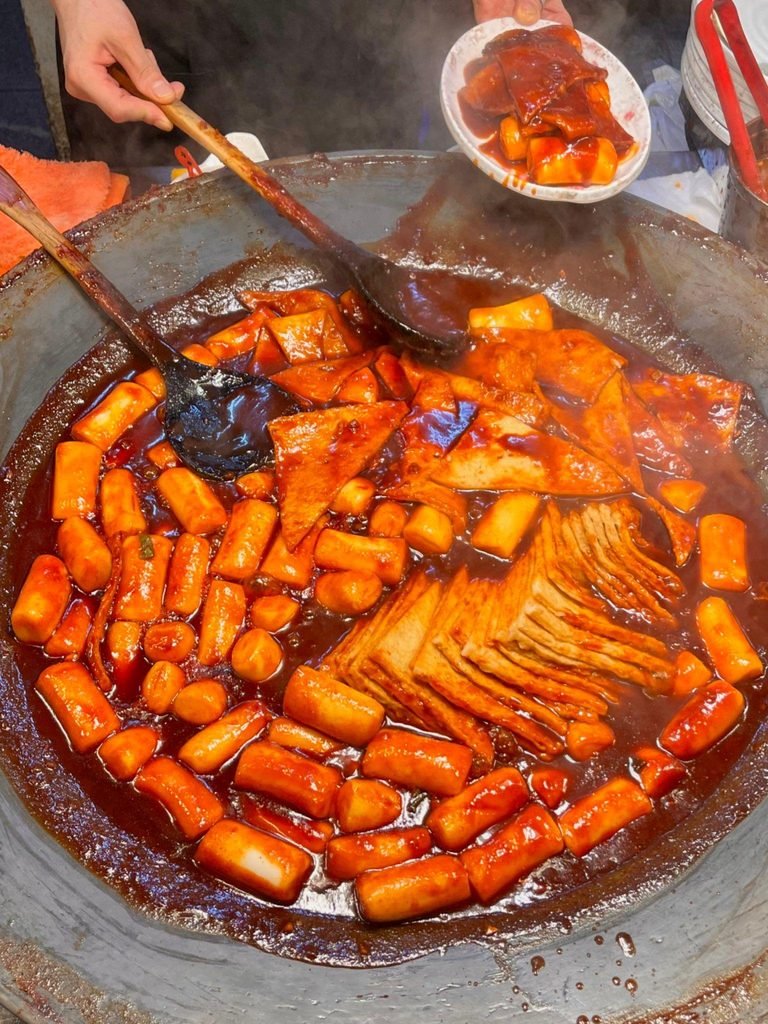
Tteokbokki is one of Korea’s most recognizable street foods.
The dish usually contains cylindrical rice cakes cooked in a red sauce, often alongside fish cake and other ingredients.
The color can be alarming.
A first-time visitor may look at the brilliant red sauce and assume every bite will be painfully hot.
Tteokbokki can definitely be spicy, but the experience varies greatly depending on the recipe and restaurant.
The biggest surprise for many beginners is actually the rice cake.
Korean rice cakes have a dense, soft, wonderfully chewy texture.
Beginner strategy
Ask how spicy the tteokbokki is before ordering.
If several heat levels are available, choose the mildest.
Cheese tteokbokki can also soften the perceived heat, although it is a more modern variation.
Tteokbokki may not be your absolute first Korean dish, but it is an excellent early adventure.
6. Kimchi Jeon — Kimchi Becomes a Crispy Savory Pancake
Someone may tell you:
“It’s a kimchi pancake.”
That description can sound strange if your idea of a pancake involves maple syrup and breakfast.
Korean jeon, however, belongs to an entirely different family of savory pancakes.
Kimchi jeon combines kimchi with batter and cooks it until the exterior develops deliciously crispy areas while the inside remains softer.
Cooking changes the experience of kimchi.
Its fermented flavor becomes integrated into the pancake rather than dominating every bite.
Why this can be easier than eating kimchi alone
Some first-time diners find raw or fermented kimchi surprisingly intense.
Kimchi jeon gives you many of those flavors in a warmer, crispier, more familiar format.
Cut a piece, dip it lightly in sauce, and you have an excellent introduction to kimchi-based cooking.
7. Samgyeopsal — Korean Pork Belly Barbecue
A Korean barbecue restaurant can be intimidating before you understand how it works.
There may be a grill built directly into the table.
Raw pork arrives.
Scissors appear.
Then suddenly someone starts cooking dinner in front of you.
But samgyeopsal itself is remarkably straightforward.
It is thick-cut pork belly grilled until browned, then usually eaten with rice, vegetables, dipping sauces, garlic, and lettuce.
How to eat it
Take a lettuce leaf.
Add a small piece of grilled pork.
Add a little rice if you want.
Try a small amount of ssamjang.
Fold the leaf around everything.
Eat the wrap.
You do not need to create a perfect Korean lettuce wrap.
Experiment with combinations until you discover what you like.
For American diners who enjoy bacon or grilled pork, samgyeopsal can be surprisingly approachable.
8. Sundubu Jjigae — The Bubbling Red Tofu Stew
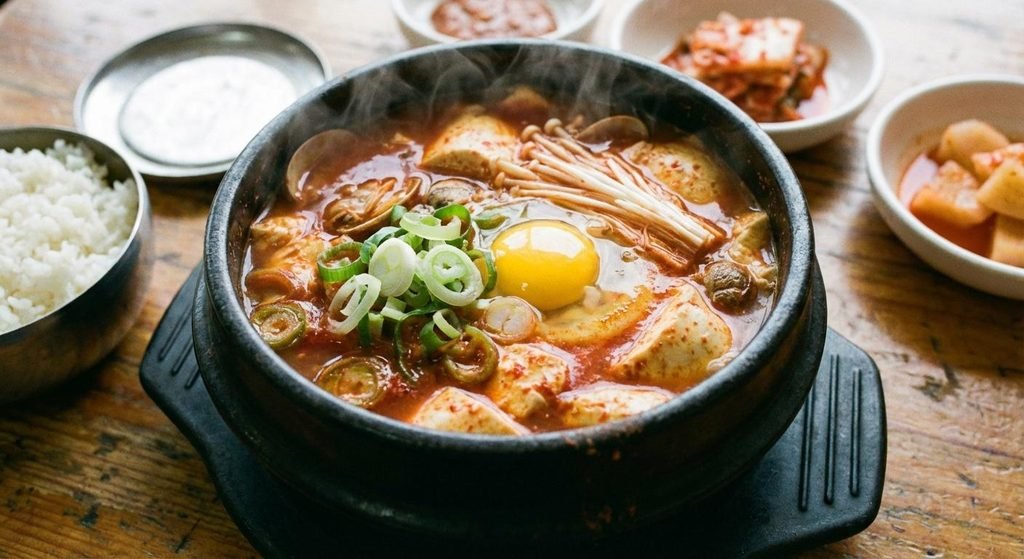
Few dishes announce themselves as dramatically as sundubu jjigae.
The server may place a stone pot in front of you while the stew is still actively bubbling.
Steam rises.
The broth may be deep red.
There may even be a raw or barely cooked egg involved.
It looks intense.
But inside is one of Korea’s most comforting ingredients: soft tofu.
The tofu has an extremely delicate texture and absorbs the flavors of the broth.
Depending on the restaurant, you may choose beef, pork, seafood, mushroom, or other variations.
Beginner warning
Unlike bulgogi or japchae, sundubu jjigae can genuinely be spicy.
Ask for a mild version when available.
And do not immediately take a giant spoonful when the pot arrives.
The bubbling is not decorative.
It is extremely hot.
Give it time to cool.
9. Gimbap — Familiar Ingredients Wrapped in Seaweed
At first glance, gimbap is frequently mistaken for sushi.
Both involve rice and seaweed, but they are different foods with different traditions and flavor profiles.
Typical gimbap fillings can include egg, carrot, spinach, pickled radish, beef, imitation crab, tuna, or other ingredients.
The rice is commonly seasoned with sesame oil, giving the dish a distinctly Korean character.
Why it is excellent for beginners
Everything arrives in small slices.
You can see many of the ingredients.
It is portable.
It is generally not spicy unless you deliberately choose a spicy variety.
Gimbap is also an everyday Korean food rather than something reserved only for restaurants.
It is associated with picnics, quick meals, convenience, travel, and packed lunches.
If you want to understand what ordinary Korean comfort food can feel like, gimbap is worth trying.
10. Korean Fried Chicken — The Gateway Food
If you remain nervous about Korean food, start here.
Chicken is familiar.
Frying is familiar.
Crispy chicken is extremely familiar.
Then Korean cooking takes that foundation and adds its own personality.
Korean fried chicken is famous for its crispy exterior and variety of sauces and seasonings.
Some versions are sweet and spicy. Others are soy-garlic flavored. Plain crispy versions are also available.
Best beginner choice
Try soy garlic or original fried chicken first if you have low spice tolerance.
Then move toward spicy varieties.
Korean fried chicken also demonstrates an important point about Korean cuisine:
Not every Korean food is ancient or strictly traditional.
Modern Korean eating culture constantly evolves, combining local flavors with international influences.
11. Doenjang Jjigae — The Smell May Challenge You Before the Taste Does
Doenjang jjigae is where beginners sometimes hesitate.
Doenjang is Korean fermented soybean paste.
Fermentation creates a deep aroma and flavor that may initially seem unusual if you did not grow up eating fermented soybean products.
The stew commonly contains tofu and vegetables and may include meat, seafood, mushrooms, or other ingredients.
It is deeply savory.
Why you should give it a chance
Doenjang jjigae demonstrates something important about Korean cuisine: delicious does not always mean sweet, salty, or spicy.
There is another dimension—fermented savory depth.
Eat a spoonful with rice rather than judging the dish by its aroma alone.
You may discover that something initially unfamiliar quickly becomes comforting.
12. Bossam — Pork Wrapped in Lettuce
3
Bossam can look like a complicated feast.
Slices of pork arrive surrounded by lettuce or cabbage, garlic, sauces, kimchi, and various accompaniments.
But the basic concept is simple.
Take pork.
Put it in a leaf.
Add whichever accompaniments you like.
Wrap.
Eat.
The pork itself is generally mild and tender.
The secret for beginners
Do not put every condiment into your first wrap.
Start simply:
pork + lettuce + a tiny amount of ssamjang.
Then experiment.
Add garlic.
Try kimchi.
Try a different vegetable.
Bossam becomes a small tasting experience where you control every bite.
That makes it far less intimidating than the full table initially suggests.
What About All Those Side Dishes?
Want to understand those small dishes better? Read our Korean Side Dishes and Banchan Guide before your next Korean meal.
Another thing that surprises first-time visitors to Korean restaurants is banchan.
You order one meal, and suddenly several tiny plates appear.
You may see kimchi, seasoned spinach, bean sprouts, pickled vegetables, potatoes, fish cake, or dishes you cannot identify at all.
You do not need to eat them in a particular order.
Banchan are shared side dishes designed to accompany the meal.
Try a little.
If you like something, eat more.
If you dislike it, move on.
That casual experimentation is one of the pleasures of eating Korean food.
Are All Red Korean Foods Spicy?
No.
This is one of the most useful lessons for Korean food beginners.
Color alone does not reliably tell you exactly how spicy something will taste.
Some dishes containing red pepper ingredients are relatively manageable, while others can be extremely hot.
Recipes also differ significantly among restaurants and households.
Rather than assuming, ask:
“Is this very spicy?”
Or:
“Can you make it mild?”
Many restaurants serving international customers hear these questions regularly.
How to Order Korean Food When You Are a Beginner
Your first Korean restaurant experience becomes much easier when you stop trying to understand the entire menu.
Choose one familiar anchor.
For example:
Beef → Bulgogi
Chicken → Korean fried chicken
Rice → Bibimbap
Noodles → Japchae
Dumplings → Mandu
Then add one unfamiliar item.
Perhaps order bulgogi plus kimchi jeon.
Next time, try bibimbap and a small tteokbokki.
Eventually, move toward sundubu jjigae or doenjang jjigae.
This approach lets you explore Korean cuisine gradually instead of treating dinner like a culinary bravery test.
A Simple Korean Food Beginner Scale
If I were introducing a friend to Korean food for the first time, I would roughly organize these dishes this way:
Very Easy:
Bulgogi, Korean fried chicken, mandu, japchae
Easy:
Bibimbap, gimbap, samgyeopsal, bossam
Slightly Adventurous:
Kimchi jeon, mild tteokbokki
More Adventurous but Worth Trying:
Sundubu jjigae, doenjang jjigae
This is not a ranking of which dishes are best.
It simply reflects how unfamiliar their flavors, textures, presentation, or spice levels may feel to someone completely new to Korean cuisine.
Why Korean Food Often Looks More Intimidating Than It Tastes
https://www.hansik.or.kr/main/main.do?utm_source=chatgpt.com
Korean cuisine is extremely visual.
Red pepper creates brilliant colors.
Stone pots arrive bubbling.
Meals contain numerous side dishes.
Seaweed adds dark colors.
Fermented ingredients create unfamiliar aromas.
Tabletop barbecue adds fire and smoke.
To someone encountering all of this for the first time, dinner can look complicated.
But underneath that visual complexity are surprisingly simple combinations:
rice + vegetables
meat + lettuce
noodles + vegetables
tofu + broth
dumpling + dipping sauce
Once you understand those foundations, Korean food becomes much easier to navigate.
The Best Way to Discover Korean Food
Do not try to prove how adventurous you are.
Start with something you genuinely think you will enjoy.
If you love beef, order bulgogi.
If you love fried chicken, start with Korean fried chicken.
If you love noodles, try japchae.
Then taste one new thing beside it.
That small unfamiliar side dish might eventually become the food you order every time.
Food culture is best discovered through curiosity rather than pressure.
And Korean cuisine rewards curiosity exceptionally well.
A dish that initially looks too red, too strange, too fermented, or simply too unfamiliar may turn out to be warm, comforting, savory, and surprisingly recognizable.
That is part of the fun.
Frequently Asked Questions
What is the easiest Korean food for beginners?
Bulgogi, japchae, mandu, gimbap, and Korean fried chicken are excellent starting points because their flavors and ingredients tend to be relatively familiar.
Is Korean food always spicy?
No. Many popular Korean foods are mild. Bulgogi, japchae, gimbap, mandu, and many types of Korean barbecue can be enjoyed without significant heat.
What Korean food should I try if I cannot eat spicy food?
Start with bulgogi, japchae, gimbap, mandu, bossam, or non-spicy Korean fried chicken. When ordering soups or sauces, ask whether mild versions are available.
What Korean food should I try first at a Korean restaurant?
Bulgogi is an especially safe first choice. Pair it with rice and sample the banchan that arrive with your meal.
Is bibimbap good for beginners?
Yes. Bibimbap is one of the best beginner friendly Korean foods because it combines rice, vegetables, egg, and often meat while allowing you to control how much spicy gochujang you add.
Should I eat all the Korean side dishes?
No. Banchan are meant to complement your meal. Try small portions and discover which ones you enjoy.
Final Thoughts
Curious about what meals actually look like in Korean homes? See What Do Koreans Really Eat Every Day? for a closer look at everyday Korean eating habits.
Some of the best food experiences begin with hesitation.
You look at the dish and think:
“I don’t know about this.”
Then you take one bite.
Korean cuisine has plenty of those moments.
The bubbling stew becomes comfort food. The strange glass noodles become addictive. The complicated barbecue table becomes fun. The fermented side dish you barely touched during your first visit becomes something you eventually crave.
So when Korean food looks intimidating, do not judge it only by its color, aroma, or presentation.
Start small.
Taste slowly.
And remember that some of the most beginner friendly Korean foods may be hiding behind the most unfamiliar appearances.