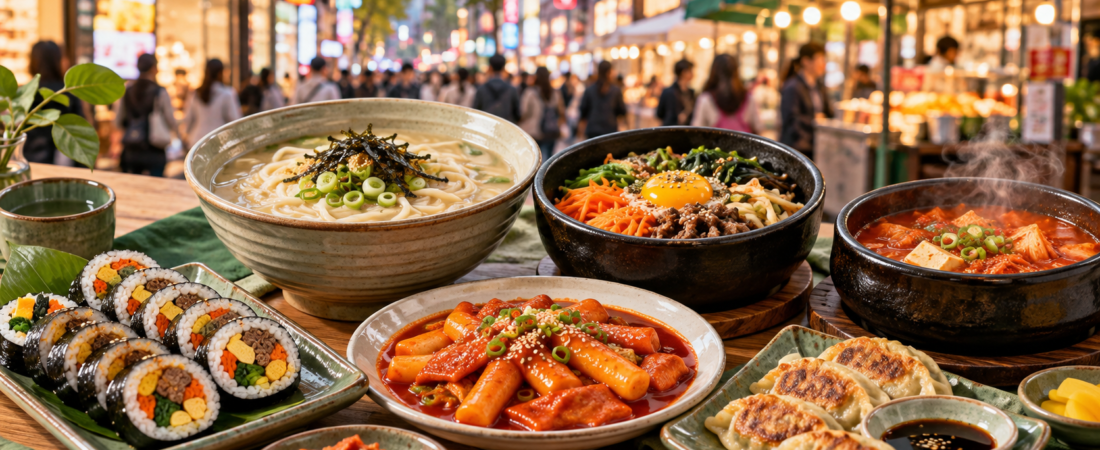
Myeongdong on a Budget Is Easier Than You Think
Myeongdong is one of the most famous neighborhoods in Seoul. It is packed with beauty stores, fashion shops, cafés, restaurants, street-food stalls, and travelers from around the world.
For updated attractions, transportation, restaurants, and visitor information, check the official Visit Seoul Myeongdong guide.https://english.visitseoul.net/editorspicks/myeong-dong/ENNlwcnrh?utm_source=chatgpt.com
Because it is such a popular tourist district, many first-time visitors assume that eating in Myeongdong will be expensive.
That is not always true.
If you know what to order, Myeongdong on a budget is completely possible. You can still enjoy comforting Korean noodles, rice dishes, dumplings, street snacks, and traditional everyday meals without choosing an expensive barbecue restaurant or trendy café for every meal.
The key is knowing the difference between a full Korean meal and tourist-priced snacks.
This guide introduces 10 Korean meals and meal-style foods that budget travelers can look for around Myeongdong.
Prices change from restaurant to restaurant, so consider the ranges below general planning estimates rather than guaranteed menu prices.
For perspective, the official Seoul tourism guide currently lists Myeongdong Kyoja, one of the neighborhood’s best-known noodle restaurants, at roughly a ₩10,000 price range. Visit Seoul
1. Kalguksu — Korean Knife-Cut Noodle Soup
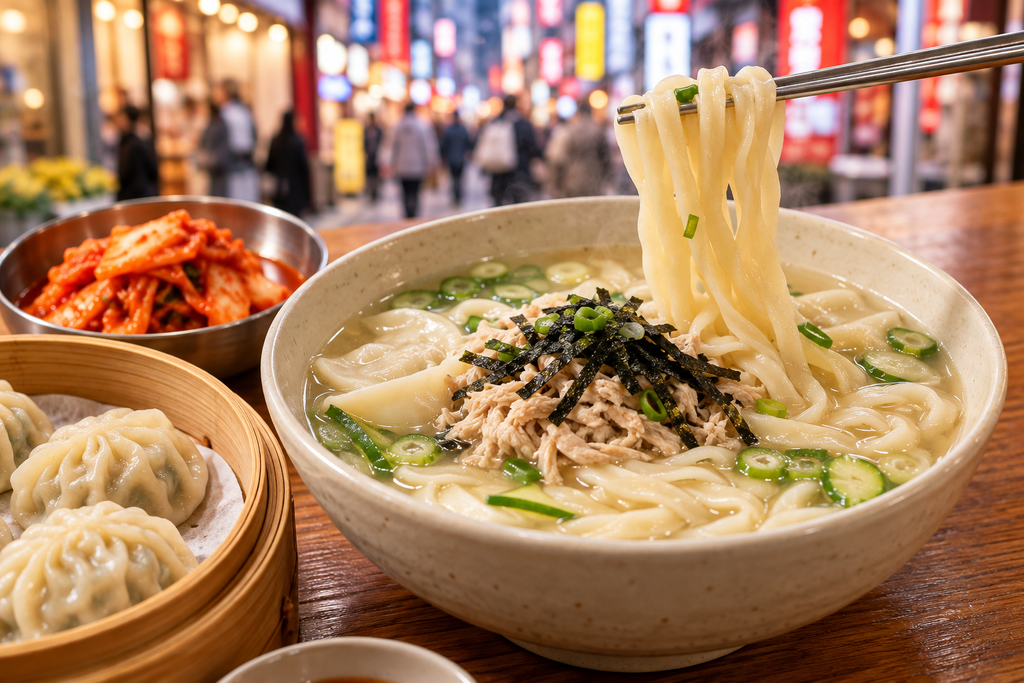
Typical budget: about ₩8,000–₩12,000
If you want a filling Korean lunch without spending much, kalguksu is one of the best places to start.
Kalguksu means “knife-cut noodles.” The noodles are usually made from wheat flour and served in a hot broth with ingredients such as chicken, clams, anchovy broth, zucchini, or green onions.
The texture is softer and thicker than ramen, making the dish especially comforting on a cold or rainy Seoul day.
Myeongdong is particularly famous for kalguksu because of Myeongdong Kyoja. Seoul’s official tourism guide describes its noodles as freshly made flour noodles served in a savory chicken broth, and lists the restaurant near Myeongdong Station Exit 8. Visit Seoul
If this is your first food-focused trip to the neighborhood, read our guide to [What to Eat in Myeongdong: 15 Korean Foods First-Time Visitors Should Try] before planning your meals.
Why It Is Good for Budget Travelers
A bowl of kalguksu can function as a complete meal.
You usually do not need to order several side dishes or appetizers, which helps keep the total bill low.
Beginner Tip
Korean restaurants often provide kimchi as a complimentary side dish. Try alternating bites of noodles with kimchi for the classic combination.
2. Kimbap — Korea’s Affordable Grab-and-Go Meal
Typical budget: about ₩3,500–₩7,000
Kimbap is one of the most practical foods for travelers exploring Seoul.
A sheet of roasted seaweed is filled with seasoned rice and ingredients such as:
- egg
- carrots
- spinach
- pickled radish
- fish cake
- tuna
- beef
The roll is sliced into bite-sized pieces.
Kimbap sometimes gets compared to sushi because of its appearance, but the flavor is quite different. Korean kimbap normally uses sesame oil and cooked or pickled ingredients rather than raw fish.
Why Kimbap Is Perfect for Myeongdong on a Budget
It is inexpensive, portable, and filling.
You can eat it before shopping, take it back to your hotel, or combine it with another inexpensive Korean dish such as ramyeon or tteokbokki.
Money-Saving Combination
Try:
Kimbap + ramyeon
or
Kimbap + tteokbokki
These combinations are common casual Korean meals and can still cost much less than a sit-down barbecue dinner.
3. Tteokbokki — Spicy Rice Cakes
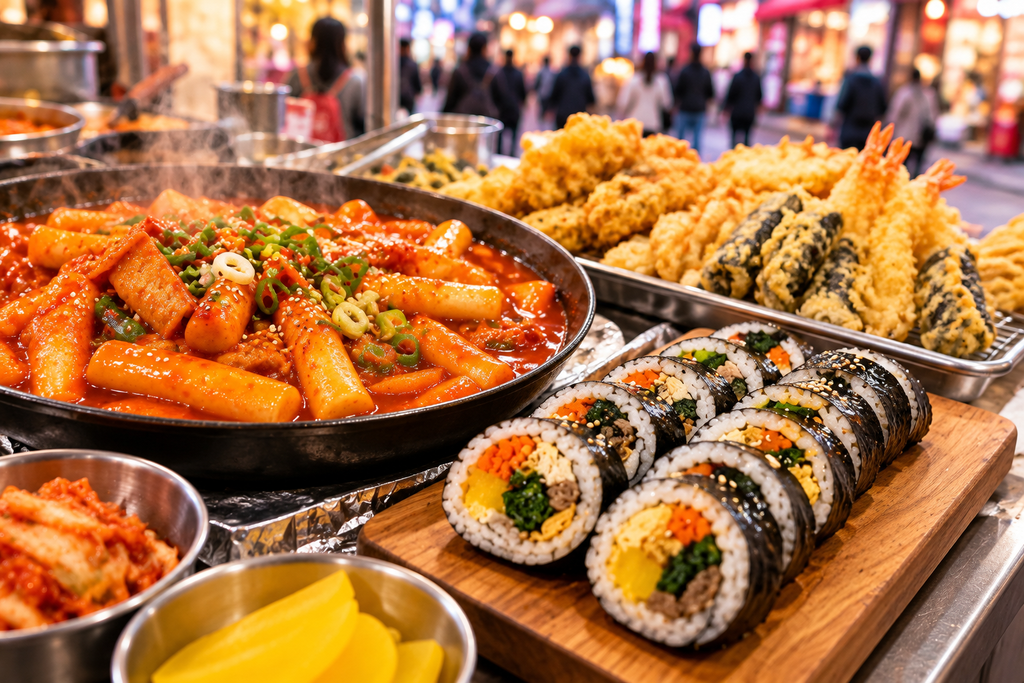
Typical budget: about ₩4,000–₩8,000
Few foods represent Korean street-food culture better than tteokbokki.
The dish is made from chewy cylindrical rice cakes coated in a red sauce usually flavored with gochujang, Korean chili paste.
The sauce is sweet, spicy, and savory.
Depending on the vendor, you may also find:
- fish cakes
- boiled eggs
- green onions
- cabbage
- ramen noodles
Is Tteokbokki a Full Meal?
It can be.
For a light lunch or dinner, one portion may be enough. For a larger meal, combine it with fish cake or kimbap.
Watch the Spice Level
The bright red sauce can be hotter than first-time visitors expect.
If you are sensitive to spicy food, eat slowly and pair it with something mild.
4. Mandu — Korean Dumplings
Typical budget: about ₩5,000–₩10,000
Mandu are Korean dumplings filled with ingredients such as pork, vegetables, tofu, glass noodles, or kimchi.
They can be:
- steamed
- boiled
- pan-fried
- served in soup
Large steamed dumplings can make a surprisingly filling meal.
Why Mandu Works for Travelers
Mandu is easy to order even if you are unfamiliar with Korean food.
The flavors are generally mild, and the ingredients are recognizable to many international travelers.
If you are nervous about trying very spicy Korean food, dumplings are an excellent starting point.
Budget Strategy
If traveling with another person, order dumplings to share with a bowl of noodles instead of ordering two larger meals.
5. Bibimbap — Rice, Vegetables, and Gochujang
Typical budget: about ₩8,000–₩13,000
Bibimbap is one of the easiest Korean dishes to recommend to first-time visitors.
A bowl usually contains rice topped with several vegetables and may include:
- spinach
- bean sprouts
- mushrooms
- carrots
- zucchini
- egg
- beef
Gochujang is added for spice and flavor.
Everything is mixed together before eating.
Why Bibimbap Is Good Value
You get rice, vegetables, protein, and several Korean flavors in one bowl.
It is particularly useful if you want something more balanced after eating fried street food or sweets.
An official Seoul tourism listing for Myeongdong Busanjib, for example, includes bibimbap among its Korean offerings, though its listed bibimbap price is ₩18,000—showing why comparing nearby menus matters if you are traveling on a strict budget. Visit Seoul
6. Kimchi Jjigae — Kimchi Stew
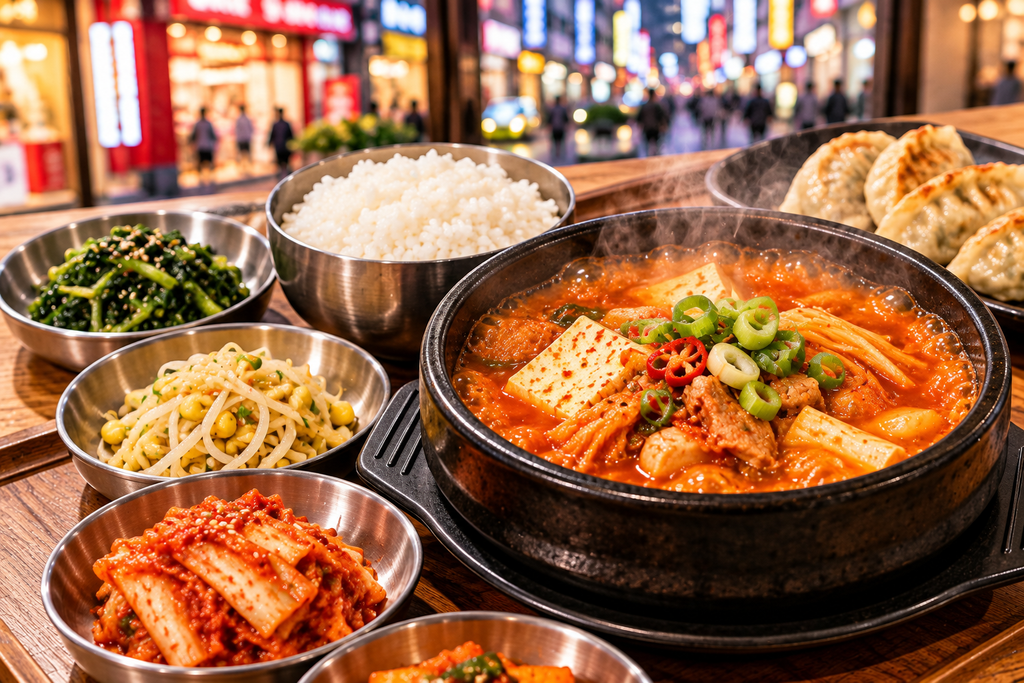
Typical budget: about ₩8,000–₩12,000
Kimchi jjigae is one of Korea’s classic everyday comfort foods.
The stew usually contains aged kimchi cooked with ingredients such as:
- tofu
- onions
- green onions
- pork
- tuna
It is usually served bubbling hot alongside a bowl of rice.
Why It Is a Smart Budget Choice
Instead of ordering multiple individual dishes, you receive a flavorful stew, rice, and usually several small side dishes.
That makes kimchi jjigae feel like a complete Korean meal.
First-Time Visitor Tip
Older fermented kimchi is often used in stews because its stronger flavor becomes rich and savory when cooked.
So the taste may be more intense than fresh kimchi.
7. Doenjang Jjigae — Korean Soybean Paste Stew
Typical budget: about ₩8,000–₩12,000
If kimchi stew sounds too spicy, consider doenjang jjigae.
Doenjang is fermented soybean paste, one of the foundational ingredients in Korean cooking.
The stew often includes:
- tofu
- zucchini
- onions
- mushrooms
- potatoes
- chili peppers
The flavor is earthy, salty, and deeply savory.
Why Travelers Should Try It
Doenjang jjigae represents everyday Korean home-style cooking better than many flashy tourist dishes.
It is also inexpensive at many neighborhood restaurants.
For travelers who want to understand what Koreans might actually eat during an ordinary lunch or dinner, this is a worthwhile choice.
8. Ramyeon — Korean Instant Noodles Upgraded
Typical budget: about ₩4,000–₩7,000
Korean ramyeon is much more than a dorm-room snack.
Small casual restaurants often prepare it with additional ingredients including:
- egg
- green onions
- cheese
- rice cakes
- dumplings
The result is inexpensive, hot, spicy, and surprisingly satisfying.
Convenience Store Option
One of the cheapest ways to eat in Seoul is buying ramyeon at a convenience store.
Many Korean convenience stores provide hot water and eating areas.
Combine ramyeon with:
- triangle kimbap
- boiled eggs
- kimchi
- a drink
and you can create an extremely inexpensive meal.
Budget Tip
Save restaurant dining for one or two special meals and use convenience-store meals occasionally. It can reduce your daily food spending considerably.
9. Jajangmyeon — Noodles with Black Bean Sauce
Typical budget: about ₩7,000–₩10,000
Although jajangmyeon comes from Korean-Chinese cuisine rather than traditional Korean cooking, it is deeply embedded in modern Korean food culture.
Thick noodles are covered with a rich black bean sauce containing onions and usually pork.
The flavor is savory with a touch of sweetness.
Why It Belongs on a Budget List
Jajangmyeon is traditionally considered an affordable everyday restaurant meal.
It is also very filling.
The official Seoul tourism guide currently lists Bobae Banjum’s Myeongdong branch as offering jajangmyeon and jjamppong, describing the restaurant as serving Chinese-style dishes at reasonable prices near Myeongdong. Visit Seoul
Good for Beginners
Jajangmyeon is usually much less spicy than many Korean red-sauce dishes, making it friendly for travelers who are not ready for strong chili flavors.
10. Gukbap — Soup with Rice
Typical budget: about ₩9,000–₩13,000
The word gukbap combines two Korean words:
guk = soup
bap = rice
There are many varieties, including beef soup, pork soup, and bean sprout soup.
It is simple, hearty Korean comfort food.
Why Gukbap Is Excellent Value
A bowl often includes:
- broth
- meat or vegetables
- rice
- kimchi
- side dishes
That is enough food for most travelers without ordering anything extra.
It is especially satisfying during Seoul’s colder months.
Street Food vs. Restaurant Meals: Which Is Cheaper?
It may seem obvious that street food should always be cheaper.
But in Myeongdong, that is not necessarily true.
Myeongdong’s street-food area is designed partly for tourists, and buying several individual snacks can quickly become more expensive than sitting down for one bowl of noodles or stew.
For example, imagine buying three different street snacks.
Even if each snack seems inexpensive individually, the total can approach the cost of a complete Korean meal.
That is why travelers visiting Myeongdong on a budget should think of street food as an experience rather than automatically assuming it is the cheapest dining option.
Seoul’s tourism resources emphasize Myeongdong’s combination of shops, restaurants, and street vendors, making it easy to compare several options before deciding what to eat.
You can also compare these meals with our [Myeongdong Street Food Guide: What’s Worth Trying and What to Skip].
A Simple One-Day Budget Food Plan in Myeongdong
Here is one possible inexpensive food schedule.
Breakfast
Kimbap + coffee
Approximate total: ₩7,000–₩10,000
Lunch
Kalguksu
Approximate total: ₩10,000–₩12,000
Afternoon Snack
Tteokbokki or fish cake
Approximate total: ₩4,000–₩7,000
Dinner
Kimchi jjigae or doenjang jjigae
Approximate total: ₩9,000–₩12,000
You could therefore enjoy several Korean foods during one day without making every meal an expensive dining experience.
Actual prices vary by restaurant and can change over time.
7 Ways to Save Money on Food in Myeongdong
1. Check the Menu Before Sitting Down
Many Korean restaurants display menus outside.
Look at prices first.
You are not obligated to enter just because a staff member greets you.
2. Look One or Two Streets Away from the Main Shopping Road
The busiest streets often contain businesses aimed directly at tourists.
Walk into nearby side streets and compare menus.
You may find smaller Korean restaurants serving simpler meals.
3. Eat Korean Everyday Food
Foods such as:
- jjigae
- guksu
- kimbap
- gukbap
- bibimbap
often provide better value than specialty barbecue or elaborate seafood meals.
4. Avoid Ordering Too Many Street Snacks
Trying one or two is fun.
Trying six can become an expensive dinner.
5. Use Convenience Stores Strategically
Convenience stores are useful for breakfast, late-night meals, drinks, or snacks.
6. Drink Water with Meals
Many Korean restaurants provide drinking water.
Ordering specialty drinks with every meal can quietly increase your budget.
7. Compare Before Ordering
Myeongdong contains a huge concentration of restaurants.
If one place looks too expensive, another option may be only a minute away.
What Budget Travelers Should Avoid
Being budget-conscious does not mean choosing the absolute cheapest food every time.
Instead, avoid spending money accidentally.
Tourist Combo Menus
Large combination menus may include food you did not really want.
Oversized Street-Food Portions
Some elaborate street snacks are made primarily to attract attention and may cost much more than basic Korean street food.
Cafés After Every Meal
Seoul café culture is wonderful, but specialty drinks and desserts can sometimes cost almost as much as lunch.
Choose the cafés you truly want to experience.
Ordering Too Much
Korean tables can look small before the side dishes arrive.
Wait until your main food arrives before adding several extra dishes.
Is Myeongdong Expensive Compared with Other Seoul Neighborhoods?
Myeongdong can be more tourist-oriented than residential areas of Seoul.
However, that does not mean every meal is expensive.
The neighborhood includes everything from inexpensive noodle dishes and dumplings to premium Korean barbecue and elaborate traditional meals.
The difference comes down to what you choose.
For comparison, Seoul’s official tourism listings currently show some Myeongdong-area meals around the ₩10,000 range, while specialized restaurants and more elaborate menus can be significantly more expensive. Visit Seoul
That range is exactly why checking menus before ordering is important.
How Much Should You Budget for Food in Myeongdong?
A very budget-conscious traveler could potentially build meals around:
Breakfast: ₩5,000–₩8,000
Lunch: ₩8,000–₩12,000
Snack: ₩4,000–₩7,000
Dinner: ₩9,000–₩15,000
That would put a simple food day somewhere around:
₩26,000–₩42,000 per person
before cafés, alcohol, premium street foods, or upscale restaurants.
Treat this as a planning example rather than a fixed daily cost.
New to Korean cuisine? Start with our [12 Korean Foods That Look Intimidating but Are Surprisingly Beginner-Friendly].
Final Thoughts: Myeongdong Can Still Be Budget-Friendly
Myeongdong may be one of Seoul’s busiest tourist districts, but you do not need an expensive food budget to enjoy it.
Some of Korea’s most satisfying foods are also among its simplest:
kalguksu, kimbap, tteokbokki, mandu, bibimbap, jjigae, ramyeon, jajangmyeon, and gukbap.
The biggest secret to enjoying Myeongdong on a budget is not hunting for the cheapest item on every street.
It is choosing foods that Koreans commonly eat as everyday meals.
A warm bowl of noodles or stew can give you a more authentic food experience—and often better value—than buying several fashionable tourist snacks.
Save your money for one or two special experiences, then enjoy Seoul’s everyday food culture for the rest of your trip.
FAQ
Is food expensive in Myeongdong?
It can be, especially at premium barbecue restaurants, trendy cafés, and tourist-focused street stalls. However, noodle soups, kimbap, stews, dumplings, and rice dishes can still provide affordable meals.
What is the cheapest Korean food to eat in Myeongdong?
Kimbap, ramyeon, tteokbokki, and convenience-store meals are generally among the least expensive options.
Can I eat in Myeongdong for under ₩10,000?
Yes, some noodle dishes, kimbap meals, ramyeon, street foods, and casual Korean meals may fall around or below that range. Prices vary by restaurant.
What Korean food should a first-time visitor try?
Kalguksu, bibimbap, mandu, and kimbap are especially approachable for beginners.
Is Myeongdong street food cheap?
Some items are inexpensive, but buying several snacks can cost more than a complete restaurant meal. Check prices before ordering.
What is a good cheap meal near Myeongdong Station?
Kalguksu is one strong option. Seoul’s official tourism guide lists Myeongdong Kyoja near Myeongdong Station Exit 8 and describes it as specializing in kalguksu. Visit Seoul