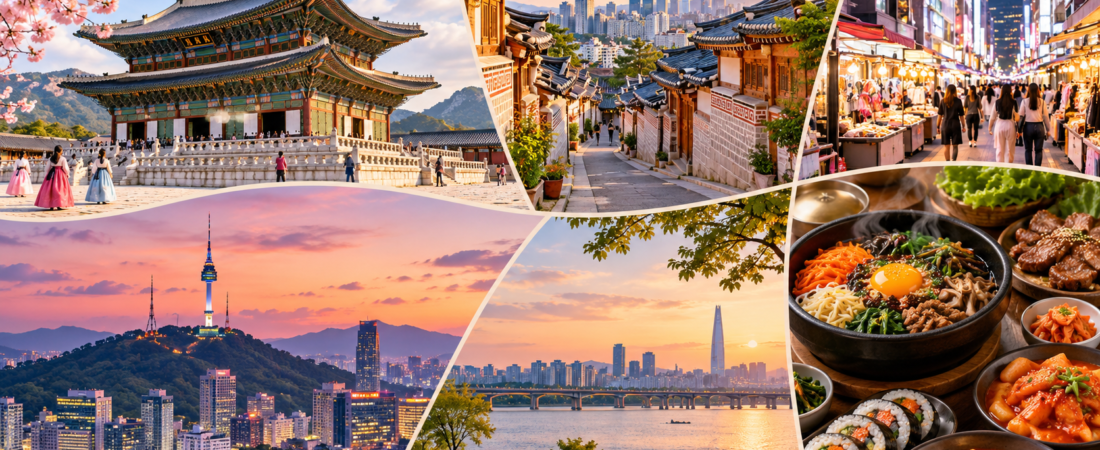
Seoul can feel overwhelming the first time you arrive.
The city is enormous, the subway map looks complicated, neighborhoods have completely different personalities, restaurants may operate differently from what American travelers expect, and even simple questions—such as where to stay or how to pay for the subway—can create uncertainty before your trip begins.
The good news is that Seoul is also one of the easiest major Asian cities to explore once you understand a few basics.
This Seoul Travel Guide for First-Time Visitors explains what you should know before arriving, how to travel from the airport, where to stay, how Seoul’s public transportation works, what foods to try, how much money you may need, what cultural differences to expect, and how to organize your first few days.
You do not need to speak fluent Korean or understand every subway line before your flight.
A little preparation goes a long way.
Whether you are visiting Seoul for Korean food, K-pop, shopping, history, skincare, nightlife, cafés, or simply because you have always wanted to experience South Korea, this guide will help make your first trip much easier.
Table of Contents
- Is Seoul Good for First-Time Visitors?
- Best Time to Visit Seoul
- How Many Days Do You Need in Seoul?
- Arriving at Incheon International Airport
- How to Get from Incheon Airport to Seoul
- Where to Stay in Seoul
- How to Use Seoul’s Subway
- T-money and Transportation Cards
- Climate Card for Tourists
- Using Maps and Navigation Apps
- Money and Paying in Seoul
- How Much Does a Seoul Trip Cost?
- What to Eat in Seoul
- Korean Restaurant Etiquette
- Convenience Stores
- Must-See Places for First-Time Visitors
- Shopping in Seoul
- Cafés and Coffee Culture
- Basic Korean Phrases
- Cultural Etiquette
- Safety in Seoul
- Internet and Mobile Data
- What to Pack
- Sample 5-Day Seoul Itinerary
- Common First-Time Mistakes
- Frequently Asked Questions
Is Seoul Good for First-Time Visitors?
Absolutely.
Seoul may be one of the world’s largest metropolitan areas, but much of the infrastructure is surprisingly visitor-friendly.
Subway stations commonly display Korean and English names, numbered exits make navigation easier, tourist districts have information centers, and public transportation reaches nearly every major attraction.
The official Visit Seoul guide describes the subway as one of the most efficient ways for tourists to explore the city. Seoul’s subway generally operates from around 5:30 a.m. until midnight, although exact first and last train times vary by station and line.
Another advantage is variety.
You can spend the morning walking around a centuries-old royal palace, eat lunch in a traditional market, visit a futuristic shopping district in the afternoon, drink coffee in a stylish café, and finish the evening surrounded by neon signs and restaurants.
Few cities combine old and new as dramatically as Seoul.
When Is the Best Time to Visit Seoul?
Seoul experiences four very distinct seasons.
Spring: March to May
Spring is one of the most popular seasons.
Temperatures gradually become warmer, parks turn green, and cherry blossoms often attract large crowds.
April is especially popular with international travelers.
However, temperatures can still change quickly, so packing layers is useful.
Summer: June to August
Summer is hot and humid.
July and August can feel especially uncomfortable if you are not accustomed to humid Asian summers.
Rainy periods are also common.
The advantage is that summer nights can be lively, and indoor attractions, malls, cafés, museums, and restaurants are heavily air-conditioned.
Fall: September to November
Fall is another excellent season for a first Seoul trip.
Temperatures are generally comfortable, humidity drops, and autumn colors can make Seoul’s mountains, parks, palaces, and traditional neighborhoods particularly beautiful.
October is often especially pleasant.
Winter: December to February
Seoul winters can be genuinely cold.
Temperatures sometimes fall well below freezing, so visitors should bring a warm coat, gloves, and appropriate shoes.
Winter does have advantages. Crowds at some attractions may be smaller, winter foods become especially appealing, and the city takes on a very different atmosphere.
How Many Days Do You Need in Seoul?
For a first visit, I recommend allowing five to seven days if your schedule permits.
Three days is possible, but you will probably feel rushed.
Seoul is geographically large. Attractions that look close on a map may require significant subway travel.
A five-day trip lets you experience several sides of the city without turning every day into a race.
With seven days, you can explore slower neighborhoods, spend more time shopping or eating, and possibly take a day trip outside Seoul.
Arriving at Incheon International Airport
Most international visitors arrive through Incheon International Airport, located west of Seoul.
It is not actually in central Seoul, so you should plan your transportation before landing.
The main options are:
- AREX Airport Railroad
- Airport limousine bus
- Taxi
- Private airport transfer
For many independent travelers, AREX is the easiest option.
How to Get from Incheon Airport to Seoul
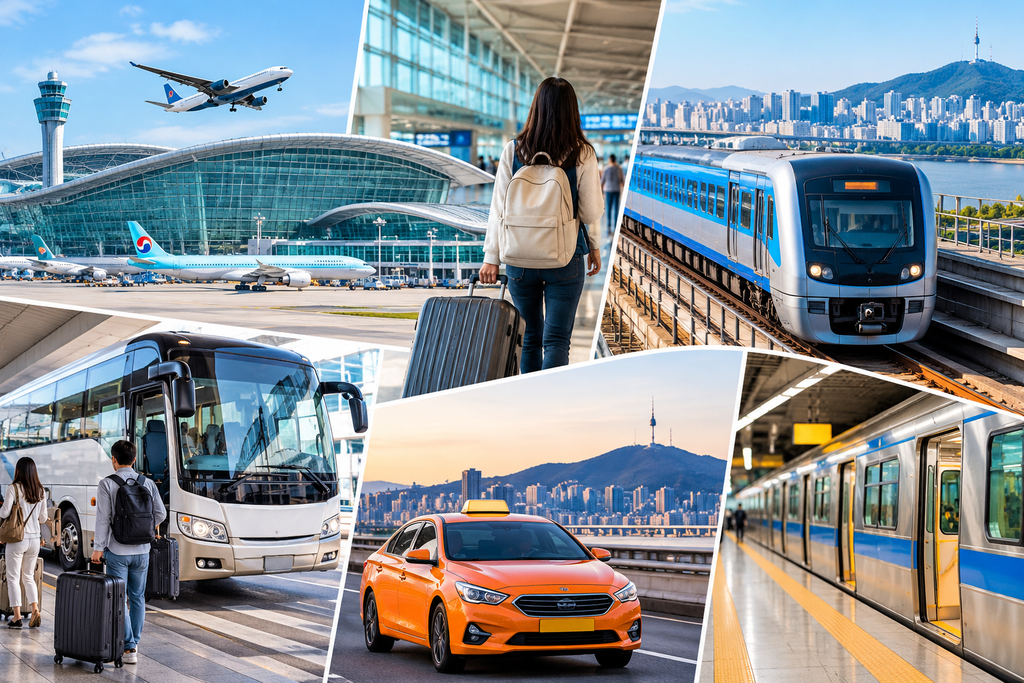
AREX Express Train
The AREX Express Train travels nonstop between Incheon International Airport and Seoul Station.
According to Korea’s official tourism information, the approximate journey is about 43 minutes from Terminal 1 to Seoul Station and about 51 minutes from Terminal 2.
This is a good option if:
- Your hotel is near Seoul Station.
- You want predictable travel time.
- You have manageable luggage.
- You plan to connect to Seoul’s subway afterward.
AREX All-Stop Train
The All-Stop Train makes several stops between the airport and Seoul.
One particularly useful stop is Hongik University Station, making it convenient for travelers staying in Hongdae.
The trip takes longer than the express service, but it can sometimes save you from transferring at Seoul Station.
Official tourism information lists approximate travel times of about 59 minutes from Terminal 1 and 66 minutes from Terminal 2 to Seoul Station.
Airport Limousine Bus
Airport buses are excellent for travelers with larger suitcases because many routes stop near major hotels and neighborhoods.
They may be more comfortable than transferring between subway lines while pulling luggage.
The disadvantage is traffic.
During busy Seoul traffic periods, the journey can take significantly longer than rail transportation.
Taxi
A taxi can make sense if:
- Several people are traveling together.
- You have heavy luggage.
- Your flight arrives late.
- Your accommodation is far from a convenient airport-bus stop or train station.
Taxis from Incheon Airport include standard and other service classes, and official tourism information states that cash, credit cards, and transportation cards are accepted in taxis.
Where Should First-Time Visitors Stay in Seoul?
Choosing the right neighborhood can completely change your Seoul experience.
There is no single “best” neighborhood for everyone.
Myeongdong
Myeongdong is one of the easiest choices for first-time tourists.
You are near:
- Shopping
- Restaurants
- Street food
- Subway stations
- Namsan
- Major central Seoul attractions
It is particularly convenient if you want a traditional sightseeing-and-shopping trip.
Hongdae
Hongdae feels younger, more energetic, and more casual.
Expect:
- Cafés
- Restaurants
- Bars
- Music
- Shopping
- Street activity
- Late-night entertainment
The airport railroad connection is also convenient.
Hongdae may be especially appealing to younger travelers or anyone interested in Seoul’s contemporary culture.
Insadong and Jongno
Choose this area if you are especially interested in Korean history and traditional culture.
You will be near places such as:
- Gyeongbokgung Palace
- Bukchon Hanok Village
- Insadong
- Changdeokgung Palace
- Jogyesa Temple
- Ikseon-dong
It is one of my favorite areas for travelers who want their first impression of Korea to include historical Seoul.
Gangnam
Gangnam offers a very different experience.
This part of Seoul has:
- Modern office towers
- Department stores
- Luxury shopping
- Restaurants
- Nightlife
- Beauty clinics
- Modern cafés
However, Gangnam is south of the Han River, while many traditional attractions are north of the river.
If palaces and historical neighborhoods are your main priority, staying in Gangnam may increase your daily transportation time.
Seoul Station
Seoul Station can be a practical base if transportation convenience matters more than neighborhood atmosphere.
It provides useful connections to:
- Incheon Airport
- Seoul subway lines
- KTX trains
- Other Korean cities
It is especially convenient if Seoul is only one part of a larger South Korea trip.
How to Use the Seoul Subway
The Seoul subway may look intimidating at first.
After one or two rides, most visitors understand it quickly.
Subway lines are identified by both numbers and colors, and stations have numbered exits.
That exit number is extremely important.
A station may have many exits spread across several city blocks. Using the wrong exit can leave you walking much farther than necessary.
When your navigation app says Exit 5, follow Exit 5 rather than simply leaving through whichever staircase appears first.
Basic Subway Process
- Enter the station.
- Check your destination and subway line.
- Tap your transportation card at the gate.
- Follow signs toward the correct direction.
- Transfer if necessary.
- Tap again when leaving the destination station.
Seoul Metro information is commonly displayed in Korean and English, making the system manageable for visitors.
Get a T-money Card
For most first-time travelers, getting a T-money card is one of the first things I would recommend.
T-money can be used across Seoul’s public transportation network and eliminates the need to buy individual tickets for every trip.
The cards are widely available at convenience stores and subway stations.
They can be used for buses and subways, and transportation-card users can receive transfer benefits when following the required tap-in and tap-out procedures.
One important habit:
Always tap your transportation card when getting off a bus.
Doing so is important for calculating fares and receiving eligible transfer discounts.
Cash Is Still Worth Carrying
Even though Seoul is highly card-friendly, carrying some Korean won remains useful.
In particular, T-money purchase or recharge procedures can sometimes differ depending on location and payment method.
Korea Tourism Organization’s 2026 transportation guidance notes that standard prepaid T-money cards purchased or topped up through many convenience-store channels still rely on cash rather than foreign-issued cards.
Keeping a modest amount of cash in your wallet prevents unnecessary problems.
What About the Seoul Climate Card?
Travelers may also encounter the Climate Card.
This requires a little explanation because the system changed in 2026.
The former 30-day prepaid Climate Card stopped accepting new 30-day recharges after August 31, 2026 as Seoul transitioned to its newer Climate Pass structure.
However, short-term Climate Card passes for visitors remain available in 1-, 2-, 3-, 5-, and 7-day versions.
Current official Seoul information lists these short-term options at:
- 1 day: KRW 5,000
- 2 days: KRW 8,000
- 3 days: KRW 10,000
- 5 days: KRW 15,000
- 7 days: KRW 20,000
The service area has limitations, so do not assume every subway or bus outside Seoul is covered.
For many first-time travelers who expect to move around constantly inside Seoul, comparing a short-term Climate Card with ordinary T-money can be worthwhile.
Download the Right Map Apps
One of the most important things American travelers should know is that navigation habits in Korea may be different from what you use at home.
Install at least one Korean navigation app before traveling.
Two widely used options are:
Naver Map
Naver Map is very useful for:
- Walking directions
- Subway routes
- Bus routes
- Restaurant locations
- Travel times
KakaoMap
KakaoMap is another strong option and is widely used in Korea.
Korea Tourism Organization’s 2026 transportation guide lists both Kakao Maps and NAVER Maps for route searches involving driving, public transit, walking, and place information.
I would install both before departure and decide which interface feels easier to you.
Money and Paying in Seoul
South Korea uses the Korean won, written as KRW or ₩.
Credit cards are accepted at a huge number of businesses, including:
- Hotels
- Department stores
- Restaurants
- Cafés
- Convenience stores
- Tourist attractions
- Larger retail stores
However, carrying cash is still useful.
You may need it for certain:
- Traditional markets
- Transportation-card recharges
- Small vendors
- Older machines
- Street purchases
You do not need to carry a large amount of cash.
A combination of credit card plus a modest amount of Korean won is usually the most practical setup.
How Much Money Do You Need in Seoul?
Seoul can be either relatively affordable or extremely expensive depending on your travel style.
A simple local meal may be surprisingly reasonable, while luxury hotels, department-store shopping, upscale Korean barbecue, beauty treatments, and nightlife can dramatically increase your spending.
A budget-conscious traveler might focus on:
- Guesthouses or modest hotels
- Subway transportation
- Local restaurants
- Markets
- Convenience stores
- Free parks and neighborhoods
A mid-range traveler may choose:
- Three- or four-star hotels
- Restaurant meals
- Cafés
- Shopping
- Paid attractions
- Occasional taxis
The important point is that Seoul does not require a luxury budget to be enjoyable.
Public transportation is efficient, many cultural areas can be explored on foot, and inexpensive Korean food is widely available.
What Should You Eat in Seoul?
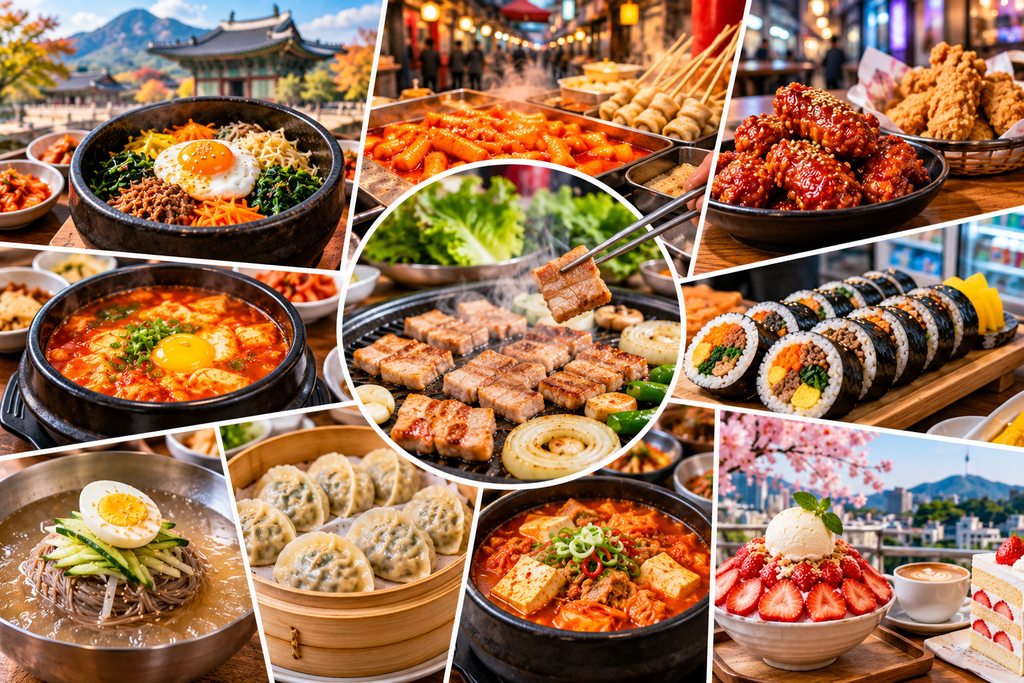
For many visitors, food becomes one of the highlights of the trip.
Do not limit yourself to Korean barbecue.
Korean Barbecue
Try:
- Samgyeopsal
- Galbi
- Bulgogi
At many Korean barbecue restaurants, meat is cooked directly at your table.
Side dishes called banchan are commonly served alongside the meal.
Bibimbap
Bibimbap combines rice with vegetables, sauce, and often meat or egg.
It can be a comfortable introduction to Korean food for visitors unfamiliar with stronger Korean flavors.
Korean Fried Chicken
Korean fried chicken is famous for its crispy texture and wide variety of sauces.
Tteokbokki
Tteokbokki consists of chewy rice cakes in a spicy sauce.
It is one of Korea’s most recognizable casual foods.
Gimbap
Gimbap is convenient, affordable, and easy to eat while traveling.
It typically contains rice and various fillings rolled in seaweed.
Mandu
Korean dumplings come steamed, boiled, or fried and can be filled with meat, vegetables, kimchi, or other ingredients.
Korean Soups and Stews
Try dishes such as:
- Kimchi jjigae
- Sundubu jjigae
- Seolleongtang
- Doenjang jjigae
Soup-based meals are especially comforting during Seoul’s colder months.
Visit a Traditional Market
A Seoul trip should include at least one traditional market.
Gwangjang Market is one of the best-known choices among international visitors.
Popular foods include:
- Bindaetteok
- Gimbap
- Tteokbokki
- Dumplings
- Noodles
- Various Korean snacks
Markets can be crowded, noisy, and confusing—but that is part of the experience.
Do not feel pressured to try everything.
Walk through first, observe what other people are eating, and choose what looks appealing.
Korean Restaurant Etiquette for First-Time Visitors
You do not need to memorize dozens of Korean etiquette rules.
A few habits will make meals easier.
At many restaurants, utensils, water, napkins, or side dishes may be available at a self-service station.
Some restaurants place utensils in a drawer underneath the table.
This surprises many first-time visitors.
If you cannot find chopsticks or spoons, check the side or underside of the table before assuming none were provided.
Also, some restaurants specialize in one specific dish and may require a minimum order, particularly barbecue restaurants.
Menus in tourist areas frequently include pictures or English, but this should not be expected everywhere.
Do Not Ignore Seoul’s Convenience Stores
Korean convenience stores are genuinely useful for travelers.
Major chains include CU, GS25, 7-Eleven, and emart24.
You can buy:
- Bottled water
- Coffee
- Snacks
- Instant noodles
- Gimbap
- Sandwiches
- Drinks
- Basic toiletries
Some locations have tables or seating areas.
Convenience stores can also be helpful when arriving late at night or when you want an inexpensive breakfast before sightseeing.
Must-See Seoul Attractions for First-Time Visitors
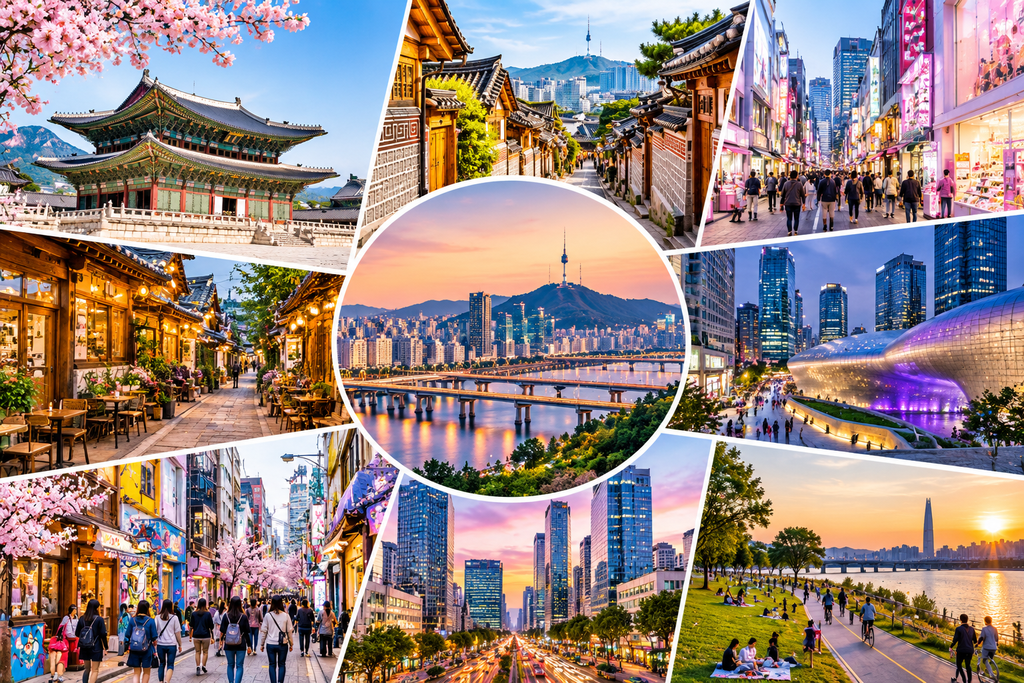
Trying to see everything is one of the biggest mistakes first-time visitors make.
Choose a smaller number of areas and experience them properly.
Gyeongbokgung Palace
If you visit only one Korean palace during your first Seoul trip, Gyeongbokgung is the obvious place to begin.
The palace gives visitors a striking contrast between historical Korean architecture and modern Seoul.
Allow enough time to walk beyond the main courtyard.
Bukchon Hanok Village
Bukchon is famous for traditional Korean houses called hanok.
Remember that parts of Bukchon remain residential.
Keep noise levels reasonable and respect signs restricting access or photography.
Insadong
Insadong is known for:
- Traditional crafts
- Souvenirs
- Tea shops
- Galleries
- Restaurants
It pairs naturally with a palace day.
Ikseon-dong
Ikseon-dong blends traditional architecture with contemporary Seoul café culture.
Inside narrow alleys, old-style buildings have been transformed into restaurants, dessert shops, and cafés.
N Seoul Tower
N Seoul Tower is one of the city’s best-known landmarks.
Even travelers who do not go to the observation deck may enjoy exploring Namsan and the surrounding views.
Myeongdong
Myeongdong remains one of Seoul’s most recognizable shopping districts.
Visitors come for:
- Korean cosmetics
- Fashion
- Street food
- Restaurants
- Souvenirs
Hongdae
Visit Hongdae in the afternoon and stay into the evening.
The neighborhood is known for youth culture, fashion, restaurants, cafés, music, and nightlife.
Dongdaemun Design Plaza
DDP represents the futuristic side of Seoul.
Its distinctive architecture and surrounding shopping areas create a completely different experience from Seoul’s palace districts.
Han River
Do not spend your entire trip surrounded by buildings.
Visit the Han River and see how Seoul residents use the city’s riverside parks for walking, cycling, picnics, and relaxation.
Shopping in Seoul
Seoul shopping can easily consume an entire trip.
For Korean Beauty Products
Try:
- Myeongdong
- Olive Young
- Department stores
- Hongdae
- Gangnam
For Fashion
Consider:
- Hongdae
- Myeongdong
- Gangnam
- Seongsu
- Department stores
For Traditional Souvenirs
Visit:
- Insadong
- Museum shops
- Palace-area stores
- Traditional markets
For Trendy Seoul Culture
Spend time in Seongsu-dong.
Seongsu has become known for cafés, pop-up stores, fashion, design-oriented spaces, and converted industrial buildings.
Experience Seoul’s Café Culture
Coffee is not simply a morning habit in Seoul.
Cafés are social spaces, date destinations, design experiences, and sometimes attractions in themselves.
You will find cafés themed around:
- Traditional hanok
- Minimalist interiors
- Rooftop views
- Bakeries
- Desserts
- Art
- Music
- Gardens
- Industrial architecture
Neighborhoods such as Seongsu, Ikseon-dong, Yeonnam-dong, and Hongdae are especially fun for café exploration.
Do not schedule every hour of your trip.
Leave time to discover an interesting café unexpectedly.
That often becomes one of the most memorable parts of visiting Seoul.
Basic Korean Phrases Worth Knowing
You can travel through Seoul without speaking Korean, but learning a few words is useful and appreciated.
Hello:
Annyeonghaseyo — 안녕하세요
Thank you:
Gamsahamnida — 감사합니다
Excuse me / I’m trying to get someone’s attention:
Jeogiyo — 저기요
How much is it?
Eolmayeyo? — 얼마예요?
Please give me this:
Igeo juseyo — 이거 주세요
Yes:
Ne — 네
No:
Aniyo — 아니요
Do not worry about perfect pronunciation.
Trying politely is usually more valuable than saying nothing because you are afraid of making a mistake.
Cultural Etiquette Visitors Should Know
Seoul is modern and international, but cultural differences still exist.
Speak Quietly on Public Transportation
Subways can be crowded yet surprisingly quiet.
Avoid loud phone conversations or videos played through speakers.
Respect Priority Seating
Subway cars have designated seats for elderly passengers, pregnant passengers, and people with mobility needs.
Be aware of signage.
Stand to One Side
Do not block subway doors or escalator entrances.
Seoul moves quickly, especially during commuting hours.
Use Both Hands in Formal Situations
When giving or receiving something from an older person or in a more formal interaction, using both hands can be considered polite.
Tourists are not expected to understand every cultural rule, but basic awareness is appreciated.
Is Seoul Safe?
Seoul generally feels very safe to many international visitors, including people traveling alone.
Public areas often remain active late into the evening.
That does not mean you should abandon normal travel precautions.
Keep track of your:
- Wallet
- Phone
- Passport
- Shopping bags
- Luggage
Be particularly attentive in nightlife areas, crowded markets, subway stations, and tourist districts.
If drinking alcohol, use the same judgment you would use in any unfamiliar city.
Internet and Mobile Data
Having mobile internet dramatically improves a Seoul trip.
You will probably use your phone constantly for:
- Maps
- Subway directions
- Translation
- Restaurant searches
- Taxi apps
- Messaging
- Reservations
Options include:
- eSIM
- Korean SIM card
- Portable Wi-Fi router
- International roaming
For most visitors with compatible smartphones, an eSIM can be one of the simplest options because there is no physical card to manage.
Check phone compatibility before departure.
What Should You Pack for Seoul?
Your packing list depends heavily on the season.
However, a few items are useful almost year-round.
Bring:
- Comfortable walking shoes
- Portable battery
- Small day bag
- Credit card
- Some Korean won
- Lightweight reusable bag
- Appropriate seasonal clothing
- Any required prescription medicine
- Charging cables
- Phone with navigation apps installed
Comfortable shoes deserve special emphasis.
You may walk far more than expected even when using the subway because stations themselves can be large and transfers sometimes involve long underground walks.
Sample 5-Day Seoul Itinerary for First-Time Visitors
Here is a simple itinerary that avoids excessive travel between opposite sides of Seoul.
Day 1: Traditional Seoul
Start with:
Gyeongbokgung Palace → Bukchon Hanok Village → Insadong → Ikseon-dong
This creates a natural introduction to Korean history, architecture, and traditional culture.
Finish with dinner around Jongno or Ikseon-dong.
Day 2: Myeongdong and Namsan
Explore:
Myeongdong → Namdaemun Market → Namsan → N Seoul Tower
Spend the evening shopping and eating around Myeongdong.
Day 3: Hongdae and Yeonnam-dong
Take a slower day.
Explore:
Hongdae → Yeonnam-dong → Cafés → Shopping → Evening restaurants or nightlife
This provides a strong contrast with the historical first day.
Day 4: Gangnam
Explore the southern side of Seoul.
Possible stops include:
COEX → Starfield Library → Gangnam → Apgujeong or Garosu-gil
This day shows you modern, commercial Seoul.
Day 5: Seongsu and the Han River
Explore trendy Seongsu cafés and shops before spending part of the afternoon or evening along the Han River.
This final day can be intentionally less structured.
After several days of intensive sightseeing, slowing down allows you to experience Seoul more like a local rather than treating the city as a checklist.
Common Mistakes First-Time Seoul Visitors Make
Trying to See Too Much
Seoul is huge.
Do not schedule Myeongdong, Gangnam, Hongdae, Bukchon, and Seongsu within a few hours simply because a map makes them look manageable.
Group nearby neighborhoods together.
Depending on Only One Map App
Install Naver Map or KakaoMap before arriving.
Learning the interface before the trip can save considerable time.
Forgetting Subway Exit Numbers
The correct station is only half the navigation problem.
Always check the exit number.
Carrying No Cash
Seoul is extremely card-friendly, but cash still has uses, particularly with some transportation-related transactions and small businesses.
Wearing Uncomfortable Shoes
Expect serious walking.
Stylish shoes are less important than comfortable ones when you are exploring Seoul for eight or ten hours.
Eating Only Familiar Foods
Korean barbecue is excellent, but Korean cuisine extends far beyond grilled meat.
Try markets, stews, noodles, dumplings, rice dishes, fried chicken, street snacks, and local neighborhood restaurants.
Spending the Entire Trip in Tourist Areas
Myeongdong and major palaces deserve attention, but Seoul becomes much more interesting when you explore neighborhoods such as Seongsu, Yeonnam-dong, Ikseon-dong, and the Han River.
Final Thoughts: Your First Trip to Seoul
Your first trip to Seoul does not need to be perfectly planned.
In fact, it probably should not be.
Create enough structure to understand transportation, choose a convenient hotel, identify the neighborhoods you most want to visit, and make a short list of foods you want to try.
Then leave room for discovery.
You may walk down an alley and find a tiny restaurant you never saw online.
You may enter a café because its window looks interesting and stay for two hours.
You may discover a market stall you want to return to the next day.
Or you may realize that your favorite part of Seoul is not one of its famous tourist attractions at all.
That is part of what makes the city so enjoyable.
Seoul combines royal palaces, skyscrapers, mountain views, traditional markets, high-tech transportation, late-night restaurants, quiet temples, enormous shopping centers, neighborhood cafés, and contemporary Korean culture within one metropolitan area.
For a first-time visitor, that variety can initially feel confusing.
But once you understand the subway, transportation cards, basic neighborhoods, payment system, and a few cultural habits, Seoul becomes remarkably easy to explore.
Use this Seoul Travel Guide for First-Time Visitors as your starting point rather than a rigid itinerary.
Pick a few essential attractions.
Eat something unfamiliar.
Take the subway.
Walk through neighborhoods without rushing.
Spend an evening beside the Han River.
And give yourself enough time to experience Seoul rather than simply photograph it.
Your first visit may begin with questions about transportation, food, money, and etiquette.
By the end of the trip, the more difficult question may be deciding what you want to see the next time you come back.
Frequently Asked Questions About Visiting Seoul
Is Seoul difficult for first-time visitors?
No. Seoul is large, but its extensive public transportation system, English-language subway signage, numbered exits, and navigation apps make independent travel relatively straightforward.
Do I need to speak Korean to visit Seoul?
No. You can travel through Seoul without speaking Korean, particularly in major tourist areas. Learning a few polite Korean expressions can still make everyday interactions easier.
Is T-money worth buying?
For most travelers, yes. It simplifies subway and bus travel and makes transfers much easier than purchasing individual tickets repeatedly.
Can I use credit cards in Seoul?
Credit cards are accepted by many hotels, restaurants, cafés, convenience stores, department stores, and major shops. Keeping some Korean won is still useful for smaller purchases and certain transportation-related transactions.
How many days should I spend in Seoul?
Five to seven days is an excellent amount of time for a first visit. Three days can cover major highlights, but the schedule will feel much more rushed.
What is the best neighborhood for a first-time tourist?
Myeongdong is one of the most convenient all-around choices. Hongdae is excellent for younger travelers and nightlife, while Jongno or Insadong works particularly well for travelers interested in traditional Seoul.
Is Seoul expensive?
It can be, but it does not have to be. Public transportation, casual Korean restaurants, convenience stores, traditional markets, parks, and many neighborhoods make a lower-cost trip possible.
Is Seoul walkable?
Individual neighborhoods are very walkable, but Seoul as a whole is too large to explore entirely on foot. The best approach is to use the subway between districts and walk extensively within each neighborhood.
Should I use AREX from Incheon Airport?
AREX is one of the easiest airport transportation choices, particularly for travelers staying near Seoul Station, Hongdae, or locations with simple subway connections.
What is the most important Seoul travel tip for beginners?
Do not attempt to cover the entire city in a few days. Group nearby attractions together, learn how subway exits work, and leave unscheduled time to explore neighborhoods at a comfortable pace.