Updated: November 10, 2026
Iran oil disruptions have become an important concern for American households in 2026. The effects extend beyond international energy markets to gasoline prices, transportation expenses, delivery costs, and everyday household budgets.
For Americans who depend on their vehicles for work, medical appointments, shopping, and family responsibilities, changes in gasoline prices can create immediate financial pressure.
But how can events thousands of miles away affect fuel prices at a neighborhood gas station?
The answer involves global crude oil supplies, the Strait of Hormuz, transportation risks, refinery operations, and the way energy prices move through the economy.
According to the U.S. Energy Information Administration (EIA), petroleum shipments through the Strait of Hormuz declined significantly during the first half of 2026. This disruption illustrates why tensions involving Iran can affect international energy markets.
However, geopolitical conflict does not automatically mean gasoline prices will increase continuously. Oil prices respond to production, transportation, inventories, global demand, and expectations about future supply.
This guide explains seven important ways Iran-related oil disruptions can affect American consumers, provides verified 2026 energy data, and offers practical strategies for managing transportation expenses.
Table of Contents
1. Why Iran Oil Disruptions Matter to the United States
Iran is an important oil-producing country located in one of the world’s most strategically significant energy regions.
Its influence extends beyond the crude oil produced within its borders.
Iran borders the Strait of Hormuz, a narrow waterway connecting the Persian Gulf with the Gulf of Oman and international shipping routes.
Several major oil-exporting countries rely on this transportation corridor to deliver petroleum to global customers.
When conflicts threaten the safety or reliability of shipping through the region, the effects can spread across international oil markets.
1.1 The Strait of Hormuz and Global Energy Supplies

The Strait of Hormuz is one of the world’s most important maritime oil transportation routes.
According to the EIA, approximately 21.6 million barrels of crude oil and petroleum liquids moved through the strait daily during the fourth quarter of 2025.
During the second quarter of 2026, estimated flows declined to approximately 4.9 million barrels per day.
This was a substantial reduction in shipments through a critical global energy corridor.
The decrease does not mean the entire difference represented permanently lost oil production. Shipping delays, alternative routes, inventory changes, and production adjustments can influence transportation volumes.
Nevertheless, the disruption demonstrates the importance of the waterway.
1.2 Why American Drivers Are Affected
The United States produces substantial quantities of crude oil domestically, but American fuel prices remain connected to international petroleum markets.
Crude oil is traded internationally, and producers generally respond to prices available across global markets.
When an international disruption changes the value of crude oil, American refineries may face higher acquisition costs even when they purchase oil from domestic suppliers.
Those costs can affect wholesale gasoline prices and eventually reach consumers.
This connection explains why American energy production does not completely protect U.S. drivers from international oil-market volatility.
2. How Iran Oil Disruptions Influence Crude Oil Prices
Crude oil prices reflect the interaction of global supply and demand.
Supply includes petroleum production, inventories, and the ability to transport oil to refineries.
Demand depends on economic activity, transportation, manufacturing, and other energy needs.
When global supply becomes less certain, market participants may be willing to pay more to secure future deliveries.
2.1 Physical Supply Disruptions
A physical disruption occurs when oil cannot be produced, transported, or delivered as expected.
Examples include damaged production facilities, interrupted pipelines, tanker restrictions, or port closures.
A disruption involving a major oil-producing region can reduce the availability of certain crude oil grades.
Refineries may need to purchase alternative supplies.
These replacement supplies can involve different transportation costs, longer delivery times, or adjustments to refinery operations.
The economic consequences depend on the duration and severity of the disruption.
2.2 The Geopolitical Risk Premium
Oil prices can increase even before actual shortages develop.
When traders expect a conflict to interrupt future shipments, they may assign greater value to oil that is available for immediate delivery.
This additional price pressure is often called a geopolitical risk premium.
The premium can change rapidly.
If diplomatic negotiations improve expectations about future transportation, market prices may decrease.
If conflict spreads or major facilities are damaged, prices may rise again.
This is why consumers should avoid interpreting one day’s crude oil price movement as a reliable prediction of future gasoline costs.
2.3 Why Alternative Supplies Cannot Always Solve the Problem Immediately
Other oil-producing countries may be able to increase production or redirect shipments.
However, spare production capacity is not unlimited.
Different refineries also require crude oil with particular characteristics.
Transporting replacement oil can involve additional shipping time, insurance expenses, and logistical requirements.
Strategic petroleum reserves may help address severe disruptions, but they are not an unlimited source of supply.
International oil markets therefore need time to adjust when large transportation routes become unreliable.
3. What the 2026 Oil Market Data Reveals
Understanding Iran oil disruptions requires looking at actual market data rather than assuming that every international headline produces an identical price response.
The EIA publishes information about crude oil benchmarks, shipping volumes, gasoline prices, and international energy conditions.
Two widely followed crude oil benchmarks are Brent and West Texas Intermediate (WTI).
Brent is commonly used to evaluate international crude oil prices.
WTI is an important U.S. crude oil benchmark.
On November 9, 2026, EIA daily price information reported Brent crude at $91.03 per barrel and WTI crude at $90.40 per barrel.
These were market observations for a specific date, not forecasts.
3.1 Recent U.S. Gasoline Prices
The EIA’s weekly gasoline report showed that the national average regular gasoline price was approximately $3.995 per gallon for the week of November 9, 2026.
This was lower than the approximately $4.269 per gallon reported for October 26, 2026.
The decline illustrates that gasoline prices can move downward even during a period of significant international energy uncertainty.
Several factors may contribute to falling retail prices, including changes in crude oil costs, gasoline inventories, refinery conditions, and demand.
Consumers should therefore distinguish between the existence of geopolitical risk and the actual direction of retail gasoline prices.
3.2 How Different Parts of the Country Are Affected
Gasoline prices vary across the United States.
Regional differences reflect fuel specifications, taxes, refinery capacity, transportation networks, and local competition.
For example, states on the West Coast generally face different fuel supply conditions from states near major Gulf Coast refineries.
A crude oil price increase may affect both regions, but the retail price response can differ.
Table 1. Seven Ways International Oil Disruptions Can Affect U.S. Consumers
| Potential Impact | How It Happens | Possible Household Effect |
|---|---|---|
| 1. Higher crude oil costs | Buyers compete for uncertain oil supplies | Greater pressure on gasoline prices |
| 2. Shipping disruptions | Tankers encounter route restrictions or delays | Higher transportation expenses |
| 3. Increased shipping insurance | Conflict raises risks for vessels | Potentially higher delivered oil costs |
| 4. Refinery supply problems | Refiners face difficulty obtaining appropriate crude | Regional fuel price volatility |
| 5. Diesel price increases | Petroleum and fuel markets face cost pressures | Higher trucking and delivery expenses |
| 6. Air travel costs | Jet fuel becomes more expensive | Potential airline fare increases |
| 7. Household budget pressure | Transportation and distribution costs increase | Less money available for other expenses |
The table describes possible transmission channels rather than guaranteed outcomes.
4. How Higher Crude Oil Prices Reach U.S. Gas Stations

Gasoline prices include several components.
Crude oil is a major cost, but the final retail price also reflects refining, transportation, distribution, taxes, and retail operations.
A change in crude oil prices can therefore affect gasoline prices without producing an exact one-to-one increase.
4.1 The Crude Oil Cost Calculation
One barrel of crude oil contains 42 U.S. gallons.
A hypothetical increase of $10 per barrel is equivalent to approximately 24 cents per gallon when dividing the barrel price increase by 42.
However, this is only a simplified comparison.
A barrel of crude oil is processed into multiple petroleum products, including gasoline, diesel, and jet fuel.
Refining yields, product demand, operational costs, and wholesale market conditions affect the price ultimately paid by drivers.
4.2 Why Gasoline Prices Do Not Always Change Immediately
Gasoline reaches consumers through a supply chain.
Refineries purchase crude oil and process it into finished fuel.
The gasoline is stored and transported to wholesale terminals.
Distributors then deliver the fuel to retail stations.
Because these stages involve inventories and purchasing arrangements, price adjustments may occur at different times.
A retailer may sell gasoline acquired before a recent change in wholesale prices.
Likewise, a refinery may process crude oil purchased under earlier market conditions.
Consequently, gasoline prices can lag behind changes in crude oil benchmarks.
4.3 Why Local Refinery Conditions Matter
A refinery outage can cause gasoline prices to rise in a particular region even when global crude oil prices remain relatively stable.
If local supply becomes tight, wholesale buyers may compete for available gasoline.
Regions with limited access to alternative refining centers can experience stronger effects.
This is especially relevant in markets requiring specialized gasoline formulations.
International oil disruptions and local refinery problems are separate risks, but they can occur simultaneously.
5. How Iran Oil Disruptions Can Affect Everyday Household Expenses
Gasoline is only one way international energy conditions influence household finances.
Higher petroleum costs can affect transportation, freight, agriculture, aviation, and manufacturing.
However, the relationship between energy costs and consumer prices varies across industries.
5.1 Grocery Prices and Food Distribution
Food travels through multiple stages before reaching consumers.
Farmers use machinery to grow and harvest crops.
Food processors package products.
Trucking companies deliver shipments to warehouses and stores.
Many of these activities depend on diesel fuel and other energy sources.
If transportation costs increase substantially, businesses may eventually pass part of the increase to customers.
However, grocery prices also depend on labor, agricultural conditions, packaging, competition, and supply-chain efficiency.
It would therefore be inaccurate to attribute every food price increase to Iran-related oil disruptions.
5.2 Delivery Services and Online Shopping
Online retailers and delivery companies depend on transportation networks.
Higher diesel expenses may increase operating costs for companies that operate large vehicle fleets.
Some businesses absorb these costs temporarily.
Others adjust shipping fees, delivery surcharges, or product prices.
The actual impact depends on contracts, competition, and the company’s ability to control expenses.
Consumers may benefit from consolidating orders, reviewing delivery charges, and avoiding unnecessary expedited shipping.
5.3 Air Travel and Vacation Expenses
Airlines use jet fuel, which is produced from petroleum.
When fuel prices increase for an extended period, airlines may face greater operating expenses.
However, ticket prices also depend on passenger demand, route competition, aircraft utilization, and available seating capacity.
As a result, higher crude oil prices do not guarantee that every airfare will increase immediately.
Travelers planning vacations can compare flexible travel dates and review total trip costs before making reservations.
5.4 Manufacturing and Consumer Products
Petroleum and energy are used in manufacturing, transportation, packaging, and industrial processes.
Prolonged increases in energy costs may create financial pressure for producers.
The degree to which those costs reach consumers depends on the industry and competitive conditions.
Some companies may reduce profit margins instead of immediately raising prices.
Others may adjust production or seek cheaper transportation arrangements.
These differences explain why the economic effects of an oil shock often emerge gradually.
5.5 The Human Cost of Rising Prices: When Everyday Life Becomes a Struggle
Behind every economic headline, every increase in gasoline prices, and every report about inflation are millions of ordinary people trying to make ends meet.
For many Americans, the rising cost of living is no longer an abstract economic issue. It is something they confront every morning, every time they enter a grocery store, and every time another bill arrives in the mail.
I have personally experienced how difficult everyday life has become when prices keep rising but the money coming into a household does not increase at the same pace.
Walking into a grocery store used to be a simple part of daily life. Today, it can feel like a financial calculation. A person may pick up a carton of eggs, a gallon of milk, a package of meat, or a bag of vegetables and hesitate before placing it in the shopping cart.
The questions become painfully familiar:
Can I afford this today? Should I buy the cheaper version? Can I make this food last another week? What will happen if my electricity bill is higher than expected?
These may appear to be small decisions, but when they are repeated every day, they create enormous emotional and financial pressure.
According to the U.S. Bureau of Labor Statistics, consumer prices increased 0.4% in October 2026, while grocery prices rose 0.4% and shelter costs increased 0.3% during the same month.
These national averages do not mean that every product becomes more expensive every day. However, they help illustrate the ongoing financial pressure experienced by households whose incomes do not keep pace with essential expenses.
For some workers, the fear of losing a job adds another layer of uncertainty.
A person may have worked responsibly for decades, paid taxes, raised children, and tried to save money, only to discover that maintaining a basic standard of living has become increasingly difficult.
When employment becomes unstable, the consequences extend far beyond a lost paycheck.
A family may worry about rent, mortgage payments, health insurance, utility bills, transportation, and groceries. Parents may sacrifice their own needs to provide food and necessities for their children.
Older Americans living alone may face particularly difficult decisions. Retirement benefits and savings may provide predictable monthly income, but those resources do not necessarily increase enough to cover every rising expense.
For someone living on a fixed income, even an additional $50 or $100 in monthly essential expenses can make a meaningful difference.
The struggle is not about purchasing luxury goods or maintaining an extravagant lifestyle.
It is about being able to afford food, clothing, shelter, transportation, and healthcare — the basic necessities of a dignified life.
Many hardworking people are not asking for wealth. They simply want to work, support themselves, pay their bills, and live without constant fear of financial hardship.
There is also an emotional cost that economic statistics rarely capture.
It is the anxiety of opening another bill, the embarrassment of putting an item back on a grocery shelf, the exhaustion of constantly comparing prices, and the quiet fear of wondering whether next month will be even harder.
For some households, financial pressure means postponing dental care, delaying home repairs, reducing nutritious food purchases, or giving up activities that once brought happiness and connection.
These sacrifices can accumulate over time.
Inflation figures may eventually improve, but that does not necessarily mean that the prices consumers pay return to their previous levels. A lower inflation rate usually means that prices are increasing more slowly, not that they have become inexpensive again.
This distinction is important.
When wages or retirement income remain largely unchanged, even slower price increases can leave households struggling with costs that are already difficult to afford.
Rising oil prices can contribute to these pressures through gasoline, diesel, transportation, and distribution expenses. However, inflation also reflects housing costs, labor expenses, supply conditions, and many other economic factors.
Understanding these connections matters because the consequences are deeply personal.
Behind every household budget is a human life. Behind every grocery receipt is someone trying to provide a meal. Behind every unpaid bill is a family or individual making difficult choices.
For many Americans, financial stability no longer means getting ahead. It means finding a way to get through another month without falling behind.
5.6 The Farmers Who Feed America Are Facing Their Own Financial Struggles
The hardship experienced by consumers is closely connected to another serious concern: the rising cost of producing the food that Americans depend on.
Farmers are among the people most directly exposed to changes in fuel and energy expenses.
Growing food requires much more than planting seeds and waiting for harvest.
Farmers must operate tractors, harvesters, irrigation systems, trucks, and other equipment. They purchase fertilizer, maintain machinery, pay workers, manage land, and transport crops to buyers.
Each of these activities involves costs that can increase even when the prices farmers receive for their products do not.
Imagine a farmer standing in a field before sunrise, preparing equipment for another long day.
The work still needs to be done. Crops still need water. Machinery still needs fuel. Workers still need to be paid.
But when diesel, fertilizer, repairs, and financing become more expensive, the farmer must confront a difficult question:
Will the harvest bring in enough money to cover the cost of producing it?
For smaller farms operating with narrow profit margins, this uncertainty can become overwhelming.
According to the U.S. Department of Agriculture’s September 2026 forecast, American farm fuel and oil expenses were projected to increase by approximately 28.8% compared with 2025. Inflation-adjusted net farm income was also forecast to decline by 5.5%.
These figures show why rising agricultural operating costs deserve serious attention.
For some farmers, the response may involve planting fewer acres, switching crops, delaying equipment purchases, or reducing expenses wherever possible.
Others may reconsider whether their operations can remain financially sustainable.
However, farm closures cannot be attributed to fuel costs alone without examining individual circumstances. Crop prices, debt, weather conditions, labor availability, and market access can also influence whether a farm survives.
There is something particularly troubling about a situation in which the people producing food struggle to cover their costs while the people purchasing that food struggle to afford it.
Consumers see higher prices at grocery stores.
Farmers see higher expenses in their fields and on their balance sheets.
Both may feel trapped between costs they cannot control and income that offers little room for adjustment.
Public demonstrations by agricultural workers and producers can reflect broader concerns about operating costs, farm income, regulations, and economic sustainability. The scale and specific causes of individual protests should be documented rather than assumed to be the same across every state.
The economic consequences of agricultural hardship can extend into rural communities.
When a farm reduces operations or closes, the impact may reach equipment dealerships, repair shops, transportation companies, seasonal workers, and nearby small businesses.
A struggling farm is not only a business facing financial difficulties. It may also represent generations of family effort, local employment, and a community’s economic foundation.
5.7 When Both Farmers and Families Struggle, the Entire Community Feels It
The connection between high energy costs, agricultural expenses, and household affordability reveals a larger problem.
Farmers need enough income to produce food sustainably.
Consumers need enough purchasing power to buy that food.
Workers need stable employment, and older adults need reliable resources to maintain independent lives.
When these needs become increasingly difficult to meet, the effects are felt across communities.
Families may cut discretionary spending, which can reduce revenue for local businesses.
Small businesses may struggle with higher transportation and operating expenses.
Farmers may delay investment, and financially stressed households may postpone necessary purchases.
This does not mean that every hardship is caused by oil prices or the Iran conflict. Economic pressures have multiple causes, and their effects vary among industries and households.
Nevertheless, international energy disruptions can make already difficult financial circumstances more challenging.
A strong economy should be understood not only through oil prices, stock markets, or national economic indicators, but also through whether ordinary people can afford to live with security and dignity.
A person who works hard should have a reasonable opportunity to meet essential expenses.
A farmer who produces food should have a sustainable path to continue farming.
An older adult who has worked for decades should be able to face retirement without constant anxiety about groceries, housing, and transportation.
These are not extravagant expectations. They reflect the basic importance of economic security.
When discussing the effects of Iran-related oil disruptions, it is therefore essential to look beyond the global price of a barrel of crude oil.
The human consequences matter just as much.
The real question is not simply how high oil prices might rise. It is how families, workers, retirees, and farmers can maintain stable and dignified lives when the cost of basic necessities becomes increasingly difficult to manage.
6. What Higher Gasoline Prices Mean for Families and Retirees
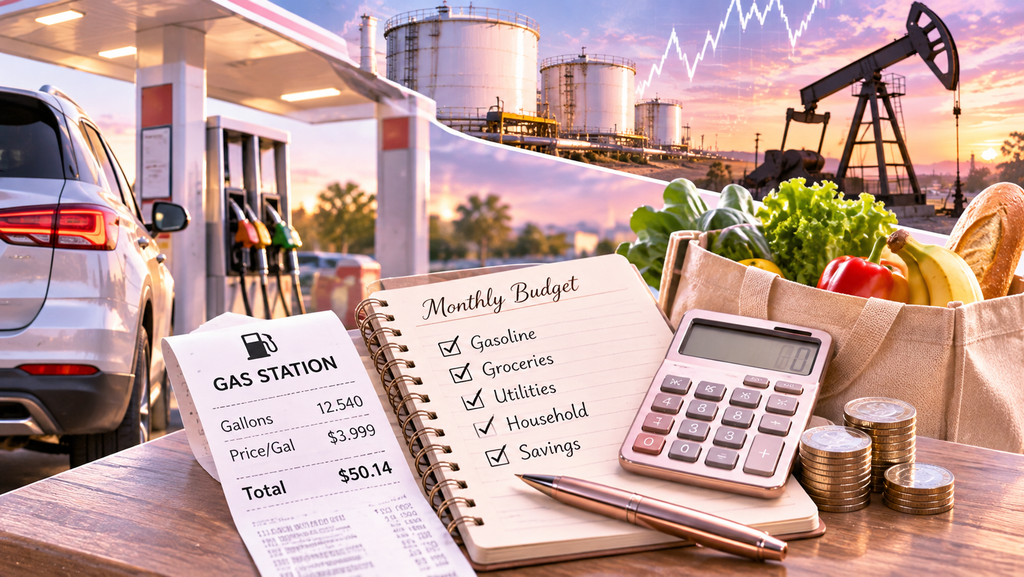
The financial impact of higher gasoline prices depends on how much fuel a household uses.
A person who drives only occasionally may experience a relatively small increase.
A family with multiple vehicles and long daily commutes may face a much larger expense.
6.1 A Practical Monthly Gasoline Budget
The table below illustrates how hypothetical gasoline price increases would affect different levels of consumption.
Table 2. Additional Monthly Gasoline Spending
| Gallons Used Monthly | $0.25 Increase | $0.50 Increase | $1.00 Increase |
|---|---|---|---|
| 20 | $5 | $10 | $20 |
| 40 | $10 | $20 | $40 |
| 60 | $15 | $30 | $60 |
| 80 | $20 | $40 | $80 |
| 100 | $25 | $50 | $100 |
These figures are illustrative calculations, not predictions about future gasoline prices.
A household using 80 gallons per month would spend an additional $40 monthly if gasoline prices increased by 50 cents per gallon.
If that increase continued for a full year, the additional expense would total $480.
For a family with limited disposable income, this could affect spending on groceries, utilities, or savings.
6.2 Why People on Fixed Incomes May Be More Vulnerable
Retirees and people living alone may have less flexibility when transportation costs increase.
Some individuals depend primarily on Social Security, pensions, or other relatively predictable income sources.
Gasoline spending can become more difficult to manage when essential expenses already consume most of the household budget.
Older adults may also need reliable transportation for medical appointments, prescriptions, groceries, and social activities.
Reducing necessary trips should not be the primary strategy for managing rising fuel costs.
Instead, households can consider combining errands, reviewing transportation alternatives, and planning a modest reserve for unexpected expenses.
6.3 Why Emergency Savings Matter
Unexpected fuel costs are one example of a broader household budgeting challenge.
The same households may also experience increased insurance premiums, utility bills, or repair expenses.
A small financial reserve can help reduce the need to rely on high-interest credit cards when costs suddenly increase.
Even modest savings accumulated consistently may improve household flexibility.
The appropriate amount depends on income, essential expenses, existing savings, and other obligations.
7. Seven Practical Ways to Reduce Gasoline Spending
Although consumers cannot control global energy markets, they can make decisions that reduce unnecessary transportation expenses.
The following strategies are especially relevant during periods of fuel price uncertainty.
7.1 Compare Prices at Convenient Gas Stations
Gasoline prices can vary between stations in the same community.
Checking several convenient locations may help identify lower prices.
However, drivers should calculate whether traveling farther eliminates potential savings.
A cheaper station is most valuable when it is already located along a regular route.
7.2 Combine Weekly Errands
Combining grocery shopping, pharmacy visits, and other necessary errands into one trip can reduce unnecessary driving.
This approach may also save time and limit vehicle wear.
People living alone may find it helpful to establish a regular weekly schedule for essential errands.
7.3 Maintain Recommended Tire Pressure
Proper tire inflation supports safe driving and efficient vehicle operation.
Drivers should follow the tire-pressure recommendation provided by the vehicle manufacturer.
The correct specification is generally displayed on the vehicle’s door-jamb label or in the owner’s manual.
Underinflated tires can increase rolling resistance and fuel consumption.
7.4 Avoid Unnecessary Idling
Long periods of unnecessary engine idling consume fuel without moving the vehicle.
Drivers can reduce avoidable fuel consumption by minimizing excessive idling when safe and practical.
Local rules and vehicle-manufacturer recommendations should also be considered.
7.5 Drive Smoothly and Maintain Your Vehicle
Aggressive acceleration, unnecessary speeding, and abrupt braking can reduce fuel efficiency.
Smooth driving habits may help lower gasoline consumption.
Routine maintenance can also support vehicle reliability.
Drivers should follow appropriate service intervals rather than purchasing unnecessary fuel-saving products.
7.6 Consider Available Transportation Alternatives
Public transit, carpooling, walking, and other alternatives may reduce fuel consumption.
However, their practicality depends on where someone lives, mobility needs, safety, and scheduling.
Not every household has convenient access to public transportation.
A transportation plan should prioritize reliable access to work, healthcare, and essential services.
7.7 Build a Small Transportation Reserve
Households can estimate their typical monthly gasoline expenses and set aside a modest additional amount when possible.
For example, a driver might reserve an extra $15 or $25 for temporary price increases.
This is not a prediction that gasoline prices will rise.
It is a budgeting strategy designed to make unexpected changes easier to manage.
8. Three Possible Oil Price Scenarios for the Months Ahead
Oil prices cannot be predicted reliably from geopolitical headlines alone.
Nevertheless, considering several possible scenarios can help consumers understand what might influence future costs.
8.1 Scenario One: Shipping Conditions Improve
If commercial oil shipments become more predictable, concerns about supply shortages may decrease.
Improved transportation could reduce logistical costs and uncertainty.
This would generally support more stable crude oil markets.
However, retail gasoline prices would still depend on refinery operations, inventories, and consumer demand.
8.2 Scenario Two: Disruptions Continue
If shipping restrictions or security risks persist, buyers may face uncertainty about future delivery schedules.
Alternative shipping routes and replacement supplies could help offset disruptions, but they may involve higher costs.
Under these conditions, energy prices could remain volatile.
Volatility does not mean prices will rise every week. Markets can experience temporary increases and declines as information changes.
8.3 Scenario Three: Global Demand Weakens
Oil demand depends partly on global economic activity.
If economic growth slows, demand for transportation fuels and industrial petroleum products may weaken.
Lower demand could partially offset supply-related price pressures.
This demonstrates why oil prices can decline even when geopolitical risks have not been completely resolved.
9. How Americans Can Monitor Oil and Gasoline Prices
Consumers do not need to track every international diplomatic announcement to understand energy-market developments.
A few reliable indicators can provide useful context.
9.1 Weekly Retail Gasoline Prices
The U.S. Energy Information Administration’s Gasoline and Diesel Fuel Update provides weekly gasoline prices and historical comparisons.
The data can help consumers identify national and regional price trends.
9.2 International Crude Oil Benchmarks
The EIA’s daily energy price data includes crude oil benchmark information.
Brent and WTI prices help illustrate how international and U.S. crude oil markets respond to changing conditions.
These prices are not the same as retail gasoline prices, but they provide useful background.
9.3 International Shipping Routes
The EIA’s analysis of global oil transportation chokepoints explains the significance of major international oil routes.
Understanding these transportation networks helps consumers interpret reports about oil shipments and supply disruptions.
9.4 Fuel Economy and Driving Habits
The U.S. Department of Energy’s FuelEconomy.gov provides information about vehicle fuel efficiency and fuel-saving practices.
For many households, improving transportation efficiency is more useful than trying to predict short-term oil prices.
Frequently Asked Questions
FAQ 1. Why do Iran oil disruptions affect U.S. gas prices?
Oil is traded through international markets, and disruptions involving major producers or transportation routes can change global crude oil prices. American refineries and fuel suppliers remain exposed to these market changes.
FAQ 2. Does the United States depend entirely on Middle Eastern oil?
No. The United States produces significant amounts of crude oil domestically and also trades petroleum internationally. However, domestic production does not completely isolate American fuel prices from changes in global crude oil markets.
FAQ 3. What is the Strait of Hormuz?
The Strait of Hormuz is a narrow maritime passage connecting the Persian Gulf with the Gulf of Oman. It is an important transportation route for crude oil and other petroleum products exported from the Middle East.
FAQ 4. Can gasoline prices fall during an international conflict?
Yes. Gasoline prices depend on multiple factors, including crude oil costs, refinery production, fuel inventories, seasonal demand, and local market conditions. Prices may decline even when international risks remain.
FAQ 5. How much would a 50-cent gasoline price increase cost a household?
A household using 60 gallons monthly would spend approximately $30 more each month. Actual spending depends on the number of gallons purchased.
FAQ 6. Can higher oil prices affect grocery prices?
Yes, potentially. Higher fuel costs can increase expenses associated with agricultural production, trucking, food processing, and distribution. However, food prices also depend on numerous other factors.
FAQ 7. Are retirees especially affected by gasoline price increases?
Some retirees may be more financially vulnerable because they depend on fixed or limited incomes. The impact varies according to driving habits, available transportation, housing location, and household savings.
FAQ 8. What is the most practical way to prepare for future gasoline price changes?
Track normal monthly fuel consumption, compare convenient gasoline stations, avoid unnecessary driving, maintain vehicle efficiency, and establish a modest transportation reserve if financially possible.
Conclusion: Understanding the Connection Between Iran and Everyday Costs
Iran oil disruptions demonstrate how international energy transportation can influence everyday life in the United States.
The Strait of Hormuz is important not only because of Iran’s own oil production but also because the waterway supports petroleum shipments from several major producing countries.
When transportation becomes unreliable, global energy markets face uncertainty.
This uncertainty can affect crude oil prices and, over time, increase pressure on gasoline, diesel, shipping, and other transportation-related costs.
However, the effects are not automatic or permanent.
Refinery conditions, inventories, international demand, alternative supplies, and changes in market expectations can all influence the outcome.
For American households, the most useful response is not to attempt to predict every oil-market movement.
Instead, families, retirees, commuters, and individuals living alone can focus on manageable financial decisions.
Tracking fuel expenses, reducing unnecessary mileage, maintaining vehicles, and planning for modest price fluctuations can help improve financial stability.
The true cost of rising energy prices cannot be measured in dollars alone. It is reflected in the families who struggle to fill their grocery carts, the workers who worry about their next paycheck, the retirees who carefully calculate every monthly expense, and the farmers who face increasingly difficult decisions about their livelihoods.
Behind every statistic is a person, a family, or a community trying to maintain financial stability.
Affordable food, secure housing, reliable employment, and the ability to live with dignity should remain central to every discussion about the economic consequences of rising energy costs.
The bottom line: International oil disruptions can influence U.S. gasoline prices, but informed budgeting and practical transportation choices can help households manage uncertainty without making decisions based on alarming headlines.
Editorial Note: This article was updated on November 10, 2026, using publicly available U.S. government energy information. Market prices change frequently. Household spending examples are illustrative and should not be interpreted as forecasts.