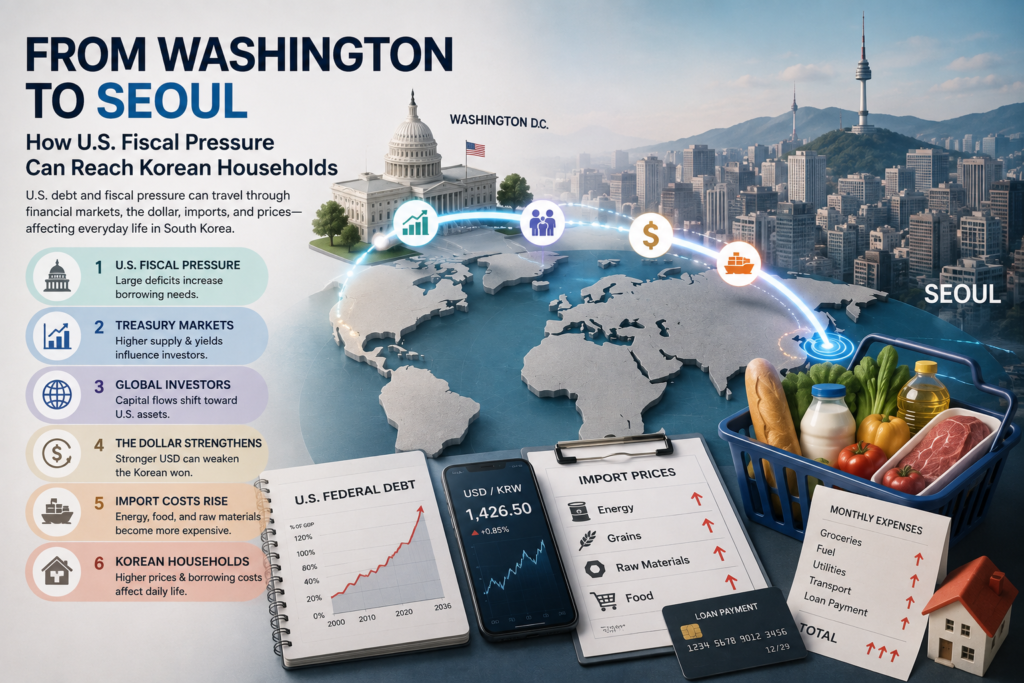
A decision about federal borrowing made in Washington may seem completely unrelated to the price of gasoline, bread, or a mortgage payment in South Korea.
Yet the global financial system connects them.
The connection does not happen overnight, and U.S. government debt does not directly determine Korean consumer prices.
Instead, financial pressure can travel through several layers:
U.S. fiscal conditions → Treasury markets → global investment → the dollar → the Korean won → import costs → Korean households.
Understanding those layers provides a better picture of how global economics can enter everyday life.
Start in Washington: The Government Needs More Financing
The Congressional Budget Office’s February 2026 baseline illustrates the scale of U.S. federal borrowing.
CBO projects a federal budget deficit of approximately $1.9 trillion in fiscal year 2026.
Debt held by the public is projected at approximately 101% of GDP in 2026 and 120% by 2036.
By 2036, CBO projects debt held by the public at roughly $56 trillion.
Net interest payments are also projected to consume a larger share of the economy, rising from approximately 3.3% of GDP in 2026 to 4.6% in 2036.
These numbers matter because persistent deficits require continued government financing.
Stage 1: Treasury Markets
The U.S. government finances deficits partly by selling Treasury securities.
Investors around the world buy these securities.
Their yields are affected by many variables, including inflation, Federal Reserve policy, economic growth, demand for safe assets, expected future interest rates, and government financing requirements.
Therefore, rising federal debt should not be treated as an automatic predictor of higher Treasury yields.
But large borrowing requirements are an important part of the financial environment investors evaluate.
Stage 2: Global Investors Respond
Now imagine an international investment fund deciding where to place its money.
If U.S. government securities offer more attractive returns, the fund may increase its exposure to American assets.
Federal Reserve research describes this financial channel: higher U.S. longer-term yields can encourage international investors to rebalance portfolios toward U.S. assets, tightening financial conditions abroad.
The dollar’s dominant position in international trade and finance makes this channel particularly important.
South Korea operates inside this system.
Stage 3: The Exchange Rate Becomes the Bridge
Suppose a Korean manufacturer needs to purchase $1 million of imported materials.
At:
$1 = ₩1,300
the currency cost is:
₩1.3 billion
At:
$1 = ₩1,450
the cost becomes:
₩1.45 billion
That is a difference of:
₩150 million.
The foreign supplier did not increase the dollar price.
The difference came entirely from the exchange rate.
This is why the USD/KRW rate can be so important for an import-dependent business.
Stage 4: Energy Can Amplify the Effect
Now consider energy.
A Korean household does not purchase crude oil directly.
But energy is hidden inside an enormous number of everyday expenses.
It powers factories.
It moves trucks.
It transports imported products.
It supports delivery networks.
It affects airlines, shipping companies, farms, restaurants, stores, and warehouses.
When the local-currency cost of imported energy increases, businesses throughout the economy can face additional expenses.
Those costs may eventually appear in consumer prices.
Stage 5: The Grocery Store
Food demonstrates how complicated this transmission can become.
According to USDA’s Foreign Agricultural Service, Korea continues to depend heavily on imported grains.
USDA estimates that Korea relies on imports for about 98% of milling wheat.
Its 2025 agricultural outlook also describes Korea as dependent on imports for approximately 99% of corn consumption.
Soybeans provide another example.
USDA’s 2025 oilseed outlook estimated that Korea would remain dependent on imports for approximately 89% of total soybean supply in the 2025/26 marketing year.
These commodities are connected to a much larger food network.
Wheat becomes flour, noodles, bread, snacks, and restaurant ingredients.
Corn can enter food processing and animal feed.
Soybeans are connected to cooking oil, food products, and livestock feed.
That means currency and commodity-price changes can travel through multiple layers before reaching the supermarket.
Stage 6: Businesses Decide Who Absorbs the Cost
An important step is often overlooked.
Higher import costs do not automatically become higher consumer prices.
A company can absorb some of the cost.
It can accept a smaller profit margin.
It can hedge currency exposure.
It can change suppliers.
It can reduce other expenses.
Or it can raise prices.
This is why exchange-rate changes and consumer inflation do not move one-for-one.
The amount passed to consumers depends on competition, contracts, inventories, demand, and the financial condition of individual companies.
Stage 7: Borrowing Costs Affect Household Budgets Differently
There is another way global financial conditions can reach households.
Interest rates determine how much borrowers pay for money.
The Bank of Korea makes monetary-policy decisions based primarily on Korean economic conditions.
However, global interest rates, currency movements, international capital flows, and imported inflation can become part of the environment policymakers must evaluate.
For households carrying debt, this can matter even without a dramatic increase in consumer prices.
Imagine a family paying a mortgage and other variable-rate debt.
If financial conditions prevent borrowing costs from declining as quickly as expected, that household has less money available each month for groceries, transportation, entertainment, and savings.
In that case, the cost-of-living problem is not simply:
“Everything became more expensive.”
It can also be:
“More of my income must go toward interest payments.”
Exporters Can Experience the Same Currency Movement Differently
A weaker won creates winners as well as losers.
Suppose a Korean exporter earns $1 million overseas.
At ₩1,300 per dollar, that revenue converts into:
₩1.3 billion
At ₩1,450:
₩1.45 billion
The company receives an additional ₩150 million in won terms before considering costs and currency hedging.
That can help some export-oriented businesses.
But suppose the same company imports large quantities of energy, components, or raw materials.
Its costs may rise at the same time.
The net effect therefore depends on the structure of the business.
Why This Matters to Ordinary Households
The most important lesson is that macroeconomic events rarely arrive at the household level under the same name.
Nobody receives a supermarket receipt with a line saying:
“U.S. federal debt surcharge.”
Instead, global financial developments appear indirectly.
They may appear as:
higher imported-product prices,
more expensive fuel,
higher transportation costs,
changes in food prices,
or borrowing costs that remain elevated.
This is why understanding the transmission mechanism matters.
Five Indicators Worth Watching
For someone trying to understand whether U.S. financial conditions are reaching Korea, five indicators are especially useful:
1. U.S. Treasury yields
They provide information about American financial conditions and investor expectations.
2. USD/KRW exchange rate
This helps show how expensive dollar-denominated imports are in Korean won.
3. International oil prices
Energy prices have broad effects throughout Korea’s economy.
4. Korean consumer inflation
This indicates whether cost pressures are reaching household prices.
5. Bank of Korea monetary policy
Interest-rate decisions influence household borrowing and savings.
No single indicator tells the entire story.
Together, however, they provide a useful economic dashboard.
Final Perspective
The U.S. national debt does not control South Korea’s economy.
Nor does every increase in federal borrowing cause the Korean won to weaken or Korean prices to rise.
The relationship is more nuanced.
But the United States occupies an extraordinary position in global finance.
Its Treasury securities are widely held around the world.
Its currency dominates large parts of international trade and finance.
Its financial conditions influence investment decisions across borders.
For an import-dependent economy such as South Korea, those global movements can eventually matter at the household level.
The journey can begin with a budget deficit in Washington.
It can pass through Treasury markets and international investment portfolios.
It can reach the foreign-exchange market.
Then it can enter Korea through energy, food, raw materials, business costs, and financial conditions.
And eventually, it can arrive somewhere much closer to home:
a grocery receipt, a gasoline bill, or a monthly loan payment.