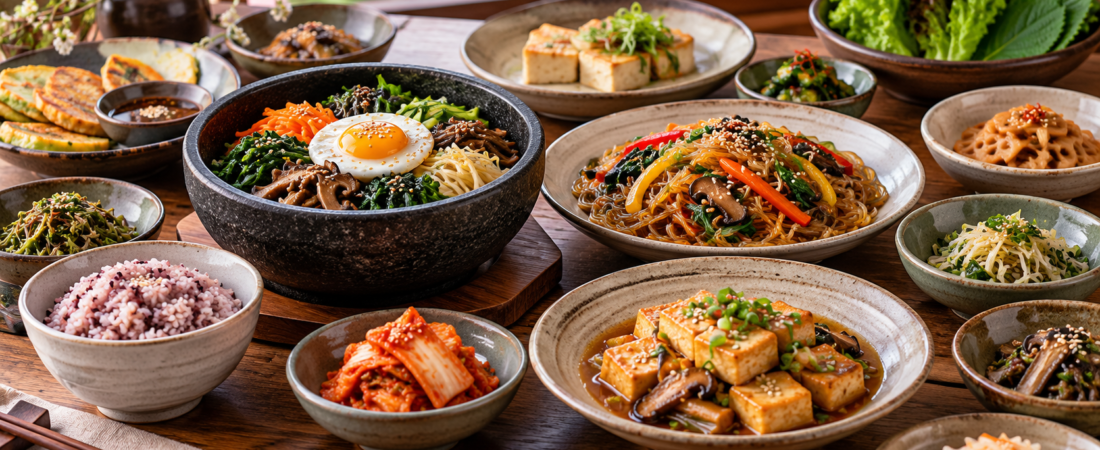
South Korea is famous for its flavorful cuisine, colorful vegetable side dishes, fermented foods, and comforting rice-based meals. From bibimbap and japchae to tofu dishes and traditional Buddhist temple cuisine, Korean food offers many exciting possibilities for travelers who prefer plant-based meals.
However, understanding vegetarian vs vegan food in Korea is essential before ordering at a restaurant.
A dish that appears completely vegetarian may contain anchovy broth, fish sauce, or fermented shrimp. A vegetable pancake may include eggs, while a seemingly simple bowl of noodles could be prepared with beef stock.
These ingredients are not always obvious from a restaurant menu or the appearance of a dish.
For American travelers who follow vegetarian or vegan diets, this can create confusion.
The good news is that South Korea offers a wide variety of vegetables, grains, tofu, mushrooms, and traditional plant-based dishes. With a little preparation, visitors can enjoy Korean cuisine while respecting their dietary preferences.
This comprehensive guide explains the differences between vegetarian and vegan food in Korea, identifies ingredients to watch for, compares popular Korean dishes, and provides useful Korean phrases for ordering meals confidently.
What Is the Difference Between Vegetarian and Vegan Food?
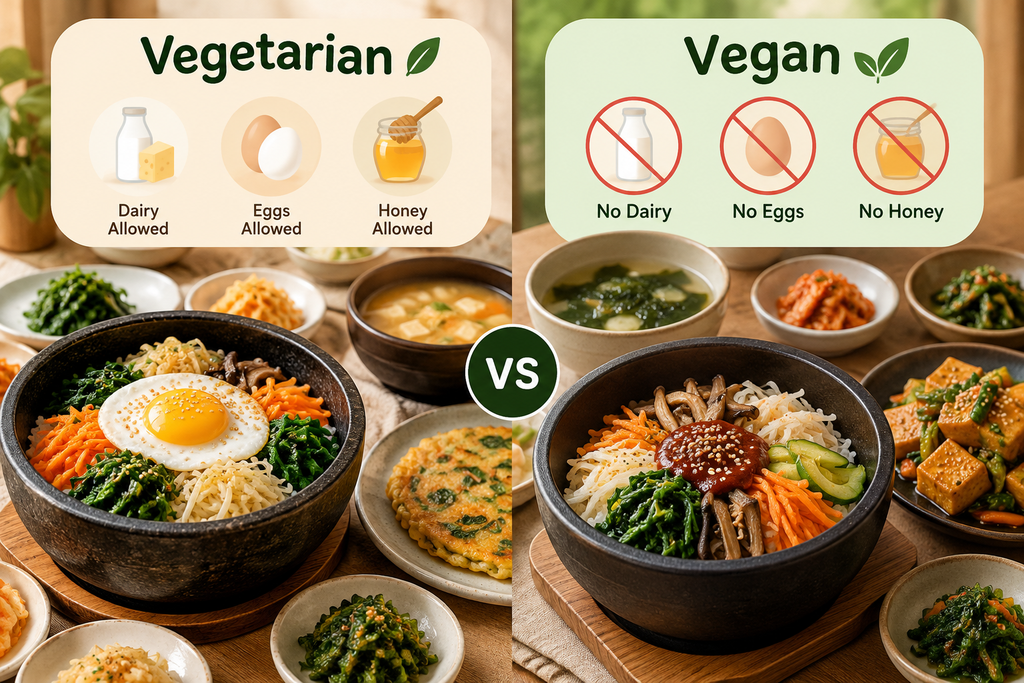
Although vegetarian and vegan diets share several characteristics, they are not identical.
Both typically exclude meat, poultry, and seafood. However, the main difference involves other ingredients derived from animals.
What Does Vegetarian Mean?
A vegetarian generally avoids eating meat, poultry, fish, and seafood.
However, different types of vegetarian diets may include certain animal-derived products.
For example, a lacto-ovo vegetarian eats dairy products and eggs, while a lacto-vegetarian consumes dairy but avoids eggs.
An ovo-vegetarian eats eggs but excludes dairy products.
A pescatarian eats fish and seafood but is not generally classified as vegetarian in the strict sense.
This distinction is particularly important when ordering food in South Korea because fish and seafood ingredients frequently appear in traditional Korean cooking.
What Does Vegan Mean?
A vegan diet excludes all foods derived from animals.
This includes meat, poultry, fish, seafood, eggs, milk, cheese, butter, honey, and animal-derived gelatin.
Veganism can also extend beyond food choices to clothing, cosmetics, and other everyday products.
According to The Vegan Society, veganism involves avoiding animal-derived products as far as possible and practicable.
For visitors to Korea, following a vegan diet often requires more detailed ingredient questions than following a lacto-ovo vegetarian diet.
Vegetarian vs. Vegan Food Comparison
| Food ingredient | Lacto-ovo vegetarian | Vegan |
|---|---|---|
| Vegetables and fruit | Yes | Yes |
| Rice and grains | Yes | Yes |
| Tofu and beans | Yes | Yes |
| Eggs | Yes | No |
| Milk and cheese | Yes | No |
| Honey | Usually yes | No |
| Fish and seafood | No | No |
| Anchovy broth | No | No |
| Fish sauce | No | No |
| Meat-based broth | No | No |
The table illustrates an important point: a vegetarian dish is not automatically vegan.
For example, bibimbap made with vegetables, rice, and an egg may be suitable for a lacto-ovo vegetarian but not for a vegan.
Removing the egg could make the dish vegan if the remaining ingredients, sauces, and cooking preparations contain no animal products.
Why Is Ordering Vegetarian or Vegan Food in Korea Sometimes Difficult?
Korean cuisine uses vegetables extensively, but not every vegetable-based dish is vegetarian.
Traditional Korean cooking often combines plant-based ingredients with small amounts of seafood or meat-derived seasonings.
These ingredients provide savory flavors and are sometimes difficult to identify by looking at the finished meal.
The Korea Tourism Organization’s vegetarian dining guide recommends clearly explaining dietary requirements because many restaurants do not offer dedicated vegetarian menus.
1. Hidden Seafood Ingredients
Fish sauce, known as aekjeot (액젓), is commonly used in Korean cooking.
It often appears in kimchi, sauces, and vegetable side dishes.
Fermented salted shrimp, called saeujeot (새우젓), is another important ingredient.
Although these seasonings are used in small quantities, they make the dish unsuitable for vegetarians who exclude seafood and for vegans.
2. Animal-Based Broths
Many Korean soups and stews begin with a flavorful broth.
Common broth ingredients include dried anchovies, beef bones, chicken, and seafood.
Even when a soup contains only vegetables and tofu, the broth may not be vegetarian.
For example, some versions of doenjang jjigae use anchovy stock to create a rich, savory taste.
A restaurant may be able to prepare an alternative using water, mushrooms, or seaweed broth, but this needs to be confirmed before ordering.
3. Eggs and Dairy Products
Eggs appear in many popular Korean dishes, including bibimbap, gimbap, and certain pancakes.
Modern Korean restaurants also use cheese, milk, cream, and butter in dishes influenced by Western cuisine.
Vegetarians who consume eggs and dairy may find these dishes acceptable.
Vegans should specifically ask restaurants to exclude these ingredients.
4. Restaurant Communication
Language differences can make dietary restrictions difficult to explain.
For example, saying that you do not eat meat may not automatically communicate that you also avoid anchovies, shrimp, fish sauce, or broth made from animals.
A clearer approach is to describe the exact ingredients you cannot eat.
Learning a few basic Korean expressions makes this process much easier.
Hidden Animal Ingredients in Popular Korean Foods
Understanding hidden ingredients is one of the most important aspects of finding vegetarian vs vegan food in Korea.
Here are several ingredients travelers should recognize.
| Korean name | English meaning | Where it may appear |
|---|---|---|
| 멸치육수 | Anchovy broth | Soups, stews, noodles |
| 액젓 | Fish sauce | Kimchi, seasonings |
| 새우젓 | Salted fermented shrimp | Kimchi, stews |
| 굴소스 | Oyster sauce | Stir-fried dishes |
| 사골육수 | Beef bone broth | Soups and noodles |
| 계란 | Egg | Bibimbap, gimbap |
| 우유 | Milk | Drinks, desserts |
| 치즈 | Cheese | Modern Korean dishes |
| 꿀 | Honey | Sauces, tea, desserts |
| 젤라틴 | Gelatin | Some desserts and sweets |
Why These Ingredients Matter
The amount of an animal-derived ingredient does not determine whether a dish is vegetarian or vegan.
Even a small quantity of fish sauce makes a dish unsuitable for a strict vegetarian who avoids fish.
Similarly, a dessert containing gelatin derived from animals is not vegan, regardless of whether its main ingredients are fruit or plant-based.
Travelers should check both visible ingredients and seasonings.
Is Korean Kimchi Vegetarian or Vegan?

Kimchi is one of Korea’s most famous foods.
It is usually made by fermenting vegetables such as napa cabbage or radish with seasonings.
Because the main ingredients are vegetables, many international travelers assume that kimchi is automatically vegetarian.
However, that assumption can be incorrect.
Traditional Kimchi Ingredients
Many traditional kimchi recipes contain fish sauce or salted fermented shrimp.
These ingredients help create the complex savory flavor associated with fermented kimchi.
As a result, traditional kimchi is frequently unsuitable for vegetarian and vegan diets.
Can Kimchi Be Vegan?
Yes. Vegan kimchi can be made without fish sauce, salted shrimp, or other animal-derived ingredients.
Plant-based recipes may use soy sauce, seaweed stock, mushrooms, and other vegetable seasonings.
Some restaurants and packaged-food companies specifically offer vegan kimchi.
Look for labels such as:
- 비건 김치 — Vegan kimchi
- 채식 김치 — Vegetarian kimchi
- 젓갈 없음 — No salted fermented seafood
When purchasing packaged kimchi, check the complete ingredients rather than relying only on the product name.
Practical tip: If you are served kimchi as a complimentary side dish, ask whether it contains fish sauce or salted shrimp before eating it.
Is Bibimbap Vegetarian or Vegan?
Bibimbap is one of the easiest traditional Korean meals to adapt to different dietary preferences.
The dish typically combines rice with assorted vegetables, seasonings, and sometimes meat or eggs.
Vegetarian Bibimbap
A lacto-ovo vegetarian may be able to enjoy bibimbap with vegetables and eggs, provided that no meat, fish sauce, or animal-based seasoning is used.
Ask the restaurant to remove the meat and confirm the ingredients in the vegetables and sauce.
Vegan Bibimbap
For vegan bibimbap, request that the dish contain no meat, eggs, dairy, seafood, or animal-derived seasonings.
A simple vegan version can include rice, spinach, carrots, mushrooms, bean sprouts, zucchini, and plant-based gochujang.
Gochujang is often made from chili peppers, fermented grains, soybean ingredients, and sweeteners, but sauces and commercial formulations vary.
Check the product or restaurant recipe before assuming it is vegan.
What About Dolsot Bibimbap?
Dolsot bibimbap is served in a hot stone bowl.
The bowl helps create a crispy layer of rice and keeps the meal warm.
The cooking format itself does not determine whether the dish is vegetarian or vegan.
Travelers should still check the toppings, sauces, and any oil or cooking fat used.
Is Japchae Vegetarian or Vegan?
Japchae is a popular Korean noodle dish made with sweet potato starch noodles.
It is commonly prepared with vegetables, mushrooms, sesame oil, soy sauce, and other seasonings.
Many traditional restaurant versions also include beef.
Vegetarian Japchae
Japchae can be suitable for vegetarians when the meat is omitted and the other ingredients are free from fish or meat-derived seasonings.
The noodles themselves are generally made from plant-based starch.
Vegan Japchae
Japchae can also be vegan when prepared entirely with plant-based ingredients.
Ask whether the restaurant uses beef, oyster sauce, meat broth, or other animal-derived seasonings.
A vegan japchae dish made with mushrooms, spinach, onions, and carrots can be both satisfying and flavorful.
However, it is important to verify the recipe because ingredients differ among restaurants.
Are Korean Vegetable Pancakes Vegan?
Korean vegetable pancakes, often called yachaejeon (야채전), can appear to be an ideal vegan meal.
They usually contain vegetables mixed into a flour-based batter and cooked in a pan.
However, some recipes include eggs, seafood, or animal-derived broth.
Vegetarian Pancakes
Vegetable pancakes made with flour, water, vegetables, and eggs may be suitable for lacto-ovo vegetarians.
They are not vegan if eggs are included.
Vegan Pancakes
A vegan pancake should be made with plant-based ingredients only.
Request a batter without eggs, milk, seafood, or animal-based stock.
Also check the dipping sauce, since some sauces may contain fish-derived seasonings.
A pancake made from flour, water, vegetables, and vegetable oil can be a delicious plant-based option.
Which Korean Foods Can Be Vegetarian or Vegan?
South Korea offers numerous dishes that can be adapted for vegetarian or vegan diets.
However, their suitability depends on the ingredients used by the restaurant.
| Korean dish | Vegetarian possibility | Vegan possibility | What to check |
|---|---|---|---|
| Bibimbap | Yes, with modifications | Yes, with modifications | Meat, egg, sauce |
| Japchae | Yes | Yes | Beef, oyster sauce |
| Vegetable gimbap | Yes | Yes, with modifications | Egg, ham, surimi |
| Dubu jorim | Yes | Yes | Seafood seasonings |
| Yachaejeon | Yes | Yes, egg-free | Egg, stock, seafood |
| Doenjang jjigae | Yes, if adapted | Yes, if adapted | Anchovy broth |
| Kimchi | Recipe-dependent | Recipe-dependent | Fish sauce, shrimp |
| Tteokbokki | Recipe-dependent | Recipe-dependent | Fish cakes, broth |
| Kongguksu | Often possible | Often possible | Toppings, additives |
| Temple cuisine | Usually suitable | Frequently suitable | Dairy and recipe details |
Vegetable Gimbap
Gimbap consists of rice and fillings wrapped in dried seaweed.
Vegetable versions may contain carrots, spinach, pickled radish, cucumber, and other vegetables.
However, the word “vegetable” does not guarantee that the roll contains no eggs, ham, imitation crab, or dairy.
Ask to confirm every filling.
Dubu Jorim
Dubu jorim is a Korean braised tofu dish often prepared with soy sauce, chili flakes, garlic, and other seasonings.
It can be vegan when cooked without animal-derived ingredients.
Some versions contain seafood-based seasonings, so always ask.
Kongguksu
Kongguksu is a chilled noodle dish traditionally served in a creamy soybean broth.
It can be a promising plant-based option because the rich broth may come entirely from soybeans.
Nevertheless, confirm the noodle ingredients, toppings, and whether any dairy or animal-based additions are used.
What Is Korean Buddhist Temple Food?

One of the most interesting parts of Korea’s culinary culture is Buddhist temple cuisine, known as sachal eumsik (사찰음식).
Temple food reflects Buddhist traditions emphasizing simplicity, mindful eating, respect for living beings, and seasonal ingredients.
It frequently highlights vegetables, mushrooms, tofu, grains, seaweed, nuts, seeds, and fermented soybean products.
Why Temple Food Is Popular With Plant-Based Travelers
Korean temple cuisine generally avoids meat and seafood and emphasizes plant-based preparations.
However, traditional practice does not necessarily establish that every temple-food meal is strictly vegan.
The Korea Tourism Organization notes that dairy can be an exception in temple-food traditions, so strict vegans should verify individual dishes.
What Makes Temple Food Different?
Korean Buddhist temple cuisine traditionally avoids the five pungent vegetables, often called oshinchae.
These include garlic, green onions, chives, wild chives, and Chinese squill.
Many temple cooks instead build flavor through ingredients such as mushrooms, kelp, perilla seeds, and fermented sauces.
This creates meals with distinctive flavors that differ from some everyday Korean restaurant dishes.
Is Temple Food Worth Trying?
Absolutely.
For visitors interested in Korean culture, a temple-food meal provides more than a plant-based alternative.
It offers an opportunity to experience Korean culinary traditions through seasonal vegetables, careful preparation, and a mindful approach to eating.
A temple-food restaurant can be a particularly appealing choice when traveling with vegetarians and nonvegetarians who want to explore Korean cuisine together.
How to Order Vegetarian Food in Korean Restaurants
Learning a few Korean phrases can make ordering much easier.
Even if a restaurant has an English menu, the descriptions may not provide complete ingredient information.
The following expressions can help travelers explain their dietary needs.
Essential Korean Phrases for Vegetarians
| Korean | English |
|---|---|
| 저는 채식주의자예요. | I am vegetarian. |
| 고기 없이 만들어 주세요. | Please make it without meat. |
| 생선이나 해산물은 먹지 않아요. | I do not eat fish or seafood. |
| 이 음식에 고기가 들어가나요? | Does this dish contain meat? |
| 멸치 육수가 들어가나요? | Does it contain anchovy broth? |
| 계란은 먹을 수 있어요. | I can eat eggs. |
Essential Korean Phrases for Vegans
| Korean | English |
|---|---|
| 저는 비건이에요. | I am vegan. |
| 동물성 재료는 먹지 않아요. | I do not eat animal-derived ingredients. |
| 계란이나 유제품도 먹지 않아요. | I also do not eat eggs or dairy products. |
| 액젓이나 새우젓이 들어가나요? | Does it contain fish sauce or salted shrimp? |
| 채소 육수로 만들 수 있나요? | Can you make it with vegetable broth? |
| 꿀도 빼 주세요. | Please leave out honey as well. |
A Practical Vegan Ordering Card
Travelers who cannot easily communicate in Korean can save the following message on their phones.
Korean Vegan Restaurant Card Copy
안녕하세요. 저는 비건이라서 고기, 생선, 해산물, 멸치육수, 액젓, 새우젓, 계란, 우유, 치즈, 꿀 등 동물성 재료를 먹지 않습니다. 육수와 양념에도 동물성 재료가 들어가지 않는 음식을 주문할 수 있을까요? 감사합니다.
Hello. I am vegan, so I do not eat animal-derived ingredients, including meat, fish, seafood, anchovy broth, fish sauce, salted shrimp, eggs, milk, cheese, or honey. Could I order a meal without these ingredients, including in the broth and seasonings? Thank you.
This message is more specific than simply requesting a meat-free meal.
It helps restaurant staff understand that animal-derived broths and seasonings are also excluded.
If staff cannot confirm whether a dish meets your requirements, choose another dish rather than assuming the ingredients are suitable.
How to Find Vegetarian and Vegan Restaurants in South Korea
Finding appropriate restaurants becomes easier when travelers understand where and how to search.
Major cities such as Seoul and Busan offer a mix of traditional restaurants, specialty plant-based establishments, international dining options, and cafes.
However, availability and menu choices vary significantly by neighborhood.
1. Search for Dedicated Vegan Restaurants
Dedicated vegan restaurants can reduce the uncertainty associated with hidden animal ingredients.
When searching on Korean map services, useful Korean terms include:
- 비건 식당 — Vegan restaurant
- 채식 식당 — Vegetarian restaurant
- 비건 카페 — Vegan cafe
- 사찰음식 — Buddhist temple food
- 비건 베이커리 — Vegan bakery
Search results and restaurant descriptions should still be reviewed carefully.
A restaurant offering vegan options is not necessarily an entirely vegan establishment.
2. Check Restaurant Menus Before Visiting
If possible, examine a restaurant’s menu before arriving.
Look for clear ingredient descriptions, vegan menu symbols, or information about substitutions.
Photographs of restaurant menus can sometimes provide useful clues, but photographs alone cannot confirm whether a dish contains animal-derived seasonings.
3. Consider Traditional Temple-Food Restaurants
Specialty temple-food restaurants are another option for travelers interested in vegetable-centered meals.
Many offer thoughtfully prepared dishes featuring mushrooms, grains, wild greens, and tofu.
Some provide multi-course dining experiences that introduce visitors to unfamiliar Korean ingredients and cooking techniques.
For strictly vegan diners, confirm whether dairy or other animal-derived ingredients are used.
4. Ask About Menu Modifications
Some restaurants may agree to remove meat or eggs from a dish.
However, not every dish can be modified.
For example, if a soup’s main broth was prepared using beef bones or anchovies earlier in the day, removing visible meat will not make it vegetarian.
Choosing a dish that is prepared with a vegetable-based broth from the beginning is often more practical.
5. Keep a Backup Meal Option
Traveling with dietary restrictions becomes less stressful when you have a backup plan.
Plain rice, fresh fruit, nuts, tofu, and packaged foods with verified ingredients can be useful when restaurant options are limited.
Supermarkets and convenience stores may carry plant-based items, but travelers should read ingredient labels carefully.
How to Read Korean Food Labels for Vegan Ingredients

Supermarkets can be helpful for vegetarians and vegans traveling in South Korea.
Packaged foods often provide ingredient lists in Korean, allowing shoppers to identify potentially unsuitable ingredients.
However, travelers unfamiliar with Hangul may find these labels difficult to understand.
Important Korean Label Terms
| Korean word | English meaning |
|---|---|
| 원재료명 | Ingredients |
| 비건 | Vegan |
| 채식 | Vegetarian or plant-based diet |
| 우유 | Milk |
| 계란 / 달걀 | Egg |
| 생선 | Fish |
| 새우 | Shrimp |
| 멸치 | Anchovy |
| 쇠고기 / 소고기 | Beef |
| 돼지고기 | Pork |
| 닭고기 | Chicken |
| 꿀 | Honey |
| 젤라틴 | Gelatin |
A product displaying vegetables on its packaging is not necessarily vegan.
For example, vegetable-flavored instant noodles may contain powdered meat extracts or seafood-based seasonings.
Similarly, a snack may contain butter, milk powder, or other animal-derived ingredients.
When ingredient details are unclear, products carrying a credible vegan certification can provide greater assurance.
What About Allergen Statements?
Korean packaged foods may include allergen information separate from the ingredient list.
These statements are useful for identifying certain ingredients, but they should not be treated as proof that a product is vegan.
A vegan assessment requires examining the complete formulation, including ingredients that may not be major allergens.
If you have a food allergy in addition to following a vegan or vegetarian diet, explain the allergy separately to restaurant staff.
A dish suitable for vegans is not automatically free from allergens or cross-contact.
Vegetarian vs. Vegan Food in Korea: Dining Costs and Budget Tips
The cost of eating vegetarian or vegan food in South Korea depends on several factors.
Location, restaurant type, portion size, and specialty ingredients can influence the final price.
Traditional Korean Restaurants
Traditional restaurants may offer affordable rice, tofu, and vegetable-based dishes.
However, budget-friendly does not automatically mean vegetarian-friendly.
Meals prepared with inexpensive anchovy stock or seafood seasonings may still be unsuitable.
Specialty Vegan Restaurants
Restaurants serving exclusively vegan meals may use special substitutes, imported ingredients, and more labor-intensive preparations.
Some specialty meals may cost more than ordinary local restaurant dishes.
Nevertheless, these restaurants can offer convenience and peace of mind for travelers who want clearly identified plant-based food.
Grocery Shopping
Shopping at supermarkets can help travelers manage food expenses.
Rice, tofu, vegetables, fruit, seaweed, and beans are useful ingredients for assembling simple meals.
Accommodation with kitchen facilities can make a vegetarian or vegan trip easier, especially for longer stays.
How to Save Money
Rather than relying entirely on specialty restaurants, combine verified traditional dishes with supermarket meals.
For example, breakfast might consist of fruit, plain oatmeal, and soy milk with confirmed vegan ingredients.
Lunch could be a modified vegetable bibimbap.
Dinner might be enjoyed at a temple-food restaurant or another establishment offering clearly identified vegan dishes.
This approach provides variety without requiring expensive specialty dining for every meal.
Common Mistakes Vegetarian and Vegan Travelers Make in Korea
Even experienced international travelers can misunderstand Korean restaurant ingredients.
Avoiding the following mistakes can make dining more comfortable.
Mistake 1: Assuming That No Visible Meat Means Vegetarian
A meal without visible meat may still contain anchovy broth, fish sauce, or oyster sauce.
Always ask about the complete recipe.
Mistake 2: Assuming That Every Vegetable Dish Is Vegan
Vegetable dishes sometimes include eggs, dairy, shrimp paste, or animal-derived seasonings.
The word “vegetable” describes a main ingredient, not necessarily every ingredient.
Mistake 3: Assuming That Kimchi Is Always Plant-Based
Kimchi frequently contains seafood-derived ingredients.
Choose verified vegan kimchi when following a strict plant-based diet.
Mistake 4: Forgetting About Side Dishes
Korean restaurants commonly serve banchan, or small side dishes, alongside the main meal.
These may include seasoned vegetables, kimchi, fish-based dishes, or other preparations.
Each side dish should be considered separately.
Even if your main dish is vegan, the entire table may not be.
Mistake 5: Relying Only on English Menu Descriptions
English translations sometimes provide a simplified description of the meal.
For example, “vegetable soup” may not explain what type of broth was used.
Asking specific ingredient questions is more reliable than relying solely on the English dish name.
Mistake 6: Expecting Every Restaurant to Modify Its Recipes
Some restaurants prepare broth, sauces, and vegetable side dishes in large batches before customers arrive.
It may not be possible to remove an animal-derived ingredient after preparation.
Respectfully asking whether an alternative is available usually works better than requesting an impossible modification.
Sample One-Day Vegetarian and Vegan Meal Plans in Korea
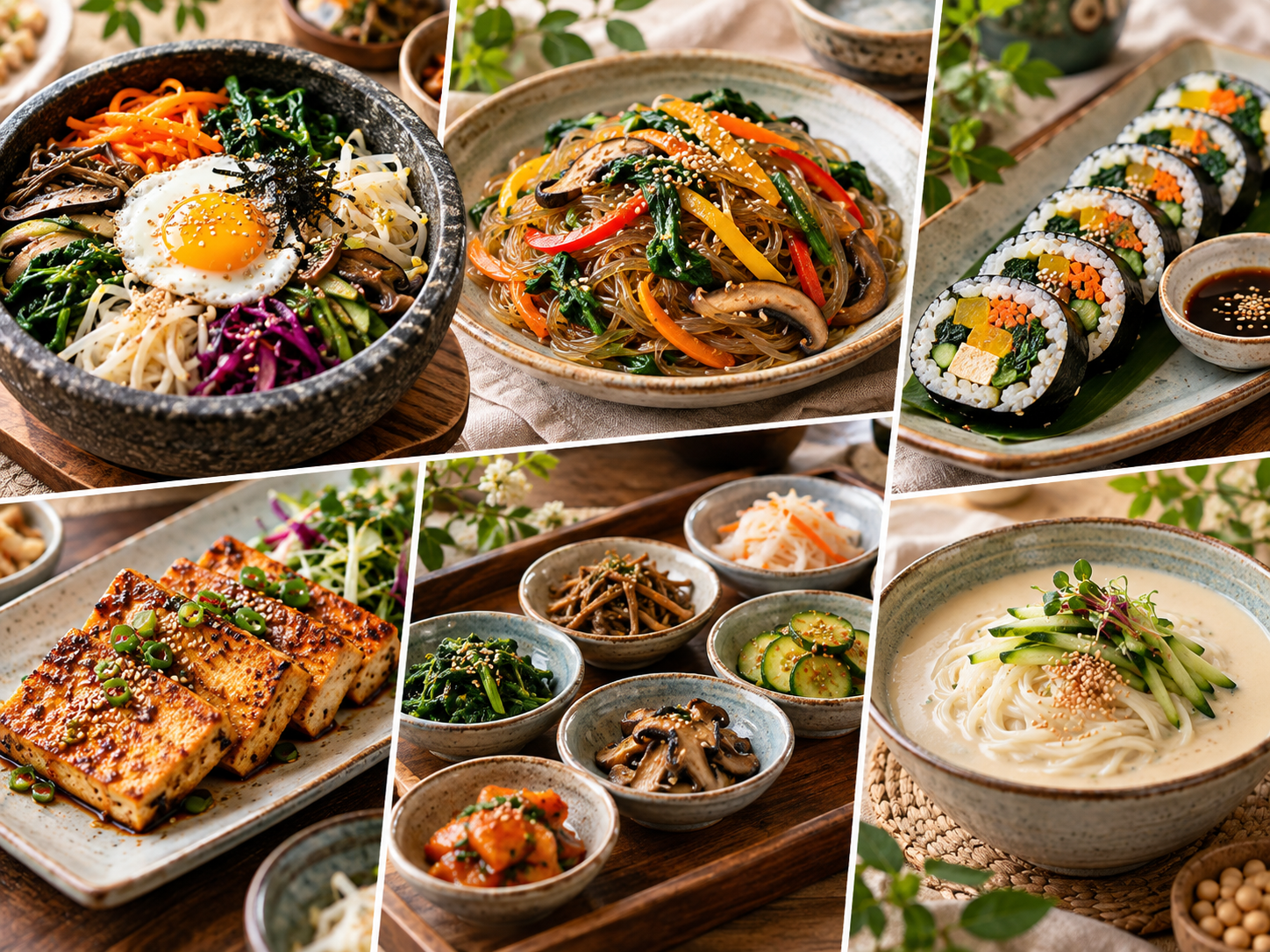
Understanding ingredients is important, but it is equally helpful to imagine what a full day of plant-based eating might look like.
The following meal plans provide examples rather than guarantees about restaurant recipes.
Sample Vegetarian Meal Plan
Breakfast: Toast with eggs, fresh fruit, and coffee or tea.
Lunch: Bibimbap with vegetables and eggs, prepared without meat, fish sauce, or animal-based broth.
Afternoon snack: A pastry or dessert confirmed to contain no meat-derived gelatin or other unsuitable ingredients.
Dinner: Japchae without beef, served with rice and verified vegetarian side dishes.
This meal plan is intended for a lacto-ovo vegetarian who consumes eggs and dairy.
Sample Vegan Meal Plan
Breakfast: Plain oatmeal with plant-based milk, fresh fruit, and nuts.
Lunch: Bibimbap made without meat, eggs, dairy, seafood, or animal-based sauces.
Afternoon snack: Fresh fruit, roasted sweet potato, or a verified vegan packaged snack.
Dinner: A plant-based Korean temple-food meal featuring grains, seasonal vegetables, mushrooms, tofu, and other verified vegan ingredients.
These sample meals demonstrate that Korean dining can be varied and satisfying even when animal products are excluded.
The essential requirement is to verify ingredients rather than rely only on a dish’s appearance.
Is South Korea a Good Destination for Vegetarian and Vegan Travelers?
South Korea can be a rewarding destination for vegetarian and vegan travelers, particularly those willing to explore its traditional vegetable-centered dishes.
Korean cuisine includes a wide range of plant ingredients, from mushrooms and leafy greens to soybeans, rice, sesame seeds, seaweed, and fermented vegetables.
The country’s Buddhist temple-food tradition is especially valuable for travelers interested in plant-forward cooking and Korean cultural heritage.
At the same time, animal-derived broths and fermented seafood seasonings are common in everyday restaurant meals.
Strict vegans may need to plan more carefully than travelers who simply prefer eating less meat.
The best approach combines curiosity, preparation, and respectful communication.
Before ordering, focus on three questions:
- Does the dish contain meat, fish, seafood, or animal-based broth?
- Does the seasoning contain fish sauce, salted shrimp, oyster sauce, or another animal-derived ingredient?
- For vegan meals, are eggs, dairy, honey, and other animal-derived ingredients excluded?
Answering these questions can prevent most common misunderstandings.
Frequently Asked Questions About Vegetarian vs. Vegan Food in Korea
1. Is it easy to find vegan food in South Korea?
It is possible, particularly in larger cities and at dedicated vegan or temple-food restaurants. However, many traditional dishes contain animal-derived broths or seasonings, so checking ingredients remains important.
2. Is Korean kimchi vegan?
Not always. Many traditional kimchi recipes contain fish sauce or salted shrimp. Vegan kimchi is available, but shoppers and diners should confirm the ingredients.
3. Can vegetarians eat bibimbap in Korea?
Yes, when it is prepared without meat, seafood, or animal-based seasonings. Lacto-ovo vegetarians may consume the egg, while vegans need to request an egg-free version.
4. Is japchae naturally vegan?
Not necessarily. Although sweet potato noodles are generally plant-based, japchae can contain beef, oyster sauce, or other animal-derived ingredients. A verified plant-based version can be vegan.
5. Are Korean vegetable pancakes vegan?
Some are, but others contain eggs, seafood, or animal-based broth. Ask about the batter, cooking ingredients, and dipping sauce.
6. Does Korean tofu soup contain meat?
Some tofu soups contain meat, seafood, anchovy broth, or other animal-derived ingredients. The presence of tofu does not automatically make the soup vegetarian or vegan.
7. Is Korean temple food always vegan?
No. Temple cuisine generally emphasizes plant-based ingredients and avoids meat and seafood, but dairy can be an exception. Strict vegans should verify each preparation.
8. Can vegans eat tteokbokki?
Vegan tteokbokki is possible, but ordinary restaurant versions may contain fish cakes, anchovy broth, or animal-based seasonings. Rice cakes and sauce ingredients should both be checked.
9. What is the best Korean phrase for ordering vegan food?
“저는 비건이에요. 동물성 재료는 먹지 않아요.”
This means, “I am vegan. I do not eat animal-derived ingredients.”
It is helpful to mention fish sauce, anchovy broth, eggs, and dairy separately.
10. Are Korean convenience stores good for vegetarians and vegans?
They can be useful for simple snacks and packaged foods, but ingredients must be checked. Products containing vegetables or labeled with vegetable flavors are not automatically vegan.
Final Thoughts: Enjoying Korean Food as a Vegetarian or Vegan
Understanding the differences between vegetarian and vegan food in Korea can transform the dining experience for international travelers.
The biggest challenge is not necessarily finding vegetables, tofu, or rice. It is recognizing animal-derived ingredients that may be hidden in broth, sauces, kimchi, and side dishes.
Vegetarians who consume eggs and dairy may have more flexibility when ordering traditional Korean dishes.
Vegans need to check additional ingredients, including eggs, milk, honey, and animal-derived cooking products.
Fortunately, with a little knowledge and preparation, visitors can explore many delicious aspects of Korean cuisine.
Learning useful Korean phrases, choosing suitable restaurants, and understanding traditional cooking methods can help travelers enjoy Korean food while staying consistent with their dietary preferences.
Whether you are trying your first vegetable bibimbap, exploring vegan kimchi, or experiencing Korean Buddhist temple food, South Korea offers many opportunities to discover enjoyable plant-based meals.
The most important rule is simple: never judge whether a Korean dish is vegetarian or vegan by appearance alone. Always check the broth, seasonings, and ingredients before ordering.