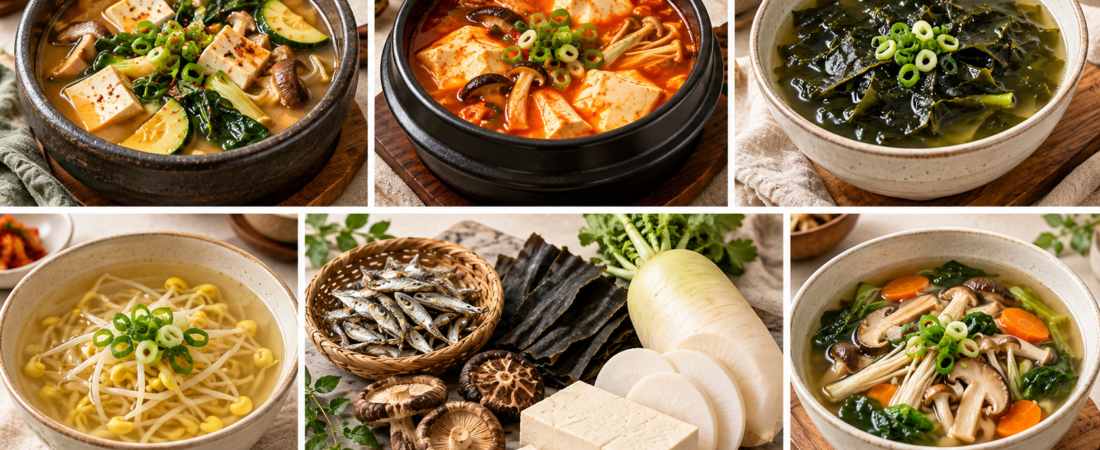
Korean soups are famous for their comforting flavors, nutritious vegetables, fermented seasonings, and warming broths. From soybean paste soup to soft tofu stew, these dishes are an essential part of everyday dining in South Korea.
But are Korean soups vegetarian?
The answer is not always straightforward.
Although many Korean soups contain tofu, mushrooms, seaweed, spinach, radish, or other vegetables, they may also contain ingredients derived from fish, shellfish, meat, or animal bones. These ingredients are sometimes difficult to recognize because they are dissolved into the broth rather than served as visible pieces of meat.
A bowl of soup that appears completely plant-based may have been prepared with dried anchovies, beef stock, fish sauce, salted shrimp, or seafood extracts.
For vegetarian travelers, this creates an important challenge: identifying what is inside a soup before ordering it.
The Korea Tourism Organization specifically advises vegetarian visitors to check soup and stew ingredients because meat and fish broths are frequently used in Korean cooking.
Fortunately, enjoying vegetarian Korean soup is possible. Understanding traditional cooking methods, learning a few Korean phrases, and knowing which dishes are easier to adapt can make dining much more enjoyable.
This guide explains the hidden ingredients found in Korean soups, which popular dishes may contain animal products, how to request vegetarian alternatives, and practical ways to enjoy Korean food without accidentally consuming meat or seafood.
Why Are Korean Soups Not Always Vegetarian?
Korean cuisine includes a remarkable variety of plant-based ingredients.
Vegetables such as napa cabbage, radish, spinach, zucchini, mushrooms, and bean sprouts are commonly used in soups.
Tofu and fermented soybean paste also appear in many traditional recipes.
Because these ingredients are plant-based, international visitors may assume that soups containing them are automatically vegetarian.
However, Korean cooking frequently depends on broth for flavor.
A traditional soup may begin with dried anchovies simmered in water. After the anchovies are removed, vegetables and tofu are added.
The finished dish might contain no visible fish, but the broth still comes from an animal source.
Other recipes use beef bones, pork stock, clams, or fermented seafood seasonings.
This is why identifying individual vegetables is not enough.
Vegetarian travelers need to understand how a soup was prepared from the beginning.
The Difference Between Vegetarian Ingredients and Vegetarian Preparation
Consider two bowls of soybean paste soup.
Both contain zucchini, mushrooms, tofu, onions, and fermented soybean paste.
The first bowl is prepared with water, dried kelp, and shiitake mushrooms.
The second bowl contains the same vegetables but uses anchovy stock.
Visually, the dishes may appear identical.
However, only the first bowl qualifies as vegetarian, assuming its remaining ingredients are also animal-free.
The difference comes from the preparation method rather than the visible toppings.
This distinction applies to many Korean soups and stews.
7 Hidden Animal Ingredients in Korean Soups
Understanding the most common hidden ingredients makes it easier to recognize which soups require additional questions.
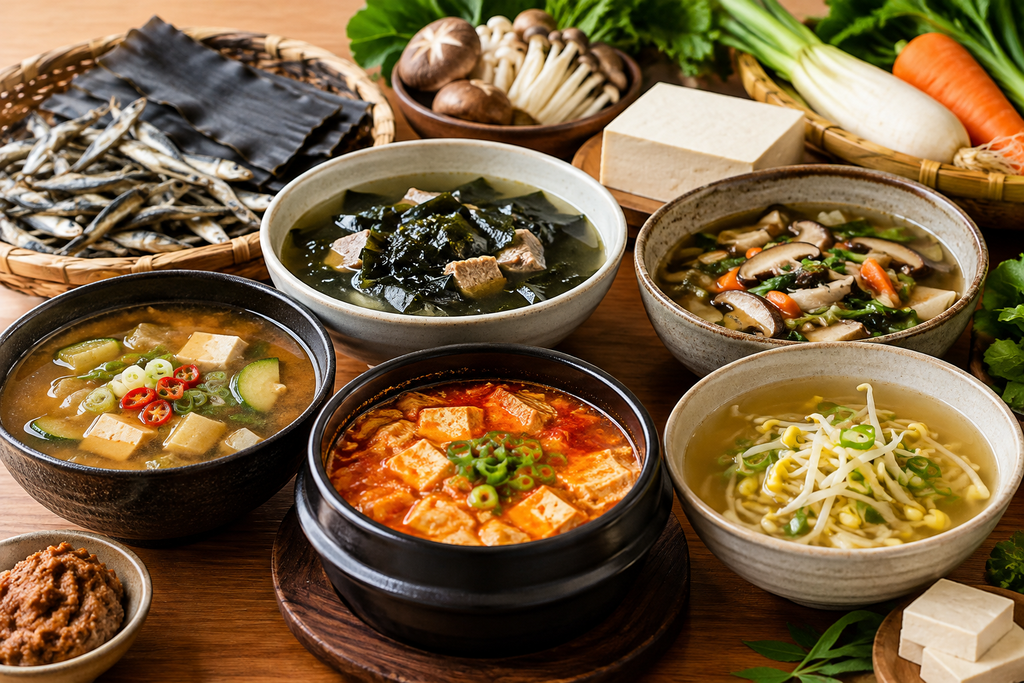
1. Dried Anchovy Broth (멸치육수)
Dried anchovies are widely used to prepare savory stock.
In Korean, anchovy is called myeolchi (멸치), while broth or stock is called yuksu (육수).
Anchovy broth is often made by simmering dried anchovies with water and sometimes dried kelp or radish.
After cooking, the anchovies may be removed.
This creates a clear broth that can easily be mistaken for a vegetable-based soup.
Dishes that may use anchovy broth include:
- Doenjang-guk (soybean paste soup)
- Doenjang-jjigae (soybean paste stew)
- Kongnamul-guk (soybean sprout soup)
- Various noodle soups
- Vegetable and tofu soups
Not every version contains anchovy broth, but it is common enough that vegetarians should always ask.
2. Beef Broth and Bone Stock (소고기육수 / 사골육수)
Beef stock is another important ingredient in Korean soup preparation.
Some dishes are intentionally made with beef bones, which are simmered for hours to create a rich broth.
Even when the visible meat has been removed, the soup remains unsuitable for vegetarians.
Two important Korean terms are:
소고기육수 (sogogi-yuksu): Beef stock.
사골육수 (sagol-yuksu): Bone stock, commonly prepared from beef bones.
Beef or bone broth may appear in rice cake soup, dumpling soup, noodle dishes, and other recipes.
Restaurant recipes vary, so the name alone does not always reveal the ingredients.
3. Fish Sauce (액젓)
Fish sauce is a fermented seasoning made from fish.
It provides saltiness and savory depth to Korean cooking.
Although more commonly associated with kimchi and side dishes, fish sauce can also be added to certain soups or stews.
In Korean, fish sauce is generally called aekjeot (액젓).
Common varieties include anchovy fish sauce and sand lance fish sauce.
A small amount can significantly change the flavor of a dish without leaving visible fish pieces.
Vegetarians should ask whether fish sauce is used as a seasoning, even when the broth itself is vegetable-based.
4. Salted Shrimp (새우젓)
Salted shrimp, called saeujeot (새우젓), is another traditional fermented seafood seasoning.
It is used to add savory flavor and saltiness to various Korean dishes.
Certain soups and stews may contain salted shrimp as a seasoning.
Because the shrimp are tiny and may be stirred into the broth, they are not always obvious.
Salted shrimp is particularly important for people avoiding shellfish.
For a vegetarian meal, the seasoning needs to be excluded entirely.
5. Clam and Seafood Stock (조개육수 / 해물육수)
Some Korean soups use clams, mussels, shrimp, or mixed seafood to create broth.
The resulting stock may taste light and refreshing rather than strongly fishy.
This can make seafood-based broth difficult to identify by taste alone.
Common terms include:
- 조개육수 (jogae-yuksu): Clam stock
- 해물육수 (haemul-yuksu): Seafood stock
- 바지락 (bajirak): Short-neck clam
A vegetable-heavy soup may still contain a few clams or be prepared with seafood stock.
Check both the broth and its toppings.
6. Meat-Based Seasoning Powders and Extracts
Some restaurant kitchens use concentrated seasoning products to prepare soups quickly and consistently.
These products can contain beef extracts, chicken ingredients, seafood powder, or other animal-derived flavorings.
The exact ingredients depend on the product.
This means that asking whether a soup contains visible meat may not reveal everything.
A more useful question is whether the broth or seasoning contains any animal-derived ingredients.
Packaged soup bases should also be checked carefully.
7. Kimchi Made With Seafood Seasonings
Kimchi is one of Korea’s best-known fermented foods.
Although cabbage and radish are plant-based, traditional kimchi recipes often use fish sauce or salted seafood.
When kimchi becomes the main ingredient in kimchi-jjigae or kimchi-guk, those seafood seasonings remain part of the finished dish.
Even a kimchi soup prepared without added meat may therefore be unsuitable for vegetarians.
Fortunately, vegan kimchi made without fish sauce or salted shrimp is available, and it can be used to prepare an entirely plant-based version.
Which Popular Korean Soups Are Vegetarian?
There is no single answer for every Korean soup.
Recipes differ between households, regions, restaurants, and packaged food brands.
The following table summarizes common ingredients and the main issues vegetarian travelers should check.
| Korean soup | Vegetarian status | What to check |
|---|---|---|
| Doenjang-guk | Depends on recipe | Anchovy or meat broth |
| Doenjang-jjigae | Depends on recipe | Anchovy stock, clams |
| Sundubu-jjigae | Depends on recipe | Seafood, meat stock, egg |
| Miyeok-guk | Depends on recipe | Beef or seafood |
| Kongnamul-guk | Depends on recipe | Anchovy broth |
| Kimchi-jjigae | Frequently non-vegetarian | Pork, tuna, fish sauce |
| Tteokguk | Depends on recipe | Beef or bone stock, egg |
| Gyeran-guk | Usually contains egg | Egg and broth |
| Seolleongtang | Not vegetarian | Beef bone broth |
| Samgyetang | Not vegetarian | Whole chicken |
| Mushroom soup | Depends on recipe | Broth and seasonings |
| Vegetable temple soup | Generally vegetarian | Confirm exact preparation |
The most useful approach is to treat the dish name as a starting point rather than proof that the soup is vegetarian.
Is Doenjang-Guk Vegetarian?
Doenjang-guk is a traditional Korean soup made with fermented soybean paste.
It may contain spinach, napa cabbage, radish greens, mushrooms, zucchini, or tofu.
Because fermented soybean paste is generally made from soybeans, many travelers expect doenjang-guk to be vegetarian.
However, the broth is an important consideration.
Many recipes use dried anchovy stock to enhance the savory flavor of the soybean paste.
Some versions also contain seafood or meat.
How to Make Doenjang-Guk Vegetarian
A vegetarian version can be prepared using vegetable stock or water flavored with kelp and shiitake mushrooms.
Ingredients may include fermented soybean paste, tofu, zucchini, onions, mushrooms, and leafy greens.
Before ordering, ask whether the soup contains anchovy stock.
If it does, ask whether a separate vegetarian version can be prepared.
Replacing a finished broth is usually more difficult than omitting a garnish, so it is helpful to ask before ordering.
Is Sundubu-Jjigae Vegetarian?
Sundubu-jjigae is a popular Korean soft tofu stew.
It features delicate tofu in a flavorful broth that is often spicy.
Although tofu is the central ingredient, traditional restaurant versions may contain pork, beef, clams, shrimp, or other seafood.
Some versions also include an egg.
This means sundubu-jjigae is not automatically vegetarian.
What About Vegetable Sundubu-Jjigae?
A vegetable version may be suitable if it is prepared with animal-free broth and seasonings.
However, the word vegetable on a menu does not necessarily guarantee a vegetarian soup base.
Ask whether the restaurant uses seafood stock, meat stock, fish sauce, or salted shrimp.
If you follow a vegan diet, also request that no egg be added.
Is Miyeok-Guk Vegetarian?
Miyeok-guk is Korean seaweed soup.
It is traditionally associated with birthdays and is also commonly eaten as an everyday meal.
Seaweed itself is plant-based, but many versions include beef or seafood.
A familiar version contains sliced beef cooked with seaweed.
Other versions use mussels, clams, or seafood stock.
Vegetarian miyeok-guk is possible when the soup is prepared with seaweed, water or vegetable stock, sesame oil, and appropriate seasonings.
Seaweed naturally contributes savory flavor, so a meat-free version can still be satisfying.
Always ask whether beef or seafood was used.
Is Kongnamul-Guk Vegetarian?
Kongnamul-guk is a Korean soybean sprout soup.
It is often made with soybean sprouts, garlic, green onions, and water or stock.
The dish looks simple and vegetable-based.
However, anchovy broth is used in many recipes.
Some versions may also contain additional seafood seasonings.
A vegetarian version can be prepared with plain water, kelp stock, or mushroom broth.
Because soybean sprouts produce a naturally refreshing flavor, they work well in a simple plant-based soup.
Kongnamul-guk can be an excellent vegetarian option when the broth is confirmed.
Is Kimchi-Jjigae Vegetarian?
Kimchi-jjigae is one of Korea’s most recognizable stews.
It usually features aged kimchi, tofu, and a rich, spicy broth.
Many restaurant versions contain pork, tuna, or other animal-based ingredients.
Even when the visible meat is removed, the kimchi itself may contain fish sauce or salted shrimp.
The broth may also be meat-based.
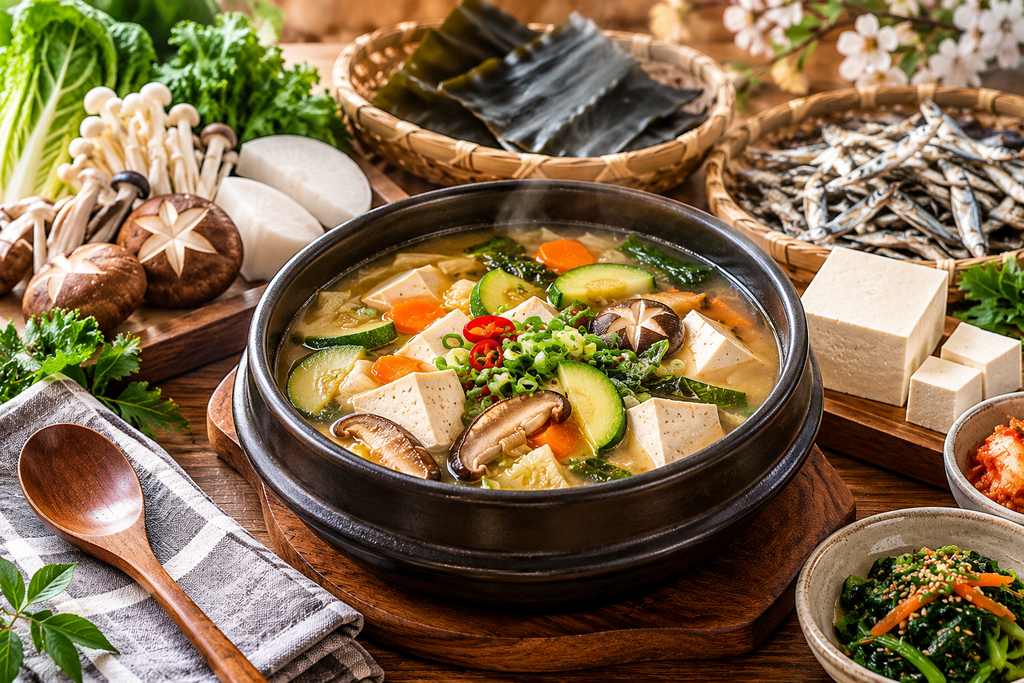
Can Vegans Eat Kimchi-Jjigae?
Yes, if the dish is intentionally prepared with vegan kimchi, vegetable broth, and plant-based ingredients.
A vegan recipe might include mushrooms, tofu, onions, zucchini, garlic, and chili flakes.
However, traditional kimchi-jjigae should not be assumed to be vegetarian or vegan.
Check the kimchi, broth, and seasonings separately.
Is Tteokguk Vegetarian?
Tteokguk is Korean rice cake soup traditionally enjoyed during Lunar New Year.
Its main ingredient is thinly sliced rice cake.
However, many recipes include beef stock, bone broth, or beef toppings.
Egg garnish is also common.
The rice cakes themselves may be plant-based, but that does not make the complete dish vegetarian.
A vegetarian tteokguk can be prepared with mushroom or kelp broth, rice cakes, vegetables, and optional egg for ovo-vegetarians.
Vegans should choose a version without egg and verify the rice cakes and seasonings.
Are Korean Temple Food Soups Vegetarian?
Korean Buddhist temple cuisine is one of the best traditions to explore for people seeking plant-based Korean food.
Temple cuisine emphasizes vegetables, grains, mushrooms, seaweed, fermented ingredients, and seasonal produce.
Traditional Korean temple cooking generally excludes meat, fish, and seafood.
Instead, natural ingredients such as dried mushrooms, kelp, and perilla seeds provide depth and flavor.
According to the Korea Tourism Organization, Korean temple cuisine avoids animal ingredients with a noted exception that dairy may be permitted in some contexts. Therefore, strict vegans should still confirm the specific preparation.
Why Temple Soups Are Different
Temple soups can develop rich, satisfying flavors without anchovy or bone broth.
Dried mushrooms provide umami.
Kelp contributes a gentle ocean-like savoriness without using fish.
Vegetables and fermented soybean paste build additional complexity.
Certain temple recipes also avoid pungent vegetables such as garlic and green onions, reflecting Buddhist culinary traditions.
This makes temple cuisine distinctive beyond simply removing meat.
Where Can Visitors Experience Temple Food?
Visitors can experience Korean temple cuisine through dedicated temple food restaurants, cultural programs, and selected temple experiences.
The Korea Tourism Organization provides information about Korean temple cuisine and opportunities to learn about this food tradition.
Official resource: Korean Temple Food — VISITKOREA.
How to Recognize Vegetarian Korean Broth
One of the most important skills for vegetarian travelers is learning to recognize different Korean broth names.
A menu may not provide a complete ingredient list, but certain Korean words offer useful clues.
Korean Broth Vocabulary
| Korean | English | Vegetarian? |
|---|---|---|
| 멸치육수 | Anchovy broth | No |
| 사골육수 | Bone broth | No |
| 소고기육수 | Beef broth | No |
| 닭육수 | Chicken broth | No |
| 해물육수 | Seafood broth | No |
| 조개육수 | Clam broth | No |
| 다시마육수 | Kelp broth | Potentially |
| 버섯육수 | Mushroom broth | Potentially |
| 채소육수 | Vegetable broth | Potentially |
The word potentially is important.
A broth labeled mushroom or kelp stock may still be combined with animal-based seasonings.
For example, a common Korean stock combines dried anchovies and kelp.
Therefore, the presence of kelp does not guarantee that the stock is vegetarian.
Ask whether the broth contains only plant-based ingredients.
How to Order Vegetarian Korean Soup at a Restaurant
Ordering vegetarian soup becomes easier when travelers communicate their dietary requirements clearly.
Rather than asking only whether a dish contains meat, mention fish, seafood, broth, and fermented seasonings.
Essential Korean Phrases for Vegetarians
1. I am vegetarian.
저는 채식주의자입니다.
Jeoneun chaesikjuuija-imnida.
2. Does this soup contain meat?
이 국에 고기가 들어가나요?
I guge gogiga deureoganayo?
3. Is the broth made with anchovies?
이 국물에 멸치가 들어가나요?
I gungmure myeolchiga deureoganayo?
4. Does it contain fish sauce or salted shrimp?
액젓이나 새우젓이 들어가나요?
Aekjeosina saeujeosi deureoganayo?
5. Can you make it with vegetable broth?
채소 육수로 만들어 주실 수 있나요?
Chaeso yuksuro mandeureo jusil su innayo?
6. Please do not use meat, fish, or seafood.
고기, 생선, 해산물은 넣지 말아 주세요.
Gogi, saengseon, haesan mureun neotji mara juseyo.
For strict vegans, it is also necessary to mention eggs, dairy products, and other animal-derived ingredients.
A Useful Korean Message to Show Restaurant Staff
저는 채식주의자입니다. 고기, 생선, 멸치육수, 해물육수, 액젓, 새우젓이 들어간 음식은 먹지 않습니다. 이 국은 채소 육수로만 만들었나요?
English meaning:
I am vegetarian. I do not eat foods containing meat, fish, anchovy broth, seafood broth, fish sauce, or salted shrimp. Is this soup made entirely with vegetable broth?
This message communicates the most important hidden ingredients more clearly than simply requesting a meat-free meal.
However, restaurant staff may need to confirm the recipe with the kitchen.
Vegetarian vs. Vegan Korean Soups: What Is the Difference?
Vegetarian and vegan diets are related, but they are not identical.
Most vegetarians avoid meat, poultry, fish, and seafood.
Some vegetarians eat eggs or dairy products.
Vegans avoid all animal-derived ingredients, including eggs and dairy.
For Korean soup, both groups need to check for anchovy broth, meat stock, fish sauce, and seafood ingredients.
Vegans must also consider egg toppings, dairy ingredients, and concentrated seasonings that may contain animal products.
Examples of Different Dietary Requirements
A vegetable soup with an egg garnish may be acceptable for an ovo-vegetarian but not a vegan.
A soybean paste soup containing anchovy stock is unsuitable for both vegetarians and vegans.
A soup made with tofu, mushrooms, seaweed, and vegetable broth can be suitable for both, provided its seasonings are animal-free.
The safest approach is to explain exactly which ingredients you avoid.
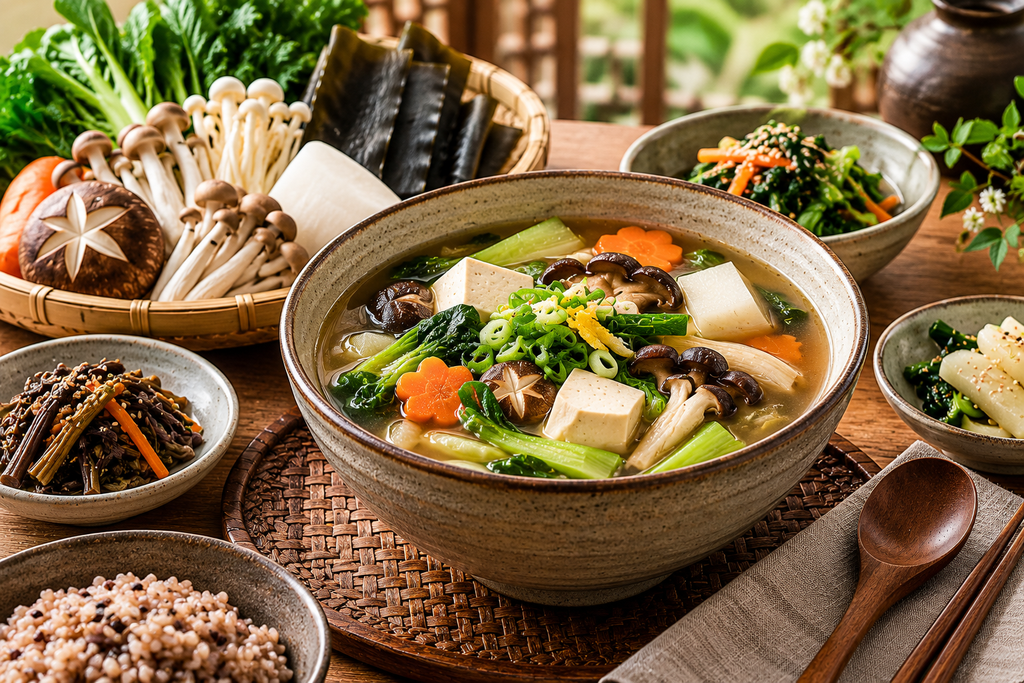
How to Make Vegetarian Korean Soup at Home
Preparing Korean soup at home gives vegetarians greater control over ingredients.
The most important step is replacing animal-based stock with a flavorful plant-based alternative.
Fortunately, several traditional Korean ingredients naturally provide the savory taste known as umami.
Easy Korean Vegetable Broth Recipe
A simple vegetarian Korean broth can be made using dried shiitake mushrooms, kelp, radish, onions, and water.
Ingredients:
- 6 cups water
- 2–3 dried shiitake mushrooms
- 1 piece of dried kelp (dashima)
- 1 cup sliced Korean radish
- 1 small onion, quartered
- 1–2 cloves garlic, optional
Instructions:
- Rinse the dried mushrooms and kelp if needed.
- Place the mushrooms, radish, onion, and water in a pot.
- Bring to a gentle simmer and cook for approximately 20 minutes.
- Add the kelp for the final 5–10 minutes.
- Remove the kelp and strain the broth.
- Use the prepared broth as a base for soybean paste soup, tofu soup, rice cake soup, or other Korean dishes.
This stock can be used in many Korean recipes that traditionally require anchovy broth.
For additional flavor, experiment with mushroom varieties, Korean soup soy sauce, or fermented soybean paste.
Check prepared seasonings to ensure they do not contain animal-derived additives.
Three Easy Vegetarian Korean Soup Ideas
1. Vegetarian Doenjang Soup
Combine vegetable broth, fermented soybean paste, zucchini, mushrooms, tofu, and spinach.
Simmer until the vegetables are tender.
The soybean paste creates a rich, satisfying flavor.
2. Vegan Seaweed Soup
Soak dried Korean seaweed, then cook it with sesame oil, vegetable broth, garlic, and soup soy sauce.
This creates a gentle, savory soup without beef or seafood.
3. Mushroom and Soft Tofu Soup
Simmer mushrooms, zucchini, onions, and soft tofu in vegetable broth.
Season with Korean chili flakes, garlic, and soy sauce.
For a spicy version, use a little chili oil made without seafood ingredients.
These recipes demonstrate that vegetarian Korean soup does not have to be bland or complicated.
Can You Trust Vegetarian Labels on Korean Restaurant Menus?
Vegetarian labeling has become more visible in some Korean restaurants, particularly in major cities and tourist-oriented dining areas.
However, descriptions and ingredient information vary.
A dish advertised as containing vegetables may still be prepared with fish or meat broth.
Similarly, a menu photo showing only tofu and mushrooms does not guarantee that its seasonings are vegetarian.
For greater confidence, look for restaurants that explicitly describe their meals as vegetarian or vegan and can explain the preparation method.
What to Ask Before Ordering
A few specific questions can prevent misunderstandings.
First, ask whether the soup contains any meat or seafood.
Second, ask about the broth.
Third, confirm whether fish sauce or salted shrimp is used.
Finally, ask whether vegetable broth is prepared separately from meat and seafood stocks.
A restaurant may not be able to change a large batch of soup that has already been prepared.
In that situation, choosing another dish is more practical than asking staff to remove individual ingredients.
Are Packaged Korean Soups Vegetarian?
Packaged Korean soups are convenient for international travelers and people preparing Korean food at home.
However, packaged soups can also contain hidden animal ingredients.
Instant soybean paste soup, seaweed soup, and tofu stew bases may include concentrated extracts or powdered seasonings.
Never assume that a product is vegetarian simply because the front of the package displays vegetables.
Ingredients to Look for on Korean Food Labels
Some useful Korean ingredient terms include:
| Korean label term | Meaning |
|---|---|
| 멸치추출물 | Anchovy extract |
| 쇠고기추출물 | Beef extract |
| 사골농축액 | Concentrated bone broth |
| 어류 | Fish |
| 새우 | Shrimp |
| 조개 | Clam or shellfish |
| 액젓 | Fish sauce |
| 굴소스 | Oyster sauce |
| 육수분말 | Broth powder; source must be checked |
| 채소추출물 | Vegetable extract |
Ingredient lists may contain multiple concentrated flavoring ingredients.
If you cannot identify a seasoning, do not assume it is plant-based.
Look for products with clear vegetarian or vegan labeling and verify the ingredients when necessary.
A Note About Food Allergies
A vegetarian preference and a food allergy require different precautions.
People with fish or shellfish allergies should not rely only on a restaurant’s description of a meal as vegetarian.
Cross-contact can occur when food is prepared using shared equipment, utensils, or cooking surfaces.
If you have an allergy, communicate the specific allergen and ask whether the kitchen can prevent cross-contact during preparation.
A dish without visible seafood is not necessarily safe for someone with a seafood allergy.
Common Mistakes Vegetarian Travelers Make in Korea
Even experienced travelers can misunderstand Korean menu descriptions.
One frequent mistake is assuming that tofu dishes are always vegetarian.
Tofu is plant-based, but the soup surrounding it may contain seafood or meat.
Another mistake is checking only for visible meat.
Stock, fish sauce, and fermented seafood seasonings can remain in a dish even when no animal ingredients are visible.
A third mistake is believing that removing meat toppings makes a soup vegetarian.
If the broth was prepared with beef bones or anchovies, removing toppings will not change its ingredients.
Travelers should also avoid assuming that all kimchi is vegan.
Traditional kimchi often contains fermented seafood seasonings, although vegan versions are available.
Finally, simply asking for less meat or no meat may not communicate a strict vegetarian requirement.
The most effective approach is to identify the exact ingredients you want to avoid.
Best Practical Tips for Eating Vegetarian Korean Soup
Vegetarian travelers can enjoy Korean cuisine with a little preparation.
Before visiting a restaurant, review the menu and identify soups that appear easiest to adapt.
Mushroom soups, vegetable soups, seaweed soups, and certain soybean paste soups may be good starting points, provided the kitchen can confirm an animal-free recipe.
Restaurants specializing in vegetarian or vegan food may offer clearer ingredient information.
Temple cuisine restaurants are also worth exploring because their cooking traditions emphasize plant-based ingredients.
When ordering at a traditional Korean restaurant, ask about broth before choosing the dish.
Remember that stock is often prepared in advance.
If a restaurant cannot confirm whether its broth contains anchovies, fish sauce, or meat, consider ordering an alternative meal.
Learning a few Korean ingredient names is also valuable.
Words such as myeolchi (anchovy), saeujeot (salted shrimp), and sagol (bone broth) can help you recognize ingredients that are not mentioned in English descriptions.
Above all, approach Korean cuisine with curiosity.
Korea has a rich tradition of vegetables, fermented foods, mushrooms, grains, tofu, and seaweed.
These ingredients provide many possibilities for delicious vegetarian meals when prepared without animal-based broths and seasonings.
Final Thoughts: Are Korean Soups Vegetarian?
So, are Korean soups vegetarian?
Some Korean soups are vegetarian, but many traditional versions contain hidden animal-based ingredients.
Anchovy broth, beef stock, fish sauce, salted shrimp, seafood extracts, and meat-based seasoning powders are among the most important ingredients to recognize.
A soup containing tofu, mushrooms, vegetables, or seaweed is not necessarily vegetarian.
The preparation method matters just as much as the visible ingredients.
Fortunately, plant-based Korean soups can be flavorful, comforting, and satisfying.
Vegetable broth made with kelp, mushrooms, and radish provides an excellent alternative to traditional meat or seafood stock.
Korean temple cuisine also demonstrates how rich Korean flavors can be created through plant-based ingredients and careful preparation.
Whether you are visiting Seoul for the first time, exploring Korean restaurants abroad, or cooking Korean food at home, understanding these hidden ingredients will help you make more confident choices.
The key is simple: check the broth, check the seasonings, and never judge a soup only by its appearance.
3. Frequently Asked Questions (FAQ)
1. Are Korean soups vegetarian?
Some Korean soups are vegetarian, but many traditional recipes use anchovy stock, beef broth, seafood, or fermented fish seasonings. Always check the broth and ingredients before ordering.
2. Is Korean soybean paste soup vegetarian?
Doenjang-guk can be vegetarian when prepared with vegetable broth and animal-free seasonings. However, many recipes use anchovy stock, so the preparation method must be confirmed.
3. Does Korean tofu soup contain fish?
Korean soft tofu stew may contain anchovy broth, clams, shrimp, or other seafood. Some versions contain meat. Vegetarian alternatives are possible when prepared with vegetable stock.
4. Is Korean seaweed soup vegan?
Miyeok-guk can be vegan when prepared with seaweed, vegetable broth, sesame oil, and plant-based seasonings. Traditional versions frequently include beef or seafood.
5. What is anchovy broth in Korean?
Anchovy broth is called myeolchi-yuksu (멸치육수). It is made by simmering dried anchovies in water and is not suitable for vegetarian or vegan diets.
6. Is Korean kimchi soup vegetarian?
Many kimchi soups contain pork, tuna, fish sauce, or salted shrimp. A vegetarian version requires animal-free kimchi, vegetable broth, and no meat or seafood.
7. Can vegans eat Korean temple food?
Korean temple cuisine generally excludes meat, fish, and seafood and relies heavily on plant-based ingredients. However, strict vegans should check for dairy or other animal-derived ingredients in the specific meal.
8. What Korean soup is best for vegetarians?
Mushroom soup, soybean sprout soup, seaweed soup, and soybean paste soup can be suitable when prepared with vegetable broth and no animal-derived seasonings.
9. How do I ask for vegetarian soup in Korean?
You can say, “채소 육수로 만들어 주실 수 있나요?” This means, “Can you make it with vegetable broth?” It is also helpful to mention that you avoid anchovy broth, fish sauce, and seafood.
10. Are Korean instant soups vegetarian?
Not necessarily. Some instant Korean soups contain beef extracts, anchovy powder, seafood concentrates, or other animal-derived ingredients. Check the complete ingredient list before purchasing.