A Complete Guide to Korean Sunscreen Benefits, SPF 50, PA++++, Ingredients, and U.S. Regulations
Korean sunscreens have become one of the most talked-about products in the American skincare community. From beauty enthusiasts discovering K-beauty routines to consumers searching for comfortable everyday sun protection, interest in Korean sunscreen continues to shape conversations about skincare.
But why are Korean sunscreens so popular in the United States?
The answer goes beyond attractive packaging or social media trends. Korean sunscreen brands have helped introduce American consumers to lightweight textures, skincare-focused formulas, moisturizing ingredients, and different ways of describing UVA protection.
For many people, sunscreen used to mean a thick, sticky product reserved for beach vacations. Korean skincare has helped promote a different approach: sunscreen as an enjoyable part of a daily beauty routine.
However, there are important differences between Korean and American sunscreens, particularly in regulatory requirements, ultraviolet filters, and labeling systems.
In this guide, we explain seven major reasons for the appeal of Korean sunscreens, compare Korean and American products, explore SPF and PA ratings, and provide practical advice for choosing and using sunscreen safely.
What Makes Korean Sunscreen Different From American Sunscreen?
Korean sunscreen products are frequently designed to fit into a multistep skincare routine.
While many American products emphasize sun protection, sports performance, or water resistance, numerous Korean formulas also prioritize how sunscreen looks and feels on the skin.
A typical Korean facial sunscreen may feature a lightweight lotion, watery gel, moisturizing cream, or serum-like texture.
Some formulas include ingredients commonly used in moisturizers, such as hyaluronic acid, glycerin, panthenol, and niacinamide.
These ingredients can improve the cosmetic experience, depending on the formula and individual skin tolerance.
American sunscreen products can contain these ingredients as well. Therefore, the distinction is not that one country’s products are universally better. It is more accurate to say that different brands and markets have historically emphasized different combinations of protection, texture, and convenience.
Another important distinction involves regulations.
In the United States, sunscreen products making sun-protection claims are regulated as over-the-counter drugs by the Food and Drug Administration (FDA).
In South Korea, sunscreens are regulated within the country’s functional cosmetics framework.
These different systems influence which ultraviolet filters are permitted and how products are labeled.
Understanding these differences helps consumers make informed choices rather than relying only on viral recommendations.
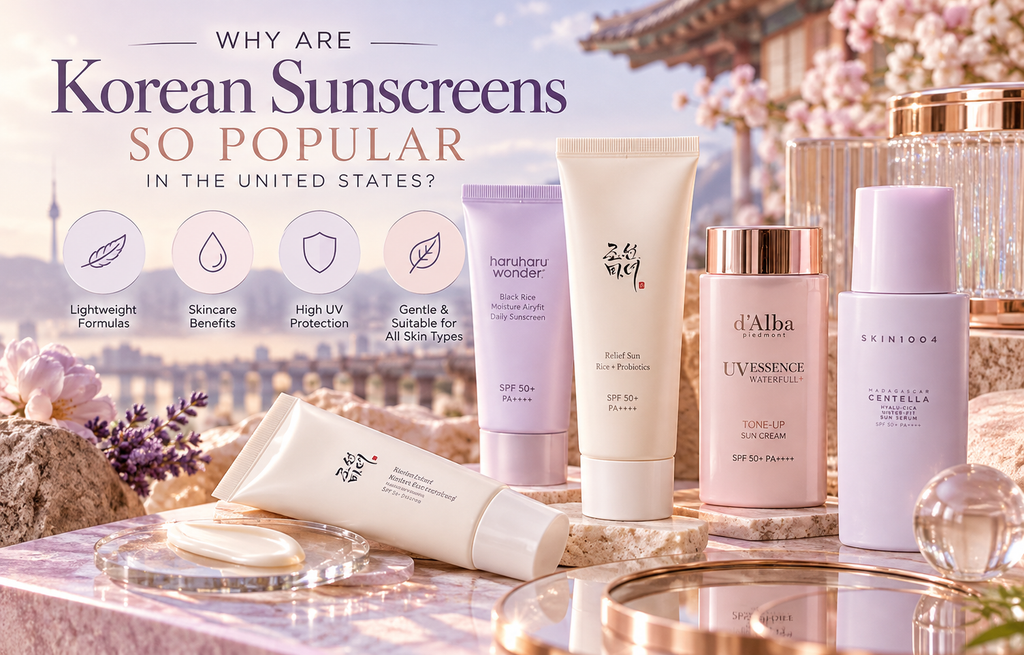
7 Reasons Why Korean Sunscreens Are So Popular in the United States
Table of Contents
1. Lightweight Textures Make Daily Sunscreen More Comfortable
One of the biggest reasons Americans explore Korean sunscreen is the desire for comfortable daily wear.
Traditional sunscreen experiences can involve heavy creams, greasy finishes, or products that feel noticeable throughout the day.
Many Korean facial sunscreens are marketed around lightweight textures that spread easily and absorb comfortably.
Popular texture descriptions include:
- Watery sunscreen
- Sun essence
- Moisturizing sun cream
- Lightweight sun gel
- Sun serum
- Soft-finish sunscreen
These names describe cosmetic formats and sensations rather than guaranteed levels of protection.
A lightweight formula may be especially appealing to someone who dislikes the feeling of sunscreen under makeup.
For example, an office worker who spends time commuting, attending meetings, and working indoors might prefer a moisturizing sunscreen that feels similar to a facial lotion.
Someone with oily skin may prefer a lighter finish, while a person with dry skin may appreciate a creamier product.
The advantage is personal comfort.
When sunscreen is pleasant to apply, people may be more willing to make it part of their routine. However, the correct quantity and proper reapplication remain essential regardless of texture.
2. Many Korean Sunscreens Combine Sun Protection With Skincare Ingredients
Korean beauty products often emphasize maintaining skin hydration and supporting a comfortable skincare routine.
Sunscreens are no exception.
Depending on the product, Korean sunscreens may contain ingredients such as:
Hyaluronic Acid: A humectant that helps attract and retain moisture in the skin.
Niacinamide: A form of vitamin B3 widely used in skincare formulations to help support the skin barrier and improve the appearance of uneven skin tone.
Panthenol: A moisturizing ingredient commonly used in products intended to support skin comfort.
Glycerin: A widely used humectant that helps maintain hydration.
Ceramides: Lipid ingredients that may help support the skin’s moisture barrier.
Centella Asiatica: A botanical ingredient often included in products marketed for soothing skincare routines.
These ingredients are not exclusive to Korean beauty products, and their presence does not automatically make a sunscreen effective or suitable for everyone.
The final formulation, ingredient concentration, skin compatibility, and product testing matter.
A sunscreen that contains moisturizing ingredients can be convenient because it may reduce the need for multiple layers of skincare products.
For example, someone with normal skin may find that a hydrating sunscreen works comfortably over a simple moisturizer or, in some circumstances, replaces a separate morning moisturizer.
People with very dry skin may still prefer to use both.
The key is to choose a product that offers appropriate sun protection while meeting individual skincare needs.
3. Korean Sunscreens Often Emphasize Both SPF and PA Ratings
Another reason Korean sunscreen attracts attention is its labeling system.
Many Korean products display two familiar-looking but different measurements:
SPF 50+ PA++++
SPF stands for Sun Protection Factor. It primarily describes protection against the ultraviolet radiation responsible for sunburn, especially UVB.
PA stands for Protection Grade of UVA and indicates a category of protection against UVA radiation.
UVA exposure contributes to premature skin aging and can cause skin damage even when visible sunburn does not occur.
South Korea uses four PA categories, with PA++++ indicating the highest category in that labeling system.
The Korean Ministry of Food and Drug Safety established PA++++ as a category associated with a UVA protection factor of at least 16.
In the United States, consumers are more likely to see the phrase “Broad Spectrum” on sunscreen packaging.
This indicates that the product satisfies the applicable U.S. broad-spectrum testing requirements for UVA protection relative to UVB protection.
These systems are not interchangeable numerical measurements.
A PA++++ label should not be interpreted as a direct substitute for an FDA-compliant broad-spectrum label.
Consumers should also remember that higher protection ratings do not mean sunscreen lasts longer on the skin.
Even a sunscreen labeled SPF 50+ PA++++ needs appropriate reapplication.
4. Korean Beauty Trends Make Sunscreen Part of Everyday Skincare
Korean beauty culture has influenced how many international consumers think about skincare.
Rather than viewing sunscreen only as a seasonal beach product, K-beauty content frequently presents sun protection as the final step in a morning skincare routine.
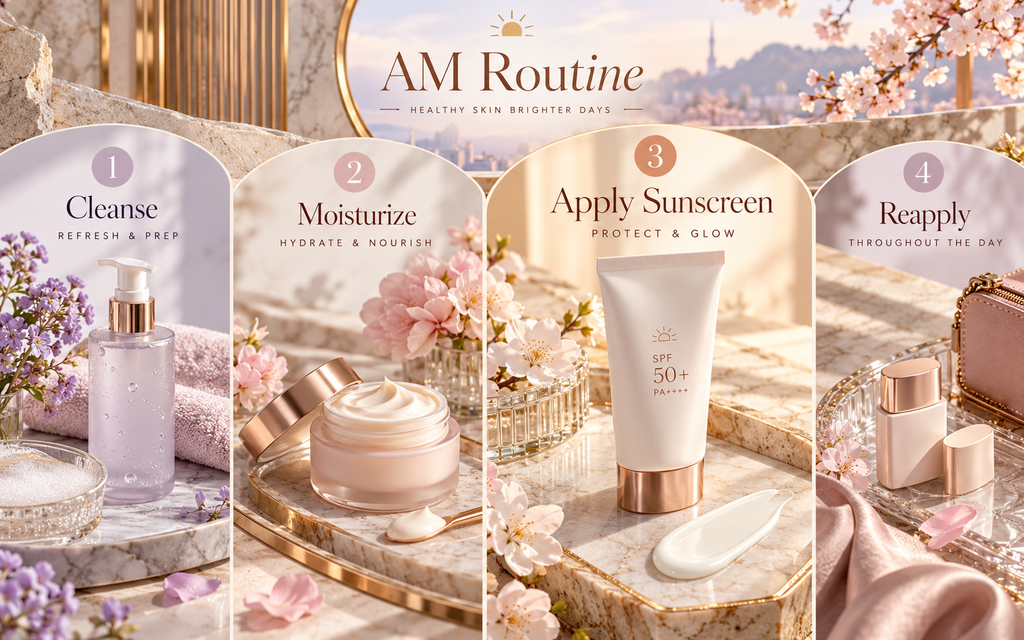
A simple routine may include:
- Gentle cleanser
- Hydrating toner or serum, if desired
- Moisturizer
- Sunscreen
People may adjust or skip steps depending on their skin needs.
The most important protective step is using sunscreen correctly, not completing a complicated routine.
American consumers who discover Korean skincare through tutorials, beauty communities, and online product reviews may become interested in Korean sunscreen as part of that broader routine.
Korean entertainment and international beauty trends can also increase awareness of Korean skincare products.
However, it is important to separate appearance-related marketing from scientifically supported skincare claims.
Sunscreen does not guarantee flawless skin, prevent every wrinkle, or eliminate every risk associated with sun exposure.
Its value comes from helping protect the skin against ultraviolet radiation when used as directed and combined with other protective measures.
5. Some Korean Sunscreens Leave Less Visible White Cast
White cast is the pale or chalky appearance that certain sunscreen formulas leave on the skin.
This can be especially noticeable on medium and deeper skin tones.
Some mineral sunscreens containing zinc oxide or titanium dioxide can create visible residue, depending on their particle characteristics, tint, and overall formulation.
Many Korean chemical sunscreen formulas are designed to spread transparently.
This makes certain products attractive to people who want sunscreen that is less noticeable after application.
However, not all Korean sunscreens are invisible, and not all American sunscreens leave a white cast.
Tinted mineral sunscreens, transparent chemical formulas, and modern cosmetic formulations are available in both markets.
People concerned about hyperpigmentation may also benefit from learning about tinted sunscreens containing iron oxides.
According to the American Academy of Dermatology, tinted sunscreens containing iron oxides can provide additional protection against visible light, which may contribute to dark spots in some skin tones.
The best choice depends on a product’s actual properties, not its country of origin.
6. Korean Sunscreen Offers a Wide Range of Textures and Finishes
Consumers increasingly expect skincare products to match their individual preferences.
Korean sunscreen manufacturers and beauty brands market products in a variety of finishes, including:
- Dewy and moisturizing
- Lightweight and fresh
- Soft matte
- Natural skin finish
- Creamy and nourishing
- Makeup-friendly
This variety encourages consumers to experiment with different formats.
For example, a person with dry skin may prefer a moisturizing sunscreen cream, while someone with oily skin may look for a product that feels lightweight and does not leave excessive shine.
People who wear foundation may choose formulas that layer smoothly under makeup.
A good cosmetic match matters because sunscreen is most useful when applied generously and consistently.
Nevertheless, finish alone does not establish sunscreen effectiveness.
A cosmetically elegant product must still provide verified protection appropriate for its intended market and use.
7. Social Media Has Increased Awareness of Korean Sunscreen
Beauty videos, product demonstrations, online discussions, and skincare reviews have introduced Korean sunscreen to a broader American audience.
Short-form videos can demonstrate how a product spreads, whether it appears greasy, and whether it leaves visible residue.
Creators may compare several sunscreens under makeup or discuss how a formula feels during everyday activities.
These demonstrations help consumers discover products they might not otherwise encounter.
However, online popularity is not the same as scientific evidence.
A creator’s experience may not predict another person’s results.
Skin sensitivity, climate, makeup compatibility, and personal preference vary considerably.
Consumers should treat product reviews as one source of practical information while also checking ingredients, labeling, regulatory compliance, and manufacturer information.
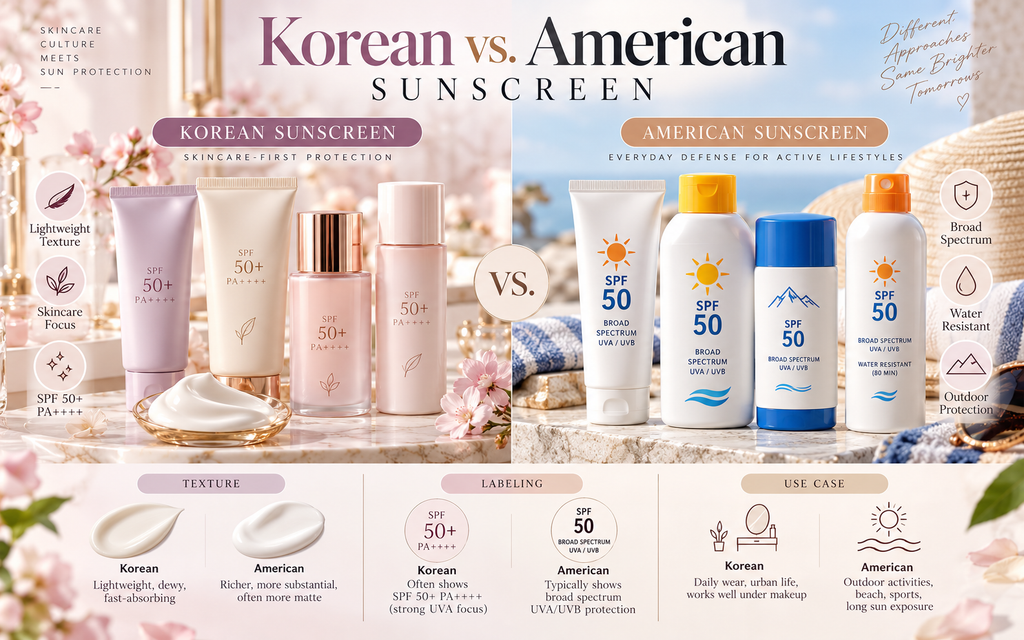
Korean Sunscreen vs. American Sunscreen: Practical Comparison
The following table highlights common differences between the two markets. These are general tendencies, not universal rules.
| Feature | Korean Sunscreens | American Sunscreens |
|---|---|---|
| Regulatory classification | Functional cosmetics in South Korea | OTC drugs in the U.S. |
| UVA information | Often includes PA ratings | Often uses Broad Spectrum labeling |
| Popular facial textures | Creams, gels, essences, lightweight lotions | Lotions, creams, gels, sticks, sprays |
| Moisturizing ingredients | Common in skincare-focused formulas | Also available in many products |
| White cast | Depends on filters and formulation | Depends on filters and formulation |
| Water resistance | Must be verified for each product | Labeled resistance may be 40 or 80 minutes |
| UV filters | Subject to Korean requirements | Subject to FDA requirements |
| Makeup compatibility | Varies by formula | Varies by formula |
| Best use | Depends on labeling and individual needs | Depends on labeling and individual needs |
This comparison reveals an important point: the best sunscreen is not necessarily Korean or American.
The better product is the one that meets applicable standards, provides appropriate protection, suits your skin, and can be applied correctly.
For consumers in the United States, checking the product’s U.S. labeling and regulatory status is especially important.
What Does SPF 50+ PA++++ Actually Mean?
The labeling on Korean sunscreens can be confusing for first-time buyers.
Understanding SPF and PA helps consumers distinguish marketing from protection information.
Understanding SPF Ratings
SPF is determined through standardized testing related to sunburn protection.
Higher SPF values generally indicate greater UVB protection, but the increase becomes smaller at higher numbers.
Under ideal test conditions, approximate UVB filtering percentages are:
| SPF Rating | Approximate UVB Filtering |
|---|---|
| SPF 15 | 93.3% |
| SPF 30 | 96.7% |
| SPF 50 | 98.0% |
| SPF 100 | 99.0% |
These figures are simplified mathematical illustrations based on the SPF ratio. They are not guarantees of real-world performance.
Protection depends on applying enough product, covering exposed skin, and reapplying when required.
SPF 50 does not mean a person can remain in direct sunlight for 50 hours or skip reapplication.
Understanding Korean PA Ratings
Korean PA categories describe increasing UVA protection.
| PA Rating | UVA Protection Factor |
|---|---|
| PA+ | 2 to less than 4 |
| PA++ | 4 to less than 8 |
| PA+++ | 8 to less than 16 |
| PA++++ | 16 or higher |
PA++++ is the highest category within this rating system, but it does not mean that every PA++++ sunscreen provides identical UVA protection.
The precise protection level can vary from one product to another.
It also does not mean that protection lasts all day.
Why UVA and UVB Protection Both Matter
UVB radiation is a major cause of sunburn.
UVA radiation penetrates more deeply into the skin and contributes to visible signs of photoaging.
Both can contribute to skin damage and cancer risk.
For this reason, American dermatologists recommend broad-spectrum protection rather than focusing on SPF alone.
When choosing a sunscreen marketed in the United States, look for a broad-spectrum product with SPF 30 or higher and appropriate water resistance.
Are Korean Sunscreens FDA-Approved in the United States?
This is one of the most important questions for Americans purchasing imported sunscreen.
In the United States, sunscreen is regulated as an over-the-counter drug rather than an ordinary cosmetic product.
A sunscreen sold legally in the American market must comply with the applicable FDA drug requirements.
An imported product does not automatically satisfy those requirements simply because it is popular, widely reviewed, or sold through an online marketplace.
Some ultraviolet filters permitted in South Korea have historically not been included among the ingredients allowed under the U.S. OTC sunscreen monograph.
That means a Korean sunscreen formulated for the domestic Korean market may not be legally marketable as a sunscreen in the United States without meeting applicable FDA requirements.
An important 2026 regulatory update: In June 2026, the FDA added bemotrizinol to the U.S. OTC sunscreen monograph. This was a significant change because the ingredient had already been used in sunscreen formulations in other markets.
The development illustrates why claims that the United States has never approved modern sunscreen filters are now outdated.
The FDA also updated its sunscreen framework in September 2026 concerning PABA and trolamine salicylate.
Consumers should understand that FDA compliance applies to the specific formulation and marketing conditions, not to an entire country’s sunscreen industry.
It is also inaccurate to assume that every individual OTC sunscreen product receives its own separate FDA premarket approval.
For shoppers, the practical approach is to examine the U.S. Drug Facts label, active ingredients, broad-spectrum designation, and manufacturer information.
When considering imported products, verify that the specific version is appropriate for the market where it is being sold.
How to Choose the Best Korean Sunscreen for Your Skin Type
Rather than selecting a sunscreen solely because it is popular, consider personal skin characteristics and how the product will be used.
Best Sunscreen Features for Dry Skin
Dry skin often feels tight, rough, or uncomfortable when it lacks sufficient moisture.
People with dry skin may prefer sunscreen creams containing moisturizing ingredients.
Look for formulas that feel comfortable and layer well over existing skincare products.
Ingredients such as glycerin, hyaluronic acid, and ceramides may contribute to a more moisturizing formula.
However, the finished product matters more than any single ingredient.
Best Sunscreen Features for Oily Skin
People with oily skin may prefer lightweight lotions, gels, or soft-finish products.
A sunscreen that feels too heavy may be uncomfortable during warm weather.
Look for a texture that can be applied in the recommended quantity without making the skin feel excessively greasy.
Do not assume that every gel product is oil-free or that every lightweight sunscreen is suitable for acne-prone skin.
Read the full product information when available.
Best Sunscreen Features for Sensitive Skin
Sensitive skin can react to fragrances, preservatives, botanical extracts, or particular sunscreen ingredients.
Choosing a fragrance-free formula may be helpful for people who experience fragrance-related irritation.
Mineral sunscreens containing zinc oxide or titanium dioxide are often considered by people with sensitive skin.
Still, any formulation can cause irritation in some individuals.
Test a new skincare product on a small area before applying it more broadly, especially if you have experienced reactions to cosmetics.
Best Sunscreen Features for Acne-Prone Skin
People with acne-prone skin may prefer noncomedogenic products or formulas specifically designed for facial use.
However, the term “noncomedogenic” does not guarantee that a product will never cause breakouts.
Consider the entire formula, how it interacts with your other skincare products, and your individual experience.
If irritation or a persistent rash develops, stop using the product and obtain appropriate medical guidance.
Best Sunscreen Features for Outdoor Activities
For swimming, sports, hiking, and extended outdoor activities, water resistance becomes especially important.
The American Academy of Dermatology recommends a broad-spectrum, water-resistant sunscreen with SPF 30 or higher.
In the U.S., water-resistant sunscreen labels specify protection for 40 or 80 minutes during swimming or sweating.
A comfortable everyday facial sunscreen that lacks demonstrated water resistance may not be the most practical choice for a beach trip or outdoor workout.
How to Apply Korean Sunscreen Correctly
Even an excellent sunscreen cannot provide its labeled protection if it is applied incorrectly.
The American Academy of Dermatology recommends applying sunscreen before outdoor exposure and reapplying approximately every two hours while outdoors, as well as after swimming or sweating.
Step 1: Begin With Clean Skin
Start with a gentle cleanser when appropriate.
Allow your skincare products to settle before applying sunscreen.
There is no need to follow a complicated ten-step routine to obtain effective sun protection.
Step 2: Apply Your Moisturizer if Needed
If your skin needs additional hydration, apply moisturizer before sunscreen.
Some hydrating sunscreen formulas may provide enough moisture for certain skin types.
Avoid mixing sunscreen directly into moisturizer or foundation, because altering the formulation or applying too little can compromise the intended protection.
Step 3: Apply a Generous, Even Layer
Follow the product’s labeled instructions.
The American Academy of Dermatology advises applying enough sunscreen to thoroughly cover exposed skin, including the face, ears, and neck.
For the face, the AAD describes approximately one teaspoon as a general application guide.
The commonly discussed two-finger method may be convenient for some products, but finger size and product texture vary. It is not a standardized dose.
Step 4: Allow the Product to Set
When possible, apply sunscreen about 15 minutes before going outdoors, following the product instructions.
If you wear makeup, let the sunscreen settle before applying foundation.
Avoid rubbing away the sunscreen layer while blending cosmetics.
Step 5: Reapply During the Day
Reapply approximately every two hours outdoors.
Reapply after swimming, heavy sweating, or towel drying, according to the label.
Do not assume that SPF 50+ offers all-day protection.
Step 6: Combine Sunscreen With Other Protection
Use shade, hats, UV-protective clothing, and sunglasses when appropriate.
Sun protection is a combination of habits, not a single cosmetic product.
How Much Should Americans Expect to Spend on Korean Sunscreen?
Sunscreen prices vary by brand, bottle size, retailer, import arrangements, and promotional discounts.
A lower sticker price does not necessarily mean a better value.
Instead, compare the price relative to the quantity supplied.
For example, suppose two products are available:
| Example Product | Package Size | Example Price | Cost per 10 mL |
|---|---|---|---|
| Sunscreen A | 50 mL | $15 | $3.00 |
| Sunscreen B | 100 mL | $24 | $2.40 |
These are hypothetical prices provided solely to explain cost comparison, not current retail quotations.
Although Sunscreen B costs more initially, its cost per 10 mL is lower.
Before deciding which product offers better value, consider how much sunscreen is needed, its expiration date, product authenticity, and suitability for your skin.
Sunscreen should not be applied sparingly just to make a bottle last longer.
Buying a less expensive sunscreen that you can use correctly may be more useful than purchasing a luxury product and applying too little.
Where Can Americans Buy Korean Sunscreen?
American consumers encounter Korean sunscreen products through several retail channels.
These may include official brand websites, authorized beauty retailers, specialty Korean skincare stores, and larger online marketplaces.
However, product availability does not automatically establish FDA compliance or authenticity.
Before purchasing, consider the following checklist:
- Confirm the identity of the manufacturer and seller.
- Check whether the seller is an authorized retailer.
- Review the ingredient information and package labeling.
- Look for applicable U.S. Drug Facts labeling when buying a sunscreen marketed in the United States.
- Verify the expiration date and package condition.
- Be cautious about unusually low prices or listings with inconsistent photographs.
- Read return policies for damaged or questionable products.
Also remember that the same brand may offer different formulas in different countries.
A familiar product name does not guarantee that every international version contains the same ultraviolet filters.
When selecting a sunscreen for daily protection in the United States, prioritize products that meet applicable U.S. requirements.
Common Mistakes Americans Should Avoid With Korean Sunscreen
Mistake 1: Assuming Every Korean Sunscreen Is Better
Country of origin alone cannot determine sunscreen performance.
Protection, testing, formulation, water resistance, and individual compatibility matter more.
Mistake 2: Believing SPF 50+ Lasts All Day
Higher SPF does not eliminate the need for reapplication.
Outdoor activity, sweating, swimming, and towel drying can affect protection.
Mistake 3: Confusing PA++++ With FDA Broad Spectrum
The Korean PA rating system and U.S. broad-spectrum requirements are different methods of describing UVA protection.
Consumers should interpret each label within its own regulatory context.
Mistake 4: Applying Too Little Sunscreen
A thin cosmetic layer may feel appealing but can provide less protection than the label suggests.
Apply a generous, even amount according to the instructions.
Mistake 5: Ignoring Water Resistance
A sunscreen that performs comfortably during office work may not be ideal for swimming or intense exercise.
Choose a water-resistant product when necessary.
Mistake 6: Trusting Social Media More Than Product Information
Online reviews can help describe texture and appearance.
They cannot replace product testing, regulatory information, or established sun safety guidance.
Frequently Asked Questions About Korean Sunscreens
1. Why are Korean sunscreens so popular in the United States?
Korean sunscreens attract American consumers because many formulas emphasize lightweight textures, comfortable daily application, skincare ingredients, and cosmetic finishes that work well with everyday routines. K-beauty content and online product reviews have also increased awareness.
2. Are Korean sunscreens better than American sunscreens?
Not necessarily. Some Korean sunscreens may be more appealing to people seeking particular textures, while American products may offer features better suited to specific activities. Both markets include products with varying formulations and protection characteristics.
3. What does SPF 50+ PA++++ mean?
SPF 50+ indicates a high category of tested sunburn protection, while PA++++ represents the highest UVA protection category in the Korean PA system. Neither rating eliminates the need for appropriate reapplication.
4. Can I legally buy Korean sunscreen in the United States?
The answer depends on the specific product and applicable regulations. Sunscreens marketed as such in the United States must comply with FDA drug requirements. A product made for the Korean market does not automatically satisfy U.S. requirements.
5. Do Korean sunscreens work for sensitive skin?
Some may be suitable, but compatibility depends on the entire formula. Fragrance-free products and certain mineral sunscreens may be worth considering. Individuals can react to ingredients regardless of a product’s country of origin.
6. Can Korean sunscreen replace a moisturizer?
For some people, a sufficiently moisturizing sunscreen may simplify the morning routine. Others, particularly those with dry skin, may prefer applying a separate moisturizer before sunscreen.
7. How often should I reapply Korean sunscreen?
When outdoors, reapply approximately every two hours, and after swimming, sweating, or towel drying as indicated by the product label. An SPF 50+ label does not guarantee all-day protection.
8. What is the best Korean sunscreen for everyday use?
There is no single best sunscreen for everyone. Choose a product that meets applicable market requirements, provides suitable UV protection, feels comfortable on your skin, and can be applied and reapplied correctly.
Final Thoughts: Is Korean Sunscreen Worth Trying?
Korean sunscreen has helped broaden the American conversation about daily sun protection.
Its appeal reflects a combination of skincare-focused textures, innovative cosmetic formulations, consumer interest in K-beauty, and the desire for products that feel comfortable enough to use consistently.
For many American skincare enthusiasts, discovering Korean sunscreen means realizing that sun protection does not always have to feel heavy or inconvenient.
However, popularity should never be confused with universal superiority.
A Korean sunscreen is not automatically safer, stronger, or more effective than an American sunscreen.
The most important factors are verified protection, appropriate labeling, regulatory compliance, individual skin compatibility, and correct application.
The U.S. sunscreen landscape is also evolving. The FDA’s addition of bemotrizinol in 2026 demonstrates that ultraviolet filter regulations and available formulations can change over time.
Ultimately, the best sunscreen is one that provides appropriate protection and fits comfortably into your daily life.
Whether you prefer Korean skincare-inspired textures or familiar American sunscreen formulas, consistent sun protection remains one of the most valuable habits in a healthy skincare routine.
The real secret to effective sunscreen is not where it comes from, but choosing it carefully and using it correctly.
Official References and Further Reading
- U.S. Food and Drug Administration — Sunscreen: How to Help Protect Your Skin from the Sun
https://www.fda.gov/drugs/understanding-over-counter-medicines/sunscreen-how-help-protect-your-skin-sun - U.S. Food and Drug Administration — Questions and Answers: FDA’s Regulatory Actions on OTC Sunscreen
https://www.fda.gov/drugs/understanding-over-counter-medicines/questions-and-answers-fdas-regulatory-actions-over-counter-sunscreen - U.S. Food and Drug Administration — FDA Expands Sunscreen Options, June 2026
https://www.fda.gov/news-events/press-announcements/fda-expands-sunscreen-options-first-time-20-years - American Academy of Dermatology — How to Select a Sunscreen
https://www.aad.org/public/everyday-care/sun-protection/shade-clothing-sunscreen/how-to-select-sunscreen - American Academy of Dermatology — How to Apply Sunscreen
https://www.aad.org/public/everyday-care/sun-protection/shade-clothing-sunscreen/how-to-apply-sunscreen - Korean Ministry of Food and Drug Safety — UVA Protection Rating Categories (Korean)
https://www.mfds.go.kr/brd/m_100/view.do?seq=33335
Editorial note: This article discusses sunscreen labeling, product selection, and general sun-safety information. Product formulas, regulations, and availability may change. Verify current product-specific information before purchasing or making protection claims.
Published by TIPVERO | Korean Beauty, Culture & Lifestyle