Korean beauty products have become increasingly popular among American skincare enthusiasts. From lightweight sunscreens and hydrating serums to soothing moisturizers and innovative sheet masks, Korean skincare has captured the attention of consumers who want healthy, glowing skin without spending a fortune.
But an important question remains: Are Korean beauty products better than American beauty products?
The answer is more complicated than choosing one country over another.
Korean beauty, commonly known as K-beauty, is often associated with hydration, prevention, gentle formulations, and a radiant complexion. American skincare, meanwhile, has a strong presence in dermatologist-developed products, targeted treatments, and straightforward routines designed to address concerns such as acne, wrinkles, dryness, and uneven skin tone.
Both markets offer excellent products, and both have advantages and disadvantages.
A Korean moisturizer may provide an elegant, lightweight texture that feels comfortable during humid summers. An American moisturizer may offer a thicker, protective formula that works particularly well in cold, dry weather.
Similarly, Korean skincare enthusiasts may enjoy layering hydrating products, while American consumers may prefer using a smaller number of multipurpose products.
Understanding these differences can help shoppers make better decisions, avoid unnecessary purchases, and create skincare routines that actually suit their needs.
In this comprehensive guide, we will explore how Korean and American beauty products compare in ingredients, effectiveness, affordability, sunscreen technology, anti-aging skincare, sensitive skin care, and overall value.
1. What Is Korean Beauty, and Why Is It So Popular?
Korean beauty refers to skincare and cosmetic products developed by brands based in South Korea or influenced by Korean beauty trends.
The global popularity of K-beauty has grown alongside interest in Korean entertainment, fashion, and lifestyle.
However, its appeal goes beyond attractive packaging and social media trends.
One of the most recognizable characteristics of Korean skincare is its emphasis on maintaining comfortable, hydrated skin.
Rather than focusing exclusively on correcting visible problems after they develop, many Korean skincare routines emphasize consistent moisturizing, gentle cleansing, sun protection, and supporting the skin barrier.
This approach appeals to consumers who experience dryness, tightness, or irritation from aggressive skincare routines.
Common characteristics of Korean beauty products
- Lightweight moisturizers and hydrating essences
- Toners designed to replenish moisture
- Soothing ingredients such as centella asiatica
- Sheet masks and overnight moisturizing masks
- Gentle cleansing oils and facial cleansers
- Sunscreens designed for comfortable daily wear
- Products marketed toward a dewy or glass-skin appearance
Popular Korean skincare brands include COSRX, Laneige, Beauty of Joseon, Anua, and Round Lab.
These companies offer products at different price points and for different skin concerns.
Nevertheless, being manufactured in South Korea does not automatically make a skincare product superior. Its ingredients, formulation, stability, packaging, and suitability for the individual are much more important.
2. What Makes American Beauty Products Different?
American skincare has a long history of combining mass-market beauty products with dermatology-focused treatments.
Many American consumers are familiar with brands such as CeraVe, Neutrogena, Olay, and Paula’s Choice.
American skincare products often highlight recognizable ingredients, measurable concerns, and convenient routines.
For example, a moisturizer may emphasize ceramides and hyaluronic acid, while a targeted treatment may focus on retinol, benzoyl peroxide, or salicylic acid.
The American skincare market also offers many products designed for consumers who prefer minimal routines.
Instead of layering multiple hydrating products, someone might use a gentle cleanser, a treatment, a moisturizer, and sunscreen.
Common characteristics of American skincare
American skincare often includes:
- Targeted acne treatments
- Retinol and other anti-aging formulations
- Rich moisturizers for very dry skin
- Fragrance-free products for sensitive skin
- Multipurpose moisturizers
- Dermatologist-associated skincare lines
- Products available through pharmacies and major retailers
These characteristics are not exclusive to American brands. Korean companies also produce effective products with active ingredients, and American companies also offer gentle, hydration-focused skincare.
The most significant differences often involve product texture, marketing philosophy, preferred routines, and regulatory requirements rather than a strict division between the two countries.
3. Korean Beauty vs. American Beauty: Key Differences
The following table summarizes broad market tendencies. Individual products can differ considerably.
| Feature | Korean Beauty | American Beauty |
|---|---|---|
| General approach | Hydration and maintenance | Maintenance and targeted treatment |
| Product textures | Frequently lightweight and layered | Wide range, including rich creams |
| Popular ingredients | Centella, snail mucin, hyaluronic acid | Retinoids, ceramides, salicylic acid |
| Routine preference | Often encourages multiple optional steps | Often promotes simplified routines |
| Sunscreen experience | Many elegant daily-wear textures | Broad selection, including water-resistant formulas |
| Anti-aging products | Hydration, elasticity, appearance of radiance | Retinoids, peptides, and targeted treatments |
| Affordability | Many competitively priced products | Excellent options at budget and premium prices |
| Availability in the U.S. | Online and increasingly in stores | Widely available in pharmacies and stores |
Neither side wins every category.
A consumer with sensitive, dehydrated skin may prefer the feel of a Korean hydrating toner or calming moisturizer.
Someone seeking a treatment for persistent acne may prefer an American over-the-counter product containing a familiar acne medication.
Meanwhile, a person with dry skin might benefit from combining products from both markets.
The best comparison is therefore not simply Korea versus America, but which product provides the right combination of effectiveness, comfort, affordability, and convenience.
4. Are Korean Beauty Ingredients Better?
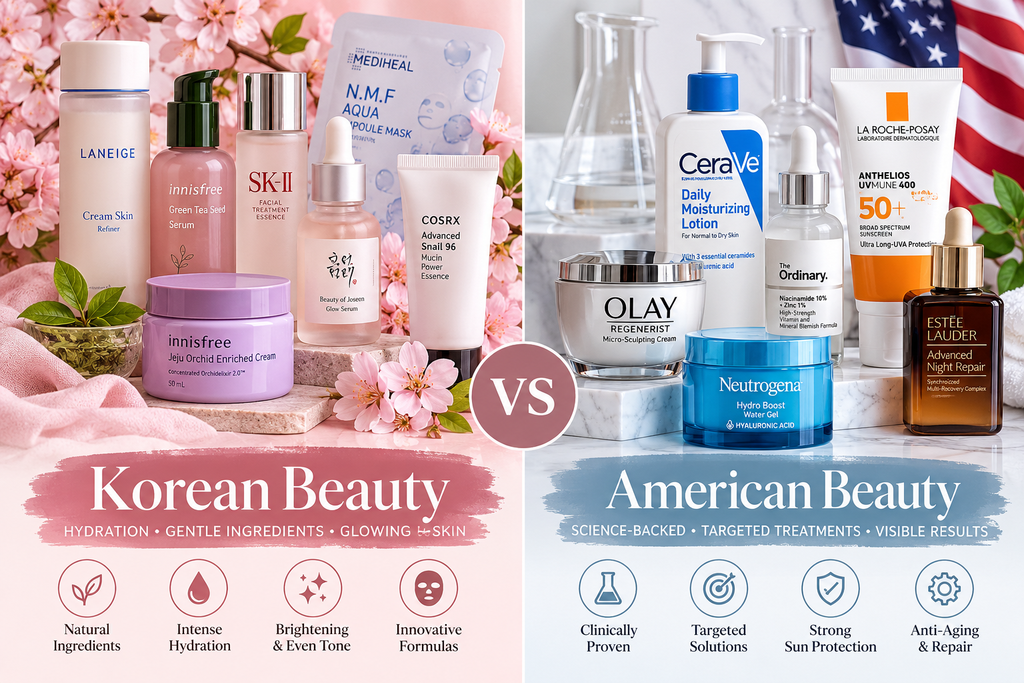
One major reason Korean skincare attracts attention is its interesting range of ingredients.
Some formulas combine familiar moisturizing ingredients with botanical extracts or fermented ingredients associated with Korean beauty traditions.
However, an unusual ingredient is not necessarily more effective than a well-established one.
Centella asiatica
Centella asiatica, often called cica, is widely found in Korean skincare.
It is commonly included in products marketed for soothing and comforting irritated-feeling skin.
Centella-containing moisturizers may appeal to consumers experiencing temporary dryness or visible redness.
However, the benefits depend on the product’s concentration, formulation, and the person’s skin.
Snail mucin
Snail secretion filtrate became particularly recognizable through Korean beauty products.
It is often used in hydrating essences and moisturizers.
Consumers may appreciate its slippery texture and moisturizing feel.
However, claims that snail mucin can dramatically erase wrinkles, remove acne scars, or replace proven treatments should be viewed cautiously.
Anyone concerned about allergies or ingredient sensitivities should carefully evaluate products containing snail-derived materials.
Rice extracts
Rice-derived ingredients are frequently included in Korean toners, creams, and masks.
They may function as moisturizing or conditioning ingredients, depending on the formula.
Their presence does not guarantee skin brightening or visible improvements in pigmentation.
Hyaluronic acid
Hyaluronic acid appears in both Korean and American skincare products.
It helps attract and retain water in formulations and is commonly used to improve the feeling of hydration.
A Korean hyaluronic acid serum is not automatically better than an American one. The overall formula and supporting ingredients matter more than the country printed on the package.
Ceramides
Ceramides are lipids naturally present in the outer layer of the skin.
They are frequently used in products designed to support the skin barrier and reduce moisture loss.
Ceramide-containing products are available from both Korean and American companies.
According to the American Academy of Dermatology, ceramides and hyaluronic acid are among the ingredients worth considering when choosing moisturizers for dry skin.
The verdict: Korean beauty offers an appealing variety of moisturizing and soothing formulas, but no ingredient becomes superior simply because it is associated with K-beauty.
According to the American Academy of Dermatology, choosing the right moisturizer depends on your skin type, with ingredients such as ceramides and hyaluronic acid worth considering.
5. Are American Beauty Ingredients More Effective?
American skincare products frequently emphasize active ingredients associated with specific skin concerns.
Some of these ingredients have been studied extensively.
Retinol and retinoids
Retinol is widely used in cosmetic products intended to improve the appearance of fine lines, uneven texture, and signs of aging.
Other retinoids may be available as medications.
They can be beneficial for certain skin concerns, but they can also cause dryness, peeling, and irritation.
It is usually better to introduce a retinoid gradually rather than combining it immediately with several other strong active ingredients.
People who are pregnant or planning pregnancy should avoid retinoids unless their clinician specifically directs otherwise.
Salicylic acid
Salicylic acid is commonly found in exfoliating products and certain acne treatments.
It helps remove dead skin cells and can be useful for clogged pores.
However, excessive use can irritate the skin.
Benzoyl peroxide
Benzoyl peroxide is a well-established acne-treatment ingredient available in American over-the-counter products.
It can be useful for inflammatory acne, although dryness and irritation are possible.
Niacinamide
Niacinamide, a form of vitamin B3, appears in many products from both countries.
Depending on the formulation, it may help improve the appearance of uneven skin tone, support the skin barrier, and regulate the appearance of excess oil.
Vitamin C
Vitamin C products are commonly marketed for antioxidant benefits and improving the appearance of uneven skin tone.
However, the results depend on the particular form of vitamin C, concentration, packaging, stability, and frequency of use.
American skincare is not inherently more effective because it uses stronger ingredients.
A product with a powerful active ingredient is only useful when it is appropriate for the person’s skin and used correctly.
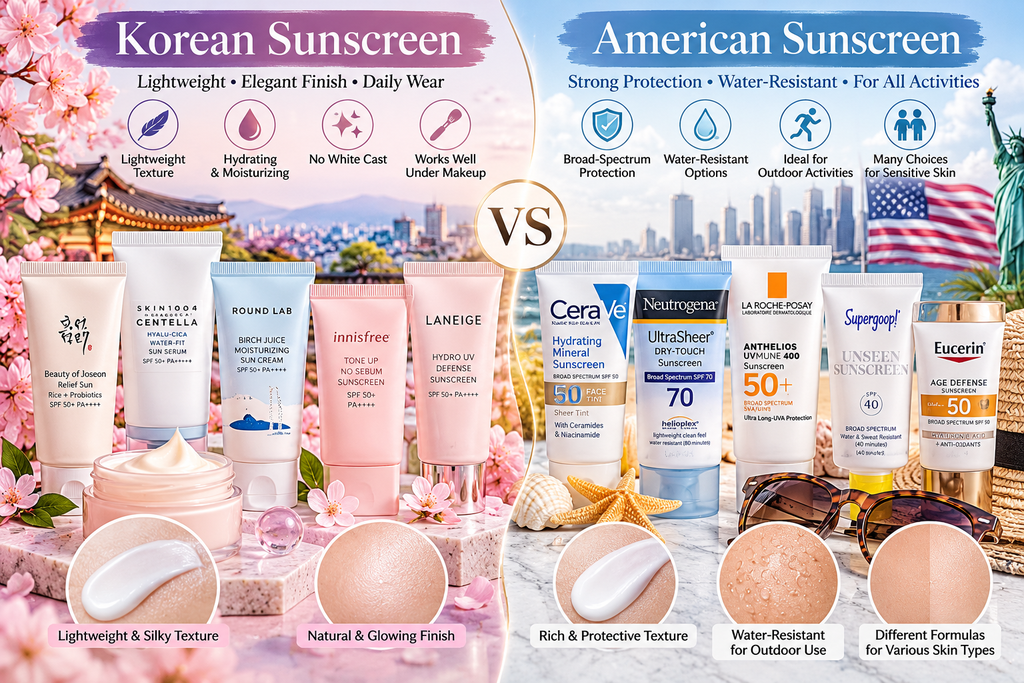
6. Korean Sunscreen vs. American Sunscreen: Which Is Better?
Sunscreen is one of the most interesting areas of comparison between Korean and American skincare.
Many Korean sunscreens are admired for their lightweight textures, comfortable finishes, and ability to work under makeup.
Some feel closer to a daily moisturizer than traditional sunscreen.
American sunscreen products offer a wide selection of mineral and chemical formulations, including options specifically designed for sports, swimming, outdoor activities, and sensitive skin.
Why do Korean sunscreens feel different?
Differences in available UV filters and formulation approaches have historically influenced sunscreen textures.
South Korea and the United States regulate sunscreen products differently.
In the United States, sunscreen products are regulated as over-the-counter drugs, rather than simply as ordinary cosmetics
Historically, some UV filters widely used in Asian and European sunscreen products were not available in American sunscreen formulations.
That regulatory landscape has begun changing. In 2026, bemotrizinol, a UV filter already used in other markets, entered the U.S. market following an FDA approval, expanding formulation possibilities.
This development demonstrates why older claims suggesting American sunscreens cannot use modern filters should not be repeated without checking current regulations.
Is SPF 50 better than SPF 30?
SPF 50 provides greater measured UVB protection than SPF 30 when products are properly applied, but the difference is not as dramatic as the numbers might suggest.
Broad-spectrum protection, adequate application, and regular reapplication matter significantly.
The American Academy of Dermatology recommends choosing a broad-spectrum sunscreen with SPF 30 or higher and reapplying approximately every two hours when outdoors, as well as after swimming or sweating.
Which sunscreen should Americans choose?
For everyday office use, commuting, or wearing makeup, a lightweight Korean-style sunscreen may be comfortable and convenient.
For swimming, hiking, or outdoor sports, a water-resistant sunscreen with appropriate U.S. labeling may be more practical.
A sunscreen sold in Korea should not automatically be assumed to meet all U.S. labeling requirements, even if the original product is well regarded.
The winner: Neither country universally wins. Choose a properly labeled sunscreen that you enjoy wearing consistently and that suits your exposure conditions.
The American Academy of Dermatology recommends broad-spectrum sunscreen with SPF 30 or higher as part of a daily skincare routine.
7. Are Korean Beauty Products Better for Sensitive Skin?
Sensitive skin requires careful product selection, regardless of where a product is manufactured.
Some Korean skincare products emphasize gentle moisturizing and minimal-feeling textures.
These products may work well for people who experience tightness, dryness, or discomfort from heavier skincare.
However, Korean products can still contain fragrances, essential oils, exfoliating acids, and botanical extracts that trigger irritation.
American brands also offer extensive fragrance-free product ranges designed for sensitive skin.
Important factors for sensitive skin
A suitable product should ideally have:
- A short, understandable ingredient list when possible
- No known personal allergens
- A comfortable texture
- Appropriate moisturizing ingredients
- Limited exposure to irritating ingredients
- Clear usage instructions
People with sensitive skin should not assume that “natural,” “clean,” or “botanical” automatically means safe.
The American Academy of Dermatology specifically cautions that natural ingredients can still trigger allergies or irritation.
A simple sensitive-skin routine
Morning:
- Wash with a gentle cleanser or rinse with water if appropriate.
- Apply a fragrance-free moisturizer.
- Finish with broad-spectrum SPF 30 or higher.
Evening:
- Cleanse gently.
- Apply a suitable moisturizing cream.
Optional products can be introduced slowly, one at a time.
The winner: Both Korean and American skincare can work well for sensitive skin. Fragrance-free, well-formulated products are more important than national origin.
8. Is Korean Skincare Better for Anti-Aging?
Anti-aging skincare is a major interest among American consumers, particularly those in their 40s, 50s, and beyond.
As skin matures, changes in moisture retention, collagen, elasticity, and natural oil production can make fine lines and dryness more noticeable.
Korean and American skincare approach these concerns in somewhat different ways.
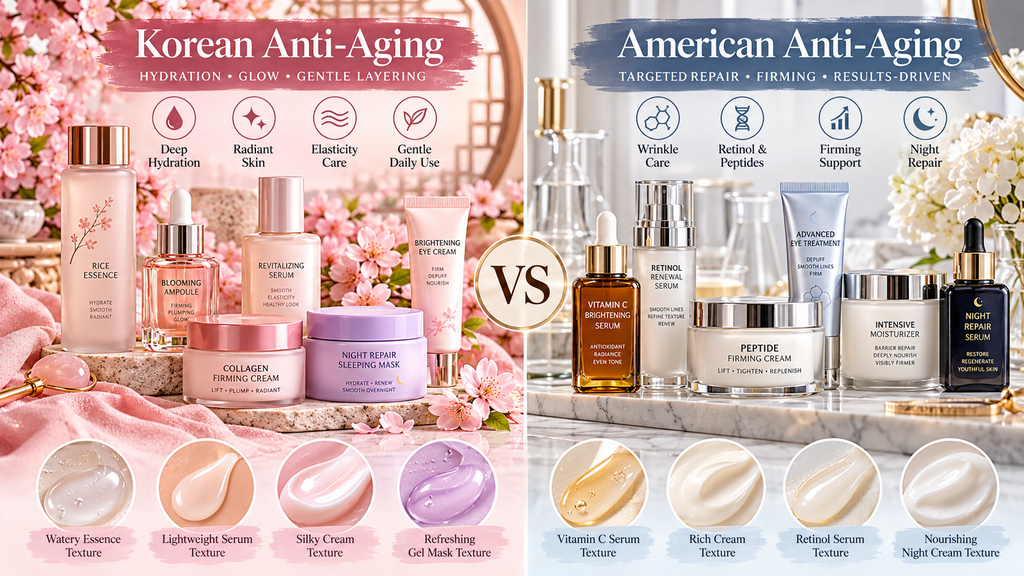
Korean anti-aging skincare
Korean anti-aging products commonly emphasize:
- Hydration and moisture retention
- A smoother-looking skin surface
- A dewy complexion
- Peptides and conditioning ingredients
- Gentle moisturizing routines
- Daily sun protection
A well-formulated Korean cream may temporarily make fine lines less noticeable by improving skin hydration.
This does not mean that the product permanently removes wrinkles.
American anti-aging skincare
American anti-aging products frequently emphasize:
- Retinol and other retinoids
- Vitamin C formulations
- Peptides
- Moisturizers containing ceramides
- Sunscreens
- Treatments targeting uneven texture
Some active ingredients have stronger clinical evidence for particular concerns than ordinary hydrating cosmetics.
However, using too many active ingredients can damage comfort and tolerance, making a skincare routine harder to maintain.
Which is better after age 50?
For mature skin, combining approaches may be especially practical.
For example, someone might use a gentle Korean hydrating essence, an American retinol product on selected evenings, and a nourishing moisturizer from either country.
Daily sun protection remains essential.
The American Academy of Dermatology identifies sun protection as one of the most important components of an anti-aging skincare routine.
The winner: Korean products may excel at delivering comfortable hydration, while targeted treatments commonly available from American brands may be useful for specific concerns. A combination can provide greater flexibility than choosing only one category.
The American Academy of Dermatology provides dermatologist-recommended skincare guidance for maintaining healthy skin and addressing visible signs of aging.
9. Are Korean Beauty Products Cheaper Than American Products?
Price is another important reason American shoppers explore Korean beauty.
Many Korean skincare brands offer attractively packaged toners, cleansers, moisturizers, and serums at accessible prices.
However, Korean products are not always cheaper.
Imported products may cost more because of shipping, retailer markups, international distribution, and availability.
American drugstore skincare also includes many affordable and effective options.
Typical skincare price ranges in the U.S.
The following figures are illustrative shopping-budget estimates, not live retail quotes or a formal market-wide price study.
| Product category | Korean beauty budget | American beauty budget |
|---|---|---|
| Facial cleanser | $8–$22 | $7–$20 |
| Hydrating toner | $10–$25 | $10–$28 |
| Facial serum | $12–$35 | $12–$45 |
| Daily moisturizer | $12–$35 | $10–$40 |
| Facial sunscreen | $12–$30 | $10–$35 |
| Face mask | $2–$8 each | $2–$10 each |
Prices vary by brand, size, retailer, promotion, and formula.
A $15 Korean serum is not necessarily a better deal than a $20 American serum.
A shopper should consider how much product is included, how frequently it must be used, and whether it replaces another step.
How to calculate real value
The most useful comparison is cost per unit combined with actual use.
For example, a 100-milliliter product selling for $20 may provide better value than a 30-milliliter product selling for $15.
However, a concentrated treatment used only a few times per week may last longer than a daily moisturizing serum.
The best purchase is the product that delivers a useful benefit at a sustainable cost.
10. Korean Glass Skin vs. American Minimalist Skincare
Glass skin is one of the most recognizable Korean beauty trends.
The term typically describes skin that looks smooth, luminous, hydrated, and reflective.
A glass-skin appearance is frequently associated with layering lightweight hydrating products.
An example routine might include a cleanser, toner, essence, serum, moisturizer, and sunscreen.
However, none of those optional layers is individually required to achieve healthy skin.
The American minimalist approach
A minimalist skincare routine prioritizes a smaller number of essential products.
It might include a cleanser, moisturizer, sunscreen, and one targeted treatment when needed.
This approach has practical advantages.
It can save money, reduce the time required for skincare, and limit exposure to unnecessary ingredients.
Dermatologists also caution that using too many products, especially multiple anti-aging treatments, can increase irritation.
Not everyone needs an essence, ampoule, sheet mask, exfoliator, eye cream, or sleeping mask.
Some people love the experience of a longer skincare routine.
Others find that three or four products provide everything they need.
Both approaches can be reasonable.
The most important factors are skin tolerance, product effectiveness, and consistency.
11. Which Beauty Products Are Better for Oily and Acne-Prone Skin?
Oily skin does not necessarily need aggressive cleansing.
In fact, repeatedly washing or stripping the skin can contribute to irritation.
Korean skincare offers many lightweight gels, watery toners, and non-greasy moisturizers that may feel comfortable on oily skin.
American brands provide a broad selection of acne treatments and oil-control products.
Korean beauty advantages
Lightweight moisturizing formulas may be appealing for people who dislike thick creams.
Some products include niacinamide and soothing ingredients.
American beauty advantages
Common over-the-counter acne medications include benzoyl peroxide, salicylic acid, and adapalene, depending on the product.
These ingredients can be useful for particular forms of acne when used appropriately.
A balanced routine for acne-prone skin
An example morning routine includes a gentle cleanser, lightweight moisturizer, and suitable sunscreen.
In the evening, a person may use a targeted acne treatment according to its instructions, followed by a moisturizer.
It is better to introduce one acne treatment at a time than to immediately combine multiple exfoliating products, retinoids, and strong cleansers.
People with persistent, painful, or scarring acne may need individualized medical treatment rather than additional cosmetic products.
The winner: Korean skincare offers attractive lightweight textures, while targeted acne medications sold in the U.S. can be especially useful when treatment is the goal.
12. Which Products Are Better for Dry Skin?
Dry skin often benefits from products that combine moisture-attracting ingredients with substances that reduce water loss.
Korean products frequently include hydrating toners, essences, and moisturizing creams designed for layering.
American products often include rich creams and ointments suitable for substantial dryness.
Neither approach is inherently superior.
Ingredients worth considering
Look for moisturizers containing appropriate combinations of:
- Glycerin
- Hyaluronic acid
- Ceramides
- Squalane
- Petrolatum
- Dimethicone
- Other suitable moisturizing ingredients
These ingredients serve different purposes.
Humectants help attract water, emollients improve skin feel, and occlusive ingredients help reduce moisture loss.
A practical dry-skin routine
A person with dry skin might use a Korean hydrating toner followed by an American fragrance-free moisturizing cream.
This combination can provide a comfortable first layer followed by a richer product that helps retain moisture.
Alternatively, a single well-formulated moisturizer may be enough.
Applying moisturizer to slightly damp skin can help improve hydration, as recommended by the American Academy of Dermatology.
13. Korean Makeup vs. American Makeup: Which Looks Better?
The beauty comparison extends beyond skincare.
Korean and American makeup trends have historically differed in their preferred finishes, colors, and application styles.
Korean makeup is often associated with soft, natural-looking skin, cushion foundations, delicate blush, tinted lips, and subtle eye makeup.
American makeup offers a wide variety of looks, ranging from minimal everyday makeup to high-coverage foundations and dramatic evening styles.
Korean makeup characteristics
Korean makeup commonly features cushion compacts, soft pink or peach blush, glossy lip tints, and luminous complexion products.
Cushion foundations can be convenient for touch-ups.
However, shade availability, coverage, and wear time differ significantly among brands.
American makeup characteristics
American makeup brands frequently offer extensive selections of traditional liquid foundations, concealers, setting powders, and long-wear products.
Some major American brands provide especially broad complexion-shade ranges.
Still, shade inclusivity varies from brand to brand in both markets.
Which makeup is better for mature skin?
Mature skin may look more comfortable with products that do not emphasize dryness or settle heavily into fine lines.
A lightweight Korean cushion foundation may appeal to some people.
Others may prefer an American serum foundation or a hydrating liquid formula.
The correct undertone, texture, coverage, and preparation matter more than national origin.
14. Are Korean Beauty Products Safe to Use in America?
Korean beauty products are not automatically unsafe because they are imported, and American products are not automatically safer because they are domestic.
Safety depends on ingredients, manufacturing quality, labeling, authenticity, and appropriate use.
In the United States, the FDA regulates cosmetics, although most cosmetic products and ingredients do not require FDA premarket approval. Certain color additives are an important exception.
Companies are responsible for complying with applicable laws and ensuring that marketed cosmetic products are safe under their intended conditions of use.
Important considerations for imported skincare
When purchasing imported skincare, consumers should examine the seller’s reputation, ingredient information, packaging, expiration details, and product condition.
Be especially careful with unfamiliar online sellers offering unusually low prices.
Counterfeit or improperly stored cosmetics may create avoidable risks.
Consumers should also understand that cosmetics and medications are different regulatory categories in the United States.
A product promoted for treating acne or providing sun protection may be subject to drug requirements rather than ordinary cosmetic rules.
Does FDA approval mean a skincare product works better?
Most regular moisturizers, cleansers, and cosmetic serums are not individually FDA-approved before entering the market.
Therefore, a claim such as “FDA-approved moisturizer” should be examined carefully.
Regulatory compliance does not prove that one country’s skincare products are universally more effective than another country’s products.
15. How to Build a Routine Using Both Korean and American Beauty Products
One of the simplest ways to benefit from the strengths of both markets is to build a combined skincare routine.
The goal is not to purchase as many products as possible.
Instead, choose products that address different needs without unnecessary overlap.
Morning routine
Step 1: Gentle cleansing
Use a cleanser that removes overnight oil and impurities without leaving the skin feeling uncomfortable.
A Korean low-foam cleanser or an American hydrating cleanser may work well.
Step 2: Optional hydrating toner
Apply a lightweight Korean toner if additional hydration improves comfort.
This step can be skipped.
Step 3: Optional treatment serum
Depending on individual needs, consider an appropriate niacinamide or vitamin C product.
Step 4: Moisturizer
Choose a lightweight gel or richer cream based on skin type and climate.
Step 5: Sunscreen
Finish with a broad-spectrum sunscreen with SPF 30 or higher, following the directions for adequate application.
Evening routine
Step 1: Remove makeup and sunscreen
A cleansing balm or oil can be useful for removing makeup and certain sunscreen formulas.
A second cleanser may be helpful, but double cleansing is not mandatory for everyone.
Step 2: Cleanse gently
Use a suitable facial cleanser.
Step 3: Apply a targeted treatment if needed
A retinol or other treatment can be introduced according to the product instructions and individual tolerance.
Step 4: Moisturize
Finish with a comfortable moisturizer that helps reduce dryness.
This routine provides flexibility without requiring ten products.
16. Common Mistakes Americans Make When Trying Korean Skincare
The growing popularity of Korean beauty has encouraged consumers to experiment with unfamiliar formulas.
Experimentation can be enjoyable, but several mistakes can lead to unnecessary spending or irritation.
Buying products because they are viral
A product trending on social media may not suit every skin type.
An influencer’s experience does not establish that a formula will work equally well for everyone.
Starting too many products at once
Introducing five new products simultaneously makes it difficult to identify the cause of irritation or breakouts.
Introduce products individually and observe how your skin responds.
Assuming gentle means irritation-free
A product marketed as soothing can still cause sensitivity.
Botanical ingredients, fragrances, and preservatives may trigger reactions in certain people.
Confusing hydration with acne treatment
A hydrating essence can improve moisture and comfort, but it should not automatically be considered a treatment for persistent acne.
Ignoring product size
Beautiful packaging can make a product seem luxurious, but a small bottle may not offer good value for daily use.
Expecting overnight results
Some moisturizing effects are noticeable quickly.
Other visible changes, particularly those involving uneven skin tone or texture, may take weeks or months.
Realistic expectations can prevent disappointment and unnecessary purchases.
17. Are Korean Beauty Products Worth Buying in the United States?
For many American consumers, Korean beauty products are worth considering.
They offer additional choices in textures, ingredient combinations, and moisturizing routines.
Someone who dislikes the heavy feeling of traditional creams may discover a lightweight moisturizer that makes everyday skincare more enjoyable.
Someone with dry skin may appreciate a hydrating essence used under a richer moisturizer.
However, imported products are not automatically necessary.
Excellent skincare can also be found at American drugstores without complicated routines or premium prices.
When Korean skincare may be a good choice
Korean products may be appealing when shoppers want elegant moisturizing textures, lightweight daily skincare, or a particular formula they cannot easily find elsewhere.
When American skincare may be a good choice
American products may be practical when consumers want convenient local availability, a familiar acne-treatment ingredient, a rich fragrance-free moisturizer, or a sunscreen formulated and labeled for specific outdoor conditions.
When combining products makes sense
A combined approach can be useful when different products address different needs.
For example, a Korean moisturizing serum can be paired with an American sunscreen or treatment.
There is no skincare rule requiring every product in a routine to come from the same country, brand, or collection.
18. The Final Verdict: Are Korean Beauty Products Better Than American Beauty Products?
So, are Korean beauty products better than American beauty products?
Korean beauty products are not universally better, but they can be better for certain people, preferences, and skincare goals.
Korean skincare has helped popularize enjoyable textures, hydration-focused routines, and accessible beauty products.
American skincare offers a broad range of effective formulations, targeted treatments, affordable moisturizers, and convenient purchasing options.
Both markets continue to innovate, and their strengths increasingly overlap.
For dry or dehydrated skin, a Korean hydrating product may feel particularly appealing.
For acne treatment, an appropriately selected over-the-counter medication may be more useful than a cosmetic serum.
For mature skin, a combination of consistent moisturizing, suitable treatments, and daily sun protection often makes more sense than choosing products based solely on their country of origin.
Consumers should prioritize their individual skin type, ingredient tolerance, the evidence supporting product claims, and their budget.
The secret to better skincare is not choosing Korea or America.
It is choosing products that work well together, using them consistently, and protecting the skin from unnecessary irritation and sun exposure.
The best skincare routine is one that your skin tolerates, your budget supports, and your daily life makes easy to maintain.
Frequently Asked Questions (FAQ)
1. Are Korean beauty products actually better than American products?
Not universally. Korean skincare is often recognized for lightweight hydration-focused formulas, while American skincare includes many targeted treatments and rich moisturizers. Individual formulations are more important than country of origin.
2. Why are Korean skincare products so popular in America?
Their popularity reflects several factors, including accessible pricing, appealing packaging, lightweight textures, social media exposure, and interest in Korean culture.
3. Is Korean skincare better for people over 50?
It can be a good option, especially for consumers seeking additional hydration. However, mature skin may also benefit from suitable targeted treatments, rich moisturizers, and daily sun protection.
4. Are Korean beauty products cheaper than American products?
Some Korean products are competitively priced, but shipping, import costs, and retailer markups can change the final price. American drugstore skincare also offers excellent value.
5. Is Korean sunscreen better than American sunscreen?
Some Korean sunscreens are appreciated for their cosmetic feel. American sunscreens offer many options for outdoor activities and water resistance. Protection, regulatory compliance, appropriate application, and consistent use matter more than origin.
6. Can I mix Korean and American skincare products?
Yes. Products from different countries can be combined as long as their ingredients and intended uses are compatible with the person’s skin.
7. Is a 10-step Korean skincare routine necessary?
No. Most people can build an effective foundation using a cleanser, moisturizer, and sunscreen, adding targeted treatments only when appropriate.
8. Are Korean skincare products good for acne-prone skin?
Some lightweight formulas may be comfortable for oily or acne-prone skin. However, persistent acne may require products containing established treatment ingredients or prescription care.
9. Which country has better anti-aging products?
Neither country consistently produces better anti-aging skincare. The evidence behind active ingredients, product formulation, and regular sun protection matters more.
10. Are Korean cosmetics FDA-approved?
Most ordinary cosmetics marketed in the United States do not require FDA premarket approval. Sunscreens and certain other products are regulated differently because they qualify as drugs under U.S. law.
11. What is the best Korean skincare ingredient?
There is no single best ingredient. Hyaluronic acid, centella asiatica, niacinamide, and ceramides may be useful in different formulations, depending on the skin’s needs.
12. Should beginners start with Korean or American skincare?
Beginners can start with affordable, gentle products from either market. A simple routine usually provides a better starting point than purchasing an entire collection.
Trusted References and Further Reading
The following sources provide additional information about skincare, product safety, and sun protection.
1. American Academy of Dermatology — Skin Care on a Budget — Guidance on affordable routines, moisturizing, cleansing, and sun protection.
2. American Academy of Dermatology — Skin Care Product Application Order — Advice on routine order and avoiding excessive product use.
3. American Academy of Dermatology — How to Pick the Right Moisturizer — Information on choosing moisturizing ingredients.
4. U.S. Food and Drug Administration — Cosmetics and U.S. Law — Official regulatory guidance for cosmetics marketed in the United States.
5. FDA — Cosmetics Safety Questions and Answers — Explanation of the differences between cosmetics and drugs.