How Korean semiconductor technology supports artificial intelligence—and why it matters to American consumers in 2026
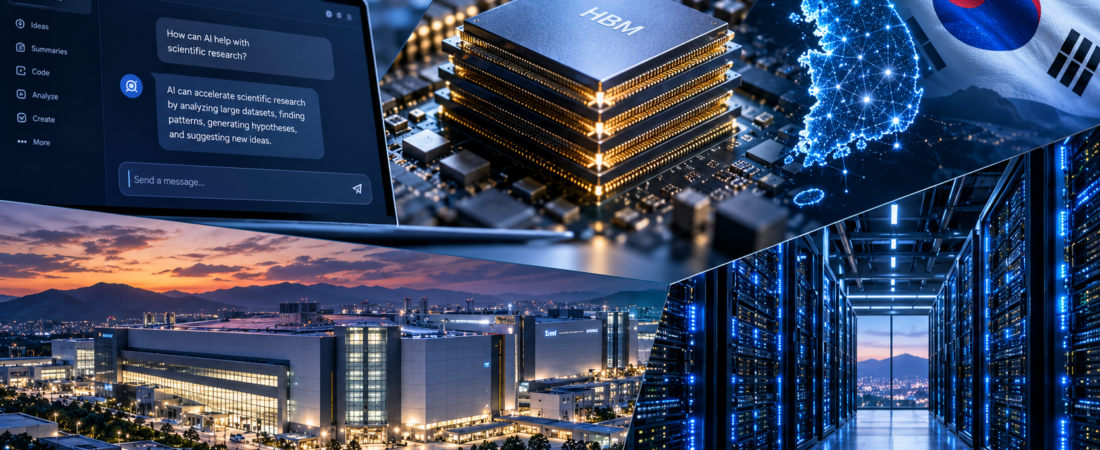
ChatGPT Memory Chips play an essential role in the powerful AI computing systems that help services like ChatGPT process questions and generate responses. South Korean semiconductor companies, including Samsung Electronics and SK hynix, are major suppliers of advanced memory technology used throughout the global AI industry.
When you use ChatGPT to write emails, plan vacations, manage household budgets, or run a small business, you may not realize how closely artificial intelligence is connected to South Korea’s semiconductor industry.
As AI demand grows in 2026, advanced memory chips are becoming increasingly important. This rising demand can influence computer prices, smartphone costs, and the long-term affordability of AI services for American consumers.
So, does ChatGPT need memory chips from South Korea?
The answer is that modern AI systems rely heavily on advanced memory technology, and South Korean companies are important suppliers to the global AI computing industry.
However, ChatGPT does not depend exclusively on Korean chips. Its computing infrastructure also relies on processors, networking systems, storage, software, and components developed and manufactured across several countries.
To understand this relationship, we need to examine what happens when someone asks ChatGPT a question—and why memory chips have become so important in 2026.
1. What Happens When You Ask ChatGPT a Question?
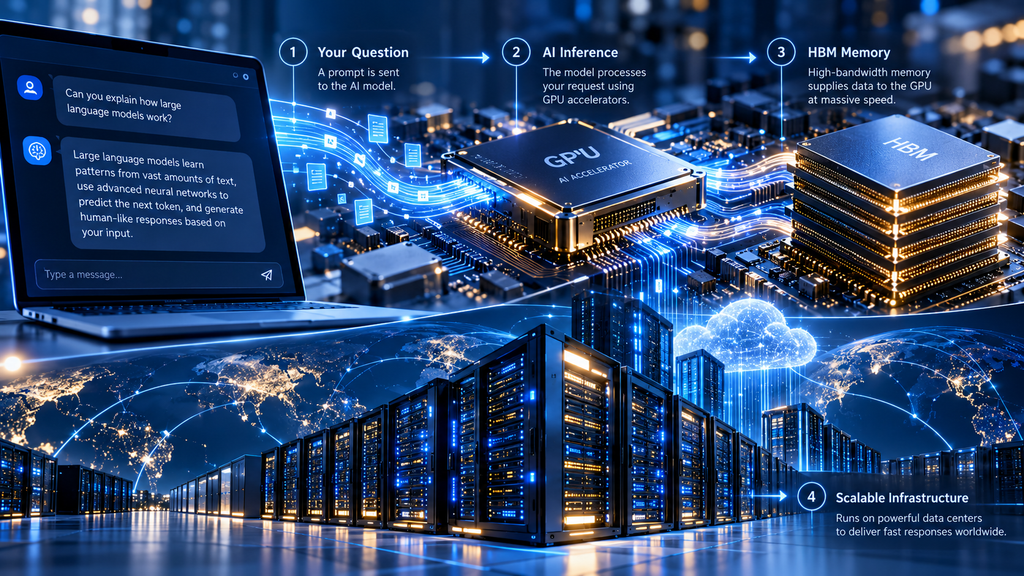
Imagine opening ChatGPT and asking:
“What is the best way to organize my monthly household budget?”
Your question does not normally require your personal computer to perform all the complicated calculations involved in generating the answer.
Instead, the request is processed using computing infrastructure that runs advanced AI models.
These systems perform mathematical operations to analyze the request and generate a response.
Many AI workloads use graphics processing units, commonly called GPUs, or other specialized AI accelerators.
A GPU can perform large numbers of calculations in parallel, making it useful for many machine-learning operations.
However, processors cannot perform these calculations efficiently without access to information stored in memory.
An AI system needs memory to hold model parameters, intermediate calculations, and other data required during processing.
The processor performs calculations, while memory supplies and temporarily holds the information involved.
Think of a restaurant kitchen.
The chef represents the processor. The ingredients and prepared items within easy reach represent information held in fast memory.
A highly skilled chef cannot work efficiently if ingredients arrive too slowly.
Similarly, a powerful AI processor can lose efficiency when memory cannot provide information fast enough.
This is one reason advanced memory chips are essential to modern AI infrastructure.
2. Why Are ChatGPT Memory Chips Important for AI?
ChatGPT is based on large artificial intelligence models.
These models learn mathematical relationships from training data and use their learned parameters to generate responses.
Some advanced models require significant computing resources to train and operate.
Memory plays several important roles.
Storing model parameters
AI models contain numerical parameters that influence how they process information.
During operation, relevant parameters must be accessible to computing hardware.
Depending on the model and system architecture, parameters may be distributed across multiple processors and memory devices.
Holding temporary calculations
AI systems repeatedly create temporary mathematical results.
Memory provides space to hold information needed during these operations.
Processing conversation context
When you ask multiple questions, an AI system may need to process earlier parts of the conversation alongside the current request.
Longer contexts can increase memory requirements, depending on the model architecture and optimization methods.
Serving many users
Large AI platforms must handle many simultaneous requests.
An individual response may be manageable, but millions of requests create major demands for computing capacity and memory.
This explains why AI infrastructure requires more than powerful processors.
Memory capacity, memory speed, software efficiency, networking, and the number of available computing systems all influence overall performance.
3. What Is HBM, and Why Is It Important for AI?
One of the most important technologies in modern AI computing is high-bandwidth memory, usually called HBM.
HBM is a specialized form of DRAM designed to transfer large amounts of data at very high speeds.
Unlike conventional desktop memory modules, HBM uses advanced manufacturing and packaging techniques.
Multiple memory dies are stacked vertically and connected using specialized electrical connections.
This design allows very high data bandwidth in a compact package.
Why bandwidth matters
Memory bandwidth describes how much data can move between memory and a processor within a given period.
Imagine two highways.
One has two lanes, while the other has sixteen.
When traffic is heavy, the wider highway can move many more vehicles simultaneously.
HBM serves a similar purpose by making it possible to move large amounts of data quickly.
For demanding AI workloads, that can improve processor utilization and reduce certain performance bottlenecks.
Does HBM make every ChatGPT response faster?
Not necessarily.
Response speed depends on several factors, including the model, server availability, processor performance, system load, networking, and software optimization.
HBM is an important component, but it does not independently determine the speed of every response.
It is more accurate to say that advanced memory helps AI infrastructure operate efficiently at scale.
4. Why Is South Korea So Important to AI Memory?
South Korea has spent decades building expertise in semiconductor manufacturing.
Two companies are especially important:
Samsung Electronics and SK hynix.
Both manufacture advanced memory products used in computing and electronic systems.
Their capabilities include DRAM, NAND flash, and high-bandwidth memory technologies.
Memory semiconductor manufacturing is difficult because it requires extraordinary precision, expensive equipment, and sophisticated engineering.
Manufacturers must repeatedly produce complex semiconductor structures while keeping defects extremely low.
South Korean companies developed significant advantages through long-term investment, engineering expertise, large-scale production, and relationships with global technology customers.
Samsung Electronics
Samsung produces a wide range of memory semiconductors and also operates businesses involving smartphones, electronic devices, and semiconductor foundry services.
Its semiconductor activities contribute to global computing infrastructure.
SK hynix
SK hynix is another major memory manufacturer with a particularly important role in HBM development.
Its advanced memory products are used in demanding computing applications, including AI acceleration.
Both companies compete internationally, including against U.S.-based Micron Technology.
This competition is important because a diverse supplier ecosystem can help customers manage technology requirements, production capacity, and supply risks.
For a broader comparison of the Korean companies, read TIPVERO’s SK Hynix Stock vs Samsung Electronics Stock: Why Investors Are Watching the AI and HBM Race.
For a closer look at the two companies, read our SK Hynix vs. Samsung Electronics comparison to understand how their AI memory strategies differ.
5. Does OpenAI Actually Work With Samsung and SK hynix?
Yes.
On October 1, 2025, OpenAI announced strategic partnerships with Samsung and SK as part of its Stargate AI infrastructure initiative.
The announcement identified advanced memory semiconductors as an important part of expanding AI computing infrastructure.
Samsung Electronics and SK hynix planned to increase production of advanced memory chips to support future AI development.
The announcement included a target associated with an accelerated rollout of 900,000 DRAM wafer starts per month.
A wafer start means beginning the manufacturing process on a silicon wafer; it does not mean that 900,000 completed HBM chips are produced each month.
The partnerships also addressed potential AI data center development in South Korea.
This is significant because it demonstrates a direct commercial and strategic relationship between an American AI developer and major Korean semiconductor companies.
However, the announcement should not be interpreted as proof that every ChatGPT request uses a specific Samsung or SK hynix chip.
Public information does not establish the exact memory manufacturer used for each response.
OpenAI’s infrastructure includes multiple cloud and hardware partners, and actual component configurations can vary.
The important conclusion is that Korean advanced memory manufacturing supports the broader infrastructure required to operate large-scale AI services.
6. South Korea vs. United States: Who Does What in AI?

The United States and South Korea have different but complementary strengths in the semiconductor ecosystem.
The United States is home to major AI software developers, processor designers, cloud computing companies, and semiconductor equipment businesses.
South Korea is particularly strong in large-scale memory manufacturing.
Neither country independently produces every component needed to build advanced AI infrastructure.
South Korea vs. United States AI Semiconductor Comparison
| Category | South Korea | United States |
|---|---|---|
| Major memory manufacturers | Samsung Electronics, SK hynix | Micron Technology |
| AI software ecosystem | Growing domestic developers and services | Major global AI model developers |
| AI processor design | Developing specialized chip capabilities | NVIDIA, AMD and other leading designers |
| HBM manufacturing | Major global production capability | Micron and a broader supporting ecosystem |
| Data center industry | Expanding AI infrastructure | Large cloud and AI infrastructure market |
| Semiconductor equipment | Domestic suppliers and international partners | Major equipment and design-tool companies |
| Primary strength | Advanced memory manufacturing | AI software, processor design and cloud platforms |
This comparison summarizes broad industrial strengths as of October 2026. It does not imply that one country dominates every category.
For consumers, international specialization makes advanced AI possible.
A single AI server may include American-designed processors, Korean memory, and components produced elsewhere.
Its performance depends on how effectively those technologies work together.
7. How Do ChatGPT Memory Chips Affect American Consumers?
The relationship between Korean memory chips and American AI technology has practical consequences.
Laptop and desktop computer prices
Computer manufacturers purchase memory components as part of their production costs.
When memory prices rise, manufacturers may face pressure to raise retail prices, reduce specifications, or absorb higher costs.
Consumers shopping for a new laptop may notice changes in available configurations or prices.
However, the final price also depends on competition, retailer discounts, processor costs, inventories, and other factors.
Smartphones and tablets
Mobile devices use memory to run applications and store information.
Strong demand for AI infrastructure can affect the broader semiconductor market, potentially influencing component availability and production planning.
The effect on individual smartphones varies by model, manufacturer, and purchasing agreement.
Small businesses
Small businesses increasingly use AI services for marketing, scheduling, writing, customer support, and research.
The companies providing these services pay for computing infrastructure.
If infrastructure costs increase, providers may eventually adjust prices, features, or service limits.
That possibility is different from a confirmed ChatGPT price increase.
Creative work and home businesses
People working from home may use AI to prepare product descriptions, organize online stores, generate marketing ideas, or edit digital content.
These activities benefit from affordable software and reliable computing services.
Understanding the hardware behind AI also helps small-business owners make smarter decisions about upgrading computers.
For many online businesses, paying for more expensive local hardware is unnecessary because much of the AI processing occurs remotely.
Education and everyday problem-solving
Students, parents, and older adults may use AI systems to understand complicated information or complete everyday tasks.
Efficient AI infrastructure can help expand access to these services.
However, affordability, service policies, accessibility, and digital literacy remain equally important.
8. Why Did Memory Chip Prices Become a Major Issue in 2026?
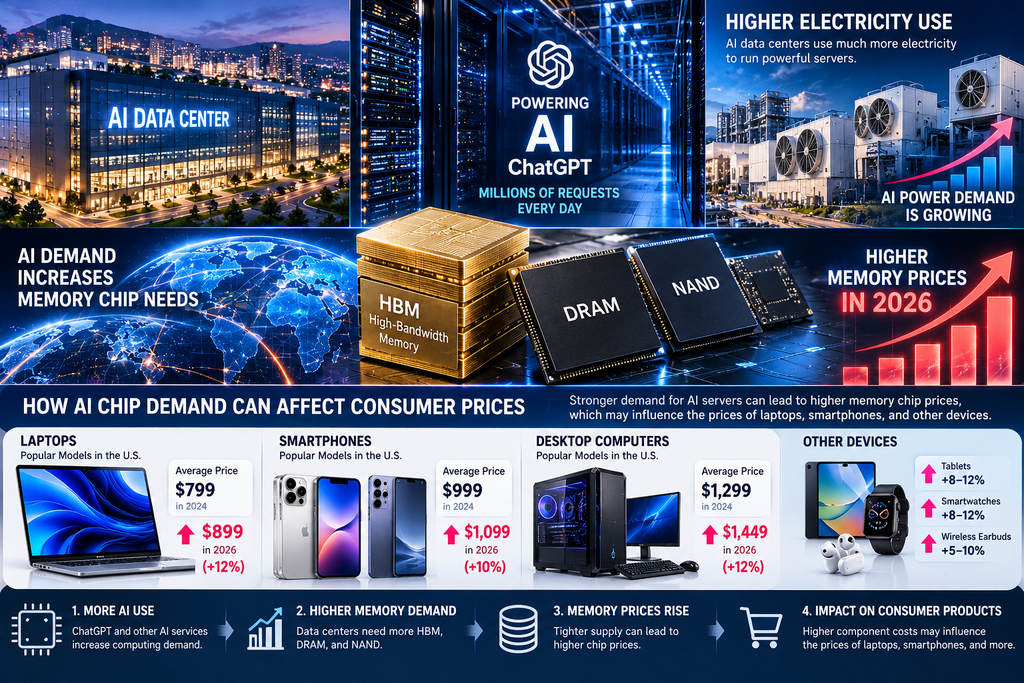
The AI infrastructure boom has increased demand for advanced memory.
Manufacturers must decide how to allocate equipment, manufacturing capacity, and investment across different memory products.
Producing more advanced HBM can affect the resources available for conventional DRAM.
This relationship has contributed to tight supply conditions.
According to TrendForce’s September 30, 2026 industry update, conventional DRAM contract prices were projected to rise between 10% and 15% quarter over quarter in the fourth quarter of 2026.
NAND flash contract prices were projected to increase between 15% and 20% during the same quarter.
These are forecasts for contract prices, not direct predictions of retail laptop or smartphone price increases.
Separately, Gartner reported on April 8, 2026 that global semiconductor revenue was projected to exceed $1.3 trillion in 2026, reflecting rapidly growing demand and memory price inflation.
Key 2026 Semiconductor Figures
| Indicator | 2026 Figure | Publication Date |
|---|---|---|
| Global semiconductor revenue | More than $1.3 trillion forecast | April 8, 2026 |
| Industry revenue growth | 64% forecast | April 8, 2026 |
| Conventional DRAM contract prices, Q4 | 10–15% quarterly increase forecast | September 30, 2026 |
| NAND flash contract prices, Q4 | 15–20% quarterly increase forecast | September 30, 2026 |
Sources: Gartner and TrendForce. All figures are industry forecasts published in 2026, not independently verified final full-year results.
These trends help explain why Korean memory manufacturers have become increasingly important to AI companies and ordinary technology buyers.
Memory costs are not the only concern. Learn how U.S. semiconductor tariffs could affect Samsung and SK hynix and potentially influence American technology prices.
9. What Is Changing With HBM4 in 2026?
Semiconductor technology continues evolving.
HBM4 represents a newer generation of high-bandwidth memory designed for increasingly demanding AI workloads.
It aims to provide greater bandwidth, improved efficiency, and higher memory performance.
On July 29, 2026, SK hynix announced that it had begun mass shipments of HBM4 during the second quarter.
That represented an important step in bringing next-generation memory technology into commercial AI infrastructure.
Samsung has also advanced its HBM4 technology and production.
These developments matter because faster memory can help powerful processors handle increasingly complex workloads.
However, introducing a new memory generation requires careful testing, manufacturing reliability, compatible hardware, and customer qualification.
The latest technology is not automatically the most suitable or cost-effective option for every computing system.
For consumers, HBM4 is primarily important because it contributes to future AI infrastructure rather than serving as an ordinary upgrade for a personal computer.
10. Is South Korea Building Semiconductor Facilities in the United States?
Korean semiconductor companies are also investing in American manufacturing and technology infrastructure.
One important example is SK hynix’s project in Indiana.
On August 28, 2026, SK hynix announced a groundbreaking ceremony for its planned HBM production and advanced packaging facility in West Lafayette.
The project involves an investment exceeding $4 billion.
The company stated that it planned to begin supplying next-generation HBM products from the U.S. facility during the second half of 2029.
The announcement also described plans to develop an ecosystem involving more than 100 partners and approximately 7,000 direct and indirect jobs.
Those job figures are projected contributions, not confirmed positions already filled.
This matters to Americans because semiconductor investments can generate opportunities in engineering, construction, equipment maintenance, research, manufacturing, and supporting services.
However, advanced manufacturing facilities take years to develop.
A groundbreaking ceremony does not mean a factory is already producing commercial quantities of chips.
The Indiana project also illustrates how American and Korean industries are becoming more closely connected.
11. Could Korean Memory Chips Make ChatGPT Cheaper?
Improved semiconductor technology may help reduce certain computing costs.
More efficient memory can support higher performance and potentially improve how much useful work an AI system performs per unit of energy or hardware spending.
However, the connection between memory technology and consumer subscription prices is complicated.
Operating an AI platform involves multiple expenses, including:
- Computing hardware and memory
- Data center construction and maintenance
- Electricity and cooling
- Networking and storage
- Software development and research
- Safety, security, and operational support
A reduction in one expense does not necessarily translate directly into a cheaper subscription.
AI companies may instead use efficiency improvements to provide more features, increase service capacity, or support more complex models.
Therefore, consumers should not assume that improved Korean semiconductor technology automatically guarantees lower ChatGPT prices.
The stronger conclusion is that memory innovation can improve the economic and technical foundations of large-scale AI services.
12. Will ChatGPT Always Depend on Korean Memory?
South Korea is likely to remain an important participant in the global memory industry, but the future supply chain is not fixed.
American, Korean, and other semiconductor companies continue investing in new manufacturing processes and memory architectures.
AI developers are also exploring ways to make models more efficient.
These include techniques that reduce memory requirements, improve caching, optimize calculations, and distribute workloads more effectively.
Future processors may use different combinations of memory technologies.
Some AI tasks may increasingly run on smartphones or personal computers, while others remain dependent on large data centers.
There are also significant risks.
Trade restrictions, manufacturing problems, natural disasters, energy limitations, and geopolitical tensions can affect global semiconductor production.
Competition may encourage innovation, but it can also create difficult investment cycles.
Ultimately, the resilience of AI infrastructure depends on technology, engineering, diversified suppliers, and responsible long-term planning.
13. What Should American Consumers Do in 2026?
Most people do not need to become semiconductor experts.
However, understanding a few practical points can help with technology purchases and everyday AI use.
Compare computer specifications before upgrading
If your current computer works well, you may not need a replacement simply because new AI technology is available.
Consider whether you actually need additional RAM, faster storage, or a more powerful processor.
Understand cloud AI versus local AI
Many AI services perform their most demanding calculations on remote servers.
Buying a more expensive laptop will not necessarily make a cloud-based ChatGPT response significantly faster.
Local AI applications have different hardware requirements.
Watch total costs
Compare subscription fees, computer prices, energy usage, and other expenses when choosing technology for work or personal use.
Avoid assumptions about semiconductor shortages
Not every technology product experiences the same supply conditions.
Retail pricing can differ considerably from industry-wide memory contract trends.
Focus on practical value
The most useful AI service is not always the one using the newest processor.
For ordinary people, reliability, affordability, ease of use, and accurate information may be more important.
Frequently Asked Questions
1. Does ChatGPT use memory chips made in South Korea?
ChatGPT runs on AI computing infrastructure that requires advanced memory. South Korean manufacturers are important suppliers of AI memory, and OpenAI has announced partnerships with Samsung and SK. However, the manufacturer of the memory used for each individual ChatGPT request is not publicly identified.
2. Does ChatGPT work without Korean semiconductors?
AI systems can operate using hardware from different suppliers and countries. Korean memory is highly important to the global industry, but ChatGPT is not exclusively dependent on one country’s semiconductor products.
3. What is the difference between HBM and regular RAM?
HBM is specialized high-bandwidth memory commonly integrated into advanced computing packages. Conventional RAM is used in everyday devices such as desktop and laptop computers. They serve related memory functions but have different designs, performance characteristics, costs, and applications.
4. Why do AI companies need Samsung and SK hynix?
Both companies have advanced memory manufacturing capabilities. AI infrastructure requires reliable, high-performance memory, making experienced semiconductor suppliers strategically important.
5. Will AI make laptops more expensive in 2026?
Strong AI demand has contributed to tight memory supply and higher component prices. This can influence laptop manufacturing costs, but retail prices also depend on other components, inventory, competition, and manufacturer decisions.
6. Can better Korean memory chips improve ChatGPT speed?
Improved memory bandwidth and efficiency can help AI systems perform certain workloads more effectively. However, the speed experienced by an individual user also depends on the AI model, server load, network performance, and software optimization.
7. Is SK hynix manufacturing AI memory in the United States?
SK hynix announced a groundbreaking ceremony for its Indiana HBM facility in August 2026. The company targets U.S. production and supply of next-generation HBM beginning in the second half of 2029. That future production target should not be confused with current commercial output from the facility.
8. Should Americans care about South Korea’s semiconductor industry?
Yes. Korean memory technology supports a global computing ecosystem that includes AI services, consumer electronics, enterprise computing, and cloud infrastructure. Changes in this industry can affect technology availability, business investment, employment opportunities, and component costs.
Conclusion: The Korean Technology Behind America’s AI Future
The next time you ask ChatGPT to solve a problem, write an email, or explain something complicated, remember that the experience depends on far more than software.
Behind the screen is an international technology ecosystem that combines advanced processors, sophisticated memory, data centers, and engineering expertise.
South Korea plays an important role in that system through companies such as Samsung Electronics and SK hynix.
Their semiconductor technologies help support the demanding computing systems used throughout the AI industry.
The connection became particularly clear when OpenAI announced strategic AI infrastructure partnerships with Samsung and SK in October 2025.
By 2026, growing AI demand had also made memory supply and semiconductor prices important economic issues.
For ordinary Americans, the implications extend beyond technology news.
They involve the cost of computers, the future of AI services, opportunities for American workers, and the affordability of digital tools used in everyday life.
ChatGPT may feel like a simple conversation, but the technology behind it connects American software innovation with semiconductor expertise from South Korea and around the world.
Understanding that relationship helps explain why small memory chips have become so important to the future of artificial intelligence.
Official Sources and References
1. OpenAI — Samsung and SK Join the Stargate Initiative
Published October 1, 2025. Official information about AI infrastructure partnerships and advanced memory supply.
https://openai.com/index/samsung-and-sk-join-stargate/
2. SK hynix — Second Quarter 2026 Financial Results
Published July 29, 2026. Includes company information about HBM4 mass shipments and AI memory development.
https://news.skhynix.com/en/q2-2026-business-results/
3. SK hynix — Indiana HBM Facility Groundbreaking
Published August 28, 2026. Official details about U.S. investment, projected employment, and future production plans.
https://news.skhynix.com/en/groundbreaking-ceremony-in-indiana/
4. Samsung Semiconductor — HBM4 for AI Computing
Official company announcement describing advanced HBM4 technology, manufacturing, and AI computing applications.
https://semiconductor.samsung.com/news-events/news/samsung-ships-industry-first-commercial-hbm4-with-ultimate-performance-for-ai-computing/
Additional Industry Data References
Gartner — Worldwide Semiconductor Revenue Forecast, April 8, 2026.
https://www.gartner.com/en/newsroom/press-releases/2026-04-08-gartner-forecasts-worldwide-semiconductor-revenue-to-exceed-us-dollars-one-point-3-trillion-in-2026
TrendForce — AI Server Demand and Memory Contract Prices, September 30, 2026.
https://www.trendforce.com/presscenter/news/20260930-13258.html
Research cutoff: October 27, 2026. Forecasts and planned investments are identified separately from completed results.