How Samsung, SK hynix, and Korean semiconductor technology influence your smartphone’s speed, storage, battery efficiency, AI features, and price in 2026.
Updated: October 28, 2026
Introduction: Your Smartphone May Have a Hidden Connection to South Korea
Understanding South Korean memory chips in smartphones helps consumers recognize how global technology affects the devices they use every day.
Every morning, millions of Americans reach for their smartphones before doing almost anything else.
They check messages, read the news, take photographs, open banking applications, navigate traffic, watch videos, and communicate with family members.
But have you ever wondered where the tiny memory chips inside your smartphone come from?
The answer may surprise you.
Even if your phone was designed by an American company or assembled outside South Korea, it could contain memory technology developed or manufactured by South Korean companies.
South Korean memory chips in smartphones play an important role in how smoothly modern devices operate.
Two major companies, Samsung Electronics and SK hynix, are important participants in the global semiconductor supply chain. Their technologies are found across smartphones, computers, servers, and other electronic devices.
This matters directly to your personal life.
The memory inside your phone influences how easily you switch between applications, how quickly large files load, how much information you can store, and how efficiently advanced AI features operate.
Memory-chip supply and pricing can also affect the cost of future smartphones, although retail prices depend on many additional factors.
Understanding where smartphone memory comes from is therefore about more than technology.
It helps explain the relationship between everyday American consumer products and South Korea’s advanced manufacturing industry.
What Are Memory Chips, and Why Does Your Smartphone Need Them?
South Korean memory chips in smartphones include advanced RAM and NAND flash technologies that support daily mobile activities.
Smartphones depend on several different semiconductor components.
One of the most important is the processor, which performs calculations and executes instructions.
However, a powerful processor cannot deliver a smooth experience without appropriate memory.
Smartphone memory generally falls into two major categories: RAM and flash storage.
RAM: The Memory Your Phone Uses While Running Apps
RAM stands for Random Access Memory.
Think of RAM as the workspace your smartphone uses while applications are operating.
When you open a messaging application, browse websites, edit photographs, or switch between several programs, the operating system uses RAM to keep active information readily accessible.
With insufficient RAM, the operating system may need to close background applications more frequently or reload content when you return to an app.
Modern smartphones typically use low-power DRAM technologies such as LPDDR5 or LPDDR5X.
These technologies are designed to provide fast access to information while reducing energy consumption.
The amount of RAM is important, but its speed, efficiency, and compatibility with the processor also matter.
Samsung explains how LPDDR memory technology improves performance and energy efficiency in modern mobile devices.
NAND Flash: The Storage That Keeps Your Files
NAND flash memory serves a different purpose.
It stores information even when your smartphone is switched off.
This includes photographs, videos, applications, downloaded music, and operating-system files.
When you purchase a smartphone advertised with 128GB, 256GB, or 512GB of storage, that capacity generally refers to its internal nonvolatile storage.
Samsung and SK hynix both participate in the development and production of NAND flash technologies.
These two types of memory work together to provide the smartphone experience consumers expect.
RAM vs. Storage: What Is the Difference?
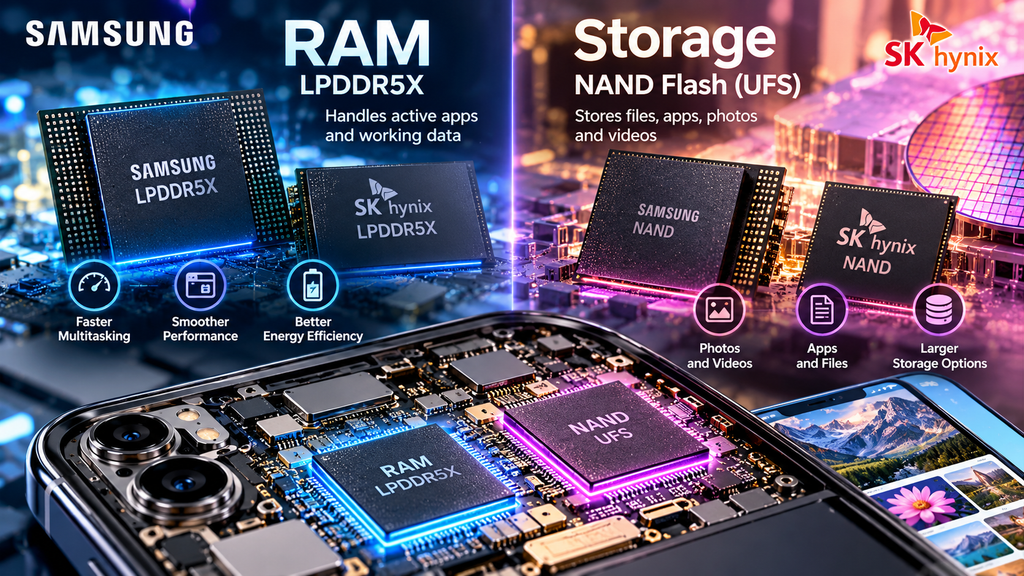
| Feature | RAM / LPDDR | NAND Flash Storage |
|---|---|---|
| Main purpose | Handles active applications and working data | Stores files, apps, photos, and videos |
| Keeps data when powered off? | No | Yes |
| Everyday benefit | Smoother multitasking | More room for content |
| Common technology | LPDDR5, LPDDR5X | NAND, often integrated into UFS storage |
| Example capacities | 8GB, 12GB, 16GB | 128GB, 256GB, 512GB |
| Korean manufacturers | Samsung, SK hynix | Samsung, SK hynix |
The capacities shown are illustrative examples, not statistics describing every smartphone sold in 2026.
Understanding this distinction can prevent an expensive purchasing mistake.
Someone who stores thousands of videos may need more storage rather than additional RAM.
Someone who frequently uses demanding applications may benefit from more RAM, a faster processor, or both.
Does Your iPhone Contain South Korean Memory Chips?
The use of South Korean memory chips in smartphones varies by manufacturer, model, and production batch.
The answer is that some iPhones do, but the exact supplier depends on the device and production configuration.
Apple designs many important components and technologies used in its devices, but it also relies on a global network of manufacturing partners.
Samsung and SK hynix are among the companies associated with memory supplies for Apple products.
However, consumers should not assume that every iPhone contains the same memory supplier.
Component sourcing can change between models, manufacturing periods, and batches.
A Confirmed Example From 2026
An especially useful example comes from the iPhone 17e.
On June 11, 2026, semiconductor-analysis company TechInsights published a teardown of the device.
Its analysis identified 8GB of SK hynix LPDDR5X RAM and 256GB of SK hynix NAND flash storage in the examined iPhone 17e.
This provides concrete evidence that South Korean memory technology is used in at least some modern iPhones.
However, a teardown establishes what was found in the examined device. It should not automatically be interpreted as proof that every production unit uses identical components.
That distinction matters because smartphone manufacturers frequently work with multiple suppliers.
For consumers, the practical lesson is simple: an American-designed smartphone can depend on sophisticated components supplied by South Korean manufacturers.
What About Samsung Galaxy Smartphones?
Samsung offers an especially interesting example because the company operates in several major technology businesses.
It designs and sells Galaxy smartphones while also operating a major semiconductor division.
Samsung’s semiconductor operations develop DRAM, NAND flash, and other electronic components.
This creates opportunities for Samsung to incorporate technologies from its broader business into consumer devices.
But owning both a smartphone business and a semiconductor business does not mean every Galaxy model necessarily uses Samsung-manufactured memory.
Component choices can differ according to model, region, availability, cost, and technical requirements.
The important point is that Samsung participates on both sides of the industry.
It helps manufacture smartphones and develops the memory technologies that support modern mobile computing.
Why Are South Korean Memory Chips in Smartphones So Important?
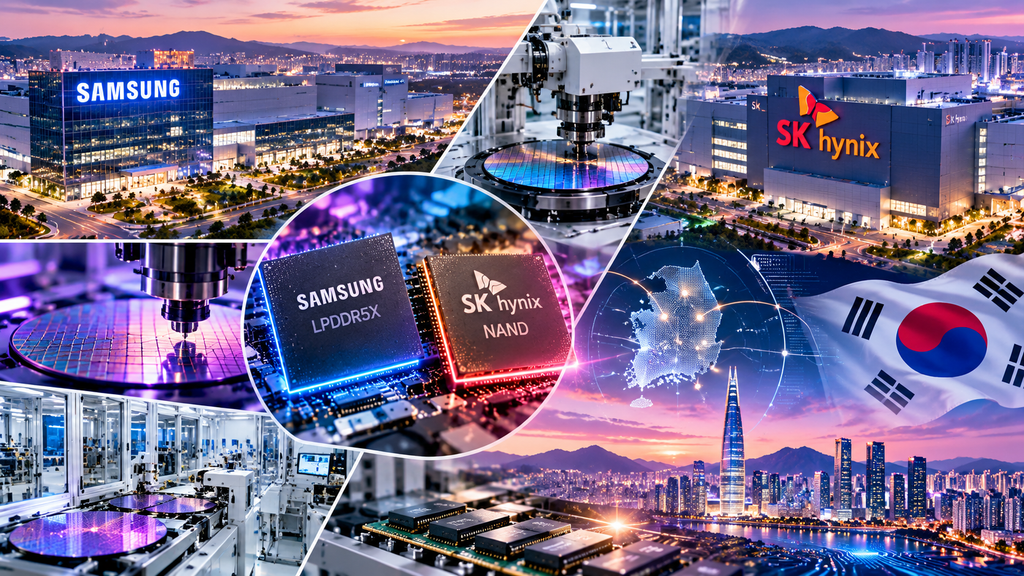
South Korea has spent decades building expertise in advanced semiconductor manufacturing.
Memory-chip production requires extraordinary precision.
Modern facilities use advanced equipment and complicated manufacturing processes to produce microscopic electronic structures in enormous quantities.
Manufacturers must balance performance, energy efficiency, manufacturing yield, reliability, and cost.
Samsung Electronics and SK hynix have developed significant capabilities in these areas.
Their technological strengths also extend beyond smartphones.
Both companies are involved in memory products used for data centers and AI computing.
This creates a connection between the smartphone in your pocket and the rapidly expanding infrastructure supporting artificial intelligence.
Samsung Electronics
Samsung’s semiconductor business offers a broad portfolio of memory products, including mobile DRAM, NAND flash, and advanced memory for computing systems.
Its position in the industry is supported by extensive manufacturing operations, research, and ongoing investment in semiconductor development.
SK hynix
SK hynix is another major South Korean semiconductor manufacturer.
The company produces DRAM and NAND technologies, including advanced memory designed for demanding computing environments.
Its growing importance in AI-related memory has also attracted attention to the wider South Korean semiconductor industry.
Although AI data-center products differ from smartphone memory, both industries depend on sophisticated memory manufacturing capabilities.
What Did South Korean Chipmakers Report in 2026?
Recent corporate financial announcements illustrate the scale and momentum of South Korea’s semiconductor industry.
Samsung’s Second-Quarter 2026 Results
On July 30, 2026, Samsung Electronics released its results for the quarter ended June 30, 2026.
Samsung reported consolidated quarterly revenue of approximately 171.5 trillion Korean won and operating profit of approximately 89.5 trillion won.
Its semiconductor business reported strong performance as demand for advanced memory and computing technologies increased.
These are company-wide financial results, not smartphone-memory revenue figures.
Nevertheless, they demonstrate the scale of Samsung’s technology operations.
These figures were published in Samsung Electronics’ official second-quarter 2026 financial results, released on July 30, 2026.
SK hynix’s Second-Quarter 2026 Results
On July 29, 2026, SK hynix announced preliminary results for the same quarter.
The company reported revenue of approximately 79.32 trillion won and operating profit of approximately 60.54 trillion won.
The announcement emphasized strong demand for advanced memory associated with AI infrastructure and related computing applications.
Again, these figures describe the company’s overall operations rather than smartphone memory alone.
The results are documented in the SK hynix second-quarter 2026 earnings announcement, released on July 29, 202
https://news.skhynix.com/en/q2-2026-business-results/?utm_source=chatgpt.com
For a deeper comparison of both companies, explore our analysis of SK hynix stock vs. Samsung Electronics stock and the AI memory race.https://tipvero.com/sk-hynix-stock-vs-samsung-electronics-stock/?utm_source=chatgpt.com
2026 Comparison Table
| Company | Reporting period | Revenue | Operating profit | Announcement date |
|---|---|---|---|---|
| Samsung Electronics | Q2 2026 | KRW 171.5 trillion | KRW 89.5 trillion | July 30, 2026 |
| SK hynix | Q2 2026 | KRW 79.32 trillion | KRW 60.54 trillion | July 29, 2026 |
Sources: Official company results. Reporting period: April 1–June 30, 2026. These are consolidated company figures, not comparable smartphone-memory market shares or mobile-memory-only sales. SK hynix described its results as preliminary at the announcement date.
The major takeaway is that advanced memory has become increasingly important across multiple technology markets.
For smartphone buyers, the key issue is how the competition for manufacturing resources, technology, and supply eventually affects consumer devices.
How Do Korean Memory Chips Affect Smartphone Performance?
South Korean memory chips in smartphones contribute to efficient multitasking, data access, and modern mobile computing.
Many people evaluate a new smartphone by looking at its camera or processor.
Memory deserves attention, too.
1. Faster Application Switching
When a phone has adequate RAM, it can keep more working information readily accessible.
That can reduce unnecessary application reloads.
The effect depends on the operating system, processor, and application behavior, not RAM capacity alone.
2. Smoother Multitasking
People often switch between messaging, navigation, shopping, banking, and photography.
Efficient memory supports these activities by providing rapid access to active data.
3. Better Support for Mobile Gaming
Games frequently process large amounts of information, including textures, animations, and interactive environments.
Memory capacity and bandwidth can influence how efficiently a device handles these demands.
However, graphics performance, thermal design, and the processor remain critical.
4. Improved Energy Efficiency
Mobile DRAM is engineered specifically for battery-powered devices.
Samsung describes LPDDR memory as a technology designed to deliver strong performance with reduced power consumption.
That can help manufacturers design more energy-efficient devices.
It does not mean that upgrading from one memory generation automatically produces a particular increase in battery life.
Real-world battery performance also depends on the display, software, wireless connections, processor, and battery condition.
How Is Artificial Intelligence Changing Smartphone Memory?
As on-device artificial intelligence expands, South Korean memory chips in smartphones are becoming increasingly relevant to mobile performance.
Artificial intelligence is changing how people use smartphones.
Modern devices increasingly offer features involving image editing, transcription, translation, writing assistance, search, and automated photo organization.
Some of these features process information on the device itself.
Others rely partly or primarily on cloud computing.
When AI functions run locally, memory bandwidth, capacity, and power efficiency become important technical considerations.
A local AI model may need rapid access to substantial amounts of data.
Efficient memory can help support responsiveness while limiting energy use.
Requirements vary according to the AI model, application design, and whether computation occurs locally or in the cloud.
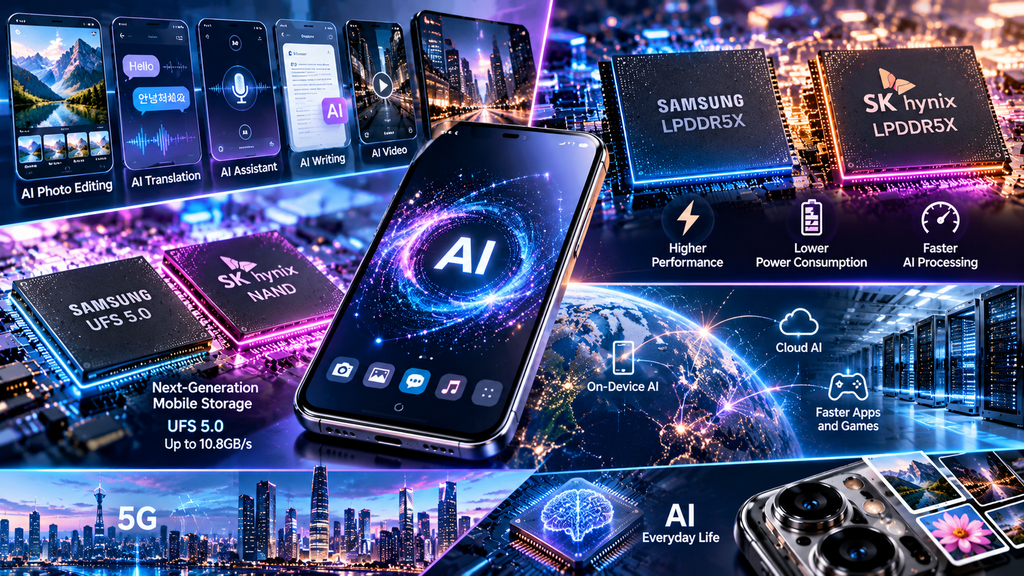
Samsung’s UFS 5.0 Announcement in 2026
On June 23, 2026, Samsung announced development of a UFS 5.0 mobile storage solution with a stated data-transfer speed of 10.8GB per second.
According to Samsung’s official UFS 5.0 announcement on June 23, 2026, the technology supports data-transfer speeds of up to 10.8GB/s for future mobile devices.
Samsung positioned the technology as an advancement for future on-device AI applications.
This figure describes the announced technology’s performance, not the storage speed of every smartphone currently on sale.
Its significance is that high-performance mobile storage is becoming more important as advanced applications evolve.
Consumers may eventually benefit through faster data access and more responsive software experiences, depending on how manufacturers integrate the technology.
Could Korean Memory Chips Affect Smartphone Prices in America?
Yes, but the connection is indirect.
Memory chips represent one component of a smartphone’s total manufacturing cost.
A smartphone also contains a processor, display, camera modules, battery, wireless components, sensors, and many smaller parts.
Manufacturers must additionally account for assembly, distribution, software development, marketing, and other expenses.
When memory prices rise, smartphone manufacturers may face additional cost pressure.
They can respond by negotiating contracts, reducing other expenses, changing configurations, accepting lower margins, or increasing retail prices.
Not every increase in semiconductor prices reaches consumers.
However, a sustained rise in component costs can influence the economics of smartphone production.
To learn how U.S. trade policy could influence the semiconductor supply chain, read our guide to U.S. semiconductor tariffs and their impact on Samsung and SK hynix in 2026.https://tipvero.com/us-semiconductor-tariffs-samsung-sk-hynix-2026/?utm_source=chatgpt.com
Why AI Demand Matters
AI infrastructure uses enormous quantities of specialized memory.
Some high-performance memory products require manufacturing resources related to those used across broader DRAM production.
This can influence how semiconductor companies allocate investments and capacity.
It does not mean that one AI-server memory chip directly replaces one smartphone chip.
The relationship is more complicated.
Manufacturers balance product demand, factory capacity, manufacturing technology, and profitability.
Over time, those choices can influence the availability and pricing of memory across different markets.
South Korean Memory vs. Other Global Suppliers
South Korea is extremely important in memory manufacturing, but it is not the only source.
American company Micron also develops major DRAM and NAND technologies.
Japan-based Kioxia is another important participant in the flash-memory industry.
Different manufacturers compete across capacity, power efficiency, speed, pricing, reliability, and supply agreements.
| Company | Headquarters country | Major memory activities |
|---|---|---|
| Samsung Electronics | South Korea | DRAM, NAND, advanced memory |
| SK hynix | South Korea | DRAM, NAND, advanced memory |
| Micron Technology | United States | DRAM, NAND |
| Kioxia | Japan | NAND flash |
This table identifies major companies and product categories; it does not rank smartphone market share.
Competition between suppliers can benefit smartphone manufacturers by providing sourcing choices.
For consumers, diversification can support supply resilience, although it cannot eliminate shortages or price volatility.
Are South Korean Memory Chips Actually Manufactured in Korea?
Not necessarily.
This is an important distinction.
A memory chip can be designed by a South Korean company without being manufactured inside South Korea.
Major semiconductor companies operate complex international manufacturing networks.
Production, packaging, testing, and final device assembly can occur in different countries.
For example, identifying SK hynix as the supplier of a memory chip does not by itself establish the geographic location of the factory where that individual chip was produced.
Similarly, a Samsung-branded component is not automatically evidence of Korean manufacturing origin.
If geographic origin matters for a particular product, consumers need model-specific or component-specific evidence.
It is more accurate to distinguish between South Korean memory technology, South Korean suppliers, and chips physically manufactured in South Korea.
How Can You Find Out Who Made the Memory in Your Smartphone?
Most smartphones do not prominently display the brand of their internal memory chips.
A settings page typically shows available RAM or storage capacity rather than the physical manufacturer.
Some diagnostic tools may provide technical information, but software results are not always definitive.
Independent device teardowns can be useful because researchers physically examine internal components.
Even then, manufacturers may change suppliers between production batches.
If you want to investigate a particular smartphone, start with its exact model number and look for reputable component-level analysis.
Avoid assuming that all phones bearing the same commercial name contain identical memory components.
What Should Consumers Consider Before Buying a New Smartphone?
Consumers usually do not need to choose a smartphone based solely on whether its memory comes from Samsung, SK hynix, or another manufacturer.
The overall device experience matters more.
Consider your everyday usage.
If you primarily make calls, browse websites, and send messages, a mainstream smartphone may provide all the performance you need.
If you create high-resolution videos or download large amounts of media, storage capacity may be especially important.
If you frequently use demanding games, professional editing tools, or advanced on-device AI applications, memory capacity and performance may deserve more attention.
Also consider how long you plan to keep the device.
Many modern smartphones do not offer user-upgradeable RAM or internal storage.
Buying sufficient capacity at the beginning may help avoid limitations later.
Practical Buying Checklist
Before purchasing, ask yourself:
- Do I need more storage for photographs and videos?
- Am I regularly switching between demanding applications?
- Will I use advanced AI features on the device?
- How long do I intend to keep this phone?
- Does the higher-memory model offer practical value for its additional price?
These questions are more useful than selecting a phone simply because a particular semiconductor brand appears inside it.
Why This Matters for Everyday American Life
South Korean semiconductor technology illustrates how interconnected American daily life has become with global manufacturing.
A person may use an American-designed smartphone, connect through a telecommunications network built with international equipment, store family photographs using globally sourced memory, and access AI services running on computers containing specialized memory from several countries.
The entire experience depends on international cooperation.
When semiconductor manufacturing improves, consumers can benefit from more capable devices.
When supply chains become strained, costs and product availability may be affected.
When manufacturers introduce energy-efficient components, device makers gain additional opportunities to improve power consumption.
The relationship between South Korean memory companies and American consumers is therefore much closer than it first appears.
For most people, the relevant question is not whether every individual chip was produced in a particular country.
It is how global semiconductor innovation continues to shape the technology they use every day.
Frequently Asked Questions
1. Does every iPhone contain South Korean memory chips?
No universal conclusion can be made. Apple uses a global supply network, and memory suppliers can vary. A June 2026 teardown identified SK hynix RAM and NAND in an examined iPhone 17e, but that does not establish the supplier for every iPhone.
2. What South Korean companies make smartphone memory?
Samsung Electronics and SK hynix are two important manufacturers of memory technologies used across mobile and other computing devices.
3. Is smartphone RAM the same as storage?
No. RAM holds information needed by active applications, while NAND flash storage retains applications, photos, videos, and other files when the device is powered off.
4. Do Korean memory chips improve battery life?
Efficient mobile-memory technology can help reduce power consumption. Actual battery life depends on the complete device design, including software, processor, display, connectivity, and battery condition.
5. Are Samsung memory chips used only in Samsung phones?
No. Samsung’s semiconductor products serve broader technology markets. However, specific supply relationships vary by product and production period.
6. Can AI make smartphones need more memory?
Yes. Some on-device AI workloads benefit from additional RAM, bandwidth, and efficient storage. Requirements vary according to the AI model, application design, and whether computation occurs locally or in the cloud.
7. Will semiconductor shortages make smartphones more expensive?
They can create cost pressure, but higher retail prices are not guaranteed. Manufacturers may absorb costs, change suppliers, adjust configurations, or change pricing.
8. Can I upgrade my smartphone’s RAM later?
Usually not. Modern smartphone RAM is generally integrated into the device design and is not user-upgradeable. Buyers should select an appropriate configuration when purchasing.
9. Does a Korean semiconductor brand mean the chip was made in Korea?
No. The company’s country of headquarters and an individual chip’s physical manufacturing location are different questions.
10. Why should Americans care about South Korean memory technology?
Because it contributes to devices and computing systems they use daily. Semiconductor innovation and supply conditions can influence smartphone performance, purchasing choices, product development, and the wider digital economy.
Conclusion: Your Smartphone Connects You to a Global Technology Industry
South Korean memory chips in smartphones demonstrate how semiconductor innovation connects South Korea with the everyday digital lives of American consumers.
The smartphone in your pocket represents the work of companies and engineers from around the world.
South Korean memory manufacturers play an important role in that ecosystem.
Samsung Electronics and SK hynix develop technologies that support modern mobile devices, while recent hardware analysis confirms the use of Korean-supplied memory in specific iPhone models.
The practical effects reach into everyday activities: storing family photographs, switching between applications, using navigation, watching videos, and exploring increasingly advanced AI tools.
Memory alone does not determine whether a smartphone is good or bad.
But understanding it helps explain why two phones with similar-looking designs may offer different capabilities, and why changes in the global semiconductor industry can eventually reach consumers.
The next time you use your smartphone, remember that some of its most important technology may have a connection to South Korea.
That connection is one small example of how global innovation shapes everyday life in America.