
NVIDIA South Korean memory chips are essential to the global artificial intelligence industry, helping power advanced AI processors, high-performance data centers, and next-generation computing systems. South Korean semiconductor leaders SK hynix and Samsung Electronics develop high-bandwidth memory (HBM) technology that helps NVIDIA GPUs process enormous amounts of data efficiently.
As demand for artificial intelligence continues to grow in 2026, the relationship between NVIDIA and South Korean memory manufacturers is becoming increasingly important. This connection affects not only AI technology but also U.S. businesses, cloud computing costs, semiconductor supply chains, and the global economy.
But why does NVIDIA depend on South Korean memory chips, and how could this relationship influence American consumers?
1. Why Are NVIDIA South Korean Memory Chips Important?
NVIDIA depends on South Korean memory manufacturers because advanced AI processors need enormous quantities of high-speed memory, and South Korea is home to some of the world’s leading HBM producers.
NVIDIA primarily designs GPUs, computing systems, and software platforms. It does not independently manufacture every component used in its products.
Instead, it works with a worldwide network of semiconductor manufacturers, packaging specialists, and technology suppliers.
1.1 GPUs need more than processing power
A GPU performs large numbers of calculations simultaneously.
This makes GPUs useful for training and operating artificial intelligence models.
However, a processor cannot calculate efficiently if the data it needs arrives too slowly.
Imagine an extremely fast chef working in a professional kitchen.
Even with extraordinary cooking skills, the chef cannot prepare hundreds of meals if ingredients arrive one item at a time.
The GPU is the chef, while memory supplies the ingredients.
HBM helps ensure that data can move rapidly enough to keep advanced processors productive.
1.2 Why South Korean companies are important
SK hynix and Samsung have spent decades developing advanced semiconductor memory.
Their expertise includes DRAM manufacturing, vertical chip stacking, energy efficiency, advanced packaging, and extremely precise manufacturing processes.
These capabilities are difficult and expensive to establish.
In 2026, South Korean manufacturers remain central to the production of HBM for AI applications.
However, NVIDIA does not depend exclusively on South Korea. U.S.-based Micron is another important HBM supplier and announced volume production of HBM4 designed for NVIDIA Vera Rubin in March 2026.
The distinction matters because NVIDIA’s strategy involves multiple suppliers rather than relying on one country or company for every memory component.
2. What Is High-Bandwidth Memory (HBM)?
High-bandwidth memory is a specialized form of DRAM designed to deliver extremely high data-transfer rates in a compact physical package.
Unlike conventional memory modules found in many desktop computers, HBM uses vertically stacked memory dies connected through advanced interconnection technology.
Understanding NVIDIA South Korean memory chips begins with high-bandwidth memory (HBM), a technology that helps AI processors access enormous amounts of data quickly.
2.1 How HBM works
Traditional memory systems often place memory chips on separate modules connected to the processor through a comparatively long electrical pathway.
HBM stacks memory dies vertically and places memory stacks close to the processor through advanced packaging.
This arrangement enables very wide data interfaces, helping move large amounts of information between memory and the processor.
The result can be substantially higher bandwidth and improved energy efficiency for suitable workloads.
HBM is particularly valuable in AI accelerators, high-performance computing, and certain advanced graphics applications.
2.2 Why AI needs enormous memory bandwidth
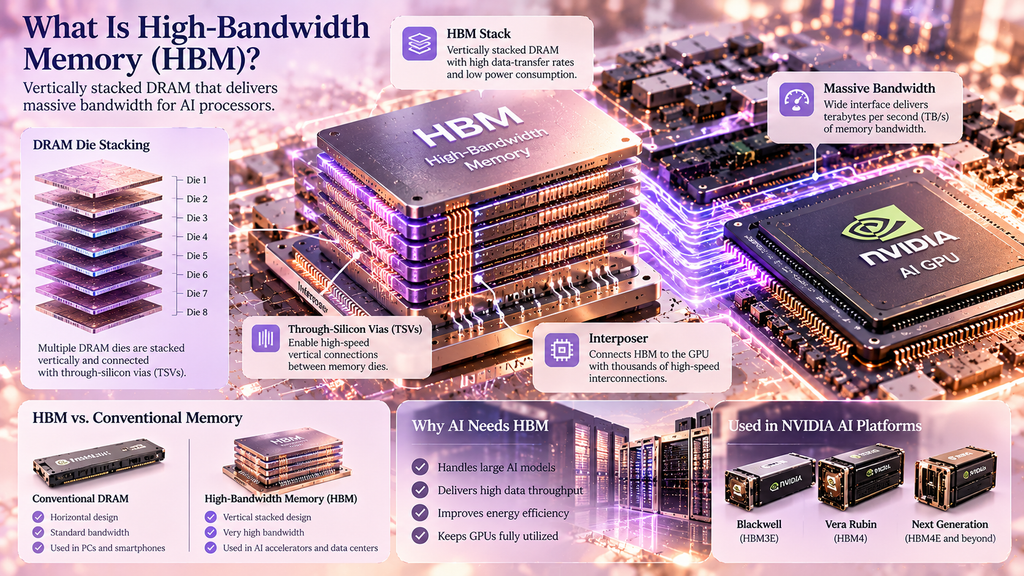
AI models perform mathematical operations involving large numbers of parameters and intermediate values.
During model training, processors repeatedly access data associated with calculations.
During AI inference, memory is needed for model weights, intermediate activations, and attention-related data.
For large language models, memory bandwidth can become a major performance bottleneck.
Adding more compute units without supplying enough data may deliver disappointing results.
2.3 HBM vs. ordinary smartphone memory
| Feature | High-Bandwidth Memory (HBM) | Smartphone LPDDR Memory |
|---|---|---|
| Main purpose | High-performance AI and computing | Mobile applications and multitasking |
| Typical environment | AI accelerators and data centers | Smartphones and portable devices |
| Architecture | Vertically stacked memory close to processors | Low-power mobile DRAM |
| Key priority | Very high bandwidth | Energy efficiency and mobile performance |
| Major manufacturers | SK hynix, Samsung, Micron | Samsung, SK hynix, Micron |
| Consumer relevance | AI services and computing infrastructure | Smartphone performance and battery efficiency |
Both technologies are important, but they serve different purposes.
A smartphone does not need the same memory architecture as a large AI data center.
3. How Did SK Hynix Become an Important NVIDIA Partner?
SK hynix has developed a particularly strong relationship with NVIDIA through advanced HBM manufacturing and technical collaboration.
The importance of NVIDIA South Korean memory chips becomes clear through SK hynix’s growing role in the global AI semiconductor supply chain.
3.1 Years of specialized memory development
HBM production requires more than manufacturing individual memory chips.
Manufacturers must successfully stack multiple dies, manage heat, maintain signal quality, and achieve high production yields.
The more complicated the design, the harder it becomes to manufacture large quantities consistently.
SK hynix invested heavily in these capabilities and developed products used in several generations of AI accelerators.
3.2 NVIDIA and SK hynix expand their partnership in 2026
The companies announced a multiyear technology partnership on June 7, 2026.
Their agreement covers co-development of next-generation memory and alignment with NVIDIA’s AI infrastructure roadmap.
The collaboration also extends beyond conventional AI data centers into personal AI systems and robotics platforms.
NVIDIA’s announcement specifically identified the Vera Rubin platform, Vera CPUs, RTX Spark-powered PCs, and Jetson Thor systems.
3.3 A major July 2026 announcement
On July 24, 2026, NVIDIA and SK Group announced a broader initiative valued at more than $500 billion in the companies’ description of planned collaboration.
The announcement included letters of intent related to AI infrastructure, an AI factory project of up to 2 gigawatts, and long-term memory cooperation.
The planned SK Telecom AI factory was described as using NVIDIA Vera Rubin computing powered by SK hynix HBM4, with the first facility expected to begin operating in 2027.
These figures represent the announced scope and future plans, not completed construction or money already spent.
3.4 How much HBM does SK hynix supply?
In January 2026, Yonhap reported, citing industry sources, that SK hynix had secured approximately 70% of NVIDIA’s HBM4 demand for the Vera Rubin platform that year.
This was an industry-sourced estimate rather than an audited disclosure of all NVIDIA memory purchases.
Actual supplier shares can change as manufacturers qualify products, expand production, or adjust orders.
The important conclusion is that SK hynix has become a strategically significant NVIDIA partner, not that every NVIDIA AI processor uses SK hynix memory.
4. What Role Does Samsung Play in NVIDIA’s AI Memory Supply?
Samsung Electronics is another major South Korean semiconductor manufacturer competing to supply advanced HBM products.
Samsung brings significant experience in DRAM manufacturing, semiconductor process technology, and advanced packaging.
Samsung Electronics also plays an important role in NVIDIA South Korean memory chips through the development and production of advanced HBM technology.
4.1 Samsung’s HBM4 manufacturing progress
On February 12, 2026, Samsung announced commercial HBM4 shipments and mass production.
According to Samsung, its HBM4 technology supports a data-transfer rate of 11.7 gigabits per second per pin, with a potential increase to 13Gbps.
These are component-level technical specifications, not measurements of complete NVIDIA systems.
4.2 Samsung showcases HBM4 and HBM4E
At NVIDIA GTC in March 2026, Samsung showcased HBM4 designed for NVIDIA’s Vera Rubin platform.
It also introduced HBM4E development, describing a target of 16Gbps per pin and up to 4.0 terabytes per second of bandwidth.
The HBM4E figures were presented as next-generation technology specifications, not evidence of widespread commercial deployment in March 2026.
4.3 Why NVIDIA benefits from multiple suppliers

Relying on multiple qualified suppliers can provide three advantages.
First, it may reduce the risk of a disruption at one manufacturer.
Second, it can create more opportunities to expand production when demand increases.
Third, competing technologies may encourage innovation in performance, packaging, and energy efficiency.
However, approving a new HBM supplier is not as simple as ordering an interchangeable commodity part.
Each product must satisfy demanding technical and reliability requirements.
5. How Does Micron Compete With South Korean Memory Companies?
Although South Korea plays a major role, the United States also has a significant HBM manufacturer.
Micron Technology, headquartered in Idaho, produces advanced memory products for data centers and other computing applications.
Although NVIDIA South Korean memory chips remain strategically important, Micron provides an alternative source of advanced HBM technology.
5.1 Micron’s HBM4 announcement
On March 16, 2026, Micron announced high-volume production of a 36GB, 12-layer HBM4 product designed for NVIDIA Vera Rubin.
Micron stated that its HBM4 product provides more than 2.8 terabytes per second of bandwidth and approximately 20% better power efficiency compared with its HBM3E design under the company’s specified conditions.
This confirms that HBM expertise is not limited to South Korea.
5.2 Comparing the three major HBM companies
| Company | Headquarters | Important 2026 development |
|---|---|---|
| SK hynix | South Korea | Multiyear NVIDIA memory partnership and HBM4 development |
| Samsung Electronics | South Korea | Commercial HBM4 production and HBM4E technology showcase |
| Micron Technology | United States | Volume production of HBM4 designed for NVIDIA Vera Rubin |
5.3 Is NVIDIA reducing its dependence on Korea?
Not necessarily.
Adding qualified suppliers does not automatically mean that NVIDIA is reducing purchases from existing partners.
AI computing demand may grow quickly enough for several manufacturers to expand their production simultaneously.
Market research firm TrendForce described Samsung, SK hynix, and Micron as the major participants in NVIDIA’s HBM4 supply ecosystem in its February 2026 analysis.
The practical strategy is better understood as supply-chain diversification combined with expanding demand.
6. How Do Blackwell and Vera Rubin Depend on Advanced Memory?
NVIDIA’s AI computing platforms demonstrate why memory has become an essential part of semiconductor performance.
NVIDIA South Korean memory chips help support the high memory bandwidth required by advanced AI computing platforms such as Blackwell and Vera Rubin.
6.1 NVIDIA Blackwell and HBM3E
Blackwell is a generation of NVIDIA GPU architecture designed for demanding AI workloads.
The Blackwell Ultra platform uses HBM3E memory to provide large amounts of fast memory close to the GPUs.
According to NVIDIA’s 2026 technical documentation, the HGX B300 platform provides 288GB of HBM3E per GPU, while the earlier B200 configuration provides 180GB per GPU.
The same technical documentation lists up to 8TB/s of memory bandwidth per GPU for these configurations.
These specifications illustrate the enormous memory requirements of advanced AI hardware.
For comparison, a mainstream smartphone may have only a fraction of that RAM capacity, because the devices are designed for entirely different workloads.
6.2 Why memory capacity and bandwidth both matter
Capacity determines how much information can fit in memory.
Bandwidth determines how quickly information can move between memory and the processor.
A system can have plenty of capacity but still be constrained by slow transfers.
Similarly, extremely fast memory may not solve the problem if a model cannot fit in the available capacity.
Large AI systems must balance both.
This is particularly important for language models with long context windows and computationally demanding inference workloads.
6.3 Vera Rubin and the transition to HBM4
Vera Rubin represents NVIDIA’s next major AI computing platform following Blackwell.
HBM4 is being developed to support higher bandwidth and demanding next-generation workloads.
During 2026, SK hynix, Samsung, and Micron all announced significant progress involving HBM4 technology.
In its October 28, 2026 earnings announcement, SK hynix said it expected HBM4 to exceed HBM3E in shipment volume and revenue during the fourth quarter.
That is a company forecast for the quarter, not a completed fourth-quarter result.
The transition illustrates why NVIDIA and memory manufacturers must cooperate years in advance.
7. Why Is HBM Manufacturing So Difficult?
HBM is challenging because it combines advanced semiconductor fabrication with complex three-dimensional assembly.
Manufacturing a conventional memory chip is already demanding.
Manufacturing multiple dies that must operate reliably as a tightly integrated stack adds additional engineering challenges.
7.1 Stacking memory dies vertically
HBM uses stacked layers of DRAM.
Electrical connections between the dies enable data transfer through the package.
As more layers are added, manufacturers must control mechanical stress, alignment, electrical reliability, and heat.
A defect within a stack can affect the usefulness of the finished package.
7.2 Managing heat and energy consumption
High-performance AI accelerators generate substantial heat.
Memory packages positioned close to these processors must function reliably under demanding operating conditions.
Manufacturers work to reduce power consumption and thermal resistance while maintaining high data-transfer rates.
Improving memory efficiency can reduce part of the energy burden of a large computing system.
However, total data-center electricity consumption also depends on processors, networking equipment, cooling, power infrastructure, and operating conditions.
7.3 Advanced packaging and production yields
Producing a working HBM package requires precision at multiple manufacturing stages.
High production yields are important because defective products increase costs and reduce usable output.
Even after a manufacturer demonstrates a technically successful memory product, scaling production requires equipment, materials, testing, and process stability.
This helps explain why a shortage of advanced memory cannot always be resolved quickly by opening another factory.
8. How Can Korean Memory Chips Affect AI Costs in America?
Advanced memory can influence how much it costs to build and operate AI infrastructure.
Companies offering cloud AI services must pay for accelerators, networking equipment, servers, electricity, cooling, facilities, and ongoing operations.
HBM contributes to the cost and performance of the AI accelerators themselves.
The supply and pricing of NVIDIA South Korean memory chips can indirectly influence AI infrastructure costs for American technology companies.
8.1 Higher memory prices can increase hardware costs
When demand exceeds available supply, component prices may rise.
Higher HBM costs can increase the expense of producing advanced AI accelerators, depending on supplier contracts and other conditions.
However, the relationship between memory prices and final AI hardware prices is not one-to-one.
Manufacturers may negotiate long-term agreements, change product configurations, or absorb some cost increases.
8.2 How this connects to cloud AI services
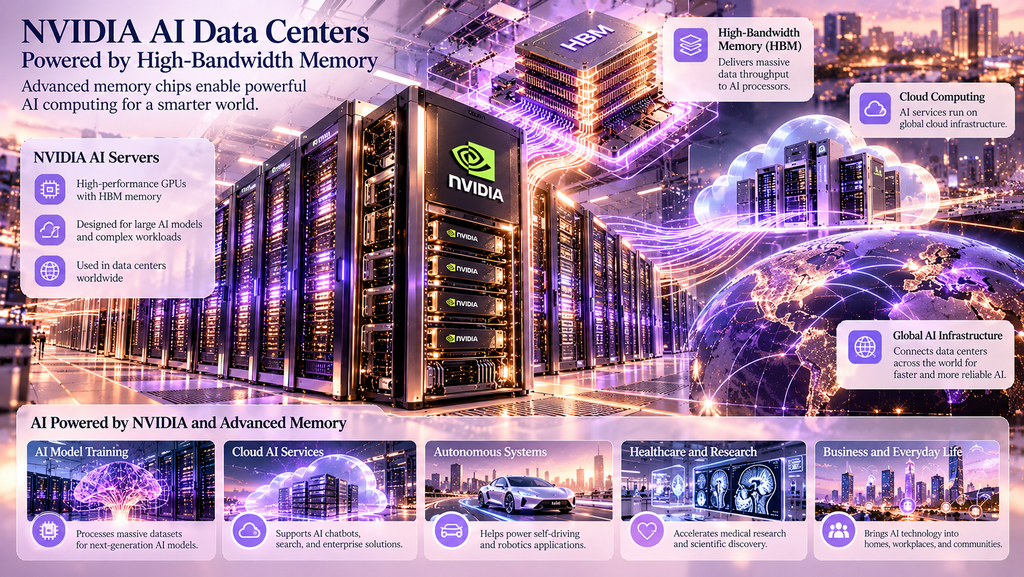
Many American businesses use cloud-based AI rather than buying their own AI servers.
These services may support customer service, document processing, software development, marketing, and research.
When hardware becomes more expensive, service providers must consider whether to absorb those costs or adjust pricing.
At the same time, more efficient hardware can lower the cost of processing individual AI requests.
The final price depends on utilization, competition, software efficiency, electricity costs, and infrastructure investment.
8.3 What this means for everyday consumers
The effect of HBM prices on an individual American consumer is usually indirect.
| Area | Potential influence |
|---|---|
| AI subscriptions | Infrastructure costs may influence future pricing |
| Small businesses | AI service expenses can affect operating budgets |
| Cloud computing | Hardware supply can influence available capacity |
| Technology employment | Semiconductor investment may support specialized jobs |
| Electronics | Shared industry resources may influence component supply |
| Financial markets | AI demand can influence semiconductor company expectations |
These are potential economic relationships, not guarantees that any particular subscription or product will become more expensive.
9. Why Does the NVIDIA–South Korea Relationship Matter to the U.S. Economy?
The relationship demonstrates how deeply American technology companies are connected to international manufacturing.
NVIDIA’s designs and software help drive the AI industry, while advanced memory suppliers contribute essential components.
The relationship surrounding NVIDIA South Korean memory chips illustrates how American AI innovation depends on an international semiconductor supply chain.
9.1 International specialization supports AI development
No single country controls every important stage of advanced semiconductor manufacturing.
Different companies specialize in chip design, memory fabrication, foundry manufacturing, lithography equipment, packaging, testing, and system integration.
This specialization can support innovation and production efficiency.
However, it also means a disruption in one part of the supply chain may affect businesses thousands of miles away.
9.2 Supply-chain risks and national competitiveness
Governments and companies increasingly view semiconductors as strategically important.
Potential disruptions include factory interruptions, natural disasters, trade restrictions, equipment shortages, and changes in international relations.
Diversifying production and suppliers may reduce some risks.
But replacing a sophisticated HBM supplier requires extensive technical validation and manufacturing investment.
This makes established expertise especially valuable.
9.3 U.S. semiconductor investment
The United States is investing in domestic semiconductor manufacturing and research capabilities.
Yet domestic expansion does not automatically replace the entire international supply chain.
Modern AI systems require complementary technologies produced by numerous companies across multiple countries.
The United States and South Korea therefore have both commercial incentives and strategic reasons to maintain a stable semiconductor relationship.
9.4 Why consumers should care
You do not need to buy NVIDIA stock or work in the technology industry to be affected by these developments.
If your employer uses AI software, your school uses AI-powered services, or your business relies on cloud computing, semiconductor supply may indirectly influence the availability and cost of those tools.
Understanding these connections can help consumers interpret technology headlines without assuming that every chip shortage will immediately increase retail prices.
10. What Could Happen to NVIDIA and Korean Memory Companies After 2026?
The future depends on AI demand, manufacturing capacity, technological progress, and competition.
Several possibilities deserve attention.
10.1 HBM4 becomes more widely adopted
As advanced AI platforms expand, manufacturers are expected to increase production of newer memory generations.
HBM4 offers opportunities for greater bandwidth, but successful adoption depends on commercial qualification, production yields, and customer demand.
10.2 Competition may become more intense
Samsung and Micron are working to strengthen their positions while SK hynix continues developing its established partnerships.
Greater competition could encourage technical improvements and more diversified supply.
However, it does not guarantee lower prices, particularly when demand is growing faster than manufacturing capacity.
10.3 Joint development could become more important
The relationship between processor designers and memory manufacturers is becoming more collaborative.
Rather than independently designing components and assembling them later, companies increasingly coordinate performance requirements and packaging decisions during development.
NVIDIA’s June 2026 partnership with SK hynix is a clear example of this approach.
10.4 Energy efficiency may become a defining advantage
Future AI infrastructure will need to manage electricity consumption as well as computing performance.
Memory manufacturers that deliver higher bandwidth with better energy efficiency may gain an advantage.
For data-center operators, the relevant question is not simply how much a memory chip costs.
It is how effectively the complete system turns electricity and hardware investment into useful computing output.
Frequently Asked Questions
1. Why does NVIDIA depend on South Korean memory chips?
NVIDIA uses advanced HBM to supply data to powerful AI processors. South Korean manufacturers SK hynix and Samsung are major producers of this specialized memory.
2. Does NVIDIA manufacture its own HBM chips?
NVIDIA designs AI computing platforms and collaborates with suppliers, but it does not independently manufacture all the HBM installed in its systems.
3. Is SK hynix NVIDIA’s only memory supplier?
No. Samsung and U.S.-based Micron also participate in the advanced HBM market. Supplier arrangements vary across products and production periods.
4. What is the difference between HBM and ordinary RAM?
HBM is a specialized, high-bandwidth form of DRAM designed for demanding computing systems. Ordinary PC and mobile memory generally prioritize different combinations of capacity, cost, energy efficiency, and performance.
5. Why is HBM important for artificial intelligence?
AI processors must access large quantities of data quickly. HBM provides high memory bandwidth and substantial capacity close to powerful processors.
6. Does Samsung supply memory for NVIDIA AI chips?
Samsung manufactures advanced HBM products, including HBM4 designed for NVIDIA Vera Rubin. Actual supply volumes depend on commercial arrangements and qualification requirements.
7. Is Micron a competitor to Korean memory manufacturers?
Yes. Micron is a U.S.-based semiconductor company producing advanced HBM products for AI applications.
8. Can HBM shortages increase AI subscription prices?
Potentially. More expensive or scarce computing hardware can influence service-provider costs, but subscription prices also depend on competition, efficiency, and business decisions.
9. Are NVIDIA GPUs made in South Korea?
NVIDIA GPU products involve international manufacturing and assembly. South Korean memory may be part of the finished system, but that does not mean every component or the GPU itself was manufactured in South Korea.
10. Will NVIDIA continue relying on Korean memory technology?
Current partnerships and announced development plans indicate that South Korean memory suppliers are likely to remain important. However, future purchasing decisions will depend on technology, capacity, pricing, and competition.
Conclusion: Why Korean Memory Is Essential to NVIDIA’s AI Strategy
NVIDIA’s AI success depends on more than designing powerful GPUs.
Advanced processors require sophisticated memory that can deliver large amounts of data at exceptional speeds.
South Korean companies, particularly SK hynix and Samsung Electronics, have developed important capabilities in manufacturing the HBM used throughout the AI industry.
Their relationship with NVIDIA has become even more significant in 2026, with new memory technologies and long-term development partnerships.
At the same time, American manufacturer Micron demonstrates that the industry is competitive and international rather than controlled by one country.
For U.S. consumers, the larger lesson is that the cost, performance, and availability of AI technology depend on a global network of specialized companies.
NVIDIA’s computing power and South Korea’s memory expertise are complementary parts of the modern AI economy.
Understanding this connection provides a clearer picture of how artificial intelligence affects American businesses, technology costs, employment, and everyday digital life.
NVIDIA South Korean memory chips demonstrate the importance of collaboration between American AI technology developers and South Korean semiconductor manufacturers.