
What Is a Memory Chip? A memory chip is a tiny semiconductor component that stores digital information and helps computers, smartphones, and other electronic devices work efficiently. From everyday laptops to powerful artificial intelligence data centers, memory chips play an essential role in modern technology.
Understanding how memory chips work can help consumers make smarter decisions when buying computers and smartphones, comparing RAM and storage, and understanding why advances in AI affect electronics prices.
A complete beginner-friendly guide to how tiny memory chips power smartphones, computers, artificial intelligence, and everyday digital life.
What is a memory chip, and why does such a tiny electronic component play such an important role in modern technology?
Every time you unlock your smartphone, open a website, take a photograph, use a banking application, or ask an AI assistant a question, memory technology helps your device process or preserve information.
Memory chips are found in smartphones, laptops, desktop computers, gaming consoles, vehicles, smart televisions, medical equipment, and enormous artificial intelligence data centers.
Although these chips are often smaller than a fingernail, they can contain billions of microscopic components designed to hold and retrieve digital information.
Without memory chips, modern computers could still perform certain calculations, but they would have difficulty managing complex programs, keeping important information readily accessible, and saving data for future use.
For Americans considering a new smartphone, upgrading a computer, or wondering why AI technology is becoming more expensive, understanding memory chips can lead to smarter purchasing decisions.
It also reveals an important international connection: major semiconductor manufacturers in South Korea and the United States produce technologies used throughout the global electronics industry.
This guide explains what memory chips actually do, how they work, why RAM differs from storage, and how memory technology influences performance, prices, and everyday life in 2026.
Table of Contents
1. What Is a Memory Chip and Why Is It Important?
A memory chip is a semiconductor component that stores digital information so an electronic system can access it when needed.
That information may include instructions, temporary calculations, photographs, application data, or information required by an operating system.
1.1 How does a memory chip store information?
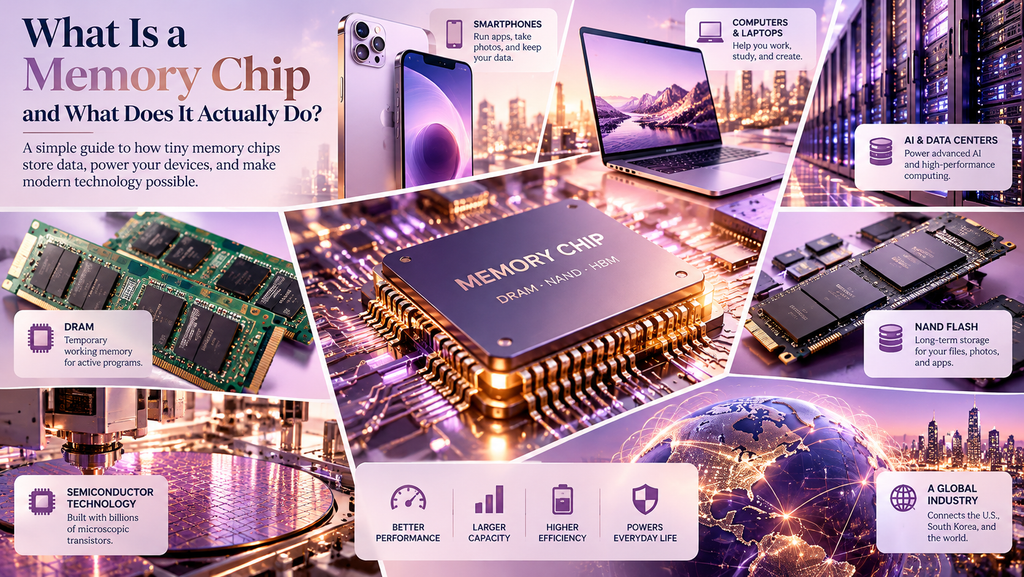
Computers represent information using binary digits called bits.
Each bit has a value of either zero or one.
Memory chips use microscopic electrical structures to represent and maintain those values.
In dynamic random access memory (DRAM), a tiny capacitor stores an electrical charge, while a transistor helps control access to the cell.
The presence or absence of sufficient charge represents a binary value.
Samsung explains this structure in its official DRAM technology guide, which describes how millions or billions of memory cells operate within modern semiconductor devices.
Other memory technologies use different physical mechanisms.
For example, NAND flash stores information using electrical charge trapped within specialized transistor structures. This allows information to remain available even after electrical power is removed.
1.2 Why do computers need memory chips?
A computer processor executes instructions and performs calculations.
However, it needs somewhere to obtain instructions, read input data, and hold intermediate results.
Memory provides that working space.
Imagine preparing a meal in a kitchen.
The processor is the cook performing the work, while memory is the countertop holding ingredients and tools that are currently needed.
Long-term storage is similar to the pantry or refrigerator, where supplies remain until they are needed.
This analogy is not technically perfect, but it helps explain why processing power and memory serve different purposes.
1.3 What happens without enough memory?
When a device runs low on working memory, its operating system must manage limited resources more aggressively.
It may close background applications, compress information, or transfer certain data to slower storage.
A person may notice applications reloading, multitasking becoming less convenient, or demanding programs operating less smoothly.
However, insufficient memory is not the only cause of poor performance. Slow processors, software problems, overheating, and aging hardware can cause similar symptoms.
2. What Does a Memory Chip Actually Do Inside Your Device?
The most important function of a memory chip is to make information available at the time and speed required by an electronic system.
Different memory technologies accomplish this in different ways.
2.1 Temporarily holding active information
When you open an application, the operating system loads the program’s working data into RAM.
The processor can then access that information without repeatedly retrieving everything from slower permanent storage.
This helps applications respond to user input.
For example, while editing a photograph, the device may temporarily hold image data, editing instructions, and intermediate results in RAM.
2.2 Helping applications switch smoothly
Smartphones frequently run several applications during a normal day.
You might listen to music, follow navigation directions, receive messages, and check your email.
Available RAM helps the operating system manage these activities.
More RAM can help when a device regularly exceeds its existing capacity, but increasing RAM does not automatically increase processor speed.
Microsoft’s official computer memory explanation describes RAM as temporary working memory and explains its relationship to multitasking performance.
2.3 Preserving information after shutdown
Nonvolatile memory chips perform a different job.
They retain saved information without continuous power.
This is why your smartphone photographs, installed applications, and downloaded documents remain available after you turn the phone off.
Permanent storage is essential for maintaining the information that makes a device useful across multiple sessions.
3. What Are the Main Types of Memory Chips?
There are several major types of semiconductor memory, and each has a particular purpose.
For everyday consumers, the most important categories are DRAM, NAND flash, SRAM, and specialized high-bandwidth memory.
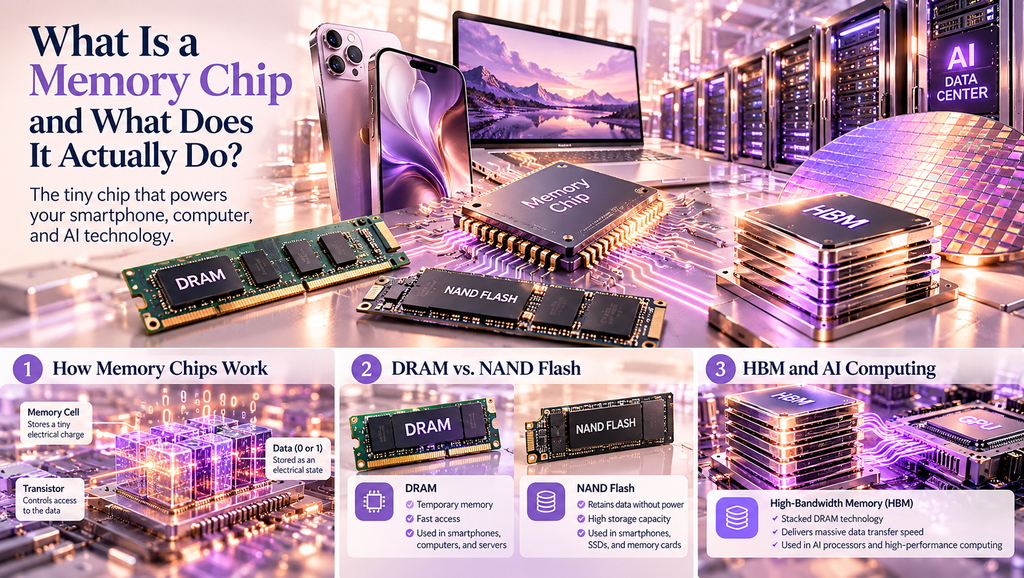
3.1 DRAM: Working memory for active programs
Dynamic Random Access Memory provides temporary working space for computers, smartphones, and servers.
DRAM is relatively fast and can store substantial amounts of information in a compact area.
However, it requires electrical power and periodic refresh operations to maintain stored information.
Common DRAM families include DDR memory for computers and LPDDR memory for mobile devices.
3.2 NAND flash: Storage that remembers
NAND flash is nonvolatile memory commonly used in smartphones, solid-state drives, USB drives, and memory cards.
It is well suited for storing large amounts of information.
Its advantages include compact size, high storage density, and the ability to retain information without power.
Unlike DRAM, NAND flash has finite program-and-erase endurance. Modern controllers manage wear and errors to support practical service life.
3.3 SRAM: Very fast memory near processors
Static Random Access Memory is commonly used for processor caches.
SRAM offers fast access and does not require the periodic refresh process used by DRAM while power remains supplied.
However, SRAM cells typically occupy more chip area, making it less economical for very large working-memory capacities.
Processors therefore use a combination of small, fast caches and larger main memory.
3.4 HBM: Specialized memory for AI computing
High-Bandwidth Memory is a stacked DRAM technology designed to deliver enormous quantities of data to high-performance processors.
HBM is used in advanced AI accelerators and other demanding computing systems.
Its stacked architecture enables extremely wide data interfaces and high memory bandwidth.
Samsung describes this technology in its official high-bandwidth memory overview.
3.5 Memory chip comparison table
| Memory type | Retains data without power? | Primary purpose | Common devices |
|---|---|---|---|
| DRAM | No | Temporary working memory | PCs, smartphones, servers |
| NAND flash | Yes | Long-term data storage | Phones, SSDs, USB drives |
| SRAM | No | High-speed processor cache | CPUs, GPUs, embedded devices |
| HBM | No | High-bandwidth working memory | AI accelerators, advanced GPUs |
| NOR flash | Yes | Firmware and program storage | Embedded electronics, industrial devices |
These technologies are not interchangeable. Their architectures are optimized for different combinations of speed, capacity, energy consumption, reliability, and manufacturing cost.
To fully understand what is a memory chip and how it differs from storage, consumers should compare DRAM, NAND flash, and processor cache according to their intended purposes.
4. What Is the Difference Between a Memory Chip and a Processor?
A memory chip primarily holds information.
A processor primarily executes instructions and performs calculations.
They cooperate continuously, but their responsibilities are different.
4.1 The processor performs the work
A central processing unit (CPU) executes general-purpose program instructions.
A graphics processing unit (GPU) performs many calculations in parallel, making it valuable for graphics and artificial intelligence.
Other specialized chips support tasks such as image processing or neural-network operations.
4.2 Memory delivers the information
Processors require instructions and data to perform useful work.
Memory provides a fast-access location for those items.
When memory cannot supply information quickly enough, the processor may have to wait.
This is called a memory bottleneck.
4.3 Why buying a faster processor is not always enough
A powerful computer with insufficient RAM may struggle when running numerous demanding programs.
Likewise, adding large amounts of RAM to an aging computer will not necessarily compensate for a slow processor.
The best performance usually comes from balancing the processor, memory capacity, memory bandwidth, storage performance, cooling, and software.
5. How Do Memory Chips Work in Smartphones?
If you are wondering what is a memory chip inside your smartphone, the most practical examples are LPDDR working memory and NAND flash storage.
Smartphones use a combination of specialized memory technologies.
Their designs must balance performance, compact size, battery efficiency, and heat.
5.1 RAM helps run smartphone applications
Modern phones commonly use low-power DRAM, often called LPDDR.
It supports active applications, browser sessions, messaging, navigation, photography, and other processing tasks.
When you switch from a camera application to your browser and back again, RAM can help retain useful working information.
5.2 NAND flash stores your personal files
A smartphone’s internal storage generally relies on NAND flash technology.
This is where your photographs, downloaded videos, music, applications, and saved documents reside.
A phone advertised as having 256GB of storage does not mean it has 256GB of RAM.
The two numbers describe different resources.
5.3 Why more memory does not always mean a better phone
Suppose one smartphone has 8GB RAM and 256GB storage, while another has 12GB RAM and 128GB storage.
The second phone has more working memory, but the first provides more room for saved files.
Which is better depends on the buyer’s needs.
Someone frequently recording videos may benefit more from additional storage.
Someone running demanding applications may benefit from additional RAM.
Processor quality, camera technology, battery life, and software support also matter.
For a deeper explanation, see TIPVERO’s related guide, What Is the Difference Between RAM and Phone Storage?
6. How Do Memory Chips Work in Computers and Laptops?
Computers use RAM, processor caches, and long-term storage to manage daily work.
6.1 Opening applications
When you start a program, the operating system loads the necessary code and working data from storage into memory.
The processor then uses that information while running the application.
Loading a program from a fast SSD may reduce startup time, while adequate RAM helps support the program’s ongoing work.
6.2 Multitasking and productivity
People who work from home may have several browser windows, documents, spreadsheets, communication applications, and creative programs open simultaneously.
Their memory requirements may be greater than those of someone who mainly checks email.
Insufficient RAM can force the system to use slower storage-based techniques to handle memory pressure.
6.3 Practical RAM recommendations for 2026
| Computer activity | Illustrative RAM recommendation |
|---|---|
| Basic browsing and documents | 8GB for modest workloads |
| Everyday office productivity | 16GB |
| Heavy multitasking | 16–32GB |
| Video editing and design | 32GB or more, depending on project |
| Advanced software development | 32GB or more for demanding workflows |
These are general purchasing guidelines, not technical requirements for every program.
Before upgrading, check whether the computer supports additional physical memory. Many modern laptops have soldered RAM that cannot be upgraded.
For a budget-conscious buyer, checking upgradeability before purchasing can prevent future replacement costs.
7. Why Are Memory Chips So Important for Artificial Intelligence?
Artificial intelligence systems require rapid access to large quantities of information.
AI workloads can involve millions or billions of numerical parameters, intermediate calculations, and complex data transfers.
7.1 AI training uses enormous amounts of data
When an AI model is trained, its processors repeatedly perform mathematical operations and update model parameters.
The hardware must move relevant information through memory efficiently.
Large AI clusters combine processors, HBM, system DRAM, networking, and storage.
Each component plays a different role.
7.2 HBM helps powerful GPUs work efficiently
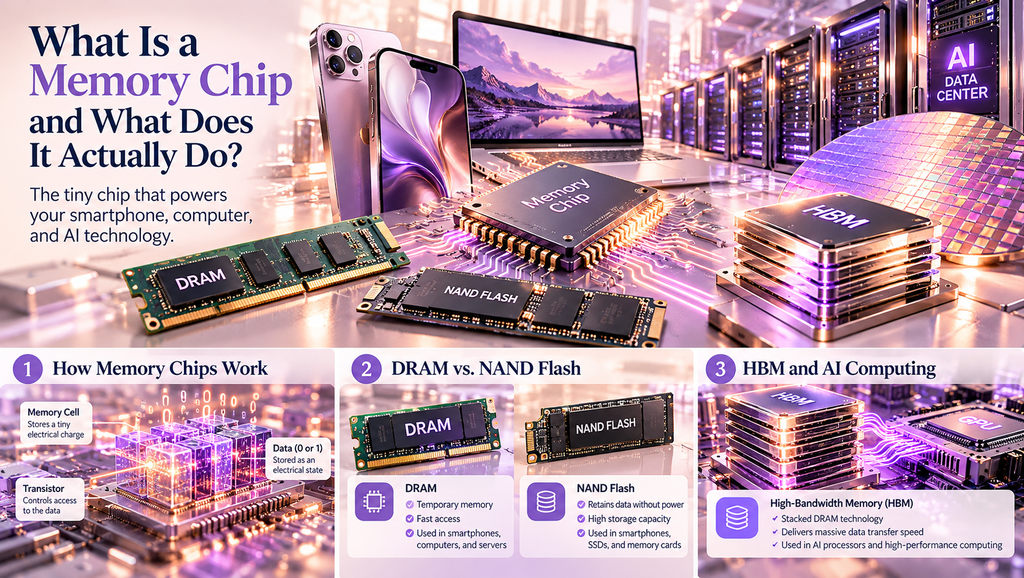
The memory bandwidth available to an AI accelerator can influence how quickly it performs certain calculations.
Stacked HBM technology supplies high data-transfer rates while placing memory close to powerful processors.
Samsung, SK hynix, and U.S.-based Micron are important participants in this market.
However, high memory bandwidth alone does not guarantee faster AI performance. Compute efficiency, model architecture, software, networking, and available memory capacity also matter.
7.3 Why NVIDIA needs memory suppliers
NVIDIA develops AI processors and computing platforms, but many memory components are supplied by specialized semiconductor manufacturers.
This creates relationships between American chip designers and international manufacturing companies.
Such partnerships illustrate how highly specialized the global AI supply chain has become.
Readers interested in this relationship can explore TIPVERO’s related article, Why Does NVIDIA Depend on South Korean Memory Chips?
Understanding what is a memory chip in an AI server also explains why advanced GPUs require both high memory bandwidth and substantial capacity.
8. Who Manufactures the World’s Memory Chips?
Memory manufacturing is a highly specialized industry requiring substantial investment in equipment, materials, engineering, and research.
Three particularly important companies are Samsung Electronics, SK hynix, and Micron Technology.
8.1 Samsung Electronics
Headquartered in South Korea, Samsung produces DRAM, NAND flash, and advanced memory products for devices ranging from smartphones to AI servers.
The company develops different memory architectures for varying performance and power requirements.
8.2 SK hynix
SK hynix, another South Korean semiconductor company, manufactures DRAM, NAND flash, and high-bandwidth memory.
Its HBM technology has become particularly relevant to the AI infrastructure market.
8.3 Micron Technology
Micron is a U.S.-based manufacturer of DRAM, NAND flash, and other semiconductor memory solutions.
In its fiscal 2026 regulatory filing, Micron described its DRAM and NAND businesses and the different markets they serve
8.4 Does a Korean memory brand mean the chip was made in Korea?
Not necessarily.
A company’s headquarters does not establish the country in which every chip was fabricated, packaged, or tested.
Major semiconductor companies operate international manufacturing networks.
The exact origin of a component depends on the product and its production arrangements.
9. How Do Memory Chips Affect Technology Prices in the United States?
Memory chips contribute to the manufacturing costs of smartphones, laptops, servers, and other electronics.
When memory prices rise, device manufacturers may face higher component expenses.
9.1 Why chip prices change
Semiconductor memory pricing is influenced by production capacity, demand, inventories, manufacturing technology, contracts, and product mix.
For example, demand for AI infrastructure can affect how manufacturers allocate investment across HBM and conventional memory products.
However, HBM and smartphone memory are distinct products, and their prices do not necessarily move together.
9.2 Can higher memory prices make phones more expensive?
Potentially.
If a smartphone manufacturer pays more for important components, it may increase retail prices, change configurations, negotiate new contracts, or accept lower margins.
There is no guaranteed one-to-one relationship between a memory price increase and the price consumers pay.
9.3 Should consumers buy electronics before prices rise?
Predictions about future component prices are uncertain.
For most households, it is more practical to buy based on a genuine need, product quality, anticipated useful life, and total ownership cost.
Buying an unnecessary device because of a forecasted chip shortage may cost more than waiting.
Knowing what is a memory chip and why its price changes can help Americans understand technology costs without overreacting to semiconductor headlines.
10. How Can You Choose the Right Memory and Storage for Your Budget?
Understanding what is a memory chip in practical terms can help distinguish useful upgrades from unnecessary specifications.
10.1 Identify your actual limitation
If your computer struggles when several large applications are open, examine RAM usage.
If your smartphone cannot save more videos or install updates, examine available storage.
If an application runs slowly despite adequate RAM and free storage, investigate the processor, software, and other hardware.
10.2 Consider your long-term needs
Think about how you expect to use the device over the next three to five years.
Content creators may benefit from higher storage capacity, especially when recording video.
People editing high-resolution images or running virtual machines may benefit from additional working memory.
Others may find a well-balanced midrange device sufficient.
10.3 Avoid confusing cloud storage with physical RAM
Purchasing additional cloud storage does not add physical RAM to your phone or computer.
Cloud services can help retain and synchronize personal files, but active applications still depend on the device’s own memory and processing resources.
10.4 Compare total value, not just memory numbers
A computer with 32GB RAM is not automatically better than one with 16GB.
A smartphone with 512GB storage is not automatically a better purchase than one with 256GB.
Consider reliability, processor capabilities, battery performance, repairability, software updates, and the price difference.
The best configuration is the one that meets your needs without unnecessary spending.
11. What Will Memory Chips Look Like in the Future?
Memory manufacturers are working to increase capacity, bandwidth, and energy efficiency while overcoming increasingly complex manufacturing challenges.
11.1 Greater bandwidth for AI
Advanced HBM generations are designed to transfer more data between memory and processors.
This can help support larger AI models and more demanding computing systems.
11.2 Higher-capacity storage
Improvements in NAND technology allow manufacturers to increase data density.
Higher density can support larger storage capacities in compact electronic devices.
Nevertheless, a greater theoretical capacity does not automatically mean a lower retail price.
11.3 Energy efficiency becomes increasingly important
Battery-powered devices benefit from efficient memory because they must operate within limited energy budgets.
Data centers face different but equally important power constraints.
Both markets create incentives to improve memory efficiency.
11.4 Reliability remains essential
Advanced memory must not only become faster and denser; it must also meet demanding reliability requirements.
Error correction, thermal management, semiconductor quality, and controller design remain essential considerations.
Future memory innovations will need to balance performance improvements with real-world dependability.
Frequently Asked Questions
1. What is a memory chip in simple terms?
A memory chip is a tiny electronic component that holds digital information so a device can use it temporarily or retain it for future access.
2. Is a memory chip the same as RAM?
Not always. RAM is one category of semiconductor memory. Memory chips can also include NAND flash, SRAM, NOR flash, and other specialized technologies.
3. Does a memory chip store photographs?
Yes, certain types do. NAND flash memory is commonly used to store photographs, videos, applications, and files on smartphones and SSDs.
4. Does adding RAM make a computer faster?
It can improve performance when insufficient RAM is the limiting factor. Adding RAM beyond what your applications need may provide little benefit.
5. Why does RAM lose data when the power is turned off?
Common DRAM technologies require electrical power and periodic refresh operations to maintain stored information. Without power, the stored electrical state cannot be preserved.
6. Are memory chips manufactured in South Korea?
Many are, but memory chips are also manufactured in other countries. A chip supplier’s country of headquarters does not necessarily identify the manufacturing location.
7. Does NVIDIA use South Korean memory chips?
NVIDIA AI computing systems use advanced memory technology supplied by specialized semiconductor manufacturers, including South Korean companies such as SK hynix and Samsung. Other suppliers, including Micron, also participate in the market.
8. What is the difference between a memory chip and an SSD?
A memory chip is an individual semiconductor component. An SSD is a complete storage device that typically combines NAND flash chips with a controller, firmware, and other supporting components.
9. Can a damaged memory chip cause a computer to crash?
Yes. Faulty RAM or other memory hardware can cause instability, corrupted data, failed operations, and system crashes. However, many software and hardware problems can produce similar symptoms.
10. Will memory chips become more important because of AI?
Yes. Growing AI workloads create demand for additional memory capacity, higher bandwidth, and better energy efficiency. The exact benefits depend on the application and computing architecture.
Conclusion: Why Tiny Memory Chips Matter So Much
A memory chip is much more than a small electronic component.
It helps make modern digital life possible by holding information that processors need and, in the case of nonvolatile memory, preserving data even after a device is powered off.
Understanding the difference between RAM, NAND flash, SRAM, and HBM makes it easier to evaluate smartphones, computers, and AI technology.
Memory chips also connect everyday American technology purchases to a global industry involving South Korea, the United States, and numerous manufacturing and research partners.
For consumers, the key is not to purchase the largest memory specification available.
It is to choose a device with the right balance of working memory, permanent storage, processing performance, and long-term value.
The next time you open an application, edit a photograph, or use an AI service, remember that a complex network of microscopic memory cells is helping make that experience possible.