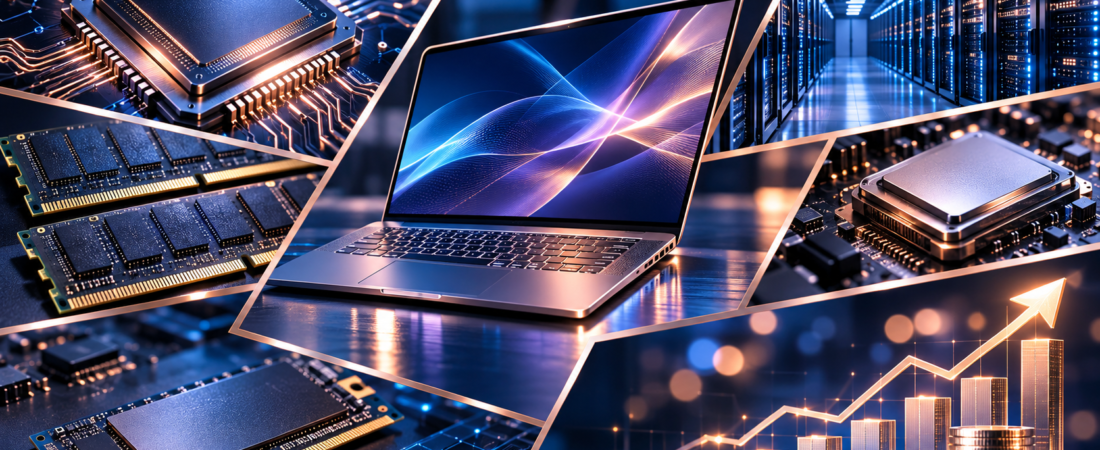
AI Computer Prices are becoming an important financial concern for American consumers in 2026. Artificial intelligence is transforming laptops, desktop computers, and data centers, but the rapid growth of AI technology is also creating new pressures on semiconductor manufacturing and memory supplies.
For many households, a computer is no longer a luxury. Students need laptops for education, employees depend on computers for remote work, and small businesses use digital equipment for everyday operations.
When computer component costs increase, those changes can eventually influence the prices Americans pay for new devices.
One of the biggest developments in 2026 is the increasing competition between AI data centers and consumer electronics manufacturers for memory chips.
According to Gartner’s February 26, 2026 forecast, memory-related cost increases could contribute to a 17% rise in average PC prices compared with 2025.
Meanwhile, IDC’s October 30, 2026 PC market update forecasts an 11.3% decline in worldwide personal computing device shipments for 2026, partly because higher memory costs are affecting demand.
These developments raise an important question: Will AI make computers more expensive, and should Americans buy a new laptop now or wait?
This guide examines seven major changes influencing computer prices, explains how AI technology affects hardware costs, and provides practical advice for consumers who want reliable computers without overspending.
Table of Contents
1. Why Are AI Computer Prices Becoming an Important Issue in 2026?
Artificial intelligence is changing both how computers are used and how they are manufactured.
Technology companies are developing more powerful processors, specialized AI accelerators, and computer systems that can perform AI tasks directly on the device.
At the same time, cloud providers are investing in enormous data centers to support advanced AI services.
These two developments create different but connected demands for semiconductor components.
1.1 AI Requires More Computing Resources
AI applications often perform complicated mathematical operations.
Tasks such as image generation, language processing, speech recognition, and video enhancement can require substantial processing power and memory.
Some workloads run in remote data centers, while others are performed on personal computers.
A computer that can handle ordinary web browsing may not be equally suitable for demanding local AI applications.
This is why manufacturers are introducing systems designed specifically for AI workloads.
1.2 Why Hardware Costs Matter
Processors, memory, storage, displays, batteries, and other components account for significant portions of manufacturing costs.
When a major component becomes more expensive, computer manufacturers face difficult decisions.
They can raise retail prices, reduce profit margins, change product specifications, or redesign future models.
Because of these choices, AI Computer Prices can rise even when demand for ordinary laptops is not especially strong.
1.3 AI Is Not the Only Cause
It would be misleading to blame every computer price increase on artificial intelligence.
Tariffs, currency movements, transportation expenses, component availability, labor costs, and competitive pricing also influence what consumers pay.
However, expanding AI infrastructure has become an important driver of memory demand and semiconductor investment.
Understanding that relationship helps explain why the consumer PC market is experiencing unusual pricing pressure.
2. Seven Reasons AI Could Make Computers More Expensive in 2026
Several developments are influencing the economics of computers in 2026.
Some affect component supply, while others change product design, demand, and purchasing behavior.
2.1 Reason 1: AI Data Centers Consume Large Amounts of Memory
AI infrastructure requires more than powerful processors.
Data centers also need substantial amounts of DRAM, specialized high-bandwidth memory, enterprise solid-state drives, networking equipment, and cooling systems.
Technology companies building AI infrastructure purchase these components in large quantities.
That increases competition for manufacturing capacity across the semiconductor industry.
According to IDC’s analysis of the global memory shortage, the rapid expansion of AI infrastructure has encouraged memory manufacturers to shift resources toward higher-value server and AI products.
This affects the availability of conventional memory components used in consumer PCs.
As a result, AI Computer Prices can be influenced by spending decisions made by companies operating enormous data centers.
2.2 Reason 2: DRAM and SSD Costs Are Increasing
Most personal computers require two important kinds of memory-related hardware.
DRAM provides temporary working space for applications, while SSD storage preserves files and software when the device is turned off.
A laptop with insufficient RAM may struggle when running several programs simultaneously.
A laptop with insufficient storage may not have enough space for applications, videos, and personal files.
These components are therefore essential to everyday computing.
Gartner projected in February 2026 that combined DRAM and SSD prices could rise sharply during the year.
The same forecast estimated that memory could represent approximately 23% of the total manufacturing materials cost of a PC, compared with 16% in 2025.
For a closer look at the supply pressures behind rising hardware costs, read our guide to Why Are Memory Chip Prices Rising in 2026?Why Are Memory Chip Prices Rising in 2026?
This is a significant change because inexpensive computers have limited room to absorb additional component costs.
2.3 Reason 3: AI PCs Often Need More RAM
An AI PC is generally a computer equipped with hardware designed to accelerate AI workloads.
Many modern AI computers include a neural processing unit, commonly called an NPU.
NPUs can perform selected AI operations efficiently, sometimes reducing the need to send information to remote servers.
However, processors are only part of the equation.
Running AI models locally may require additional system memory.
For example, a standard computer might be adequate with 16GB of RAM for ordinary office tasks, while demanding creative applications or local AI workflows may benefit from 32GB or more.
The appropriate amount depends on actual software requirements.
When memory becomes more expensive, the higher capacities associated with some AI PCs can contribute to higher retail prices.
2.4 Reason 4: Advanced Processors Add Manufacturing Costs
Modern computer processors are extremely sophisticated electronic products.
Their development requires semiconductor design expertise, advanced manufacturing equipment, engineering talent, and substantial research investment.
AI-capable systems may include CPUs, GPUs, NPUs, or combinations of specialized processing units.
Adding AI acceleration does not automatically make every processor more expensive.
In some cases, integration and manufacturing improvements can reduce costs.
However, advanced chip designs and premium performance features can increase development expenses and position devices in higher price categories.
Manufacturers also use processor performance to distinguish premium laptops from budget models.
Consumers should therefore evaluate real application performance rather than assume that every AI-branded processor offers better value.
2.5 Reason 5: Budget Computers Face Greater Pricing Pressure
Low-priced laptops are particularly sensitive to increases in component costs.
A premium manufacturer may have more flexibility to absorb higher expenses because the product already commands a substantial selling price.
A budget computer manufacturer often operates with narrower margins.
Gartner warned in February 2026 that the market for computers priced below $500 could face substantial pressure as memory costs rise.
Omdia’s March 2026 outlook similarly projected that the sub-$500 PC category would be disproportionately affected by supply constraints.
For families shopping for affordable student laptops, this could mean fewer models, smaller discounts, or weaker specifications at familiar price points.
The impact on AI Computer Prices is therefore not limited to expensive machines designed for professional users.
2.6 Reason 6: Manufacturers Are Prioritizing Premium Models
When components become expensive or difficult to obtain, computer manufacturers may allocate their limited inventory to products that provide stronger profit margins.
This can shift the product mix toward premium systems.
A manufacturer might offer more higher-priced configurations while reducing the number of entry-level choices.
Average selling prices may rise even if the price of every individual model does not increase equally.
Consumers may also find that an older configuration offers better value than a newly marketed AI model.
This makes careful comparison especially important during periods of industry disruption.
2.7 Reason 7: Global Semiconductor Supply Cannot Expand Instantly
Building semiconductor factories is complicated and expensive.
New facilities require specialized equipment, advanced materials, stable utilities, trained engineers, and extensive manufacturing qualification.
Additional capacity can take years to become fully productive.
Manufacturers must also balance the risk of investing too much during a temporary demand boom.
When AI demand grows faster than semiconductor supply, the market may remain tight for an extended period.
This explains why AI Computer Prices may not immediately return to previous levels even if consumers temporarily reduce spending.
3. How Much More Expensive Could Computers Become?
Consumers should distinguish industry forecasts from actual retail prices.
A percentage increase in semiconductor contract costs is not the same as an identical increase in laptop prices.
3.1 The 2026 Industry Outlook
| Indicator | 2026 forecast | Source and publication date |
|---|---|---|
| Average PC price increase | 17% compared with 2025 | Gartner, February 26, 2026 |
| Worldwide PC shipment decline | 10.4% | Gartner, February 26, 2026 |
| Worldwide PC and tablet shipment decline | 11.3% | IDC, October 30, 2026 |
| Q4 conventional DRAM contract prices | 10–15% quarterly increase | TrendForce, September 30, 2026 |
| Q4 NAND flash contract prices | 15–20% quarterly increase | TrendForce, September 30, 2026 |
The forecasts measure different markets, dates, and categories, so they should not be treated as interchangeable.
In its September 30, 2026 market outlook, TrendForce projected continued increases in DRAM and NAND contract prices during the fourth quarter.
These developments illustrate why AI Computer Prices have become an important issue for both hardware companies and consumers.
3.2 What a 17% Increase Could Mean for a Family
Consider three hypothetical computer prices.
A $500 laptop experiencing a 17% increase would cost $585.
An $800 laptop would cost $936.
A $1,200 laptop would cost $1,404.
These examples illustrate the financial impact of a percentage change; they are not forecasts for specific products.
Actual retailer prices may change differently because of promotions, inventories, competition, and configuration choices.
3.3 Why Discounts Can Still Exist
Rising industry costs do not eliminate every sale or promotion.
Retailers may discount older inventory or offer competitive deals on selected models.
Manufacturers sometimes maintain prices temporarily to protect market share.
A consumer who compares equivalent computers carefully may still find good value even during a period of semiconductor cost inflation.
4. What Is an AI PC, and Is It Worth the Extra Money?
The term AI PC describes a category of computers designed to support AI workloads.
However, the label can cover a wide range of capabilities.
Not every AI PC performs the same tasks at the same speed.
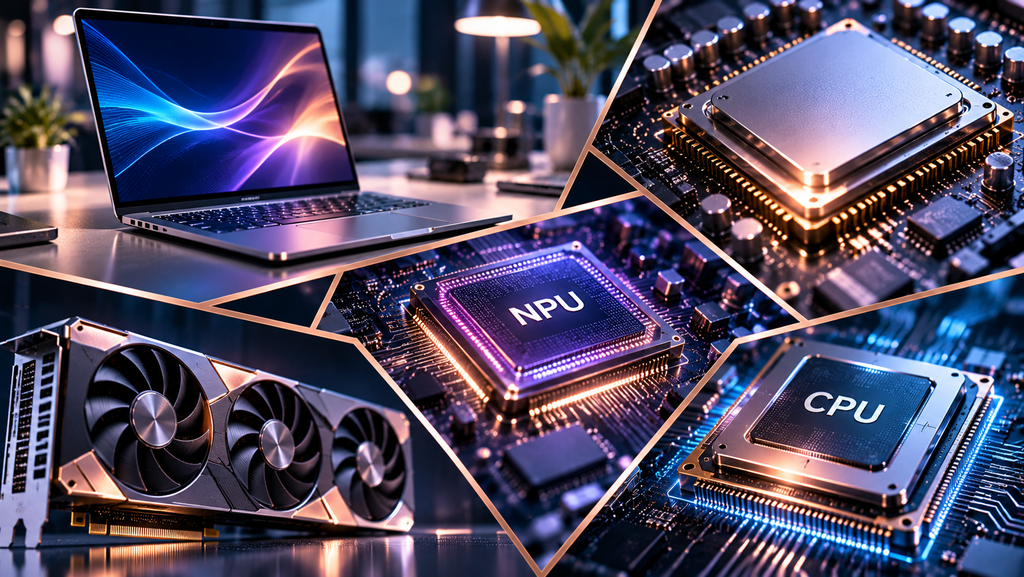
4.1 CPU, GPU, and NPU Explained
A CPU is a general-purpose processor responsible for running many ordinary computer operations.
A GPU specializes in highly parallel processing, making it useful for graphics and numerous AI tasks.
An NPU is designed to accelerate selected AI computations efficiently.
A modern computer may combine all three.
For consumers, the critical question is whether their applications actually benefit from the available hardware.
Learn more about computer memory and storage in our guide to What Is the Difference Between RAM and Phone Storage?What Is the Difference Between RAM and Phone Storage?
4.2 Comparing an Ordinary Laptop and an AI PC
| Feature | Standard laptop | AI-focused laptop |
|---|---|---|
| General computing | Yes | Yes |
| Web browsing and email | Yes | Yes |
| Dedicated NPU | Depends on processor | Usually present |
| Local AI acceleration | Varies | Generally emphasized |
| RAM requirements | Based on workload | May be higher |
| Best use | Everyday tasks | Compatible local AI applications |
| Value | Often excellent | Depends on actual AI needs |
An AI PC is not automatically the best purchase for every household.
Many people already have access to cloud-based AI services that run primarily on remote infrastructure.
A dedicated AI processor may offer advantages for selected local applications, but ordinary office work may not require one.
4.3 When an AI PC Makes Sense
A buyer may benefit from an AI-focused computer when using compatible local AI software, specific video-processing tools, accessibility features, or enterprise applications designed for NPU acceleration.
Power efficiency may also improve for suitable tasks.
However, consumers should verify software compatibility, memory capacity, battery performance, and independent benchmarks.
Paying more for an AI label alone is not a reliable purchasing strategy.
5. How Will AI Computer Prices Affect American Households?
Higher computer costs can create challenges for families, students, remote workers, and retirees.
Technology is increasingly necessary for banking, communication, education, healthcare access, and government services.
5.1 Students and Education Costs
A student may need a computer capable of handling online classes, research, video conferences, and document creation.
Most of these activities do not require an expensive AI workstation.
Parents should prioritize reliability, battery life, adequate memory, and school software compatibility.
If a less expensive computer meets those requirements, premium AI capabilities may offer little additional educational value.
5.2 Remote Workers and Small Businesses
Remote employees need dependable computers for collaboration, communication, and productivity.
Some professionals also require advanced graphics, large memory capacity, or specialized software.
Business owners purchasing multiple devices may face a significant budget impact from higher average PC prices.
For these buyers, scheduling equipment replacement and evaluating upgrade options can reduce unnecessary expenses.
5.3 Retirees and Everyday Computer Users
Many older adults primarily use computers for email, web browsing, video calls, online banking, and managing personal documents.
An expensive AI PC may not provide meaningful benefits for those activities.
A reliable existing computer with supported software and adequate performance can remain useful.
However, security updates are important, particularly for financial accounts and sensitive personal information.
Keeping an unsupported system indefinitely can create risks that outweigh the savings.
5.4 Creative Work and Content Production
Artists, photographers, musicians, and video creators may benefit from stronger hardware.
Video editing, digital painting, audio production, and AI-assisted creative tools can place substantial demands on memory, storage, and graphics processors.
Yet different workflows require different investments.
Someone creating short social media videos may need less computing power than a professional editing long 4K productions with complex effects.
Evaluating the actual workflow is more useful than choosing the highest-priced machine.
6. Should Americans Buy a Computer Now or Wait?
The best purchasing decision depends on urgency and the condition of the current device.
Trying to predict the exact lowest price can be difficult.
6.1 When Buying Now Makes Sense
A replacement may be justified when a computer regularly crashes, cannot run essential applications, lacks security support, or prevents someone from completing necessary work.
Students and businesses with deadlines may not have the flexibility to wait.
When the cost of downtime is high, dependable performance can be more valuable than the possibility of a future discount.
6.2 When Waiting Makes Sense
If an existing computer performs adequately, there may be little reason to replace it immediately.
Some performance problems can be improved through software maintenance, additional storage, or memory upgrades.
However, upgrading is not always possible, especially when laptop memory is permanently attached to the motherboard.
Before spending money, consumers should identify the actual cause of poor performance.
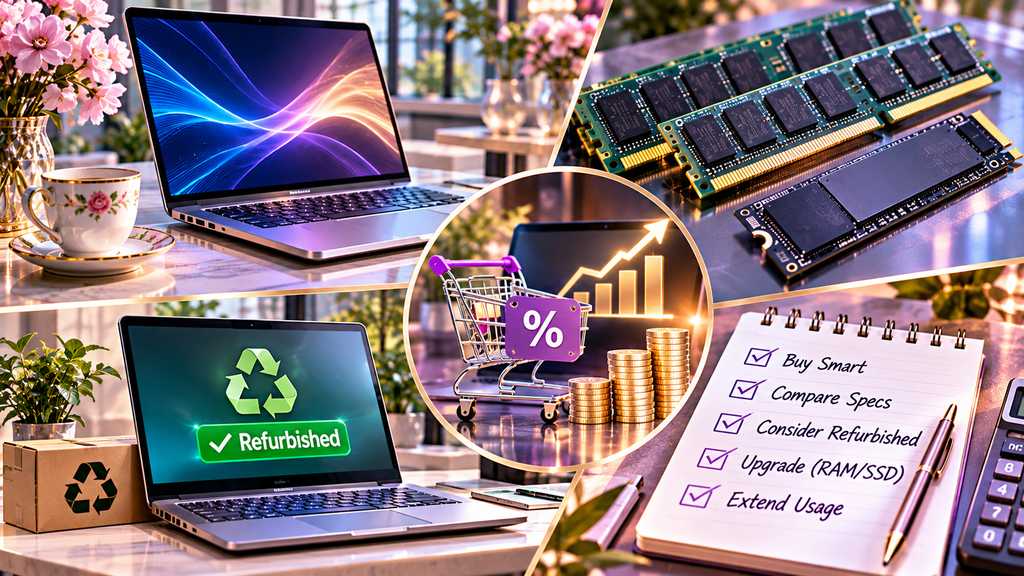
6.3 Practical Purchasing Checklist
Compare processor performance, RAM capacity, SSD storage, battery life, screen quality, repairability, warranty coverage, and software support.
Evaluate AI features separately.
An AI computer may offer excellent long-term value for a specific workload, but a conventional computer may remain the better choice for routine tasks.
The goal should be purchasing useful capabilities, not simply purchasing the newest technology.
7. Will AI Computer Prices Continue Rising in 2027?
Future prices are uncertain.
The direction of the market will depend on memory production, AI infrastructure spending, inventories, and consumer demand.
7.1 What Could Keep Prices Elevated?
Continued expansion of AI data centers could maintain strong demand for advanced memory and storage.
Semiconductor factories may also require additional time to expand capacity.
Manufacturers might continue prioritizing higher-margin server products.
These developments could sustain pressure on AI Computer Prices beyond 2026.
Explore the relationship between advanced AI processors and memory technology in Why Does NVIDIA Depend on South Korean Memory Chips?Why Does NVIDIA Depend on South Korean Memory Chips?
7.2 What Could Bring Relief?
Additional semiconductor manufacturing capacity could increase supply.
Improved production yields may reduce costs.
A slowdown in data-center expansion or weaker consumer demand could also change market conditions.
Competition among computer manufacturers may encourage more affordable configurations.
However, lower manufacturing costs do not necessarily produce immediate retail price reductions.
7.3 Current Industry Expectations
IDC’s June 2026 analysis warned that memory supply pressure could persist through 2027.
By October 30, 2026, its market outlook projected another decline in personal computing device shipments during 2027 before a return to growth in 2028.
These forecasts suggest that buyers should not assume computer prices will rapidly return to earlier levels.
The actual outcome remains dependent on market developments.
8. How Can Consumers Save Money When AI Computer Prices Rise?
Consumers cannot control global semiconductor production, but they can control many aspects of their purchasing decisions.
8.1 Extend the Useful Life of Existing Computers
Regular maintenance can improve reliability.
Remove unnecessary applications, keep adequate storage space available, install security updates, and monitor battery health.
If hardware upgrades are possible, increasing RAM or replacing a slow drive may extend the computer’s useful life.
The cost should be compared with the value of buying a replacement.
8.2 Consider Refurbished and Previous-Generation Models
Refurbished computers can offer meaningful savings.
However, buyers should examine seller reputation, return policies, battery condition, warranty terms, and operating-system support.
Previous-generation business laptops can sometimes provide better durability and repair options than inexpensive new models.
The best choice depends on the device’s condition and intended workload.
8.3 Avoid Unnecessary AI Features
Not everyone needs dedicated AI acceleration.
Many AI applications work through web browsers and cloud services.
If AI functionality is rarely used, paying a premium for specialized hardware may not be worthwhile.
Consumers should identify specific features they need before deciding to purchase an AI-branded computer.
8.4 Plan Technology Purchases
Businesses and households can reduce unexpected expenses by maintaining a simple replacement schedule.
Track device age, repair history, performance needs, and warranty expiration dates.
When equipment still works well, delaying replacement may preserve cash for other priorities.
When replacement becomes necessary, planning ahead allows time to compare products and avoid emergency purchases.
9. What Does This Mean for the U.S. Economy?
The effects of AI-related semiconductor demand extend beyond the electronics industry.
Higher computing costs can influence business investment, education budgets, technology adoption, and household spending.
9.1 Business Productivity
Computers support nearly every major sector of the economy.
Higher equipment costs may discourage some small businesses from upgrading.
At the same time, AI tools can improve productivity when applied to appropriate tasks.
The economic outcome depends on whether the additional benefits justify the technology investment.
9.2 American Semiconductor Innovation
The United States plays an important role in semiconductor design, equipment, software, research, and advanced computing.
Domestic manufacturing investment may help strengthen supply-chain resilience over time.
However, semiconductor production remains globally interconnected.
American technology companies depend on partners across multiple countries for manufacturing, materials, equipment, and memory products.
9.3 Consumer Spending Choices
When essential electronics become more expensive, households may redirect spending away from other purchases.
Some may repair devices, buy refurbished models, or choose lower specifications.
Others may pay more for reliable computers because education or employment depends on them.
These changes can reshape the computer market even if AI technology continues improving rapidly.
10. How Should Americans Evaluate AI Computer Prices in 2026?
Consumers should focus on three questions.
First, does the computer meet their actual needs?
Second, does it provide reasonable value compared with alternatives?
Third, will it remain secure and useful for several years?
Industry forecasts are helpful for understanding overall trends, but they cannot determine the best purchase for every individual.
A computer with an expensive processor and unnecessary AI features may be a poor investment for basic tasks.
A moderately priced computer with sufficient RAM, reliable storage, and good software support may offer greater value.
Consumers who understand hardware specifications and compare prices carefully are better positioned to manage rising AI Computer Prices.
Frequently Asked Questions
1. Will AI make computers more expensive in 2026?
AI infrastructure expansion is contributing to semiconductor and memory cost pressure. Industry analysts forecast higher average PC prices in 2026, although individual models may behave differently.
2. Why does AI affect laptop prices?
AI data centers require large amounts of advanced memory. Increased competition for production capacity can restrict supplies of components used in consumer laptops.
3. How much could computer prices increase?
Gartner’s February 2026 forecast projected a 17% increase in average PC prices compared with 2025. This was a global market forecast, not a guaranteed increase for every product.
4. Are AI PCs more expensive than regular laptops?
Some are, particularly premium models with advanced processors and larger memory capacities. However, prices vary, and AI capabilities are increasingly available across different product categories.
5. Do I need an AI PC to use ChatGPT?
No. Cloud-based ChatGPT can be accessed through supported browsers or applications on many ordinary computers. A dedicated AI processor is not required for typical cloud-based use.
6. Is 16GB of RAM enough in 2026?
For many everyday applications, 16GB can be sufficient. Demanding creative software, virtual machines, and certain local AI workloads may benefit from additional memory.
7. Should I buy a computer now or wait until 2027?
Replace an inadequate or insecure device when necessary. If the current computer works well, waiting and monitoring prices may be reasonable.
8. Will AI computer prices fall after 2026?
They could decline if manufacturing capacity expands or demand weakens. However, continued AI infrastructure investment may keep some component prices elevated.
9. Are refurbished laptops worth buying?
They can offer good value when purchased from reputable sellers with clear warranties, adequate specifications, and supported operating systems.
10. What is the best way to save money on a computer?
Prioritize actual performance needs, compare equivalent specifications, avoid unnecessary premium features, consider reputable refurbished devices, and maintain existing hardware when practical.
Conclusion: Will AI Make Computers More Expensive in 2026?
Artificial intelligence is creating extraordinary technological opportunities, but its expansion is also contributing to higher hardware costs.
AI data centers require advanced processors and enormous quantities of memory, while ordinary computers depend on some of the same semiconductor manufacturing ecosystem.
This competition has helped create pricing pressure across the global electronics industry.
For American consumers, the result may be higher average laptop prices, fewer inexpensive configurations, and more complicated upgrade decisions.
However, rising AI Computer Prices do not mean every household must spend more.
Consumers can protect their budgets by evaluating their actual computing needs, maintaining reliable devices, comparing specifications, and avoiding unnecessary premium features.
The smartest computer purchase is not always the newest or most expensive model.
It is the computer that provides the performance, reliability, security, and long-term value you genuinely need.
TIPVERO — Exploring Technology, Economics, and Everyday Life.