
Updated November 13, 2026 | California Food Assistance and Independent Living Guide
CalFresh County Transfer procedures help eligible California households continue receiving food assistance when they move from one county to another within the state. Understanding these procedures is especially important for older adults living alone, people with disabilities, and households that depend on monthly CalFresh benefits for groceries.
Moving can be financially and physically demanding. A new apartment may require a security deposit, moving expenses, utility connections, and transportation arrangements. During this transition, the last thing a household needs is confusion about food assistance.
Imagine a hypothetical 68-year-old retiree moving from Los Angeles County to Riverside County to find more affordable housing. The retiree receives Social Security benefits and uses CalFresh to help purchase vegetables, fruit, milk, and other groceries.
After moving, the retiree wonders whether the existing EBT card will still work, whether a new CalFresh application is necessary, and which county is responsible for issuing the next month’s benefits.
California has an established process designed to address these concerns.
The process is called an Inter-County Transfer (ICT). It allows the responsibility for an existing benefits case to move from one California county to another, generally without requiring the recipient to begin a new CalFresh application.
State law also requires counties to coordinate the transfer and protect eligible recipients from interruptions caused solely by moving.
However, moving may change household circumstances, rent, utility costs, or other information used to calculate benefits. The recipient must also continue meeting regular reporting and recertification requirements.
This guide explains five helpful steps for completing a CalFresh county transfer in 2026, understanding transfer deadlines, protecting EBT access, and resolving problems before they interfere with monthly food assistance.
It focuses specifically on transfers between California counties, not moves to another state or the general CalFresh application process.
Table of Contents
1. Understanding CalFresh County Transfers
A CalFresh county transfer is an administrative process that moves responsibility for an existing household’s CalFresh eligibility and benefits from one California county to another.
The process is commonly called an Inter-County Transfer, or ICT.
For example, someone may move from Los Angeles County to Riverside County, Sacramento County to Placer County, or San Diego County to Orange County.
Although the household changes counties, it remains within California.
The state’s transfer system is intended to maintain continuity of eligible assistance while the responsible county changes.
1.1 What is an Inter-County Transfer?
An Inter-County Transfer is the transfer of administrative responsibility for public assistance benefits from the county where a recipient previously lived to the county where the recipient now resides.
The original county is called the sending county.
The new county is called the receiving county.
During the transfer, the counties exchange case information and documents needed to maintain benefits.
The process is designed to avoid requiring recipients to repeatedly submit information already provided to the government.
California Welfare and Institutions Code Section 10003 establishes important requirements governing intercounty transfers.
The statute requires the county notified of the move to initiate the transfer within seven business days and provides that the process should avoid interruptions in benefits.
It also restricts unnecessary new eligibility interviews during the transfer.
1.2 Does moving automatically cancel CalFresh?
No.
Moving from one California county to another does not, by itself, automatically make a household ineligible for CalFresh.
The household should normally have its active case transferred.
However, ongoing eligibility still matters.
A person’s income, household composition, allowable expenses, or certification status may affect the amount of assistance available.
For example, a lower rent payment could change an applicable shelter deduction. A change in household membership could also require a review under CalFresh household rules.
The county must apply the actual eligibility and reporting requirements rather than assume that the move itself eliminates assistance.
1.3 Is a new application necessary?
For an active CalFresh case moving between California counties, the ICT process generally avoids the need for a new application or a new interview solely because of the move.
The receiving county should ordinarily continue the existing case and use the information transferred from the sending county.
This is different from a person whose case has already been lawfully discontinued for another reason.
An inactive case may require a separate review, corrective action, or new application depending on the circumstances.
1.4 When a transfer may not be appropriate
Not every change in physical location requires a county transfer.
A temporary visit to another county may not establish a new county of residence.
For example, a retiree who spends several weeks helping a relative in San Bernardino County but intends to return to a permanent residence in Los Angeles County may not need an ICT.
The county must evaluate actual residency and the household’s intentions under the applicable rules.
Moving permanently outside California is also different.
An ICT cannot transfer a California CalFresh case into another state’s SNAP program.
Comparison Table 1: Different Moving Situations
| Situation | Typical CalFresh Procedure | Important Consideration |
|---|---|---|
| Permanent move between California counties | Inter-County Transfer | Existing case generally continues |
| Move within the same county | Address and household information update | No intercounty transfer |
| Temporary visit to another county | Residency review if needed | Temporary absence is not necessarily a permanent move |
| Permanent move outside California | Separate out-of-state eligibility process | California ICT does not cross state lines |
| Only one household member moves | Household composition review | Eligibility may change for both households |
| Case already closed before the move | Review of inactive case or new application | Ordinary ICT rules may not resolve the closure |
Practical takeaway: The first question is whether you have permanently moved to a different California county while maintaining an active CalFresh case.
2. Step 1: Report Your Move to Either County

The first practical step in a CalFresh county transfer is notifying a county social services office of your new residence.
California allows a recipient to report an intercounty move to either the former county or the new county.
The county receiving the information is responsible for taking the appropriate steps to initiate the transfer.
2.1 Which county should you contact?
Suppose you previously received CalFresh through Los Angeles County and have now moved permanently to Riverside County.
You may contact the Los Angeles County benefits office or Riverside County social services office.
Explain that you already have an active CalFresh case and have moved to a different California county.
Request an Inter-County Transfer rather than asking to cancel your existing benefits automatically.
A simple statement may be sufficient:
“I currently receive CalFresh through Los Angeles County. I have moved permanently to Riverside County and would like to request an intercounty transfer of my existing case.”
This identifies the purpose of the contact.
2.2 What information should you provide?
Be prepared to confirm:
- Your name and case-identifying information through the county’s secure process
- Your previous county of residence
- Your new California county
- Your new physical address
- Your current mailing address, if different
- Your current telephone number
- The date you moved
- Any household changes relevant to eligibility
The county may also ask about updated rent, utility costs, or household circumstances.
Only provide documents and information required for the case.
California’s ICT rules are intended to prevent recipients from having to reproduce documents that were already submitted to their former county.
2.3 Is the move a mandatory mid-period report?
The answer depends partly on the household’s program and reporting circumstances.
For households receiving only Non-Assistance CalFresh, a move from one California county to another generally is not itself a mandatory mid-period report under the ordinary semi-annual reporting framework.
Nevertheless, prompt voluntary notification is strongly recommended because the counties need to coordinate the transfer.
Households also receiving CalWORKs or other assistance may have additional reporting obligations.
Other changes occurring at the same time, including changes in income or household circumstances, may be separately reportable.
Therefore, do not assume that one reporting rule applies identically to every public assistance program.
2.4 Why early notification matters
Consider a hypothetical retiree who moves on March 5 but waits until April 25 to tell the county.
The retirement income and eligibility may remain unchanged, but the delay can create practical problems.
Important notices might go to the old address.
The receiving county may not know that it needs to take over the case.
A future recertification or verification request could arrive while the recipient is unavailable to respond.
Reporting promptly helps the counties coordinate their responsibilities and keeps the recipient informed.
2.5 How to report the move
Depending on the county’s available procedures, a move may be reported:
- By telephone
- In person
- In writing
- Through supported online case-management services
California residents can use BenefitsCal for supported public assistance functions.
However, submitting an online address change should not be assumed to mean the ICT has already been completed.
Ask the county to confirm whether the transfer has actually been initiated.
2.6 Keep evidence of the report
Record the date you informed the county.
Save the confirmation number or written message if one is available.
If you reported the move by telephone, record the office contacted and the instructions received.
This becomes useful if the transfer later experiences a delay.
Practical takeaway: Notify either county promptly, clearly request an ICT, and document the date the county received the information.
3. Step 2: Understand the Seven-Business-Day Transfer Rule

California law establishes deadlines for counties to begin and complete the ICT process.
These deadlines are essential for understanding who is responsible for moving the case and when the receiving county should take over.
3.1 The seven-business-day initiation requirement
When either the sending county or receiving county is notified that a recipient has moved to another California county, the notified county generally must initiate the ICT within seven business days.
Business days are not the same as calendar days.
Weekends and legal holidays can affect the calculation.
The seven-day requirement is a deadline for the agency to initiate the process, not a requirement that the entire transfer must always be completed in seven days.
Recipients should therefore distinguish between transfer initiation and final assumption of payment responsibility.
3.2 The broader transfer timeline
California’s statewide ICT rules also require benefits and payment responsibility to move to the receiving county no later than the first day of the next available benefit month following 30 days after the county was notified.
The wording is important.
This does not mean every case will finish exactly 30 calendar days after the recipient reports the move.
The final date depends on how the statutory transfer period aligns with the monthly benefit cycle.
The counties may also coordinate an earlier transfer when permitted.
3.3 Hypothetical transfer example
Imagine the following situation:
A household permanently moves from Orange County to Riverside County on February 4.
The household informs Riverside County on February 6.
Riverside County records the notification and initiates the ICT within the required business-day period.
The counties then exchange the appropriate case information and coordinate responsibility for upcoming benefit issuance.
During the applicable transfer period, the sending county remains responsible for benefits until the receiving county assumes responsibility, subject to applicable eligibility rules.
The household should receive confirmation when the new county takes over.
This example describes the process, not a guaranteed issuance date for an individual case.
3.4 What information moves between counties?
The transfer process can include information such as:
- The original application and eligibility records
- Household membership information
- Reported and verified income
- Applicable expense information
- The latest SAR 7, where relevant
- Certification and reporting dates
- Benefit issuance information
- Applicable overissuance repayment records
- Other documents supporting eligibility
California uses a standardized electronic ICT process to support sharing between counties.
The system is designed to limit unnecessary paperwork for recipients.
3.5 The purpose of electronic transfers
Electronic transfer systems reduce the need for staff to manually recreate an entire case.
They also support communication between the county that originally authorized benefits and the county taking over responsibility.
However, automated systems can still require human review.
Information might be incomplete, a case may have an unusual reporting schedule, or the counties may need to resolve inconsistent records.
Recipients should therefore keep their own contact information current and monitor notices until the transfer is confirmed.
3.6 What happens near recertification?
A CalFresh county transfer becomes more complicated when the household is approaching the end of its certification period.
The ICT does not automatically erase the recertification requirement.
Depending on the timing, the sending and receiving counties must coordinate which agency completes the scheduled recertification.
California policy provides specific rules for transfers during the final months of a certification period.
The goal is to avoid a break in benefits while ensuring that the required eligibility review is completed.
A recipient should ask:
“Which county will handle my next CalFresh recertification?”
That question can prevent missed documents and confusion about where to return forms.
Practical takeaway: The seven-business-day rule concerns initiation. The receiving county’s final assumption of benefits follows the applicable transfer timeline.
4. Step 3: Protect Benefits During the Transfer
A major purpose of California’s ICT process is to prevent eligible households from losing food assistance simply because they have moved.
This protection is especially valuable for retirees and other households whose grocery budgets depend on regular benefit issuance.
4.1 Which county issues benefits during the transfer?
The sending county generally remains responsible for issuing benefits during the applicable transfer period.
Once the receiving county formally assumes responsibility, the receiving county becomes responsible for ongoing eligibility and future benefits.
The counties are expected to coordinate so that aid is not interrupted or duplicated solely because of the move.
A recipient should not ordinarily need to cancel one active CalFresh case and independently apply for another just to move between California counties.
4.2 Can you keep using your EBT card?
Yes, California EBT cards generally work at authorized retailers throughout California.
The California EBT system also supports authorized use in other participating U.S. jurisdictions.
Moving from one California county to another does not, by itself, mean that food benefits already available on the EBT card become unusable.
The California EBT Project Office explains the locations where California EBT cards can be used.
A card may still require replacement if it is lost, damaged, or compromised.
Those issues are separate from an ordinary ICT.
4.3 Will the benefit amount stay the same?
Not necessarily.
The act of changing counties does not automatically create a new benefit amount.
However, changes in household circumstances can affect CalFresh eligibility and deductions.
A household that moves to a less expensive apartment may have different shelter costs.
A household that begins paying more for utilities may have expenses that require review under applicable CalFresh rules.
Other changes, such as a new household member or additional income, can also affect the calculation.
The county must apply the appropriate reporting, verification, and budgeting rules.
4.4 An example involving lower rent
Consider a hypothetical retiree who previously paid $1,400 per month for rent in Los Angeles County.
The retiree moves to a Riverside County apartment costing $1,050 monthly.
The new rent may improve the retiree’s overall budget.
However, because allowable shelter expenses can affect CalFresh calculations, the new housing cost may also affect the benefit amount.
It would be inaccurate to promise that the retiree’s CalFresh allotment will remain unchanged.
It would also be inaccurate to claim that the move automatically requires a reduction.
The county must evaluate the complete circumstances.
4.5 Protect the next benefit issuance
Before the next expected payment, confirm:
- Which county currently controls the case
- Whether the transfer has been accepted
- Whether any additional information is required
- Whether the existing EBT card remains usable
- Whether the next benefit issuance is scheduled
- Whether a notice explains any change in payment
Do not rely on an EBT balance alone to determine whether the case has been transferred.
The card may work even when administrative processing remains incomplete.
4.6 What if the case is active but payment is missing?
Contact the county currently responsible for the case.
Ask whether the problem is related to the ICT, a separate eligibility action, or a technical issuance issue.
If the sending county says the case has transferred but the receiving county cannot locate it, ask both counties to confirm the transfer status and responsible office.
Keep records of those communications.
Missing benefits caused by an administrative error may require corrective action.
However, an ordinary ICT delay and restoration of benefits already lost under a separate rule are not identical procedures.
Practical takeaway: Monitor actual payments while confirming which county is responsible for issuing benefits.
5. Step 4: Verify Your New County’s Case Information
After the ICT has been initiated, the household should verify that the receiving county has accurate information and that the transfer is completed.
This is not the same as submitting a new application.
The purpose is to confirm continuity and prevent administrative mistakes.
5.1 Watch for official transfer notices
California uses informational notices for the sending and receiving sides of an ICT.
The sending county may issue Form NA 1268.
The receiving county may issue Form NA 1267.
The receiving notice is intended to acknowledge the transfer and communicate important information about the ongoing case.
Read all correspondence carefully.
If a notice arrives at the old address, the recipient may miss important information.
5.2 Confirm the effective transfer date
Ask the receiving county to confirm the effective date on which it assumed responsibility.
The date matters because it helps determine which county should handle later changes and benefit issues.
For example, if the receiving county takes responsibility in July, it should generally handle ongoing eligibility administration for the period after it assumes the case.
However, the sending county may remain responsible for matters arising during its own period of administration.
Complex issues may require coordination between the counties.
5.3 Check the household members listed
A move may involve one person, several people, or an entire household.
If every eligible household member moves together, the ICT may be relatively straightforward.
If only one member moves, the county must assess how that change affects the original household and the person who moved.
The rules governing household composition still apply.
For example, two relatives who begin living together may or may not form one CalFresh household depending on their circumstances and applicable mandatory household rules.
The recipient should provide accurate information about who lives in the household and how food is purchased and prepared.
5.4 Confirm income and expense information
The receiving county should have access to relevant eligibility records through the transfer process.
Nevertheless, households should review whether their current circumstances are accurately reflected.
Particularly relevant information may include:
- Retirement income
- Pension income
- Employment earnings
- Rent or mortgage-related shelter expenses
- Utilities
- Household size
- Qualifying medical expenses
- Relevant changes since the last eligibility determination
A move can create new expenses or eliminate old ones.
The county should apply the appropriate rules rather than simply copy outdated information without considering reportable changes.
5.5 Protect your reporting schedule
For households subject to Semi-Annual Reporting, the existing reporting cycle generally continues across the ICT.
A CalFresh county transfer does not automatically reset every SAR 7 deadline.
If a report is due soon, ask which county will process it.
If the certification period is also ending, confirm which county is handling recertification.
The receiving county may have responsibility for reports or recertification scheduled near the transition, depending on the timing and governing rules.
Keeping track of these obligations can help prevent a separate discontinuance unrelated to the move itself.
5.6 Special attention for older adults
An older adult living alone may have difficulty collecting documents after a move.
Medical records may be in another city, utility accounts may still be changing, and mailed correspondence may take time to arrive.
If a county requests information that was previously submitted, explain that it should already be part of the transferred case.
If the information relates to genuinely new circumstances, ask the county what proof is needed and which methods of verification are acceptable.
An applicant should not be required to reconstruct an entire existing case merely because the county changed.
5.7 Update mailing and communication preferences
Confirm both the physical and mailing addresses.
If you use a different mailing address, explain that clearly.
Also confirm the telephone number and any requested language assistance or accessibility accommodation.
For some households, a reliable mailing address is as important as the physical move itself.
Practical takeaway: Confirm the new county’s effective responsibility, benefit information, contact details, and existing reporting deadlines.
6. Step 5: Resolve Delays, Errors, or Interruptions
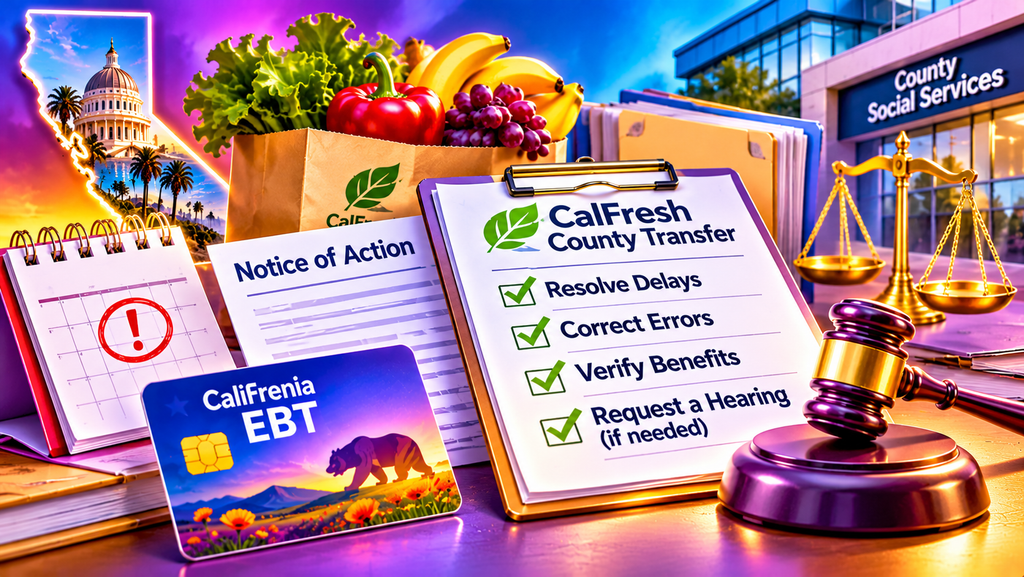
Most transfers are designed to happen without unnecessary disruption, but occasional administrative problems may still arise.
The best response depends on the nature of the problem.
An incorrect address, a missing electronic file, an unprocessed report, and a lawful eligibility change are not the same issue.
6.1 When the counties disagree about responsibility
Suppose the sending county says it has transferred the case, but the receiving county says it has not accepted responsibility.
The recipient should request clarification from both offices.
Ask for the date the transfer was initiated, the receiving county’s status, and the expected effective date.
The counties are responsible for coordinating the case under the applicable ICT rules.
A recipient should not have to resolve their agencies’ internal technical process independently.
6.2 When the transfer exceeds the expected timeframe
If the transfer has not progressed within the required timelines, document the notification date and follow-up contacts.
Ask the county to explain what is preventing completion.
A delay in the transfer system does not automatically mean the household has lost CalFresh eligibility.
The important issue is whether benefits are being issued properly and which agency is responsible for correcting any problem.
6.3 When benefits are discontinued because of the move
A household should question a discontinuance that appears to be based solely on moving to another California county.
State law is designed to prevent eligible recipients from losing benefits merely because administrative responsibility is changing.
Ask the county for the Notice of Action and the specific reason for termination.
If there was another eligibility issue, such as an expired certification period or unresolved mandatory reporting requirement, the county may need to address that issue separately.
If the termination resulted from administrative error, corrective action may be required.
6.4 Request a written explanation
When a problem is disputed, request written information showing:
- The action taken
- The effective date
- The reason for the action
- The county responsible
- Any information needed to correct the case
- The applicable hearing rights
A written explanation helps distinguish a technical transfer delay from a formal eligibility decision.
6.5 State hearing rights
California generally allows recipients 90 days to request a state hearing when they disagree with an applicable county action or failure to act.
The official California State Hearing Requests page explains how to submit a request.
The State Hearings Division can also be contacted at 800-743-8525.
A recipient should not assume that an informal county complaint suspends the hearing deadline.
Different timing or continuation-of-benefits rules may apply depending on the challenged action.
6.6 What if you need food immediately?
If a household is experiencing an immediate food shortage, it should explain the urgency to the county.
Depending on the case, the county may need to examine whether missing benefits require corrective action.
Community food assistance may also help bridge an immediate shortage.
Emergency food resources do not replace the county’s responsibility to administer an eligible CalFresh case correctly.
6.7 Avoid duplicate applications without understanding the case
When a recipient encounters an ICT delay, filing an entirely new application is not necessarily the first or best solution.
An active case should ordinarily move through the established transfer procedure.
If the case is inactive or terminated for another valid reason, different rules may apply.
Ask the county to explain why the original case cannot be transferred before starting a separate application solely to address an administrative problem.
Practical takeaway: When a transfer stalls, identify the exact failure, document county communications, and request correction without losing sight of formal hearing deadlines.
7. Special Considerations for Seniors Living Alone
A county move can have significant consequences for someone over age 60 who relies on fixed retirement income.
Even when the move lowers housing costs, the transition may introduce new challenges involving transportation, healthcare providers, accessibility, and household administration.
CalFresh county transfer planning should therefore be part of a broader independent-living plan.
7.1 Moving to reduce housing expenses
Housing is often one of the largest expenses in retirement.
A retiree may decide to leave a high-cost area in favor of a more affordable county.
However, lower rent does not automatically guarantee a lower total cost of living.
Transportation costs, medical access, utility bills, and grocery prices may differ.
A useful decision compares all essential costs rather than focusing only on rent.
7.2 Transportation and grocery access
An apartment may be less expensive but farther from grocery stores, medical clinics, and public transportation.
For an older adult who no longer drives, that difference can be substantial.
Before moving, consider whether participating grocery stores are accessible by walking, public transit, or affordable transportation.
The ability to use an EBT card at a store is only one part of practical food access.
The person must also be able to reach that store reliably.
7.3 Medical and dietary needs
Some older adults have dietary requirements connected to chronic medical conditions.
Moving to an unfamiliar area can disrupt routines for shopping, meal preparation, and medical care.
A household should identify suitable grocery stores and food resources before moving whenever possible.
If there are new allowable medical expenses or other eligibility-related changes, ask the county how the information should be reported.
7.4 Mailing difficulties and missed notices
Mail is often disrupted during a move.
An older adult may temporarily receive correspondence at two addresses or have difficulty recognizing which county sent a notice.
This creates a risk of missing a SAR 7 request, verification deadline, or recertification notice.
A practical solution is to maintain one organized folder for public benefits correspondence.
Record both the sending and receiving county contact information and confirm where future notices will be delivered.
7.5 Moving while receiving other benefits
A person may receive CalFresh together with Medi-Cal, SSI, or other assistance.
A county transfer can affect the administration of multiple programs, but the rules are not identical.
For example, a person receiving CalWORKs may have different reporting responsibilities from a household receiving CalFresh only.
Medi-Cal may also involve separate administrative processes and managed-care arrangements.
Do not assume that completing one program’s transfer automatically resolves every other benefit issue.
Ask each relevant agency or county worker to confirm the status of the benefits involved.
7.6 Assistance for people with disabilities
People who need help communicating, submitting documents, or accessing services may request appropriate accommodations.
Language assistance may also be necessary.
A person should identify the accommodation needed rather than assume the new county automatically has every preference recorded correctly.
If an authorized representative is involved, confirm whether the new county has the appropriate records.
7.7 Financial preparation before moving
An emergency budget can help protect household stability.
Possible expenses include:
- Moving transportation
- Rental deposits
- Utility connection fees
- Temporary food costs
- Replacement household supplies
- Transportation to medical appointments
- Address-change and document expenses
Not all these expenses affect CalFresh benefits directly.
Nevertheless, understanding them helps a retiree avoid making housing decisions based on rent alone.
Practical takeaway: For seniors, the goal is not merely to move the benefits case. It is to maintain food access, communication, and financial stability in the new community.
8. Practical Transfer Checklist and Examples
A successful transfer is easier to manage when the household follows a clear sequence.
8.1 Before moving
Review the next CalFresh payment date and the current certification period.
Check whether any SAR 7 or recertification deadline is approaching.
Write down the current county’s contact information and case details.
Keep essential notices in an accessible folder.
If the move is already scheduled, prepare the new address and date of relocation.
8.2 Immediately after moving
Contact either the sending or receiving county.
State that the move is permanent and request an Inter-County Transfer.
Provide accurate contact information and describe any other household changes.
Record the date the county received the notification.
8.3 During the transfer
Monitor messages and notices.
Ask whether the ICT has been initiated and which county is issuing the next benefits.
Continue completing any existing reporting obligations.
Do not discard documents from the sending county until the transfer is confirmed.
8.4 After the receiving county takes over
Confirm the effective date, case status, reporting cycle, and benefit amount.
Review updated housing expenses and other relevant circumstances.
Make sure the county has the correct mailing address.
Continue using the existing EBT card according to applicable program rules.
Comparison Table 2: CalFresh County Transfer Action Checklist
| Stage | Household Action | What to Confirm |
|---|---|---|
| Before the move | Review notices and reporting dates | No important deadline is overlooked |
| Report the move | Notify either California county | ICT request received |
| Initial processing | Monitor the seven-business-day requirement | Transfer initiated |
| Transfer period | Track benefit issuance | Sending or receiving county is responsible |
| New county takes over | Review case information | Correct amount, dates, and household details |
| After completion | Maintain reporting and recertification | Ongoing eligibility remains current |
| If problems occur | Document issues and request review | Corrective action or hearing rights |
8.5 Example: Los Angeles County to Riverside County
Consider a hypothetical 70-year-old retiree who moves to Riverside County for lower rent.
The retiree currently receives CalFresh through Los Angeles County.
After moving, the retiree contacts Riverside County, provides the new address, and asks for an ICT.
The receiving county initiates the transfer process, and the counties coordinate existing eligibility records.
The retiree confirms the expected benefit issuance and watches for the receiving county’s notice.
If rent changed, the county evaluates that information according to the applicable reporting and budgeting rules.
The retiree does not ordinarily need to restart the entire application process solely because of moving.
8.6 Example: Sacramento County to Placer County near recertification
Imagine a household moving shortly before its certification period ends.
The family reports the move, but its recertification is already due.
The counties must coordinate responsibility for the transition and the required eligibility review.
A household cannot safely assume that the ICT automatically replaces recertification.
The family should ask which county will process the recertification and where documents must be submitted.
This example demonstrates the importance of tracking both transfer and certification deadlines.
8.7 Example: A temporary move to care for a relative
A retiree temporarily stays with an adult child in another county while recovering from surgery.
The retiree intends to return to the original residence.
The county should evaluate whether this is a temporary absence or an actual change of residency.
A permanent ICT may not be appropriate when the person has not established a new residence.
The retiree should provide accurate information about the temporary arrangement.
8.8 TIPVERO Practical Insight: Protect the Payment, Not Just the Address
The most important measure of a successful CalFresh county transfer is not simply whether the new address appears correctly in the system. It is whether the household’s benefits continue without an avoidable interruption and the correct county assumes responsibility.
An address update and a completed ICT are related but separate administrative events.
For this reason, recipients should confirm three things: the date the move was reported, the county responsible for the next payment, and the date the receiving county will take over.
This approach is particularly valuable for older adults living alone, who may have limited savings available to cover unexpected grocery expenses.
A clear record of these milestones makes it easier to identify a delay and request an appropriate correction if benefits do not arrive as expected.
9. Frequently Asked Questions About CalFresh County Transfers
FAQ 1: Do I need a new CalFresh application when moving to another county?
Generally, no.
An active CalFresh case moving between California counties should ordinarily be handled through the Inter-County Transfer process.
The receiving county generally should not require an entirely new application or interview solely because the household changed counties.
However, an inactive case, expired certification, or separate eligibility problem may require additional action.
FAQ 2: How long does a CalFresh county transfer take?
The notified county generally must initiate the transfer within seven business days.
The transfer of benefits and payment responsibility must occur within the broader timeline established by California law, generally no later than the first day of the next available benefit month following 30 days after notification.
The exact effective date depends on the relevant dates and case circumstances.
FAQ 3: Can I use my California EBT card in a different county?
Yes.
A California EBT card generally works at authorized retailers throughout the state.
Moving to another California county does not automatically invalidate the card or remove benefits already available on it.
Card loss, theft, or security restrictions are separate issues.
FAQ 4: Will moving to another county reduce my benefits?
Not automatically.
The county change itself does not create a mandatory across-the-board reduction.
However, changes in income, household size, housing expenses, and other eligibility factors may affect the amount.
The county must apply current program rules to the household’s circumstances.
FAQ 5: Do I have to report my move within 10 days?
Not every CalFresh household has the same mid-period reporting requirements.
A move between California counties generally is not itself a mandatory mid-period report for households receiving only Non-Assistance CalFresh under ordinary semi-annual reporting.
Other programs, including CalWORKs, may impose different reporting duties.
Prompt notification is recommended to maintain continuity of benefits.
FAQ 6: What if my CalFresh benefits stop during the transfer?
Contact the responsible county and request the specific reason for the interruption.
Ask whether the transfer was completed, whether another eligibility issue exists, and whether corrective action is needed.
A move between California counties should not, by itself, cause an eligible case to be terminated.
If you disagree with an applicable action, review your state hearing rights promptly.
FAQ 7: Can I transfer CalFresh to another state?
No.
California’s ICT system applies to transfers between counties within California.
A permanent move to another state requires a different process because SNAP benefits are administered by each state.
An EBT card’s ability to work in another state does not mean a California case can remain active indefinitely after establishing permanent residence elsewhere.
FAQ 8: Does my SAR 7 deadline change after a county transfer?
Generally, the existing semi-annual reporting cycle continues through the ICT.
A county transfer does not automatically restart the SAR cycle.
Recipients should confirm which county is responsible for the next report and whether recertification is approaching.
The timing may be especially important when the move occurs near the end of a certification period.
10. Conclusion: A Smooth Move Without Losing Food Assistance
Moving to another California county can represent an important new beginning.
For an older adult, a move may provide more affordable housing, closer access to family, or a community that better supports independent living.
However, changing where someone lives should not create unnecessary uncertainty about food assistance.
California’s Inter-County Transfer process is designed to make the administrative transition more manageable.
An eligible household generally can move an existing CalFresh case between counties without starting a new application solely because of the relocation.
The counties are responsible for coordinating case information, initiating the transfer within the applicable deadline, and protecting continuity of benefits.
Recipients also have an important role.
They should report the move promptly, preserve contact records, confirm which county will issue the next benefits, and continue meeting applicable reporting requirements.
For seniors living alone, this preparation is especially valuable.
Reliable access to groceries supports nutrition, independence, and financial stability. Losing even one expected benefit issuance can create pressure on a limited monthly budget.
The five steps outlined in this guide offer a practical framework:
- Report the move to either county.
- Understand the transfer initiation deadline.
- Monitor benefits during the transition.
- Verify the receiving county’s information.
- Resolve delays or errors promptly.
The central principle is simple: a change of California county should be an administrative transfer, not an unnecessary loss of eligible food assistance.
By understanding the rules and keeping a clear record of important dates, recipients can reduce confusion and make their move with greater confidence.