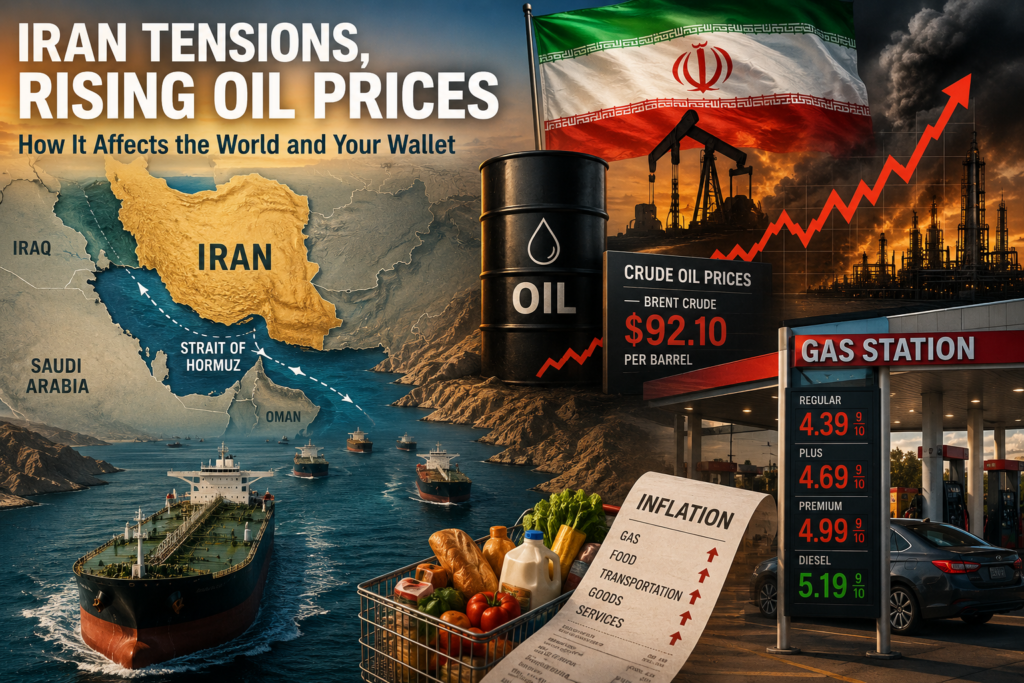
How the Iran Situation Can Affect Global Oil Prices
Events involving Iran can quickly affect energy markets around the world.
For many Americans, developments in the Middle East may seem far removed from everyday life. But when tensions involving Iran threaten oil production or major shipping routes, the effects can travel rapidly from the Persian Gulf to gas stations, transportation companies, businesses, and household budgets.
The key reason is simple: the Middle East remains one of the world’s most important energy-producing regions, and Iran sits beside one of the most critical oil-shipping routes on the planet.
Understanding this connection can help consumers understand why geopolitical events thousands of miles away can influence the price they pay for gasoline and other everyday goods.
1. Why Iran Matters to the Global Oil Market
Iran is an important oil-producing country, but its influence on energy markets goes beyond its own production.
Its geographic location is particularly important.
Iran borders the Strait of Hormuz, a narrow waterway connecting the Persian Gulf with international shipping routes.
Large amounts of crude oil and petroleum products from major Middle Eastern producers normally travel through this route.
Before the recent conflict, the Strait of Hormuz handled roughly one-fifth of global petroleum liquids consumption, making it one of the world’s most important energy chokepoints.
When shipping through the strait is threatened or disrupted, traders immediately begin worrying about whether enough oil will reach global markets. EIA
2. Why Oil Prices Can Rise During a Crisis
Oil prices are influenced by supply and demand.
If markets expect global oil supplies to fall while demand remains strong, prices generally rise.
A conflict involving Iran can create several risks at the same time.
Oil production could be disrupted. Tankers could face difficulty traveling through the Persian Gulf. Shipping insurance costs could increase. Other Middle Eastern producers could have trouble exporting their oil.
Even before supplies actually disappear, the possibility of disruption can cause traders to bid prices higher.
This is sometimes called a geopolitical risk premium.
3. The Strait of Hormuz Is the Critical Connection
The Strait of Hormuz is particularly important because several major oil-producing countries rely on it.
When the waterway operates normally, tankers transport enormous quantities of energy to customers around the world.
When traffic slows, the consequences can be significant.
U.S. Energy Information Administration data show how dramatic those changes can become. Petroleum liquids transported through Hormuz averaged about 21.6 million barrels per day in the fourth quarter of 2025 but fell to an estimated 4.9 million barrels per day during the second quarter of 2026 amid disruptions. EIA
Recent shipping data also show that traffic remains far below pre-conflict levels. Reuters
That helps explain why markets react so strongly to developments involving Iran.
4. Why Other Countries Cannot Immediately Replace Lost Oil
The world has other major oil producers.
The United States, Saudi Arabia, Canada, Brazil and other countries produce large quantities of crude oil.
Some producers may be able to increase production when supplies are disrupted elsewhere.
Countries also maintain strategic petroleum reserves that can sometimes be used during serious shortages.
But replacing millions of barrels of disrupted supply is not always quick or easy.
Alternative shipping routes may have limited capacity, take longer, or cost more.
This means even temporary disruptions can create substantial price volatility.
5. What Is Happening to Oil Prices Now?
The market has already demonstrated how sensitive prices are to the current situation.
On August 20, Brent crude rose into the low-$90-per-barrel range as concerns continued about Middle Eastern supplies and the slow movement of ships through the Strait of Hormuz. Reuters
Earlier in 2026, the volatility was even greater.
According to the U.S. Energy Information Administration, Brent crude futures reached $118 per barrel in late April before falling substantially as conditions changed. EIA
This illustrates an important point: geopolitical crises do not necessarily cause oil prices to move in one direction permanently.
Prices can rise or fall rapidly as traders react to military developments, diplomatic negotiations, inventories, production and global demand.
6. How Higher Oil Prices Reach American Gas Stations
Crude oil is one of the biggest components affecting gasoline prices.
When crude becomes more expensive, refineries generally have to pay more for the raw material used to make gasoline, diesel and other petroleum products.
Those higher costs can eventually reach consumers.
The effect is not always immediate because gasoline prices are also influenced by refining costs, inventories, taxes, transportation and local market conditions.
But a sustained increase in crude oil prices generally creates upward pressure on fuel prices.
7. The Impact Goes Beyond Gasoline
Higher oil prices can affect much more than drivers.
Trucks transport food and consumer products across the country.
Airlines use large amounts of jet fuel.
Farmers rely on diesel-powered equipment.
Manufacturers and delivery companies also depend on transportation.
When fuel costs rise, businesses may eventually pass some of those additional expenses on to customers.
That means an oil shock can contribute to higher prices for groceries, airline tickets, deliveries and other goods and services.
8. Oil Prices Can Influence Inflation
Energy is an important part of the economy.
If gasoline, diesel and transportation costs rise significantly, inflation can become harder to control.
Consumers may have less money available for restaurants, entertainment, clothing or other purchases after paying more for transportation and household expenses.
Businesses can also experience higher operating costs.
This is one reason policymakers and financial markets closely watch major oil-price movements.
A prolonged energy shock can complicate decisions about interest rates and economic growth.
9. What Could Make Oil Prices Rise Further?
Several developments could create additional upward pressure.
A major reduction in traffic through the Strait of Hormuz would be especially significant.
Damage to oil facilities, attacks on tankers, expansion of the conflict to other oil-producing countries, or prolonged diplomatic failure could also increase supply concerns.
Markets would then have to evaluate how much oil might be unavailable and how quickly alternative supplies could replace it.
10. What Could Bring Prices Down?
The opposite is also possible.
Successful diplomatic negotiations could reduce fears of supply disruptions.
More normal shipping through the Strait of Hormuz would also help.
Additional production from other countries, weaker global demand, and rebuilding depleted oil inventories could place downward pressure on prices.
The EIA has emphasized that restoring production, shipping flows and inventories would eventually help reduce crude prices, although recovery may take time. EIA
What Should Consumers Watch?
Consumers do not need to follow every military or diplomatic development.
Instead, a few indicators can provide a useful picture of where energy prices may be heading.
Watch the flow of ships through the Strait of Hormuz, Brent crude oil prices, diplomatic negotiations involving Iran, production decisions by major oil exporters, global oil inventories, and U.S. gasoline prices.
Together, these indicators can help explain whether an international crisis is beginning to affect household expenses.
The Bottom Line
The Iran situation matters to global oil prices because the issue is larger than Iran’s own oil production.
Iran’s location beside the Strait of Hormuz places it near one of the most important energy transportation routes in the world.
When conflict threatens that route, markets worry that millions of barrels of oil may not reach consumers as expected.
That uncertainty can push crude prices higher.
And when higher oil prices persist, the consequences can eventually reach ordinary households through gasoline, transportation, food prices, travel costs and inflation.
For Americans, this is why developments in the Middle East can quickly become an everyday economic issue.