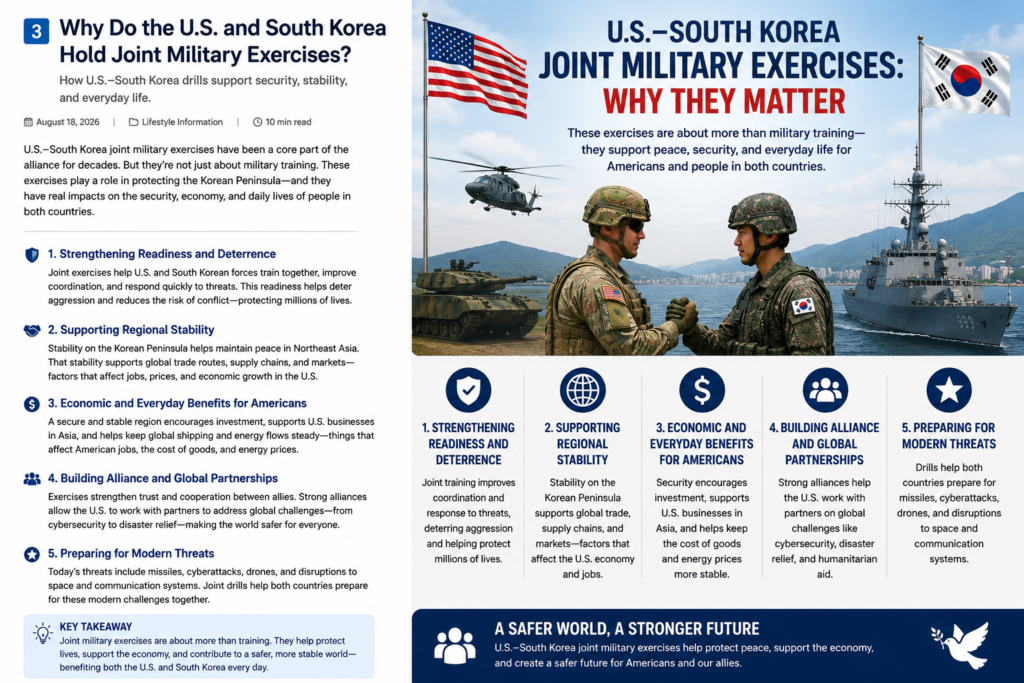
When Americans hear about U.S.–South Korea joint military exercises, the story can seem very far away.
South Korea is thousands of miles from the continental United States, and military exercises on the Korean Peninsula may appear to have little connection to an American family’s daily life.
But the issue is bigger than military training.
The U.S.–South Korea alliance is connected to regional security, international trade, technology supply chains, American businesses, military spending, and the broader U.S. strategy in Asia.
Understanding why the two countries conduct joint military exercises can therefore help Americans understand why events on the Korean Peninsula sometimes matter at home.
1. Why Are the United States and South Korea Military Allies?
The modern U.S.–South Korea security relationship developed after the Korean War.
The Korean War fighting ended with an armistice in 1953 rather than a comprehensive peace treaty.
The United States and South Korea subsequently developed a defense alliance designed to help protect South Korea from an external attack.
American military forces remain stationed in South Korea today.
For Washington, the alliance is also part of a much larger American security network in the Indo-Pacific.
The United States maintains important security relationships with countries including Japan, Australia, and the Philippines.
South Korea therefore matters not only because of North Korea but also because of America’s broader strategic position in Asia.
2. What Happens During Joint Military Exercises?
Joint exercises allow American and South Korean forces to practice working together.
Modern military operations require much more than individual soldiers knowing how to use equipment.
Two militaries must be able to communicate, exchange information, coordinate aircraft and ships, manage logistics, respond to emergencies, and make decisions quickly.
Exercises can involve field training as well as command-and-control and computer simulations.
They can also prepare forces for newer challenges.
These include:
missile attacks,
cyberattacks,
drones,
disruptions to communications,
GPS interference,
and other modern security threats.
The objective is preparedness.
Waiting until an actual emergency occurs to learn how two militaries should cooperate would create unnecessary risks.
3. Why Does Military Readiness Matter to Americans?
The first connection is national security.
The purpose of military readiness is not simply to prepare to fight a war.
Ideally, readiness helps prevent one.
If a potential adversary believes the United States and its allies are capable of responding effectively to an attack, the cost of starting a conflict becomes much higher.
This idea is known as deterrence.
Successful deterrence can reduce the likelihood that American forces will eventually have to fight a much larger conflict.
For American families with relatives serving in the military, that connection can be particularly important.
4. Stability in Asia Can Affect the U.S. Economy
Asia is one of the most economically important regions in the world.
American companies buy and sell enormous amounts of goods and services across the Pacific.
South Korea itself is an important U.S. trading partner.
The products moving between the two economies include automobiles, machinery, electronics, agricultural goods, chemicals, semiconductors, and many other products.
A serious military conflict in Northeast Asia could disrupt shipping, manufacturing, investment, and supply chains.
Those disruptions would not necessarily remain in Asia.
They could eventually reach American businesses and consumers.
This is one reason regional security can also become an economic issue.
5. What Could This Mean for American Jobs?
Trade between the United States and South Korea supports economic activity in many American industries.
American farmers sell agricultural products abroad.
Manufacturers export equipment and industrial products.
Technology and service companies conduct business internationally.
South Korean companies also invest in factories and facilities in the United States.
These economic connections mean stability in the relationship can matter to American workers.
When businesses feel confident about long-term economic conditions, they are generally better positioned to make large investments.
Serious geopolitical instability can make those decisions more difficult.
The relationship between security and jobs is therefore indirect but real.
6. Could Americans Pay Higher Prices If Conflict Occurred?
Potentially.
Modern products often rely on complicated international supply chains.
A product assembled in the United States may contain components manufactured in several different countries.
South Korea is especially important in areas such as semiconductors, electronics, batteries, automobiles, and advanced manufacturing.
If a major regional conflict disrupted production or shipping, some products could become harder or more expensive to obtain.
Businesses facing higher transportation or component costs may eventually pass part of those expenses to consumers.
That could affect prices for electronics, automobiles, appliances, and other goods.
This does not mean every military disagreement causes inflation.
Most do not.
But severe and prolonged disruption in a major manufacturing region can have consequences far beyond that region.
7. Why Semiconductors Make South Korea Especially Important
Semiconductors are among the most important products in the modern economy.
Computer chips are found in:
smartphones,
automobiles,
computers,
household appliances,
medical equipment,
industrial machinery,
data centers,
and artificial intelligence systems.
South Korea is a major part of the global semiconductor industry.
The United States is also deeply involved through chip design, software, AI, manufacturing technology, and semiconductor equipment.
This makes the stability of Asian technology supply chains particularly important.
A disruption affecting advanced chips can eventually influence American factories, technology companies, consumers, and investors.
8. What About American Taxpayers?
Military alliances also involve costs.
American taxpayers fund the U.S. military, including personnel, equipment, logistics, infrastructure, and training.
That naturally creates an important public-policy question:
How much should the United States spend defending allies overseas?
Different Americans may answer that question differently.
One perspective argues that alliances cost money but help prevent larger wars, protect international commerce, and allow countries to share security responsibilities.
Another perspective argues that wealthy allies should承担 a larger share of their own defense costs so American taxpayers carry less of the burden.
That debate has existed for many years.
Understanding both the costs and potential benefits is more useful than treating military spending as either automatically good or automatically wasteful.
9. Why Doesn’t South Korea Simply Handle Its Own Defense?
South Korea has a large and technologically advanced military.
The alliance does not mean South Korea has no responsibility for its defense.
Instead, the two countries combine different capabilities.
The United States provides capabilities and a broader regional military network, while South Korea provides substantial military forces and operates directly on the Korean Peninsula.
The important policy question is therefore often not whether South Korea contributes, but how responsibilities and costs should be divided between the two allies.
That debate can change as military technology, threats, and political priorities evolve.
10. Could Joint Exercises Increase Tensions With North Korea?
North Korea has frequently criticized U.S.–South Korea military exercises.
Pyongyang often portrays them as threatening.
The United States and South Korea describe their exercises as defensive and necessary for military readiness.
This creates a difficult policy balance.
Reducing exercises could potentially lower tensions or create diplomatic opportunities.
But reducing training too much could also weaken military preparedness.
Increasing exercises could improve readiness while potentially increasing political tensions.
There is no simple solution.
Governments therefore have to balance diplomacy and deterrence.
11. How Could Changes in the Exercises Affect Americans?
A single exercise being reduced or expanded will usually have little immediate impact on an American household.
The more important issue is what the change signals.
Americans should watch whether it leads to broader changes involving:
the number of U.S. troops in South Korea,
American defense spending,
negotiations with North Korea,
South Korean defense contributions,
U.S. strategy toward China,
semiconductor supply chains,
and U.S. investment and trade in Asia.
Those developments could have greater long-term consequences.
12. Why China Is Part of the Bigger Picture
The Korean Peninsula does not exist in isolation.
China is a major regional power and the world’s second-largest economy.
It is also North Korea’s most important economic partner.
At the same time, competition between Washington and Beijing increasingly involves technology, semiconductors, artificial intelligence, trade, and military power.
South Korea has important economic relationships with both the United States and China.
That places Seoul in a complicated position.
For the United States, maintaining strong alliances in Asia can strengthen Washington’s influence in the region.
This means the U.S.–South Korea alliance increasingly intersects with the larger U.S.–China competition.
13. Military Alliances Can Have Economic Value Too
It is easy to think of defense alliances purely in military terms.
But stability can have economic value.
Companies are more likely to invest when they believe factories, shipping routes, infrastructure, and markets will remain secure.
Consumers benefit when international supply chains operate reliably.
American exporters benefit when overseas markets remain open and stable.
Security cannot guarantee economic prosperity.
But serious instability can make prosperity much harder to maintain.
14. What Should Ordinary Americans Watch?
Americans do not need to follow every military exercise or diplomatic statement.
Instead, look for changes that could have practical consequences.
Has the United States announced a major troop reduction?
Has Congress changed funding for forces in Korea?
Have Washington and Seoul reached a new defense-cost agreement?
Have negotiations with North Korea resumed?
Have tensions disrupted shipping or manufacturing?
Have semiconductor supplies been affected?
These are the developments more likely to influence American security, businesses, jobs, or household expenses.
Final Thoughts
U.S.–South Korea joint military exercises may happen thousands of miles away, but the reasons behind them connect to issues much closer to home.
They involve American national security, military personnel, taxpayer money, international trade, technology supply chains, and the stability of one of the world’s most economically important regions.
That does not mean Americans must support every exercise or every aspect of U.S. military policy.
Those are legitimate subjects for public debate.
But understanding the connection between security and everyday life makes the debate much more useful.
Instead of asking only:
“Why is America conducting military exercises so far from home?”
Americans can also ask:
“What security and economic interests are being protected, what does it cost, and what would happen if the United States changed its approach?”
Those questions turn a distant international headline into practical information about American life.
United States Trade Representative
U.S. Trade Representative — U.S.–Korea Trade Information