What Do Koreans Really Eat Every Day?
7 Amazing Insights Into Korean Home Meals, Breakfast Habits, Convenience Foods, and Modern Life
Fact-checked: November 6, 2026 | Primary sources: Statistics Korea, Korea Disease Control and Prevention Agency, Korea Rural Economic Institute, Korea Tourism Organization, and UNESCO
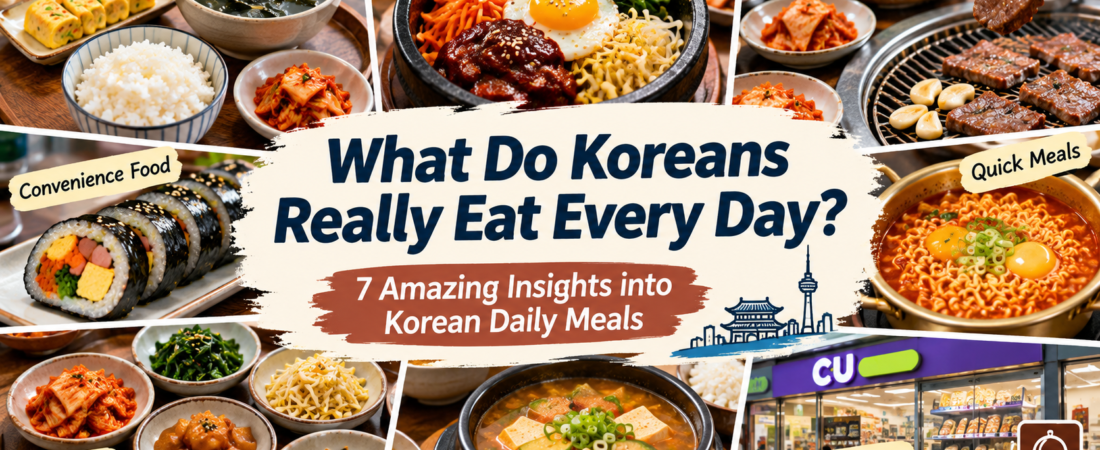
What Koreans Eat Every Day is often very different from the elaborate Korean barbecue dinners, colorful bibimbap bowls, and spicy dishes featured in travel videos.
A regular day in South Korea might begin with toast and coffee, continue with a quick office lunch, and end with rice, soup, and whatever vegetables or proteins are already in the refrigerator.
Another person may skip breakfast, purchase gimbap at a convenience store, and order dinner through a delivery app.
Traditional Korean food remains important, but modern eating habits are shaped by work schedules, household size, food prices, convenience, and personal preferences.
For American readers, understanding everyday Korean meals offers a more realistic view of life in South Korea. It also provides useful ideas for preparing affordable home meals, reducing food waste, and exploring Korean ingredients without cooking an elaborate restaurant-style dinner.
This guide combines Korean food traditions with government statistics and practical meal examples. It distinguishes documented facts from illustrative menus rather than presenting one household’s habits as typical of an entire country.
Table of Contents
1. What Koreans Eat Every Day: The Traditional Meal and Today’s Reality
1.1 Understanding the Traditional Korean Table
The classic Korean meal is often described as a combination of rice, soup, a main dish, kimchi, and several side dishes.
The Korea Tourism Organization’s official guide to Korean food explains the traditional arrangement known as han sang charim, in which several foods are served together.
Rice is called bap (밥), while soup is called guk (국). Korean side dishes are known as banchan (반찬).
A traditional home meal might contain steamed rice, soybean paste stew, grilled fish, kimchi, and seasoned spinach.
However, it would be inaccurate to assume that every Korean household prepares this arrangement three times daily.
Some meals consist of only one bowl of noodles or rice. Others include a sandwich, a supermarket lunch box, or food ordered from a restaurant.
The traditional table is a cultural foundation, not a rule followed by every person at every meal.
1.2 Household Size Is Changing the Way People Eat
One of the most important changes in Korean daily life is the growing proportion of smaller households.
According to Statistics Korea’s 2024 Population and Housing Census, published in July 2025, one-person households accounted for 36.1% of general households.
One-person and two-person households together represented 65.1%.
These figures help explain why ready-to-eat meals, small food packages, individual portions, and convenient home cooking are relevant to modern Korean life.
A person living alone may have little reason to cook several large dishes every evening.
Instead, that person might combine packaged rice, an egg, a small portion of kimchi, and a bowl of soup.
A family of four may prepare a larger shared dinner, but even that household might choose simple meals on busy weekdays.
The result is not the disappearance of traditional Korean food. It is a more flexible approach to preparing and serving it.
2. What Do Koreans Really Eat for Breakfast?
2.1 Traditional Breakfast Versus Modern Breakfast
In a traditional Korean household, breakfast might include rice, soup, kimchi, and a few side dishes.
Popular possibilities include seaweed soup, soybean sprout soup, steamed egg, grilled fish, or leftover stew.
Unlike the clear separation between breakfast and dinner foods that exists in many American households, traditional Korean cooking allows similar dishes at different times of day.
But contemporary Korean breakfasts are diverse.
Someone preparing for work might choose toast, yogurt, a boiled egg, fruit, or coffee. A student may eat cereal or a simple rice-based meal.
Others do not eat breakfast regularly.
2.2 What Official Korean Statistics Reveal
The 2024 Time Use Survey, published by Statistics Korea in July 2025, found that 63.7% of surveyed people aged 10 and older ate breakfast on weekdays.
That was four percentage points lower than in the comparable 2019 survey.
Among people in their twenties, the weekday breakfast participation rate was 36.9%.
A separate analysis published by the Korea Disease Control and Prevention Agency in January 2026 found that the proportion of people aged one year and older skipping breakfast increased from 26.2% in 2015 to 35.3% in 2024.
The two studies use different measures and survey populations, so their percentages should not be treated as interchangeable.
Nevertheless, both demonstrate why a description of Korean breakfasts must include meal skipping and changing schedules.
You can explore the published findings in the KDCA’s breakfast-skipping analysis.
2.3 What Should American Readers Understand?
Korean breakfast is not necessarily spicy, large, or time-consuming.
Rice and soup remain familiar choices, but they coexist with bread, eggs, fruit, convenience foods, and skipped meals.
Practical insight: If you want to try a Korean-style breakfast at home, begin with rice, a small bowl of soup, and one protein. You do not need five side dishes to create a recognizable Korean meal.
3. What Do Koreans Eat for Lunch and Dinner?

3.1 Office Lunches and School Meals
Lunch depends heavily on daily routines.
An office worker may visit a nearby restaurant, purchase a prepared meal, or eat in a workplace cafeteria.
Common options include kimchi stew, soybean paste stew, pork stir-fry, bibimbap, noodle soup, gimbap, and rice bowls.
School cafeterias often provide set meals designed around a combination of food groups, although menus vary by school and date.
Unlike a restaurant-style Korean barbecue meal, an ordinary lunch may need to be inexpensive, convenient, and quick enough to fit into a limited break.
3.2 Home Dinners Can Be Surprisingly Simple
Dinner offers another example of the difference between a traditional ideal and everyday reality.
One household might eat rice, grilled mackerel, soup, and kimchi.
Another might prepare fried rice using leftover vegetables.
A parent returning home late could heat frozen dumplings and packaged soup.
A person living alone could make ramyeon and add an egg, tofu, or vegetables.
Families also eat pizza, pasta, fried chicken, and many international dishes.
The exact meal depends on the household, available ingredients, budget, and time.
3.3 Do Koreans Eat Together Every Evening?
Not necessarily.
Statistics Korea’s 2024 Time Use Survey found that, among people who ate dinner on weekdays, 25.7% ate alone.
For people in their twenties who ate dinner, the share eating alone was 34.8%.
These figures do not mean family dinners have disappeared. They show that solitary meals are also an established part of modern Korean life.
A realistic account of Korean food must include both shared family tables and individual meals.
4. What Foods Do Korean Households Keep at Home?
4.1 Rice, Soup, and Flexible Everyday Ingredients
Rice remains a familiar foundation in Korean kitchens, although meals may use white rice, mixed grains, noodles, or other starches.
Soups and stews are equally versatile.
Common examples include doenjang jjigae (soybean paste stew), kimchi jjigae (kimchi stew), miyeok-guk (seaweed soup), and kongnamul-guk (soybean sprout soup).
One pot can provide several servings and accommodate vegetables, tofu, fish, or meat.
This flexibility is particularly helpful when preparing meals with ingredients already available at home.
4.2 The Role of Kimchi and Side Dishes
Kimchi is one of the best-known elements of Korean food culture.
Different varieties use cabbage, radish, cucumber, and other vegetables. Preparation and fermentation methods vary.
Some prepared side dishes can be served over several meals when handled and stored safely.
Rather than preparing every dish immediately before dinner, a household can combine previously prepared food with freshly cooked rice and a simple main dish.
For readers who want to identify individual dishes or understand restaurant etiquette, TIPVERO’s What Is Banchan? A Beginner’s Guide to Korean Side Dishes explains seven representative examples in detail.
This article focuses instead on how foods fit into everyday routines.
4.3 Fermented Sauces Make Simple Cooking Possible
Three important Korean seasonings are:
- Doenjang: Fermented soybean paste, commonly used in stews and sauces.
- Ganjang: Soy sauce, used in seasoning, marinades, and braising.
- Gochujang: Red pepper paste, used in spicy sauces and mixed dishes.
Garlic, green onions, and sesame oil are also familiar ingredients in many Korean kitchens.
In 2024, UNESCO inscribed Korean jang-making knowledge and practices on its Representative List of the Intangible Cultural Heritage of Humanity.
This recognition concerns traditional knowledge and practices, not an endorsement of the nutritional content of every fermented sauce.
4.4 An Illustrative Korean Pantry
A practical kitchen might contain packaged or cooked rice, eggs, tofu, vegetables, dried seaweed, frozen dumplings, kimchi, garlic, and a few seasoning sauces.
The precise contents vary widely.
For an American cook, the useful lesson is that Korean flavor does not always require a large collection of specialized ingredients.
A relatively small pantry can support several different meals.

5. Convenience Stores, Delivery, and One-Person Meals
5.1 The Modern Convenience-Store Meal
Korean convenience stores offer more than snacks.
Depending on the store, customers may find packaged rice balls, lunch boxes, sandwiches, cooked eggs, noodles, ready-made rice, desserts, and chilled prepared meals.
A worker with limited time might purchase a simple meal rather than visit a full-service restaurant.
A traveler may also use convenience stores for a quick breakfast or late-night snack.
However, convenience-store products differ in ingredients, portion sizes, sodium content, and prices.
Ready-made food should not automatically be assumed to be cheaper or nutritionally equivalent to home cooking.
5.2 Delivery Food Is Part of Everyday Life
Korean delivery options extend well beyond fried chicken.
Depending on location and service availability, customers can order rice dishes, noodles, soups, dumplings, pizza, burgers, desserts, and other foods.
This creates another way that traditional dishes and modern convenience overlap.
A person may enjoy homemade soybean paste stew one night and restaurant delivery the next.
Neither meal makes the person more or less authentically Korean.
5.3 Why Smaller Households Matter
The growth of one-person households changes how food can be purchased and prepared.
Buying a large quantity of fresh vegetables may be inconvenient if one person cannot use them before they spoil.
Smaller packages, frozen ingredients, ready-made meals, and flexible portion sizes become useful options.
The Korea Rural Economic Institute’s 2025 Consumer Behavior Survey for Food, published December 30, 2025, examines food purchasing, eating-out behavior, and changing consumption choices against the background of demographic and economic change.
That research provides a stronger basis for discussing modern Korean food than assuming a single traditional household model represents everyone.
5.4 Three Different Meal Situations
| Household situation | Illustrative dinner | Main practical concern |
|---|---|---|
| Person living alone | Packaged rice, tofu, kimchi, soup | Portion size and convenience |
| Busy working couple | Quick noodle dish with vegetables and eggs | Preparation time |
| Family preparing a shared meal | Rice, stew, fish or meat, side dishes | Serving several people |
These examples are hypothetical and do not represent survey averages.
Their value is to show how different living arrangements can lead to different food choices.
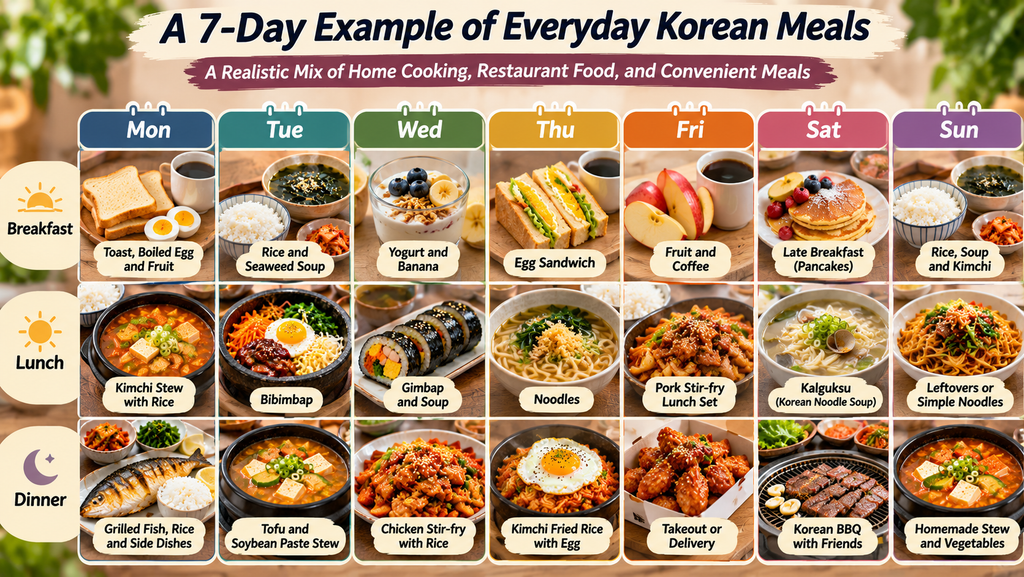
6. A Realistic Seven-Day Example of Korean Everyday Eating
A seven-day menu can help American readers imagine how traditional and modern foods fit together.
The following is an illustrative meal plan, not a food diary from an actual Korean household and not a nationally representative survey.
It intentionally mixes rice-based meals, convenience foods, international dishes, and simple home cooking.
| Day | Breakfast | Lunch | Dinner |
|---|---|---|---|
| Monday | Toast, boiled egg, fruit | Kimchi stew with rice | Grilled fish, rice, vegetable side dish |
| Tuesday | Rice and seaweed | Bibimbap | Tofu and soybean paste stew |
| Wednesday | Yogurt and banana | Gimbap and soup | Chicken stir-fry with rice |
| Thursday | Egg sandwich | Noodles | Kimchi fried rice with egg |
| Friday | Fruit and coffee | Pork stir-fry lunch set | Takeout or delivery |
| Saturday | Late breakfast | Kalguksu | Korean barbecue with friends |
| Sunday | Rice, soup, kimchi | Leftovers or simple noodles | Homemade stew and vegetables |
6.1 What This Menu Demonstrates
The sample includes meals prepared from scratch, foods made from leftovers, restaurant dishes, and convenience-oriented choices.
It also shows why Korean barbecue should not be treated as the centerpiece of every Korean dinner.
Meals can be elaborate on some occasions and very simple on others.
6.2 What This Menu Does Not Prove
The example does not establish how frequently Koreans eat any particular dish.
There is no official basis for claiming that most Korean families eat fish every Monday or barbecue every Saturday.
To understand population-wide food consumption, readers should rely on actual surveys rather than illustrative menus.
6.3 Three Practical Ideas Americans Can Borrow
First, make a small number of versatile ingredients work across several meals.
Second, plan simple options for busy evenings rather than expecting elaborate cooking every day.
Third, combine fresh ingredients with properly stored prepared foods when appropriate.
These are practical cooking ideas, not claims that all Korean households use the same system.
7. What Makes Everyday Korean Eating Different From the American Image?
7.1 The Biggest Misconception: Korean BBQ Every Night
International Korean restaurants often emphasize grilled meat, fried chicken, and dramatic presentations.
Those dishes are important parts of Korean food culture, but they are not a complete description of ordinary meals.
A simple bowl of rice with egg and kimchi can be just as recognizable in a Korean home.
7.2 Another Misconception: Every Meal Is Spicy
Many Korean dishes use chili peppers, but numerous foods are mild.
Examples include seaweed soup, steamed egg, seasoned spinach, grilled fish, and some noodle soups.
Spice levels can also vary by recipe and household.
7.3 Are Korean Meals Always Healthier?
No cuisine is automatically healthy in every form.
Some Korean meals contain a wide variety of vegetables and minimally processed ingredients.
Others may be high in sodium, refined carbohydrates, added sugar, or saturated fat.
Instant noodles, restaurant soups, fried foods, and salty side dishes should be evaluated according to their ingredients and portion sizes.
A rice-based meal with vegetables and protein can be a practical balanced option, but individual nutritional needs differ.
7.4 What About Food Costs?
Household grocery costs depend on location, food choices, store types, household size, and how frequently people eat outside the home.
A person relying heavily on restaurant delivery may have a different budget from someone preparing most meals at home.
Rather than presenting one invented national grocery budget, a more useful approach is to compare an actual shopping list at a specified store and date.
For Americans considering living in Korea, the important questions are how much they cook, how many people share food costs, and what types of ingredients they prefer.
7.5 The Cultural Significance of Asking Whether Someone Has Eaten
In Korean, bap meogeosseoyo? (밥 먹었어요?) literally means “Have you eaten?”
Depending on the relationship and context, asking about a meal can express concern or warmth.
The Korea Tourism Organization also discusses the emotional role of food in its guide to Korean food and everyday culture.
This helps explain why food is closely connected with family relationships, hospitality, memory, and care.
At the same time, modern Korean life includes solo dining, busy workdays, and changing household arrangements.
Understanding both sides provides a fuller picture of contemporary Korea.
Frequently Asked Questions
1. What do Koreans really eat every day?
Common foods include rice, soups, stews, kimchi, vegetables, eggs, tofu, fish, noodles, and convenient prepared meals. Choices differ by household, age, region, and daily schedule.
2. Do Koreans eat rice three times a day?
Some people eat rice at several meals, but it is not universal. Bread, noodles, salads, sandwiches, and other foods also appear in modern diets.
3. Do Koreans eat breakfast every morning?
No. Statistics Korea’s 2024 Time Use Survey found that 63.7% of people aged 10 and older ate breakfast on weekdays under its survey definition.
4. Do Korean families cook all their meals from scratch?
No. Many households combine home cooking with prepared foods, restaurants, school or workplace meals, and delivery services.
5. Is Korean barbecue an everyday meal?
Not necessarily. Korean barbecue is popular, but many ordinary meals use simpler foods such as eggs, tofu, fish, vegetables, or soup.
6. What is a common Korean home dinner?
One possible dinner is rice, soybean paste stew, kimchi, and a protein or vegetable dish. Many other combinations are equally possible.
7. Do Koreans always eat with other family members?
No. Solo eating is part of modern Korean life. In the 2024 Time Use Survey, 25.7% of weekday dinner participants reported eating alone.
8. What do Korean office workers eat for lunch?
Possible choices include stew with rice, rice bowls, noodles, bibimbap, gimbap, and cafeteria meals. Options depend on workplace and location.
9. Is everyday Korean food always spicy?
No. Foods such as steamed egg, seaweed soup, seasoned spinach, and some fish dishes can be mild.
10. How can an American prepare a simple Korean-style meal?
Begin with rice or another base, add vegetables and a protein, and serve a small amount of kimchi or a familiar side dish. Check allergens and store prepared foods safely.
Conclusion: The Real Korean Table Is More Diverse Than You Think
What Koreans Eat Every Day cannot be reduced to a single restaurant menu, one elaborate family table, or a viral food video.
Rice, kimchi, soup, and side dishes remain important elements of Korean culinary culture.
Yet modern Korean eating also includes skipped breakfasts, individual meals, convenience-store products, delivery food, and international cuisine.
Official statistics show that household composition and everyday routines are changing. These developments make it increasingly important to distinguish traditional food customs from what individual people actually eat.
For Americans interested in Korean life, the most meaningful lesson is not that every Korean meal looks different from an American meal.
It is that food reflects real life: available time, family arrangements, budgets, habits, preferences, and cultural traditions.
Understanding that balance provides a more accurate and interesting introduction to everyday Korean food than any single spectacular feast.