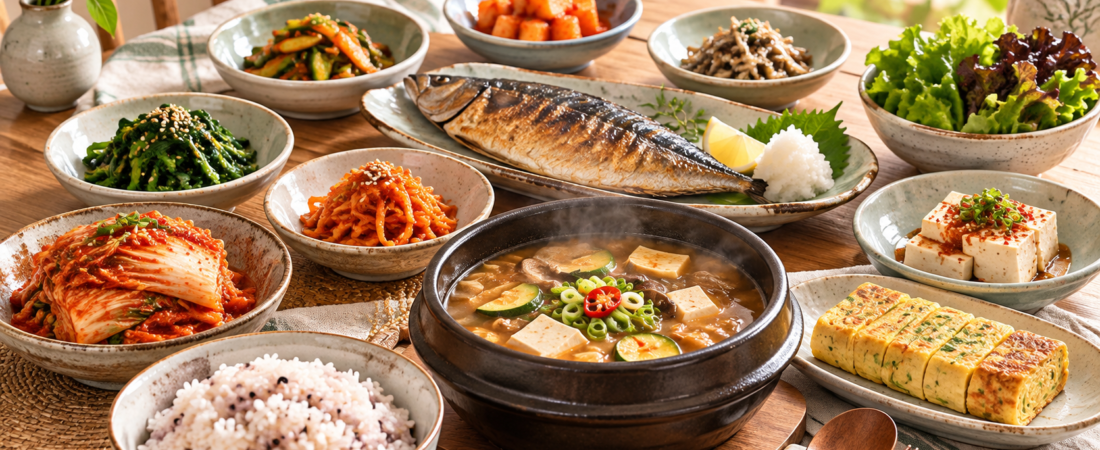
When people in the United States think about Korean food, they may picture sizzling Korean BBQ, spicy fried chicken, colorful bibimbap, or a bubbling pot of kimchi stew.
Those foods are certainly part of Korean cuisine. But they don’t tell the whole story.
What Koreans eat every day is often much simpler.
A typical home meal might consist of a bowl of rice, a warm soup or stew, kimchi, and two or three small side dishes. Another day, dinner could be noodles, dumplings, grilled fish, eggs, tofu, or leftovers from the refrigerator.
There is no single meal that represents every Korean household. Eating habits differ according to age, region, family size, work schedules, budget, and personal preferences.
Still, several patterns make everyday Korean meals distinctive.
If you have ever wondered what an ordinary Korean refrigerator looks like—or what Korean families actually put on the table when nobody is visiting—this guide will take you beyond restaurant menus and into everyday Korean food culture.
Table of Contents
- The Basic Structure of a Korean Home Meal
- Rice: The Traditional Center of the Table
- Why Soup and Stew Are So Common
- Kimchi Is an Everyday Food
- Banchan: Small Dishes That Complete the Meal
- What Koreans Really Eat for Breakfast
- A Typical Korean Lunch
- What Korean Families Eat for Dinner
- Do Koreans Eat Korean BBQ Every Day?
- Noodles and One-Bowl Meals
- Eggs, Tofu, Fish, and Everyday Proteins
- Korean Convenience Foods
- Delivery Food and Modern Korean Eating Habits
- What Is Usually Inside a Korean Refrigerator?
- How Korean Meals Are Changing
- A Realistic Seven-Day Korean Meal Example
- What Americans May Find Different
- FAQ
WordPress: 여기에는 Rank Math Table of Contents Block을 넣으세요.
The Basic Structure of a Korean Home Meal
Traditional Korean meals are usually built around several components rather than one large main dish.
The classic structure is:
Rice + soup or stew + kimchi + banchan
This doesn’t mean every Korean household prepares an elaborate table three times a day.
Modern families frequently simplify meals considerably.
For example, an ordinary dinner could be:
- Steamed rice
- Doenjang jjigae
- Kimchi
- Seasoned spinach
- Fried egg
That’s already a complete Korean-style home meal.
One important difference from many American meals is that several dishes are often placed in the middle of the table and shared.
Instead of everyone receiving an entirely separate entrée, family members may eat rice from individual bowls while sharing soup, meat, vegetables, and side dishes.
This makes the table feel varied even when the individual dishes are simple.
Rice: The Traditional Center of the Korean Table
Rice has historically been one of the foundations of Korean food culture.
The Korean word bap (밥) literally means cooked rice, but culturally it can also refer more broadly to a meal.
A common Korean expression is:
“Bap meogeosseoyo?” (밥 먹었어요?)
Literally, it means:
“Did you eat?”
But depending on context, it can also function as a warm expression of concern.
That tells you something about the cultural importance of food and rice.
White short-grain rice remains common, but Korean households may also prepare mixed-grain rice containing ingredients such as brown rice, barley, black rice, beans, or other grains.
However, modern eating patterns are changing.
Some people reduce their rice portions, particularly when trying to manage calories or increase protein intake. Others substitute bread, salad, noodles, sweet potatoes, or other foods for certain meals.
So while rice remains important, saying that every Korean eats a large bowl of white rice three times every day would be inaccurate.
Why Soup and Stew Are So Common
Another feature of what Koreans eat every day is the popularity of warm soups and stews.
Korean cuisine has an enormous variety.
Common examples include:
Doenjang Jjigae
A savory stew made with fermented soybean paste and ingredients such as tofu, zucchini, onion, mushrooms, and sometimes meat or seafood.
Kimchi Jjigae
One of Korea’s best-known comfort foods.
It commonly combines aged kimchi with tofu, pork, tuna, or other ingredients.
Miyeok-guk
Seaweed soup is famously associated with birthdays in Korea, but it can also appear as an ordinary home meal.
Kongnamul-guk
Soybean sprout soup is light, inexpensive, and relatively easy to prepare.
Gyeran-guk
A simple egg soup that can be made quickly when there isn’t much time to cook.
Soups and stews are especially appealing because one pot can provide vegetables, protein, broth, and plenty of flavor.
Kimchi Is an Everyday Food
If there is one food international visitors correctly associate with everyday Korean eating, it is probably kimchi.
Kimchi is not one single recipe.
There are many varieties made with different vegetables and seasonings.
The best-known version is baechu kimchi, made primarily from napa cabbage.
Other popular types include:
Kkakdugi — cubed radish kimchi
Oi sobagi — cucumber kimchi
Yeolmu kimchi — young radish kimchi
Baek kimchi — mild white kimchi
Many Korean households keep more than one variety in the refrigerator.
Kimchi is useful partly because it can accompany an enormous range of meals.
Rice and fried egg?
Kimchi works.
Instant noodles?
Kimchi works.
Grilled fish?
Kimchi works.
Soup and rice?
Kimchi works again.
Older or well-fermented kimchi can also become an ingredient in dishes such as kimchi jjigae, kimchi fried rice, and kimchi pancakes.
That versatility helps explain why it has remained such an important part of Korean kitchens.
Banchan: Small Dishes That Complete the Meal
Another essential concept is banchan, or Korean side dishes.
Restaurant customers in the United States sometimes assume that a Korean family prepares ten or fifteen fresh side dishes every evening.
Usually, that’s not what happens.
Many banchan dishes are prepared in advance and stored in the refrigerator.
A family might make several dishes during the weekend and eat them over the following days.
Learn more in our guide: What Is Banchan? A Beginner’s Guide to Korean Side Dishes
Common everyday banchan include:
Namul
Vegetables seasoned with ingredients such as sesame oil, garlic, salt, and sesame seeds.
Spinach and soybean sprouts are common examples.
Gyeran-mari
A rolled Korean omelet that may contain chopped vegetables.
Dubu Jorim
Tofu braised in a savory sauce.
Myeolchi Bokkeum
Small dried anchovies stir-fried with seasonings.
Gamja Jorim
Braised potatoes, often prepared with a slightly sweet and savory sauce.
Eomuk Bokkeum
Stir-fried fish cake, another familiar home-style side dish.
Banchan makes everyday Korean meals practical.
Cook rice, warm a soup, take several prepared dishes out of the refrigerator, and dinner can be ready surprisingly quickly.
What Do Koreans Really Eat for Breakfast?
Here’s something that sometimes surprises American visitors:
Traditional Korean breakfast can look remarkably similar to lunch or dinner.
Rice, soup, kimchi, eggs, vegetables, and fish can all appear at breakfast.
But contemporary Korean breakfasts have become much more diverse.
A busy office worker might have:
Coffee + toast
A student might eat:
Cereal + milk
Someone rushing out of the house might grab:
Kimbap
Others may eat yogurt, fruit, boiled eggs, sweet potatoes, sandwiches, or simply coffee.
And some people skip breakfast entirely.
Older generations may be more likely to prefer a traditional rice-based breakfast, although individual habits vary enormously.
This is a good example of why modern Korean food culture shouldn’t be reduced to traditional meals alone.
What Does a Typical Korean Lunch Look Like?
Lunch depends heavily on where someone spends the day.
Office workers may eat at nearby Korean restaurants or workplace cafeterias.
Popular lunch choices can include:
- Kimchi jjigae
- Doenjang jjigae
- Bibimbap
- Gimbap
- Ramyeon
- Jeyuk bokkeum
- Donkatsu
- Noodles
- Soups
- Rice bowls
Students may eat meals provided through school cafeterias.
A Korean school lunch can include rice, soup, a protein dish, vegetables, and kimchi.
Lunch therefore often remains relatively substantial compared with a quick sandwich-style meal.
What Do Korean Families Eat for Dinner?
Dinner varies enormously.
A traditional home dinner might include rice, soup, kimchi, vegetables, and meat or fish.
But modern Korean households also eat many convenient meals.
One night could be:
Kimchi jjigae + rice
The next:
Grilled mackerel + rice + banchan
Then:
Ramyeon + dumplings
And Friday night might be:
Delivery chicken + beer
Weekend dinner could even be:
Pizza
Modern Korean families don’t exist inside a traditional-food bubble.
Their eating habits combine Korean culinary traditions with international foods, convenience products, restaurants, and delivery culture.
Do Koreans Eat Korean BBQ Every Day?
No.
This is probably one of the biggest misconceptions about Korean food.
Korean BBQ is popular, but large servings of grilled meat are not necessarily an everyday home meal.
Samgyeopsal—grilled pork belly—is commonly associated with social meals involving friends, coworkers, or family.
Restaurants specializing in grilled meat are extremely popular because the meal itself is social.
People cook meat together at the table, talk, drink, and share side dishes.
At home, everyday protein may be considerably simpler:
Eggs.
Tofu.
Fish.
A small portion of pork.
Chicken.
Canned tuna.
Beans.
This is closer to the reality of many ordinary Korean meals.
Noodles and One-Bowl Meals
Not every Korean meal involves a table covered in banchan.
One-bowl meals are extremely common because they’re convenient.
Bibimbap
Rice topped with vegetables, protein, egg, and gochujang.
Kimchi Bokkeumbap
Kimchi fried rice is an excellent way to use leftover rice and fermented kimchi.
Gimbap
Rice and various fillings rolled in seaweed.
It is commonly eaten as a convenient meal, picnic food, or snack.
Ramyeon
Korean instant noodles are enormously popular.
People frequently customize ramyeon with:
- Egg
- Green onion
- Cheese
- Dumplings
- Rice cakes
- Kimchi
Janchi Guksu
Thin noodles served in a light broth with simple toppings.
Kalguksu
Knife-cut noodles served in broth.
These dishes show another side of what Koreans eat every day: quick, filling meals that don’t require numerous side dishes.
Eggs, Tofu, Fish, and Everyday Proteins
Korean cuisine is often marketed internationally through beef and pork dishes.
At home, however, inexpensive and versatile proteins are extremely important.
Eggs appear everywhere.
They can become:
- Fried eggs
- Rolled omelets
- Steamed eggs
- Egg soup
- Ramyeon toppings
- Bibimbap toppings
Tofu is another staple.
It can be eaten cold with seasoning, pan-fried, braised, or added to stews.
Fish also has a long history in Korean home cooking.
Grilled mackerel, hairtail, pollock, anchovies, and other seafood products appear in different regions and households.
Korean Convenience Foods
Modern Korean food culture has been transformed by convenience.
Convenience stores offer an extraordinary range of ready-to-eat foods.
Consumers can find:
Samgak gimbap — triangular rice wrapped in seaweed
Dosirak — packaged lunch boxes
Cup ramyeon
Sandwiches
Boiled eggs
Sausages
Ready-made rice
Drinks and desserts
Supermarkets also sell prepared soups, frozen dumplings, frozen fried rice, pre-marinated meats, and ready-to-heat dishes.
This means a person can eat something recognizably Korean without cooking everything from scratch.
Delivery Food and Modern Korean Eating Habits
Delivery is another major part of contemporary Korean eating culture.
Fried chicken is one of the most famous examples.
But Korean consumers can order almost anything:
Pizza.
Chinese-Korean food.
Jokbal.
Bossam.
Tteokbokki.
Sushi.
Burgers.
Soups.
Desserts.
Coffee.
This means the question “What do Koreans eat every day?” increasingly has two answers.
There is traditional Korean home food—and there is modern urban Korean food culture.
The two constantly overlap.
What Is Usually Inside a Korean Refrigerator?
Open a Korean family’s refrigerator and you might find:
Kimchi.
Eggs.
Tofu.
Green onions.
Garlic.
Vegetables.
Leftover banchan.
Gochujang.
Doenjang.
Soy sauce.
Sesame oil.
Cooked or packaged rice.
Fruit.
Milk or yogurt.
Frozen dumplings.
Seaweed.
Exact contents naturally vary by household.
But several fermented seasonings are particularly important because they make it possible to create Korean flavors quickly.
Gochujang provides spicy sweetness.
Doenjang provides fermented savory depth.
Ganjang, or soy sauce, provides saltiness and umami.
Sesame oil adds a distinctive nutty aroma.
Together with garlic and green onions, these ingredients form the flavor foundation of countless Korean dishes.
How Korean Meals Are Changing
Korean eating habits have changed considerably over the past several decades.
Smaller households are one reason.
Cooking an elaborate meal makes less sense for someone living alone.
Busy work schedules are another.
People increasingly value foods that can be prepared quickly.
Health preferences also affect meals.
Some people now prioritize:
- More protein
- Less rice
- More vegetables
- Salads
- Whole grains
- Lower-sodium foods
International cuisine is also completely normal in modern Korea.
Pasta, pizza, hamburgers, sandwiches, curry, sushi, Vietnamese pho, and many other foods are readily available.
Korean cuisine remains deeply important, but today’s Korean diet is diverse.
A Realistic Seven-Day Korean Meal Example
To understand what Koreans eat every day, imagine one ordinary household.
This isn’t a universal Korean menu. It simply demonstrates how traditional and modern foods can coexist.
Monday
Breakfast: Toast, egg, coffee
Lunch: Kimchi jjigae and rice
Dinner: Rice, grilled fish, kimchi, spinach
Tuesday
Breakfast: Yogurt and fruit
Lunch: Bibimbap
Dinner: Doenjang jjigae, rice, tofu, banchan
Wednesday
Breakfast: Rice and seaweed
Lunch: Gimbap and ramyeon
Dinner: Chicken stir-fry with rice
Thursday
Breakfast: Coffee and boiled egg
Lunch: Noodles
Dinner: Kimchi fried rice with fried egg
Friday
Breakfast: Toast and coffee
Lunch: Jeyuk bokkeum with rice
Dinner: Delivery fried chicken
Saturday
Breakfast: Late brunch
Lunch: Kalguksu
Dinner: Samgyeopsal with family or friends
Sunday
Breakfast: Rice, soup, kimchi
Lunch: Leftovers or gimbap
Dinner: Homemade stew and several banchan
That mix is much closer to contemporary Korean life than imagining Korean BBQ at every meal.
What Americans May Find Different About Korean Home Meals
For American visitors, several aspects of Korean dining may initially feel different.
First, dishes are often shared.
Second, fermented flavors appear frequently.
Third, vegetables aren’t necessarily treated as a separate salad course. They can appear in soups, stews, banchan, rice bowls, and fermented dishes.
Fourth, soup can be an everyday part of the meal rather than an occasional appetizer.
Finally, breakfast doesn’t necessarily have a completely separate category of foods.
Rice and soup can be perfectly normal in the morning.
Once you understand these patterns, Korean restaurant menus also begin to make more sense.
The many small dishes aren’t simply decorative extras.
They reflect a broader food culture built around combining rice, vegetables, fermented foods, soup, and protein at the same table.
Final Thoughts: Everyday Korean Food Is Simpler Than You Think
So, what do Koreans really eat every day?
The answer isn’t Korean BBQ every night.
Everyday Korean food is usually much more practical.
Rice remains important. Kimchi is common. Soups and stews provide warmth and flavor. Banchan brings variety without requiring every dish to be cooked immediately before the meal.
Eggs, tofu, vegetables, fish, noodles, dumplings, and simple rice dishes are everyday foods too.
At the same time, modern Korea has embraced convenience stores, meal kits, delivery apps, coffee culture, and international cuisine.
That’s what makes contemporary Korean food so interesting.
The traditional Korean table hasn’t disappeared.
It has evolved.
And if you want to understand Korean cuisine beyond restaurant BBQ and viral food videos, the best place to start isn’t a spectacular feast.
It’s an ordinary bowl of rice surrounded by a few simple dishes.
Understanding what Koreans eat every day gives us a much more realistic picture of Korean food culture than restaurant menus alone.
Frequently Asked Questions
Do Koreans eat rice every day?
Many Koreans eat rice frequently, but eating habits have diversified. Bread, noodles, salads, sweet potatoes, cereal, and other foods can replace rice for some meals.
Do Koreans eat kimchi at every meal?
Kimchi is extremely common in Korean households, but not every person eats it with every meal.
Do Koreans eat Korean BBQ often?
Korean BBQ is popular, especially for social occasions, but it isn’t necessarily an everyday home meal.
What is the most common Korean home meal?
A classic combination is rice, soup or stew, kimchi, and several banchan dishes.
What do Koreans eat for breakfast?
Breakfast can range from traditional rice, soup, and kimchi to toast, eggs, yogurt, cereal, fruit, or simply coffee.
Is Korean home food very spicy?
Not necessarily. Korean cuisine includes spicy dishes, but many everyday foods—such as egg dishes, grilled fish, tofu, soups, vegetable banchan, and mild broths—can be relatively mild.