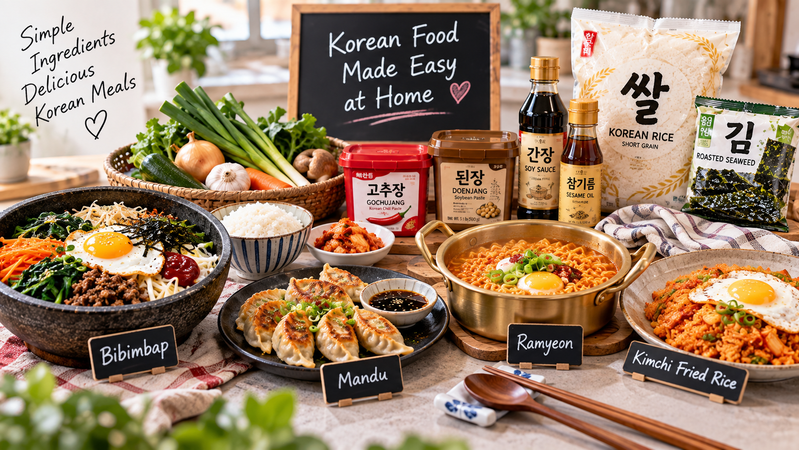
Walking into a Korean grocery store for the first time can be exciting—and a little overwhelming.
One aisle may contain dozens of soy sauces. Another may be filled with unfamiliar noodles, dried seaweed, fermented pastes, rice cakes, frozen dumplings, and bags of rice with labels you may not recognize.
The good news is that Korean grocery shopping for beginners does not have to be complicated.
You don’t need to buy everything you see, and you certainly don’t need a completely stocked Korean kitchen before cooking your first Korean meal.
A surprisingly small collection of ingredients can help you prepare many familiar Korean dishes.
This guide explains what beginners should buy first, which ingredients are worth keeping in the pantry, what can wait until later, and how to avoid spending money on ingredients you may rarely use.
Table of Contents
- Start With a Small Korean Pantry
- Korean Rice
- Soy Sauce
- Sesame Oil
- Gochujang
- Gochugaru
- Doenjang
- Gim — Korean Roasted Seaweed
- Kimchi
- Noodles and Ramyeon
- Frozen Dumplings
- Garlic, Green Onions, and Vegetables
- Korean Snacks
- What Beginners Don’t Need Yet
- A $50 Beginner Korean Grocery List
- Korean Cooking Tools Worth Considering
- Buying Korean Groceries Online
- Food Storage Tips
- FAQ
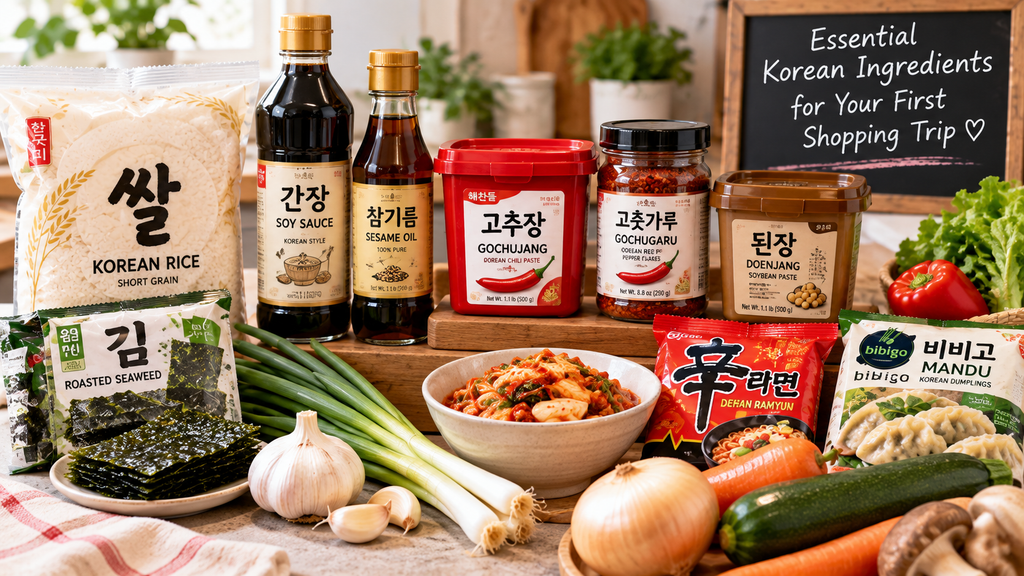
1. Start With a Small Korean Pantry
One of the easiest mistakes beginners make is buying too much.
You watch several Korean cooking videos, visit a Korean supermarket, and suddenly your cart contains fifteen sauces and seasonings.
Several months later, half of them remain unopened.
A better strategy is to create a starter Korean pantry.
Begin with ingredients that appear repeatedly across different dishes.
My suggested first group is:
- Rice
- Soy sauce
- Sesame oil
- Gochujang
- Gochugaru
- Roasted seaweed
- Kimchi
- Garlic
- Green onions
- Noodles
With these ingredients, you already have the foundation for a surprising number of meals.
2. Korean Rice: The Foundation of the Meal
If you want to understand everyday Korean food, start with rice.
Rice is traditionally the center of many Korean meals rather than simply another side dish.
For beginners shopping in the United States, look for short-grain or medium-grain rice commonly used for Korean-style meals.
Don’t assume that every Asian rice variety will produce the same texture.
Korean-style cooked rice is generally slightly sticky, making it easy to eat with chopsticks and combine with side dishes.
What can you make?
Once you have cooked rice, you can make:
Bibimbap — rice topped with vegetables, meat, egg, and sauce.
Kimchi fried rice — cooked rice stir-fried with kimchi and other ingredients.
Gimbap — rice and fillings rolled in dried seaweed.
Or simply serve rice with kimchi, roasted seaweed, and an egg.
That last combination is one of the easiest Korean-inspired meals imaginable.
Beginner Tip
You don’t need the largest bag.
Start with a manageable bag until you know how frequently you’ll cook Korean food.
Dry rice is also convenient to keep in a pantry. USDA guidance classifies rice among shelf-stable foods when properly stored. FSIS
Future Amazon link opportunity:
Korean/short-grain rice, airtight rice container, rice measuring cup.
3. Soy Sauce: Your First Korean Seasoning

Soy sauce is one of the most versatile ingredients you can buy.
It appears in marinades, dipping sauces, stir-fries and many Korean side dishes.
But Korean grocery stores may offer several different kinds.
For a beginner, don’t worry about owning all of them.
Start with one versatile soy sauce intended for general cooking.
Later, if you begin making Korean soups and more traditional recipes regularly, you can explore soup soy sauce and other varieties.
Easy beginner uses
Combine soy sauce with:
- Sesame oil
- Garlic
- Green onions
- Sesame seeds
That simple combination can become the foundation for marinades and dipping sauces.
Future Amazon opportunity:
Korean soy sauce, dipping bowls, sauce bottles.
4. Sesame Oil: A Little Goes a Long Way
Open a bottle of toasted sesame oil and you’ll immediately recognize one of the characteristic aromas associated with Korean cooking.
It is intensely aromatic.
That means beginners shouldn’t treat it like ordinary frying oil.
Instead, think of sesame oil primarily as a seasoning or finishing ingredient.
A small amount can transform:
- Bibimbap
- Vegetable side dishes
- Dipping sauces
- Fried rice
- Noodles
Because the flavor is strong, start small.
You can always add more.
Amazon opportunity:
Toasted sesame oil and sesame seeds.
5. Gochujang: The Korean Ingredient Beginners Should Know
If you buy only one distinctly Korean condiment, gochujang is an excellent candidate.
Gochujang is a fermented red pepper paste with spicy, savory and subtly sweet characteristics.
It is used in many popular dishes and sauces.
You may encounter it in:
- Bibimbap sauce
- Tteokbokki
- Spicy marinades
- Dipping sauces
- Stir-fried dishes
One important beginner lesson:
Gochujang isn’t simply Korean hot sauce.
Its thick texture and fermented flavor mean that recipes often combine it with other ingredients rather than pouring it directly over food.
Easy beginner sauce
Try combining a small amount of gochujang with sesame oil, a little sweetener, and other seasonings according to the dish you’re preparing.
The result can become a quick bibimbap-style sauce.
Amazon opportunity:
Gochujang tubs, squeeze bottles and Korean sauce sets.
6. Gochugaru: Korean Red Pepper Flakes
Gochujang and gochugaru are not interchangeable.
Gochujang = fermented pepper paste
Gochugaru = Korean red pepper flakes/powder
Gochugaru is important for dishes where you want chile flavor without adding a thick fermented paste.
You’ll see it used in kimchi, soups, stews, sauces and vegetable dishes.
If you’re just beginning Korean cooking, buy a smaller package.
Once you know how often you use it, purchasing a larger bag may make more sense.
Amazon opportunity:
Korean gochugaru and spice-storage containers.
7. Doenjang: Buy This When You’re Ready for Korean Soups
Doenjang is Korean fermented soybean paste.
It has a strong, deeply savory flavor and is particularly important in traditional home cooking.
The most famous beginner dish is:
Doenjang-jjigae.
This comforting stew can contain ingredients such as tofu, zucchini, onion and other vegetables.
Doenjang is valuable, but I wouldn’t necessarily make it the first item in a completely new Korean pantry.
Buy soy sauce, sesame oil and gochujang first.
Then add doenjang when you’re ready to explore Korean soups and stews.
Amazon opportunity:
Doenjang and Korean earthenware-style cooking pots.
8. Gim: Korean Roasted Seaweed
For beginners, roasted seaweed may be one of the easiest Korean foods to enjoy immediately.
There is almost no preparation required.
Open the package and eat it with rice.
A simple meal can be:
Hot rice + roasted seaweed + fried egg + kimchi.
You can also crumble roasted seaweed over rice bowls.
When shopping, remember that seaweed products vary.
Some are intended for soup.
Some are large sheets for rolls.
Others are seasoned and roasted for eating directly with rice.
If you’re a beginner, seasoned roasted seaweed snack packs are the easiest starting point.
Amazon opportunity:
Roasted seaweed snack packs and gimbap seaweed sheets.
9. Kimchi: The Refrigerator Essential
Kimchi may be the best-known Korean side dish internationally.
But beginners often make one mistake:
They assume all kimchi tastes the same.
It doesn’t.
Flavor varies according to ingredients, fermentation, producer and how long the kimchi has matured.
Fresh-tasting kimchi tends to be crisp and bright.
More fermented kimchi develops stronger sourness and can be particularly useful for cooking.
Older kimchi can work beautifully in:
- Kimchi fried rice
- Kimchi stew
- Kimchi pancakes
Beginner shopping advice
Start with a smaller container.
Find the style you enjoy before buying a huge jar.
And pay attention to storage instructions. Products labeled for refrigeration should remain refrigerated. USDA recommends keeping refrigerators at 40°F or below and refrigerating perishable foods promptly. FSIS
10. Noodles and Korean Ramyeon
This is probably the aisle where beginners have the most fun.
Korean grocery stores can have enormous noodle selections.
Instead of buying ten varieties, begin with two categories.
Instant ramyeon
This is the easiest introduction.
You can customize instant noodles with:
- Egg
- Green onions
- Mushrooms
- Dumplings
- Tofu
- Leftover vegetables
Cooking noodles
Later you can explore noodles for dishes such as:
Japchae — usually made with sweet-potato starch noodles.
Naengmyeon — cold Korean noodles.
Jjajangmyeon — noodles served with black bean sauce.
For your first shopping trip, one instant noodle variety and one package of sweet-potato noodles are plenty.
Amazon opportunity:
Korean noodles, ramen bowls, chopsticks and noodle pots.
11. Frozen Mandu: One of the Best Freezer Shortcuts
Mandu are Korean dumplings.
For someone learning Korean cooking, frozen mandu are extremely convenient because they can quickly turn a simple meal into something more substantial.
Depending on the product, you may be able to:
- Pan-fry them
- Steam them
- Boil them
- Add them to soup
Pair dumplings with rice, kimchi and a simple vegetable side dish and you already have an easy meal.
Because frozen foods are perishable, purchase them toward the end of your shopping trip and get them into proper cold storage quickly. USDA similarly recommends choosing refrigerated and frozen foods after nonperishable items and promptly refrigerating perishables. FSIS
12. Garlic, Green Onions and Vegetables
Don’t spend your entire budget in the Korean specialty aisles.
Some of the most important Korean cooking ingredients are ordinary fresh foods.
Keep:
Garlic
Green onions
Onions
Carrots
Zucchini
Mushrooms
Cabbage
Tofu
available depending on what you plan to cook.
Garlic and green onion alone appear in countless Korean dishes.
This is another reason Korean cooking doesn’t necessarily require dozens of exotic ingredients.
13. Korean Snacks: Fun, But Don’t Start Here
The snack aisle is tempting.
You’ll find crackers, cookies, chips, seaweed snacks, candies and many other products.
Try them.
But if your goal is actually to learn Korean cooking, don’t let snacks consume your grocery budget.
Build your basic pantry first.
Then choose one or two snacks as something fun to discover.
14. What Beginners Don’t Need to Buy Yet
This may be the most money-saving section of this guide.
You don’t need every Korean ingredient simply because a recipe might eventually require it.
I would wait before buying large quantities of:
specialty fermented sauces, unusual dried seafood, oversized spice bags, multiple varieties of soy sauce, large kimchi containers and ingredients intended for only one recipe.
Use this rule:
If you can’t name at least two dishes you plan to make with an ingredient, consider waiting.
Your Korean pantry should grow with your cooking habits.
15. A Practical $50 Korean Grocery Starter List
Prices vary significantly by store, location, size and brand, so think of $50 as a budget target rather than a guaranteed total.
A beginner basket could contain:
| Priority | Ingredient | Why Buy It? |
|---|---|---|
| 1 | Rice | Foundation for many meals |
| 2 | Kimchi | Ready-to-eat side + cooking ingredient |
| 3 | Soy sauce | Multipurpose seasoning |
| 4 | Sesame oil | Signature aroma and flavor |
| 5 | Gochujang | Versatile Korean pepper paste |
| 6 | Roasted seaweed | Instant side dish |
| 7 | Ramyeon | Easy beginner meal |
| 8 | Garlic | Essential seasoning |
| 9 | Green onions | Used across many recipes |
| 10 | Tofu | Affordable protein option |
If the budget allows, add:
Gochugaru, frozen mandu, sweet-potato noodles and sesame seeds.
The objective isn’t to leave the store with the most products.
It’s to leave with ingredients you will actually use.
16. Korean Cooking Tools Worth Buying
This section gives TIPVERO a particularly natural path to future affiliate content.
Food ingredients aren’t the only things beginners search for.
They also need equipment.
Rice Cooker
If you eat rice frequently, a rice cooker can be extremely convenient.
You don’t need an expensive model to begin.
Korean Ramen Pot
Lightweight Korean-style noodle pots are useful for quickly preparing ramyeon.
Stainless-Steel Chopsticks
Korean households commonly use metal chopsticks, although beginners can use whatever utensils they find comfortable.
Long-Handled Spoon
The Korean spoon-and-chopstick combination is useful for rice, soup and side dishes.
Airtight Food Containers
These are especially useful for organizing ingredients and storing prepared side dishes.
Korean BBQ Grill
This is not a first-purchase necessity.
But if you eventually start making Korean BBQ at home, a tabletop grill or suitable grill pan can become useful.
This also creates an excellent internal-link opportunity to TIPVERO’s Korean BBQ for Beginners article.
17. Can You Buy Korean Groceries Online?
Yes.
Shelf-stable Korean ingredients are particularly convenient to purchase online.
Products well suited to online shopping include:
- Gochujang
- Gochugaru
- Sesame oil
- Seaweed
- Noodles
- Rice
- Dried noodles
- Cooking utensils
- Rice cookers
- Chopsticks
- Food-storage containers
Fresh produce and refrigerated products may be better purchased locally depending on availability, shipping conditions and price.
This distinction is important for TIPVERO.
Instead of filling an article with affiliate links, recommend products only where the link genuinely solves the reader’s problem.
Amazon itself advises publishers to consider what their audience actually wants and link to specific products they discuss. Amazon 제휴 프로그램
18. How to Store Your Korean Groceries
After shopping, divide your groceries into three groups.
Pantry
Rice, unopened noodles and other products labeled for room-temperature storage can usually go into the pantry.
Keep them cool and dry and follow package instructions.
Refrigerator
Kimchi, tofu, opened sauces requiring refrigeration and other perishables belong in the refrigerator according to their labels.
Freezer
Frozen dumplings and other frozen foods should return to the freezer promptly.
USDA recommends four fundamental food-safety principles: clean, separate, cook and chill. FSIS
19. Your First Korean Meal After Shopping
Now comes the best part.
You don’t need an elaborate recipe.
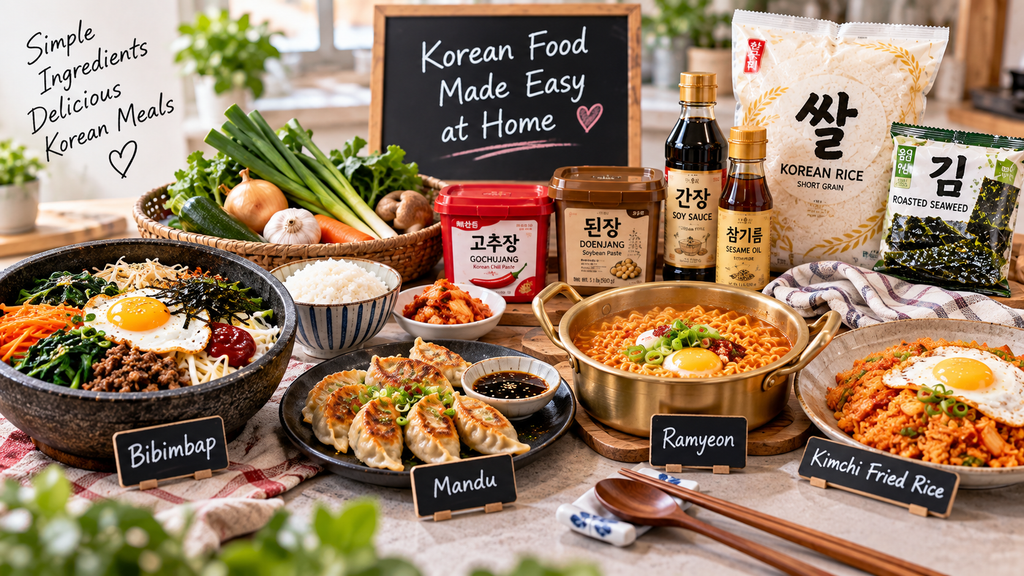
Make rice.
Fry an egg.
Open your kimchi.
Serve roasted seaweed.
Add a tiny drizzle of sesame oil to your rice if you enjoy the flavor.
Suddenly your first Korean grocery trip has turned into dinner.
On another day, use the same pantry for kimchi fried rice.
Then make bibimbap.
Then try ramyeon with an egg and green onions.
This is why buying versatile ingredients first matters.
One ingredient should lead naturally into several meals.
Final Thoughts: Build Your Korean Pantry Slowly
Korean grocery shopping for beginners becomes much easier once you stop trying to buy everything at once.
Start with rice, kimchi, soy sauce, sesame oil, gochujang, roasted seaweed and a few fresh ingredients.
Cook several meals.
Then notice what’s missing.
Maybe your next purchase is gochugaru because you want to cook spicy soups. Maybe it’s doenjang because you’re ready for doenjang-jjigae. Or perhaps it’s a rice cooker because rice has become part of your weekly routine.
That’s a much better way to build a Korean pantry than buying twenty unfamiliar products on your first visit.
The goal isn’t to own Korean ingredients.
The goal is to use them.
And once these basic ingredients become familiar, Korean cooking becomes far less intimidating—and much more enjoyable.
sis.usda.gov/food-safety/safe-food-handling-and-preparation/food-safety-basics/steps-keep-food-safe?utm_source=chatgpt.com
FAQ
What should I buy first at a Korean grocery store?
Start with versatile basics such as rice, kimchi, soy sauce, sesame oil, gochujang, roasted seaweed, garlic and green onions.
What is the most useful Korean sauce for beginners?
Soy sauce is extremely versatile, while gochujang is one of the most useful distinctly Korean condiments for beginners.
Is gochujang the same as gochugaru?
No. Gochujang is a fermented red pepper paste, while gochugaru consists of Korean red pepper flakes or powder.
Do I need a rice cooker for Korean food?
No. You can cook rice without one. A rice cooker becomes useful if you prepare rice frequently.
What Korean foods are easy to buy online?
Shelf-stable foods such as gochujang, gochugaru, noodles, seaweed and sesame oil are convenient online-shopping candidates. Cooking equipment is another good category.
Do I need to shop at a Korean supermarket?
Not necessarily. Many mainstream supermarkets carry some Korean ingredients, while specialty stores usually offer a much broader selection.