Iran sanctions and U.S. gas prices have become closely connected concerns as renewed tensions raise questions about oil supplies, inflation, and everyday household costs in America.
For most American households, sanctions on Iran may sound like a distant foreign-policy issue.
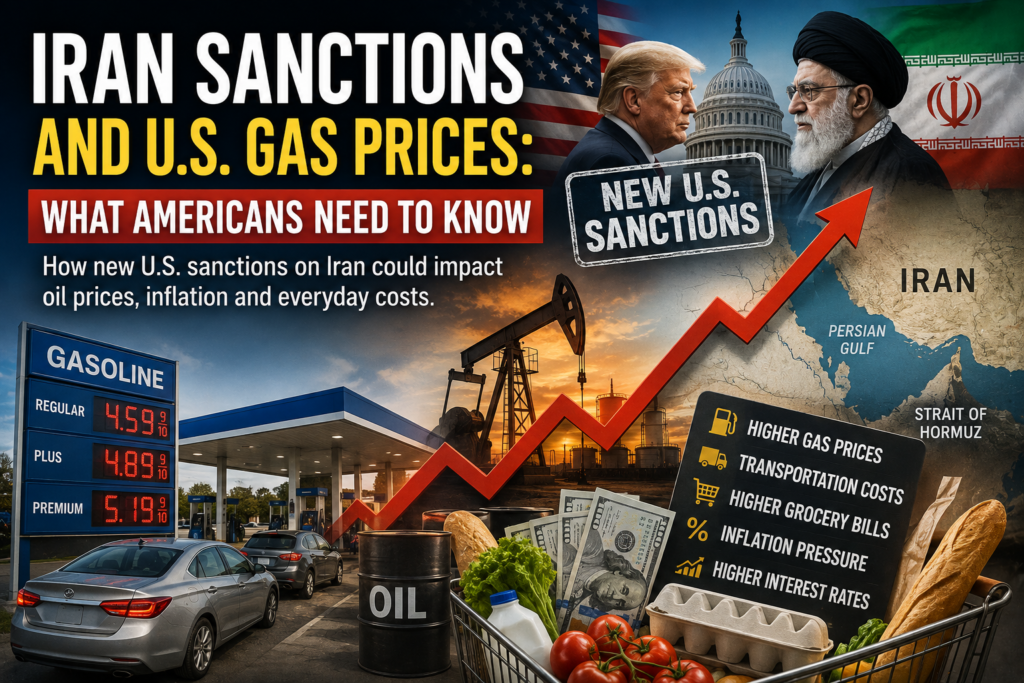
Table of Contents
Iran sanctions and U.S. gas prices are closely connected because disruptions in global oil supplies can quickly affect fuel costs, transportation expenses, and household budgets across the United States.
But the economic consequences can come much closer to home.
They can show up at the gas station, in grocery bills, in airline fares, in delivery charges, and potentially even in decisions made by the Federal Reserve.
On August 24, 2026, the United States prepared to intensify economic pressure on Iran with a major new sanctions campaign targeting Iran’s economic relationships and trading partners. Iran responded with a serious warning: if the economic confrontation continues, it could disrupt or halt oil exports from the Persian Gulf.
That possibility immediately matters to global energy markets because the Strait of Hormuz is one of the world’s most important oil transportation routes.
For American consumers, the key question is therefore not simply:
What do the new sanctions mean for Iran?
A more practical question is:
Could this conflict make everyday life in the United States more expensive?
The answer depends heavily on what happens next in the oil market.
Here is what American households should understand.
Iran sanctions and U.S. gas prices are closely connected because disruptions in global oil supplies can quickly affect fuel costs, transportation expenses, and household budgets across the United States.
What Is Happening Between the United States and Iran?
The latest development is part of a much larger confrontation between Washington and Tehran.
The United States has used financial and economic sanctions against Iran for decades. These measures have targeted areas including Iran’s oil exports, financial system and access to international markets.
The latest campaign is intended to increase that pressure.
U.S. Treasury Secretary Scott Bessent described the new effort as an “economic D-Day,” signaling an aggressive attempt to further isolate Iran economically.
Importantly, the pressure is not necessarily limited to Iranian companies.
Businesses and countries continuing certain forms of trade with Iran could also face consequences from the United States.
Iran has responded with warnings of its own.
Iranian officials have threatened that continued economic pressure could result in disruption to oil exports from the Persian Gulf, including flows connected to the Strait of Hormuz.
That is where this geopolitical confrontation becomes especially important for ordinary consumers.
How Iran Sanctions and U.S. Gas Prices Are Connected
Look at a map of the Persian Gulf and you will see a narrow waterway between Iran and Oman.
That is the Strait of Hormuz.
It may appear small geographically, but economically it is enormously important.
Before the latest conflict disrupted shipping, approximately 20% of global petroleum liquids consumption passed through the Strait of Hormuz, according to the U.S. Energy Information Administration.
Saudi Arabia, the United Arab Emirates, Kuwait, Iraq and other major energy producers rely heavily on routes connected to the Persian Gulf.
There are pipelines that can bypass the Strait, but they cannot replace all of the oil that would normally move through it.
This creates a classic economic problem.
If a large amount of oil suddenly becomes difficult to transport, the world’s available supply effectively becomes tighter.
And when supply becomes tighter while demand remains strong, prices can rise.
That is why a political statement made thousands of miles away can eventually affect what an American driver pays for a gallon of gasoline.
Oil Markets Have Already Shown How Sensitive They Are
Americans have already seen evidence of how Middle East disruptions can affect energy prices.
During the second quarter of 2026, disruptions to crude oil and petroleum-product flows through the Strait of Hormuz contributed to significant volatility in global oil prices.
According to the U.S. Energy Information Administration, Brent crude futures reached as high as $118 per barrel in late April before falling substantially by late June.
The EIA later expected improved shipping conditions and recovering global production to help reduce prices.
In July, the agency forecast U.S. retail gasoline prices averaging about $3.60 per gallon during the second half of 2026, compared with $4.48 per gallon in May.
But renewed tensions demonstrate why these forecasts can change.
Energy forecasts depend on assumptions about production, transportation and geopolitical stability.
If one of those assumptions changes dramatically, oil and gasoline prices can change as well.
How Could New Iran Sanctions Affect Oil Prices?
Sanctions themselves do not automatically cause oil prices to rise.
Their impact depends on what they actually remove from the market and how other producers respond.
Imagine that tougher sanctions significantly reduce Iranian oil exports.
Global buyers would need to obtain replacement barrels elsewhere.
If Saudi Arabia, the United States, the UAE or other producers can increase supply enough to compensate, the impact on global prices could remain manageable.
But if Iranian exports decline while Persian Gulf transportation is simultaneously disrupted, the situation becomes more serious.
Markets would then face two risks at the same time:
less Iranian oil available for purchase and greater difficulty transporting oil produced elsewhere in the Gulf.
Traders also price risk into oil before an actual shortage occurs.
That means crude prices can rise simply because investors believe future supply disruptions have become more likely.
Why Americans Can Pay More Even Though the U.S. Produces Oil
This is one of the most common questions surrounding energy prices.
The United States is a major oil producer.
So why should Americans care about oil supplies in the Middle East?
Because crude oil is traded in a global market.
American producers, refiners and fuel distributors operate within a system influenced by international prices.
If global crude oil becomes significantly more expensive, U.S. refiners do not operate in an isolated market where international conditions no longer matter.
The cost of crude oil is also one of the largest components of retail gasoline prices.
As a result, a major international oil shock can eventually reach American gas stations even when the United States itself continues producing large amounts of oil.
Domestic production provides important protection and flexibility.
It does not completely disconnect American consumers from the global energy market.
The First Household Impact: Gasoline Prices
Gasoline is probably the most visible way Americans would experience another oil-price shock.
A driver sees the price immediately.
Suppose a household uses 100 gallons of gasoline each month.
If gasoline rises by 50 cents per gallon, that household spends approximately $50 more each month.
That may not sound enormous by itself.
But for families with two long commutes, multiple vehicles, delivery work or long-distance driving, the increase can be considerably larger.
And gasoline is only the beginning.
The indirect consequences can spread through much of the economy.
Higher Diesel Prices Can Raise Transportation Costs
The American economy moves on trucks.
Food, clothing, furniture, building materials, electronics and thousands of other products travel through distribution networks before reaching consumers.
Many trucks use diesel fuel.
When energy prices increase substantially, transportation companies face higher operating costs.
Businesses then have several choices.
They can absorb those costs and accept lower profit margins.
They can try to become more efficient.
Or they can pass some of the additional expense to customers.
Usually the result is some combination of all three.
This is one reason an energy shock can eventually appear in the price of products that seemingly have nothing to do with oil.
Iran sanctions and U.S. gas prices remain important for American households because energy costs can influence transportation, food prices, and monthly budgets.
Iran sanctions and U.S. gas prices can also affect consumer confidence when families expect transportation and everyday living costs to remain high.
Grocery Prices Could Feel the Pressure
Food prices are influenced by far more than crude oil.
Weather, labor, fertilizer, agricultural production, packaging and supply conditions all matter.
But energy is embedded throughout the food supply chain.
Farm equipment needs fuel.
Food-processing plants use energy.
Refrigerated trucks transport meat, dairy products and produce.
Warehouses require electricity.
Packaging must be manufactured.
Products then need to be transported to supermarkets.
Higher energy and transportation costs can therefore add pressure to grocery prices.
This does not mean a new round of Iran sanctions will immediately make every supermarket item more expensive.
The important point is that sustained high energy prices can gradually increase costs throughout the supply chain.
For households already dealing with high food bills, even relatively small additional increases can matter.
Delivery and Online Shopping Costs Could Also Rise
Modern American consumers increasingly depend on home delivery.
Amazon packages, grocery deliveries, restaurant orders and other goods travel through transportation networks.
Fuel is a significant cost in those networks.
Companies may not always raise a visible “fuel fee.”
Instead, consumers may see the effect through higher product prices, increased delivery charges or reduced promotional discounts.
Businesses can also renegotiate shipping contracts when fuel remains expensive for an extended period.
That means an oil shock can quietly work its way into online shopping expenses.
Iran sanctions and U.S. gas prices remain important for American households because changes in energy costs can affect monthly spending decisions.
Airline Tickets Are Another Area to Watch
Airlines consume enormous quantities of jet fuel.
Fuel is one of their major operating expenses.
Airfares depend on many variables, including demand, route competition, aircraft capacity and labor expenses.
But a sustained increase in jet-fuel costs can create additional pressure on airline finances.
That does not mean ticket prices automatically rise the day crude oil increases.
Airlines often hedge fuel costs, and competitive conditions matter.
Over time, however, a prolonged period of expensive oil can contribute to higher travel costs.
Families planning holiday travel or vacations should therefore watch energy markets as well as airfare trends.
Higher Oil Prices Could Complicate America’s Inflation Problem
This may be the most important long-term consequence.
Energy affects a wide range of consumer and business costs.
If gasoline, transportation and production costs all rise together, inflation can become harder to control.
Economists often distinguish between headline inflation, which includes volatile categories such as food and energy, and measures of underlying inflation.
But households do not experience inflation as an abstract economic statistic.
They experience it through their monthly budgets.
Gasoline is real.
Groceries are real.
Electricity bills are real.
Airline tickets are real.
Delivery charges are real.
If those expenses rise at the same time, consumers can feel significantly poorer even if their wages have not changed.
What Could This Mean for Federal Reserve Interest Rates?
This is where an oil story can become an interest-rate story.
The Federal Reserve sets monetary policy with a focus on price stability and employment.
If energy prices rise temporarily and then fall, policymakers may look through some of that volatility.
But if higher energy costs begin spreading into broader inflation expectations and prices throughout the economy, the situation becomes more complicated.
Persistent inflation can make it more difficult for the Federal Reserve to lower interest rates aggressively.
That matters because interest rates influence many areas of household finance.
These include:
- Mortgage rates
- Credit-card borrowing
- Auto loans
- Business loans
- Home-equity borrowing
- Savings yields
- Investment valuations
So the economic chain can become surprisingly long:
Iran tensions → oil supply risk → higher crude prices → gasoline and transportation costs → inflation pressure → Federal Reserve concerns → borrowing costs.
This is why energy geopolitics can matter even to an American who never follows international politics.
Could Mortgage Rates Be Affected?
Mortgage rates are not set directly by oil prices.
They are influenced heavily by bond markets, inflation expectations, Federal Reserve policy expectations and economic conditions.
However, persistent energy inflation can contribute to higher inflation expectations.
If investors believe inflation will remain elevated for longer, Treasury yields can rise.
Mortgage rates often move in relation to those broader bond-market conditions.
The connection is indirect, but important.
A prolonged energy shock therefore has the potential to affect both the price consumers pay at the gas pump and the cost of financing a home.
Lower-Income Households Can Feel Energy Inflation More Intensely
Energy inflation does not affect every household equally.
A wealthy household may be able to absorb another $50 or $100 per month in transportation costs without making major changes.
For a household living close to its monthly budget limit, the same increase can require difficult choices.
Should the family reduce restaurant spending?
Delay a purchase?
Use a credit card?
Cut entertainment expenses?
Drive less?
This is one reason gasoline prices have such political and economic importance.
They are visible, frequent and difficult for many workers to avoid.
Someone who must drive to work cannot simply stop purchasing gasoline because the price increased.
Small Businesses Could Also Face Pressure
The effects are not limited to households.
Consider a landscaping company with several trucks.
A plumber driving between appointments.
A restaurant paying for food deliveries.
A construction company operating heavy equipment.
A small online retailer shipping hundreds of packages.
All of these businesses can be affected by fuel and transportation costs.
Large corporations may have sophisticated hedging strategies and significant negotiating power with suppliers.
Small businesses often have less flexibility.
If costs rise sharply, they may eventually need to increase prices.
That is another channel through which energy inflation can spread through the economy.
What Could Keep Gas Prices From Rising Sharply?
It is equally important not to assume the worst-case scenario.
Several factors could limit the impact.
1. Other producers could increase supply
Major oil-producing countries may increase production to compensate for lost Iranian barrels.
2. U.S. production could provide additional supply
America’s large domestic energy industry gives the country more flexibility than it had during some historical oil crises.
3. The Strait of Hormuz could remain operational
Iranian warnings do not necessarily mean the Strait will be completely closed.
4. Diplomatic negotiations could reduce tensions
Geopolitical situations can change quickly.
A new agreement or diplomatic breakthrough could reduce the risk premium in oil prices.
5. Global demand could weaken
If economic growth slows, oil demand can fall, putting downward pressure on prices even during geopolitical tension.
This is why consumers should distinguish between risk and certainty.
Higher oil prices are a risk.
They are not guaranteed.
What Should American Consumers Watch Now?
Instead of reacting to every political headline, consumers can monitor a few practical indicators.
Brent and WTI crude oil prices
These provide a quick indication of how global and U.S. oil markets are responding.
National gasoline prices
Crude oil movements do not always appear immediately at gas stations, so retail gasoline prices provide a clearer household-level signal.
Strait of Hormuz shipping activity
The biggest risk is not political rhetoric alone but actual disruption to energy transportation.
Iranian oil exports
If sanctions materially reduce exports, global supply conditions could tighten.
OPEC+ production decisions
Additional production from other countries could offset part of the disruption.
U.S. inflation reports
Watch whether energy increases begin affecting broader consumer prices.
Federal Reserve communication
Policymakers’ reaction to inflation will influence expectations for interest rates.
What Can Households Do If Energy Prices Rise?
Consumers cannot control geopolitics, but they can control some parts of their household budget.
If gasoline begins rising sharply, comparing local gas prices can generate meaningful savings over time.
For American consumers, Iran sanctions and U.S. gas prices are especially important because higher energy costs can gradually spread through transportation, groceries, and other household expenses.
Combining errands can reduce unnecessary driving.
Drivers can also check tire pressure and avoid excessive idling, both of which affect fuel efficiency.
Households planning road trips may want to estimate fuel expenses before traveling.
Consumers should also pay attention to grocery promotions and compare unit prices rather than simply looking at package prices.
For households carrying variable-rate debt, a period of persistent inflation may also be a good reason to review interest costs carefully.
Iran sanctions and U.S. gas prices may also contribute to inflation concerns when higher energy and transportation costs spread throughout the economy.
The objective is not to panic.
It is to recognize that energy shocks can spread into several categories of spending and adjust the household budget accordingly.
Why This Story Matters Beyond Today’s Headlines
The most important lesson from the U.S.-Iran confrontation is that global events and household finances are increasingly interconnected.
A sanctions announcement in Washington can affect decisions in Tehran.
Those decisions can affect shipping through the Persian Gulf.
Shipping conditions can affect global oil supply.
Oil supply can affect crude prices.
Crude prices can affect gasoline and diesel.
Transportation costs can affect groceries and consumer products.
Inflation can affect Federal Reserve policy.
And interest rates can affect mortgages, credit cards and auto loans.
That entire chain can begin with an event that initially appears to have nothing to do with an American family’s monthly budget.
The Bottom Line
The new U.S. economic pressure campaign against Iran does not guarantee that American gasoline prices will surge.
But it increases the importance of watching the Persian Gulf and the Strait of Hormuz.
The greatest economic risk would be a combination of tighter Iranian oil exports and significant disruption to oil shipments from other Persian Gulf producers.
If that happens, crude oil prices could face renewed upward pressure.
American households could then experience the consequences first at the gas pump and later through transportation, groceries, travel and other everyday expenses.
A prolonged energy shock could also make inflation more difficult to control, potentially complicating the Federal Reserve’s path toward lower interest rates.
For consumers, that is the key point.
Iran sanctions are not only a foreign-policy story. They can become an American cost-of-living story.
The next signals to watch are actual sanctions enforcement, Iranian oil exports, shipping conditions through the Strait of Hormuz and movements in global crude prices.
Those indicators will tell us much more about the impact on American wallets than political rhetoric alone.
Those indicators will tell us much more about the impact on American wallets than political rhetoric alone.
For American households, Iran sanctions and U.S. gas prices are worth watching as changes in energy markets can eventually reach family budgets.
Conclusion
Iran sanctions and U.S. gas prices remain closely connected because changes in global oil supplies can quickly affect American consumers.
Iran sanctions and U.S. gas prices could also influence transportation costs, grocery prices, and household budgets if energy markets become more volatile.
For U.S. households, Iran sanctions and U.S. gas prices are important to watch because higher fuel costs can spread to transportation, food, and other everyday expenses.
Updated: August 24, 2026. This article is for general informational and educational purposes and focuses on the potential economic impact of current events on U.S. households.