
Updated November 17, 2026 | California CalFresh Benefits Guide
CalFresh After a Spouse Dies can become an urgent concern for someone who has just lost a husband or wife and is suddenly responsible for managing household expenses alone. In addition to the emotional difficulty of losing a life partner, a surviving spouse may face an immediate reduction in income, changes to Social Security payments, medical expenses, housing costs, and uncertainty about continued food assistance.
For many older Californians, CalFresh is more than a monthly food benefit. It helps preserve financial stability when retirement income is limited and the cost of groceries, utilities, insurance, and housing continues to place pressure on a household budget.
When a spouse dies, the surviving person should understand how the change affects CalFresh household composition, countable income, deductions, Electronic Benefit Transfer (EBT) access, and future reporting requirements.
A spouse’s death does not automatically mean that the surviving person is ineligible for CalFresh. However, benefits should not simply continue under outdated household information without the county reviewing the circumstances.
This guide explains five important steps to protect food assistance, avoid administrative mistakes, and make informed decisions during a difficult transition.
Table of Contents
1. Understanding CalFresh After a Spouse Dies
CalFresh is California’s version of the federal Supplemental Nutrition Assistance Program (SNAP). It provides eligible low-income households with monthly food benefits through an EBT card.
According to the California Department of Social Services (CDSS), the amount of assistance a household receives depends on factors that include household size, countable income, and allowable expenses.
A married couple living together will generally be considered one CalFresh household. If one spouse dies, the number of people in that household changes.
That change may also affect income, expenses, and the person authorized to manage the case.
1.1 Why household composition matters
Household composition is important because CalFresh evaluates the number of eligible people who purchase and prepare food as part of the household, subject to program-specific rules.
For example, a couple might previously have received a benefit calculated for two people. After one spouse dies, the surviving person may become a one-person household.
However, the surviving spouse’s circumstances could be substantially different from those that existed before the death.
The deceased spouse may have been receiving retirement benefits, disability payments, or wages that are no longer available. At the same time, the survivor may continue paying much of the same rent or mortgage, utilities, and household expenses.
Therefore, the county must evaluate more than the change in household size alone.
1.2 Does CalFresh stop automatically?
Not necessarily.
The death of one household member does not, by itself, establish that every surviving household member has lost CalFresh eligibility.
If the case included two eligible spouses, the surviving spouse may continue to qualify after the county updates the household information and recalculates benefits.
However, if the deceased spouse was the only person on the case, the case cannot simply continue in that person’s name. Any surviving person who needs assistance may have to establish eligibility through an appropriate application or case process.
California county guidance also distinguishes routine voluntary household changes from reports involving a deceased member. The death report requires special handling and cannot be treated as an ordinary, unchanged household circumstance. stgenssa.sccgov.org+1
1.3 Why benefits may increase, decrease, or remain similar
The result depends on several interacting factors.
A smaller household generally has a lower maximum allotment than a larger household. However, losing a spouse’s income can also reduce countable household income. Continuing rent or medical expenses may affect deductions.
In some cases, the loss of income may partly offset the reduction in household size.
In other cases, new survivor benefits may increase countable income and reduce assistance.
The correct result depends on the individual household’s verified financial information.
Practical Insight: Never assume that moving from a two-person household to a one-person household means benefits will automatically be cut in half. CalFresh uses an eligibility and budgeting calculation, not a simple division of the previous payment.
2. Step 1: Notify the County and Update Household Information
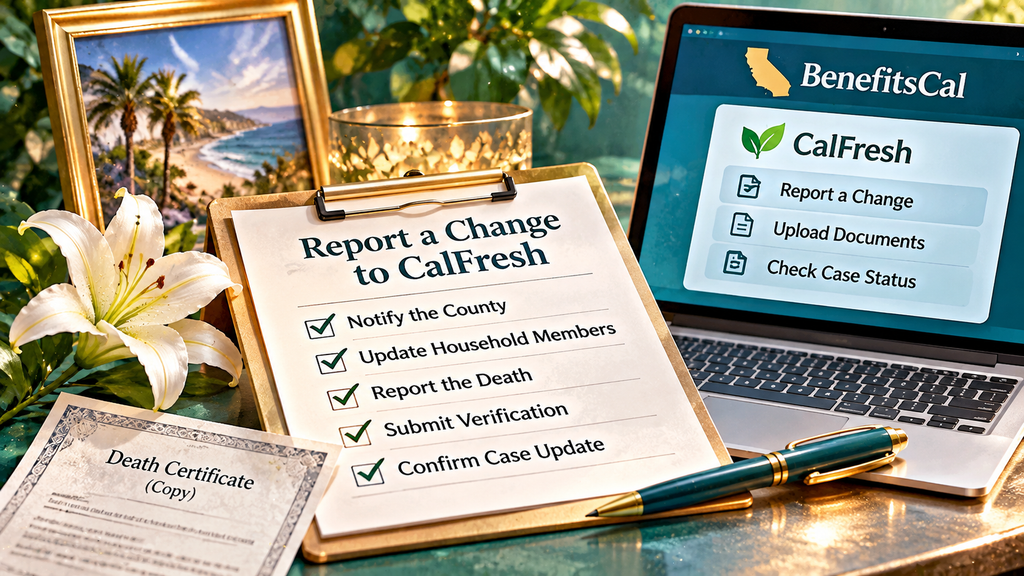
The first practical step is to notify the county CalFresh office about the spouse’s death and request a review of the household record.
This is especially important when the deceased spouse was listed as the primary applicant, household contact, or EBT cardholder.
2.1 How to report the change
A surviving spouse can generally contact the county welfare department directly. Many counties also allow case information and documents to be managed online through BenefitsCal.
The BenefitsCal portal provides access to applications, case information, renewals, and other benefits-management functions.
When reporting the death, the survivor should provide the information available, such as:
- The deceased spouse’s full name and date of death.
- The existing CalFresh case number, if known.
- The surviving spouse’s name and contact information.
- Whether other people still live in the household.
- Whether the deceased spouse was the EBT cardholder.
- Changes in employment income, retirement payments, or other household income.
- Any immediate concerns about accessing existing benefits.
It is helpful to request written confirmation or save an electronic record of the report.
2.2 Is there a 10-day reporting deadline?
California uses different reporting rules depending on household circumstances and benefit programs.
For many CalFresh semiannual-reporting households, routine changes in household composition are addressed through the required reporting process. Certain changes must be reported during the reporting period, including applicable income-threshold events. A death report also has special case-processing consequences.
A household that receives CalWORKs or other assistance alongside CalFresh may have additional reporting responsibilities.
For this reason, the safest practical approach is to report the death promptly rather than assume that every household has the same 10-day requirement.
The county’s current instructions and the household’s reporting category determine which formal deadlines apply. California’s semiannual-reporting guidance explains these distinctions. stgenssa.sccgov.org+2
2.3 What documentation might be requested?
The county may need information to confirm the death and update the case.
Useful records include a death certificate, funeral-home documentation, or other reliable information identifying the deceased person and date of death.
The survivor should also organize documents that establish ongoing eligibility, including identification, income records, housing costs, and relevant expenses.
Not every document will necessarily be required. The county may be able to verify some information through existing records or electronic sources.
If additional documentation is requested, ask the county to identify the precise items needed and the deadline for submitting them.
2.4 Keep a record of every communication
Grief can make even routine administrative tasks difficult to remember.
A short written record may prevent confusion later.
For every contact with the county, record the date, the method of communication, the case number, what was reported, and any follow-up instructions.
For example:
On November 18, I informed the county that my spouse died on November 12. I requested an update to our CalFresh household and asked whether a new EBT card or additional documentation was necessary.
This is an illustrative record, not a claim about an actual case.
Retaining confirmation numbers, screenshots, notices, and uploaded-document receipts is particularly valuable if benefit changes are delayed or disputed.
Practical Insight: Reporting a death should include two separate questions: “Has the household composition been updated?” and “Can the surviving spouse continue using the current EBT access?” Addressing both avoids treating the case update and card-access issue as the same problem.
3. Step 2: Review Income and Social Security Survivor Benefits

The second step is to review income carefully.
After a spouse dies, the surviving person’s financial situation may change more dramatically than the number of household members.
A household that previously relied on two retirement payments may suddenly have only one regular source of income.
However, certain survivor benefits or other payments may become available.
3.1 Identify income that has ended
Begin by identifying income sources associated with the deceased spouse.
These may include employment wages, Social Security retirement benefits, disability income, pension payments, business income, and other recurring payments.
Do not assume that each source ends on the same date or that every payment appearing in a bank account belongs to the surviving spouse.
Some payments may need to be returned or corrected by the issuing agency.
The county should be informed about the income actually available or reasonably anticipated under applicable CalFresh budgeting rules.
3.2 Understand Social Security survivor benefits
A surviving spouse may qualify for Social Security survivor benefits based on the deceased worker’s earnings record, subject to age, disability, marital, and other eligibility requirements.
The Social Security Administration explains that eligible survivors may include spouses, certain former spouses, children, and dependent parents.
Survivor payments are not necessarily equal to the deceased spouse’s full retirement payment.
The amount depends on factors such as the survivor’s age and eligibility circumstances. The SSA also explains that a qualifying spouse or child may receive a one-time death payment of $255.
For current information, review the Social Security Administration’s Survivor Benefits guidance. SSA+2
The important CalFresh consideration is that a survivor’s countable monthly income may change when survivor benefits begin.
A person should not assume that receiving survivor benefits automatically eliminates CalFresh eligibility.
Instead, the county evaluates the new income alongside household size and allowable expenses.
3.3 Do not confuse Social Security and CalFresh reporting
Reporting a spouse’s death to Social Security does not necessarily mean the CalFresh office has completed its own case update.
These programs have different eligibility systems, reporting processes, and administrative responsibilities.
A surviving spouse should make sure both agencies have the relevant information.
Similarly, an application for survivor benefits does not by itself establish the exact amount or timing of future CalFresh-countable income.
Until the award amount is known, avoid presenting an estimated benefit as an approved payment.
3.4 What about life insurance or inheritance?
A spouse’s death may be followed by a life insurance payment, inheritance, estate distribution, or other one-time receipt.
These payments can be treated differently depending on their legal and program classification.
For example, a one-time payment may not be treated the same way as recurring pension income, and account balances may be relevant under certain eligibility rules.
Because the treatment depends on the type of payment and the household’s circumstances, the survivor should identify the source, amount, payment date, and whether the payment is recurring before asking the county how it affects CalFresh.
Do not assume that every inheritance is automatically countable monthly income or that every lump-sum payment has no effect.
3.5 Example of a changed income situation
Consider a fictional California household.
Before the death, one spouse receives $1,450 in monthly Social Security income while the other receives $850.
The couple therefore has $2,300 in total monthly Social Security payments before any applicable deductions or other adjustments.
After one spouse dies, the household does not necessarily continue receiving both amounts.
The surviving spouse may become eligible for a survivor payment that differs from the amount previously received.
The correct income to report depends on what Social Security determines and when payments begin or change.
This illustrates why a surviving spouse should obtain updated benefit information rather than simply subtract one old payment from the household budget.
Table 1. Common Financial Changes After a Spouse’s Death
| Financial factor | Before the death | Possible change afterward |
|---|---|---|
| Household size | Two eligible spouses | One surviving spouse |
| Social Security income | Payments based on each person’s eligibility | Deceased person’s payment ends; survivor amount may change |
| Employment income | One or both spouses may work | Deceased spouse’s earnings stop |
| Rent or mortgage | Shared household obligation | Often remains substantially unchanged |
| Utility costs | Shared household expenses | May remain similar |
| Medical expenses | Costs for both spouses | Survivor’s eligible expenses remain relevant |
| CalFresh allotment | Based on the previous household budget | County recalculates the eligible household’s benefits |
This comparison explains possible changes; it does not predict a specific benefit amount.
Practical Insight: Rebuild the household budget using confirmed payments, not old bank deposits or assumptions about survivor benefits. Separating “income that ended,” “income that continues,” and “income that may begin” produces a much clearer CalFresh reporting record.
4. Step 3: Protect EBT Access and Understand Benefit Changes
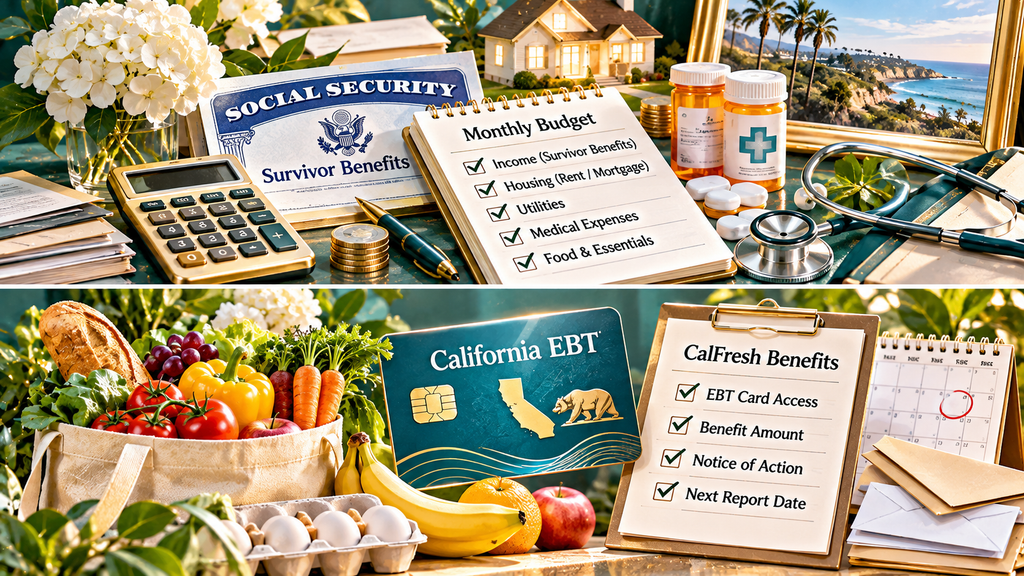
After reporting the death, the surviving spouse should determine whether they can access CalFresh benefits through their existing EBT arrangement.
An EBT card is the delivery method for food benefits, but the cardholder and the eligible household are not always the same thing.
The CDSS explains the statewide EBT system in its Electronic Benefits Transfer guidance.
4.1 When the deceased spouse was the cardholder
If the EBT card belonged to the deceased spouse, the survivor should ask the county how to obtain authorized access to any benefits legally available to the surviving household.
A surviving spouse should not simply assume that possession of the deceased person’s card and PIN provides permission to continue using it.
The county may need to update the caseholder information, issue a new card, or determine how existing benefits should be handled.
The safest approach is to obtain confirmation from the county before relying on the deceased person’s card.
4.2 What happens to an existing EBT balance?
Existing EBT balances require careful treatment.
The remaining balance is not necessarily handled in the same way in every situation.
For example, a household with a surviving eligible member presents a different situation from a single-person CalFresh household whose only member has died.
California’s EBT procedures include special requirements for deceased-person cases, including verification and notice procedures associated with certain account closures and benefit removal. stgenssa.sccgov.org+1
A surviving spouse should ask the county to determine whether the balance remains available to the household and how it can be accessed.
This protects against accidentally losing benefits or using funds that should not be accessed.
4.3 Avoid relying on an unchanged monthly deposit
A monthly CalFresh deposit may continue appearing while the county processes a household change.
That does not prove the old benefit amount will remain correct.
The county may later determine that the household’s allotment should change.
For this reason, the survivor should review any official Notice of Action and verify the amount authorized for the updated household.
If there is confusion about benefits already issued, request a written explanation before assuming that the money is owed back or permanently available.
4.4 What if the surviving spouse cannot manage the EBT card?
Some survivors may have difficulty managing benefits because of illness, mobility limitations, cognitive impairment, or other practical barriers.
CalFresh allows certain authorized-representative arrangements so another person can assist with specified case activities or benefit access.
However, an authorized representative must be properly designated and the arrangement should follow the county’s rules.
The survivor should not share their PIN casually or give unrestricted financial access to someone without understanding the consequences.
Practical Insight: EBT protection is an access-control issue as well as a benefits issue. Confirm the authorized cardholder, account status, and remaining benefits separately. A valid household benefit does not automatically make every card or person authorized to use it.
5. Step 4: Recalculate Housing and Medical Expense Deductions
One of the most important financial questions after the death of a spouse is whether the surviving person’s allowable expenses have been fully considered.
A surviving spouse may have less income but continue paying nearly the same rent, property-related housing costs, utilities, and medical expenses.
These costs may significantly affect the CalFresh calculation.
5.1 Housing expenses after a spouse dies
Housing costs frequently do not fall proportionately when the number of household members decreases.
A survivor may remain responsible for the full rent or mortgage, heating, electricity, water, and other household expenses.
CalFresh may allow qualifying shelter and utility expenses to be considered when determining net income, subject to applicable program rules.
California’s shelter-cost guidance explains how eligible housing and utility costs are evaluated. stgenssa.sccgov.org
Surviving spouses should report accurate, current housing expenses rather than assuming the county will automatically retain or update the correct amounts.
5.2 Special deductions for older adults
For CalFresh purposes, an older adult is generally someone aged 60 or older.
Households with qualifying elderly or disabled members may receive special treatment for certain allowable expenses.
For example, eligible unreimbursed medical expenses exceeding the applicable threshold may be deductible.
The USDA’s special SNAP rules for older adults and people with disabilities explain the federal framework for medical and shelter deductions. California may apply additional state-specific administrative rules. Food and Nutrition Administration+2
The key issue is not simply whether an expense exists, but whether it qualifies under CalFresh rules and is properly documented.
5.3 Examples of potentially deductible medical costs
Depending on eligibility and verification requirements, allowable expenses may include certain out-of-pocket medical services, prescription medications, qualifying health insurance premiums, dental care, and medically necessary transportation.
Reimbursements generally must be considered when determining the amount of an eligible expense.
Not every health-related purchase qualifies.
For example, ordinary grocery purchases marketed as healthy foods are not automatically medical deductions.
A surviving spouse should maintain a clear list of actual eligible medical spending and identify any reimbursements.
5.4 Why overlooked deductions matter
Consider a hypothetical older survivor who receives modest monthly retirement income.
After the spouse’s death, this person continues paying rent, utilities, medical insurance premiums, and prescription costs.
If the county has only the updated income information but not the current allowable expenses, the resulting benefit calculation may not fully reflect the survivor’s situation.
The person should request that the county review eligible shelter and medical deductions.
This does not guarantee an increase, but it helps ensure that the calculation is based on complete information.
Table 2. Expense Checklist for a Surviving Spouse
| Expense category | Example documentation | Why it matters |
|---|---|---|
| Rent or mortgage | Lease, statement, payment record | May support a shelter deduction |
| Utilities | Utility bills or applicable allowance information | May affect eligible shelter costs |
| Health insurance premiums | Premium statement | May qualify as a medical expense for an eligible individual |
| Prescriptions | Pharmacy records or receipts | May support eligible medical deductions |
| Medical transportation | Travel or transportation records | Certain qualifying costs may be allowable |
| Dental or vision expenses | Provider statement or receipt | May qualify when applicable |
| Income changes | Updated Social Security or pension letter | Helps establish current countable income |
Practical Insight: The best expense review compares old and new household budgets line by line. Survivors should not focus exclusively on income loss. Unchanged housing obligations and eligible medical costs may be equally important to an accurate benefit calculation.
6. Step 5: Follow Up on Notices, Reporting, and Eligibility
The fifth step is to verify that the county has completed the necessary case review and that the surviving spouse understands the next reporting obligation.
A death report is the beginning of the administrative process, not necessarily the end.
6.1 Review the Notice of Action
A Notice of Action, often abbreviated NOA, is an official communication explaining an eligibility or benefit decision.
After a household change, the county may issue a notice describing an adjustment, discontinuance, or other action.
The survivor should review the notice for the effective date, household size, income information, benefit amount, and appeal rights.
Do not focus only on the final dollar amount. A mistake involving household composition or income can produce a misleading calculation even when the notice appears complete.
If the notice includes an unfamiliar income source, an incorrect household member, or outdated expenses, request clarification.
6.2 Understand the SAR 7 reporting cycle
Many California CalFresh households participate in semiannual reporting, with reporting requirements that may include an SAR 7 form.
The SAR 7 asks for information about income, household changes, and other relevant circumstances.
However, not every household has exactly the same reporting schedule. Certain qualifying older or disabled households may be subject to simplified procedures.
The official SAR 7 instruction guide explains how to report relevant changes. CDSS+1
A surviving spouse should verify whether the current case requires an SAR 7, the next recertification date, and whether any special reporting category applies.
6.3 What if benefits are reduced or discontinued?
If a surviving spouse believes a CalFresh decision is incorrect, they can request an explanation from the county.
If the disagreement remains unresolved, California provides state hearing rights.
The CDSS generally requires a state hearing request within 90 days of the challenged action, although special circumstances can affect timeliness and other procedural rights.
The California State Hearings Division explains the hearing process. CDSS+1
A survivor should preserve the notice, supporting documents, relevant correspondence, and the date the notice was received.
6.4 Avoid missing an important deadline
Administrative deadlines can be difficult to manage while grieving.
A simple calendar can help.
Record the date of the death report, any deadline for additional verification, the expected date of a county decision, the next required report, and any hearing deadline.
Use the actual dates stated in county notices rather than relying on a generic schedule found in an older article.
6.5 When a new application may be necessary
The surviving spouse may need to submit a new application in certain circumstances, especially when the deceased person was the only eligible household member and the survivor was not part of the existing CalFresh household.
However, if the survivor was already an eligible household member, the county should determine whether the existing case can be updated appropriately.
Before submitting duplicate applications, ask the county to clarify the status of the existing household.
This can reduce confusion and unnecessary administrative delays.
Practical Insight: A successful case update should produce a clear answer to three questions: Who is now included in the household? What benefit amount is authorized? What must the survivor do next? If any of these remain unclear, the case should not be considered fully resolved.
7. Special Considerations for Seniors Living Alone
For older adults, the financial consequences of losing a spouse can be particularly serious.
Many retirees live on fixed incomes and may have limited opportunities to replace lost household earnings.
A surviving spouse may also have responsibilities that the deceased partner previously managed, including grocery shopping, transportation, paying bills, keeping financial records, and communicating with government agencies.
These changes can affect daily independence.
7.1 Living alone does not automatically eliminate eligibility
A person can qualify for CalFresh as a one-person household if they satisfy applicable eligibility requirements.
Marriage is not required, and living alone is not a disqualifying factor.
A widowed person should not assume that food assistance is available only to families with children.
California expressly recognizes individuals as potential CalFresh applicants. California’s Food Assistance Program
7.2 Managing grocery costs on one income
After a spouse dies, the surviving person’s grocery spending may decline, but not necessarily by half.
Many food items are sold in quantities better suited to multiple people. Smaller packages may cost more per serving, and transportation expenses can make frequent grocery trips difficult.
A survivor should develop a practical grocery budget based on actual needs, dietary requirements, and available transportation.
CalFresh can help purchase eligible food, but it is important to distinguish food benefits from money needed for rent, medicine, or household bills.
Maintaining separate spending categories makes the budget easier to understand.
7.3 Health and mobility concerns
Some older adults may have difficulty shopping or preparing meals because of health or mobility limitations.
California’s Restaurant Meals Program may be relevant for qualifying participants, including certain older adults and people with disabilities, at participating locations.
Availability and participation must be checked for the particular program and restaurant.
This option may provide additional flexibility, but it does not replace the need for accurate CalFresh eligibility and case information.
7.4 Creating a manageable routine
A bereaved spouse may benefit from simplifying essential responsibilities.
For example, keep one folder for benefit notices, another for income statements, and a third for medical and housing records.
Choose a consistent day each month to review important mail and update a calendar.
These practices are not CalFresh requirements. They are practical ways to reduce the risk that an important notice is overlooked.
8. Practical Example: A Surviving Spouse in California
The following is a fictional educational example designed to illustrate the decision-making process. It is not a real applicant’s experience or a guaranteed benefit outcome.
Imagine a 68-year-old California resident named Margaret.
Margaret and her husband lived together in a rented apartment and received CalFresh as a two-person household.
Her husband managed most of the paperwork and was the primary contact for the case.
After his death, Margaret discovered that the household’s regular income had changed.
She still needed to pay the apartment rent, utility bills, insurance premiums, and prescription expenses.
Initially, she believed that the CalFresh case would automatically close because her husband had died.
However, she decided to contact the county before making assumptions.
She reported the death, explained that she was the surviving household member, and asked how the case would be updated.
She then contacted Social Security to determine whether she qualified for survivor benefits.
Instead of estimating the amount, she kept the available income documentation and planned to provide updated award information when confirmed.
Margaret also asked about EBT card access because the card had been issued in her husband’s name.
She did not assume that she could continue using his card without authorization.
Next, she gathered her rent statement, utility information, health insurance premium notice, and prescription records.
She asked the county whether these expenses were already included in the current CalFresh calculation.
Finally, Margaret reviewed the county’s written decision and recorded the next reporting and recertification dates.
This example illustrates a practical sequence:
- Establish the correct household composition.
- Verify current and anticipated income.
- Confirm lawful EBT access.
- Review allowable deductions.
- Check the official eligibility decision.
The essential lesson is that a spouse’s death requires a coordinated review of several issues. Updating only one detail may leave the household record incomplete.
9. Common Mistakes and How to Avoid Them
9.1 Assuming benefits stop immediately
Some surviving spouses mistakenly believe that losing a partner automatically ends the household’s CalFresh eligibility.
This can discourage someone from seeking assistance even when they may still qualify.
The better approach is to request an individual eligibility review.
9.2 Continuing to use the deceased spouse’s EBT card
Another mistake is assuming that access to an EBT card remains unchanged after the named cardholder dies.
The county should clarify the correct cardholder and access arrangements.
9.3 Reporting household size but forgetting income
A death report may identify the deceased household member without fully documenting the associated income changes.
This can create confusion when the case is recalculated.
A complete financial review should address household composition and income together.
9.4 Overlooking survivor benefits
A surviving spouse may not realize that Social Security survivor benefits require a separate eligibility review.
The survivor should determine whether benefits are available and understand how approved payments could affect CalFresh.
9.5 Ignoring deductible expenses
An older adult may continue paying substantial housing and medical expenses after becoming a one-person household.
Failing to provide accurate information about these costs can lead to an incomplete benefit calculation.
9.6 Missing official notices
A county may request documents, explain a calculation, or issue a decision through written notices or the household’s online case account.
Missing such communications can create avoidable problems.
A consistent recordkeeping routine is especially valuable during this period.
9.7 Assuming a new application is always required
Some people immediately submit a new application without checking whether an existing case can be updated.
Others assume an old case will continue without any action.
Both assumptions can cause confusion.
The appropriate procedure depends on the survivor’s existing eligibility and case status.
10. Practical Insight: Protecting Financial Independence After Loss
The most important issue following the death of a spouse is not simply whether CalFresh benefits will rise or fall.
It is whether the surviving person can maintain a stable, manageable daily life with the resources now available.
For many older adults, independence depends on a combination of reliable income, affordable housing, healthcare access, transportation, food assistance, and the ability to manage essential responsibilities.
Losing a spouse can change each of these areas.
A person who previously shared financial decisions may suddenly need to understand retirement income, benefit notices, monthly expenses, and administrative requirements alone.
During this transition, accurate information becomes a form of financial protection.
10.1 Separate immediate needs from long-term decisions
In the first weeks after a spouse’s death, urgent needs may include food, housing payments, medication, and access to existing benefits.
Longer-term questions may involve survivor benefits, housing affordability, retirement budgeting, and future medical costs.
Trying to resolve every issue at once can be overwhelming.
A more practical approach is to address urgent problems first, then review ongoing income and expenses systematically.
For CalFresh, the immediate priority is ensuring that the county has correct information and that the surviving household understands its benefit status.
10.2 Focus on verified information
A survivor may receive conflicting explanations from friends, relatives, online discussions, or even outdated informational materials.
For example, someone may say that benefits always stop after a spouse dies, while another person may say that a surviving spouse automatically receives more assistance.
Neither statement is universally reliable.
The correct determination depends on the surviving household’s actual circumstances.
Verification is more useful than assumptions.
A current county decision, accurate Social Security documentation, and complete expense records are stronger foundations for planning than an estimated benefit amount.
10.3 Understand the difference between eligibility and affordability
A person may remain eligible for CalFresh but still struggle financially.
Food assistance cannot cover every household need.
Housing costs, prescription medication, medical insurance, transportation, and unexpected expenses may continue even when household income decreases.
Therefore, CalFresh should be understood as one part of a broader financial stability plan.
A realistic monthly budget should account for the money available after essential expenses, rather than treating the CalFresh allotment as a complete solution to financial hardship.
10.4 Preserve dignity through organized support
A surviving spouse should not feel compelled to understand every government procedure immediately.
Clear documentation, authorized assistance, and reliable case information can make the process more manageable.
An older adult who needs help completing forms or understanding notices may benefit from properly authorized support.
At the same time, personal financial information and EBT access should be protected.
The goal is not to surrender independence but to maintain control through informed decisions.
10.5 A practical 30-day transition plan
The following is a suggested organizational plan, not a statement of official filing deadlines.
During the first several days: Report the death to the county, confirm EBT access, identify essential expenses, and organize the most important documents.
During the following week: Review Social Security survivor eligibility, identify changes in income, and gather housing and medical expense records.
During the remainder of the month: Follow up on county requests, review any Notice of Action, confirm the updated benefit amount, and record future reporting obligations.
Some administrative processes may extend beyond 30 days. The purpose of the schedule is to establish priorities, not promise a specific processing time.
The most meaningful outcome is a clear understanding of the household’s financial position.
Practical Insight Summary: Protecting CalFresh after the death of a spouse requires more than reporting a household change. The surviving person should verify income, preserve authorized benefit access, document eligible expenses, understand official notices, and create a realistic plan for living independently.
11. Frequently Asked Questions
FAQ 1. Can I still receive CalFresh after my spouse dies?
Yes, a surviving spouse may remain eligible for CalFresh if they meet the program’s requirements. The county must evaluate the updated household size, income, and allowable expenses. The spouse’s death does not automatically disqualify the surviving person.
FAQ 2. Must I report my spouse’s death within 10 days?
Reporting requirements depend on the household’s CalFresh reporting category and whether it receives other assistance. Not every household change is subject to the same 10-day rule. Because a death requires special processing, notify the county promptly and confirm any applicable deadlines.
FAQ 3. Will my CalFresh benefits increase after my spouse dies?
They may increase, decrease, or remain similar. The county considers the smaller household size, changes in countable income, and applicable deductions. No specific outcome can be predicted without reviewing the household’s financial circumstances.
FAQ 4. Can I continue using my deceased spouse’s EBT card?
Do not assume that you may continue using a card issued in the deceased spouse’s name. Contact the county to confirm authorized access, cardholder changes, and how any remaining benefits should be handled.
FAQ 5. Will Social Security survivor benefits affect CalFresh?
Social Security survivor benefits generally must be considered when determining countable income under applicable CalFresh rules. Receiving survivor benefits does not automatically eliminate eligibility. The amount and timing of those payments matter.
FAQ 6. Do I need to submit a new CalFresh application?
Not always. If you were already an eligible household member, the county may be able to update the existing case. If you were not part of the existing eligible household, a new application may be necessary. Ask the county to confirm the appropriate procedure.
FAQ 7. Can my rent and medical expenses help me qualify?
Potentially. Allowable shelter, utility, and qualifying medical expenses may affect the benefit calculation. Certain older or disabled households receive special deduction treatment. Actual eligibility depends on applicable rules and verified expenses.
FAQ 8. What should I do if the county stops my benefits incorrectly?
Review the Notice of Action, identify the disputed information, and request clarification or correction. You may also request a California state hearing. The usual hearing request deadline is 90 days from the challenged action, subject to applicable exceptions and procedural rules.
12. Conclusion
CalFresh After a Spouse Dies is an important issue for California residents who must manage food assistance and household finances after losing a husband or wife.
The transition may involve a smaller household, reduced income, new Social Security survivor payments, changing EBT access, and continuing housing or healthcare expenses.
Understanding these changes can help the surviving spouse avoid unnecessary interruptions in assistance and make more informed financial decisions.
The five most important actions are to notify the county, review income, protect EBT access, document allowable expenses, and follow up on eligibility decisions.
For older adults living alone, the goal is not simply to preserve a particular benefit amount.
It is to maintain access to nutritious food, protect limited financial resources, and support a stable and independent life.
A spouse’s death changes the structure of a household, but it does not automatically remove the surviving person’s opportunity to receive assistance.
With accurate reporting, appropriate documentation, and careful attention to official notices, a surviving spouse can move forward with a clearer understanding of available support.
TIPVERO — Practical Information for Everyday Life and Financial Independence.