
Updated November 13, 2026 | California Food Assistance and Senior Independent Living Guide
CalFresh Notice of Action letters are important official documents that explain decisions about a California household’s food assistance. Whether your benefits have been approved, reduced, denied, discontinued, or changed, understanding the notice can help you identify what happened and what action may be necessary.
For an older adult living alone, receiving an unexpected government letter can be stressful. A notice may contain unfamiliar administrative terms, legal references, effective dates, calculations, and hearing instructions.
Imagine a hypothetical 69-year-old retiree living in Los Angeles County. The retiree receives a modest Social Security payment and relies on CalFresh to help purchase groceries.
One afternoon, a letter arrives stating that the monthly CalFresh allotment will decrease. The letter includes an income calculation and an effective date, but the retiree does not understand why the amount changed.
Should the retiree contact the county? Does the change begin immediately? Can the decision be challenged? Is there a deadline to respond?
These questions illustrate why learning to read a CalFresh Notice of Action is so valuable.
California and federal SNAP rules establish requirements for informing households about decisions affecting their benefits. Depending on the action, a notice may need to explain the reason for the decision, the effective date, applicable program rules, and the household’s right to request a state hearing.
Some adverse actions require advance notice. Other situations qualify for exceptions. Certain timely hearing requests may allow existing benefits to continue while a dispute is reviewed.
The exact protections depend on the household’s circumstances and the type of action being taken.
This guide explains seven helpful facts about CalFresh notices in 2026, including how to read them, identify possible errors, understand deadlines, request clarification, and protect your hearing rights.
It focuses on interpreting county decisions rather than repeating general application instructions or the separate procedures for restoring previously lost benefits.
Table of Contents
1. Understanding a CalFresh Notice of Action
CalFresh is California’s Supplemental Nutrition Assistance Program, which provides food purchasing assistance to eligible households.
The program is administered by county social services agencies under state and federal requirements.
When a county makes certain decisions concerning a household’s benefits, it must communicate those decisions through appropriate notices.
A Notice of Action, often abbreviated as NOA, is one of the primary documents used for that communication.
1.1 What does a Notice of Action do?
A Notice of Action informs the household about an official determination affecting its benefits.
Depending on the situation, the county may be approving assistance, denying an application, modifying an allotment, or discontinuing eligibility.
The document provides information needed to understand the decision and, when applicable, challenge it.
An NOA is therefore more than ordinary correspondence.
It may establish important dates and explain rights that must be exercised within a particular period.
1.2 Why these notices deserve attention
A household may receive multiple communications from its county.
Some request information. Others confirm appointments, explain reporting responsibilities, or provide reminders.
A Notice of Action is particularly significant because it communicates a determination affecting benefits.
Failing to read a notice can cause a household to miss an important change.
For example, an individual might assume benefits will continue at the same amount while a notice states that the allotment will decrease beginning the following month.
A recipient who opens and reviews the notice promptly has more time to investigate the calculation and request assistance if necessary.
1.3 A notice is not automatically proof of wrongdoing
Government benefit notices can sound formal or intimidating.
However, receiving one does not necessarily mean that a recipient violated program rules.
A notice may simply confirm that an application was approved, explain an annual eligibility adjustment, or reflect a change in income or household expenses.
Other notices may describe a problem that requires immediate attention.
The correct response begins with understanding the specific action rather than assuming that every official letter is negative.
1.4 The distinction between a notice and an eligibility review
A notice communicates the county’s action or determination.
An eligibility review is the process used to decide whether the household qualifies and how much assistance it may receive.
If a person disagrees with the information used in the review, the resulting NOA may identify the decision that should be examined.
These are related but distinct parts of CalFresh administration.
Practical takeaway: Read every Notice of Action promptly, but identify the actual decision before assuming that benefits have been lost.
2. Fact 1: A Notice of Action Explains an Official County Decision
The first important fact is that a CalFresh Notice of Action should communicate what the county has decided or intends to do.
A household should not need to guess whether its assistance is being approved, reduced, denied, or stopped.
2.1 Essential information to identify
When reviewing a notice, look for the following:
- The county or agency issuing the decision
- The household or case referenced
- The mailing or notice date
- The action being taken
- The effective date of the action
- The reason for the decision
- Any relevant benefit calculation
- Information about obtaining clarification
- State hearing rights when applicable
For adverse actions, federal SNAP regulations require understandable information about the proposed action, the reason, hearing rights, and other specified protections.
California county procedures also require accurate notices and appropriate references to the rules supporting the decision.
2.2 Why the reason matters
Consider a hypothetical notice stating that a household’s benefits will decrease.
The phrase “benefits decreased” explains the result, but it does not explain the reason.
The change might result from an increase in household income, a change in allowable expenses, a household membership adjustment, or another eligibility factor.
Different reasons may require different responses.
For example, a recipient who believes the county used an incorrect pension amount should focus on the income information used in the calculation.
A person who believes an allowable medical expense was omitted should ask about that deduction.
The reason determines which evidence is relevant.
2.3 Look for the legal explanation
An adequate notice of an adverse action should provide enough information for a household to understand the basis of the decision.
California county policy may require the relevant program regulation or other authority to be identified.
A legal citation may appear unfamiliar.
The recipient does not need to memorize the cited regulation, but can ask the county to explain what the rule means and how it applies.
A useful question is:
“Can you explain which information and program rule caused this change in my CalFresh benefits?”
2.4 An example of an unclear notice
Imagine an older adult receiving a notice showing a lower monthly amount but no understandable explanation of how the amount was calculated.
The person should not assume that the decision is automatically correct.
Ask the county for a calculation breakdown and clarification.
If the notice lacks required information, the household may also have grounds to challenge its adequacy.
The outcome depends on the governing rules and the circumstances.
2.5 What to do immediately
Before calling the county, write down the notice date, the action, and the effective date.
Then identify the exact information that seems unclear or incorrect.
A specific question is usually easier for county staff to investigate than a general statement that the letter is confusing.
Practical takeaway: A useful notice should explain both the decision and the reason behind it. If the explanation is unclear, request clarification promptly.
3. Fact 2: Different Notices Have Different Meanings

Not every CalFresh notice announces a termination.
Understanding the type of notice can help a household determine whether immediate action is necessary.
3.1 Notice of approval
An approval notice confirms that a household has been determined eligible for CalFresh.
It may include the approved allotment, certification period, or other important case information.
Recipients should review these details for accuracy.
An approval does not eliminate future reporting or recertification responsibilities.
3.2 Notice of denial
A denial notice informs an applicant that the county has determined the application cannot be approved.
The reason may involve eligibility requirements, insufficient verification, or another applicable issue.
The recipient should distinguish between a factual eligibility determination and an administrative issue that might be corrected.
A denial may be challenged through the available hearing process.
3.3 Notice of reduction
A reduction notice explains that the monthly CalFresh amount will be lower.
Possible causes include changes in countable income, household composition, or applicable deductions.
A benefit reduction during an existing certification period may require advance notice unless a regulatory exception applies.
The recipient should compare the new amount with the household’s actual circumstances.
3.4 Notice of discontinuance or termination
A discontinuance notice explains that ongoing benefits will stop.
This is different from an ordinary monthly allotment adjustment.
The household should identify the termination date and the specific reason.
A notice stating that the certification period is ending may involve different procedural rules from an adverse action that ends benefits during an active certification period.
3.5 Notice of an increase or no change
Some notices communicate a higher allotment or explain that a reported change did not affect benefits.
These notices can still be important.
For example, if a household reports increased allowable expenses but the county determines that the information does not change its benefit amount, the notice may explain the result.
The household can request clarification if the determination seems inconsistent with the information submitted.
3.6 Other important correspondence
Recipients may also receive interview notices, verification requests, reporting reminders, recertification documents, and information about case transfers.
These documents can have important deadlines, but they do not all function as adverse-action notices.
For example, a Notice of Missed Interview addresses an incomplete application interview requirement rather than necessarily announcing an already-final eligibility decision.
Understanding the document’s purpose prevents unnecessary confusion.
Comparison Table 1: Common CalFresh Notices
| Notice Type | What It Usually Means | Recommended Response |
|---|---|---|
| Approval | Application approved | Verify benefit amount and certification dates |
| Denial | Application not approved | Review reasons and hearing rights |
| Reduction | Monthly benefit will decrease | Check calculation and effective date |
| Discontinuance | Ongoing assistance will end | Determine reason and respond promptly |
| Increase | Benefit amount will rise | Verify the new calculation |
| No-change determination | Reported information did not alter benefits | Request clarification if calculations appear wrong |
| Verification or interview notice | Additional action is needed | Follow the instructions and deadlines |
This table is a practical summary. The notice requirements and available remedies depend on the specific action.
Practical takeaway: Identify the notice type before deciding whether to submit documents, request an explanation, or challenge the decision.
4. Fact 3: Some Benefit Reductions Require Advance Notice
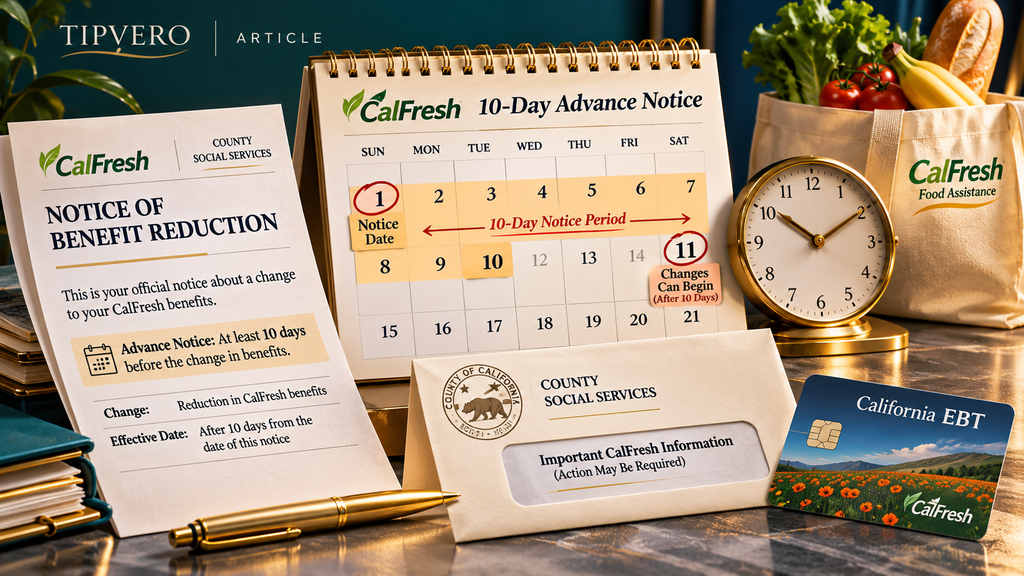
One of the most significant protections in CalFresh is the requirement for advance notice before certain adverse actions.
Under federal SNAP regulation 7 CFR §273.13, a state agency generally must provide timely and adequate advance notice before reducing or terminating benefits during a certification period.
However, specific exceptions exist.
4.1 Understanding the 10-day notice rule
For many adverse actions, the advance notice period must include at least 10 days between mailing and the effective date of the action.
This protection gives the household an opportunity to understand the decision and consider requesting a hearing before the reduction or termination takes effect.
California policy provides additional administrative guidance for calculating timely notice periods.
The date a notice is mailed and the date an action takes effect are therefore important.
4.2 Example of advance notice
Suppose a household receives a county notice explaining that its CalFresh allotment will decrease starting December 1.
The county must determine whether the proposed reduction requires advance notice and, if so, whether the notice was issued in time.
A recipient who believes the notice arrived too late should preserve the letter and envelope.
However, the rules generally concern proper issuance or mailing of the notice, and the legal analysis may involve more than the date the household physically opened it.
4.3 Why the date of mailing matters
Some recipients overlook the notice date because they focus only on the month when benefits change.
That can be a mistake.
The mailing date may affect both the advance notice analysis and the hearing request period.
Keep the original envelope when possible.
If the mailing date is disputed, the envelope and available case records may help establish what happened.
4.4 Exceptions to the standard rule
Not every action requires the same advance notice.
Federal regulations identify circumstances in which individual advance notices may be unnecessary or different notice requirements apply.
Examples include certain mass changes, specified household circumstances, previously explained benefit adjustments, and other regulatory exceptions.
These exceptions should not be generalized.
A county must have an applicable legal basis for using an exception.
A recipient should therefore ask why advance notice was not provided if benefits were reduced or ended unexpectedly.
4.5 Why certification periods matter
A reduction or termination during an active certification period is not necessarily governed by the same notice procedure as assistance ending at the conclusion of the certification period.
The household may have separate recertification responsibilities.
For this reason, always compare the effective date with the certification end date.
A person who misunderstands that distinction may assume the county violated an advance notice requirement when a different program rule actually applies.
4.6 What if the notice period seems too short?
Contact the county promptly.
Ask whether the action required timely adverse-action notice and how the county calculated the period.
If the action has not yet taken effect and the household disagrees, review state hearing rights immediately.
Timely action may affect whether existing benefits can continue while a dispute is reviewed.
Practical takeaway: The 10-day rule is an important protection, but it is not a universal requirement for every CalFresh decision.
5. Fact 4: Benefit Calculations and Effective Dates Matter
A CalFresh Notice of Action may contain financial calculations that directly affect a household’s grocery budget.
The amount shown on the notice should reflect the applicable eligibility and benefit rules.
A recipient does not need to independently reproduce every part of the county’s calculation, but understanding the major components can help identify possible errors.
5.1 Income used in the determination
CalFresh calculations may consider wages, Social Security income, pensions, and other countable income.
Different income sources can be treated differently under program rules.
When reviewing the notice, ask whether the county used current and accurate information.
For example, a retiree who stopped working should not assume that the county already knows employment earnings have ended.
The proper reporting rules still apply.
5.2 Household composition
The number of people included in a CalFresh household can affect eligibility and benefit calculations.
Household composition is not always identical to everyone living at the same address.
The rules may consider food purchasing and preparation arrangements, along with mandatory household membership provisions.
An incorrect household determination may change the amount of assistance.
If the notice lists circumstances inconsistent with the household’s actual arrangement, ask for a review.
5.3 Housing and utility expenses
Applicable shelter and utility deductions can influence the benefit calculation.
For example, a household that recently moved may have different rent or utility costs.
Not every expense produces an identical deduction.
The county must apply the relevant rules and consider information that is properly reported and verified.
If an important expense appears to be missing, ask whether it was considered.
5.4 Medical expenses for older adults
For eligible households that include an elderly or disabled member, allowable medical expenses may affect the amount of CalFresh assistance.
Potentially relevant costs can include certain insurance premiums, prescription expenses, and other qualifying medical expenditures.
A person age 60 or older should examine whether applicable deductions were considered.
However, not every medical expense is automatically deductible, and the amount depends on the program’s calculation rules.
5.5 Review the effective date
An NOA may explain when a benefit change will begin.
That date is different from the date the recipient actually reads the letter.
The effective date determines when the announced adjustment applies, subject to applicable rules and any successful challenge or correction.
A recipient should compare the effective date with the expected benefit issuance.
5.6 A hypothetical benefit calculation dispute
Consider an illustrative household with the following situation:
The recipient previously received $210 per month in CalFresh.
A new notice states that assistance will decrease to $155.
The household notices a difference of $55.
This difference alone does not prove the county made an error.
The county might have correctly applied an income change or another eligibility adjustment.
However, the recipient should ask which information produced the reduction and whether the determination is accurate.
If the change was based on an incorrect income figure, the household can provide relevant evidence and request review.
5.7 Do not confuse a lower payment with a missing payment
A reduced allotment, a delayed EBT issuance, and electronically stolen EBT benefits are different situations.
A Notice of Action may be relevant to an eligibility-based reduction.
A missing deposit could instead involve an issuance issue.
Unauthorized electronic transactions involve separate card-security and replacement procedures.
The correct remedy depends on the cause.
Practical takeaway: Compare the notice’s effective date and benefit calculation with the actual household circumstances before deciding whether the county’s action is correct.
6. Fact 5: You May Have 90 Days to Request a State Hearing
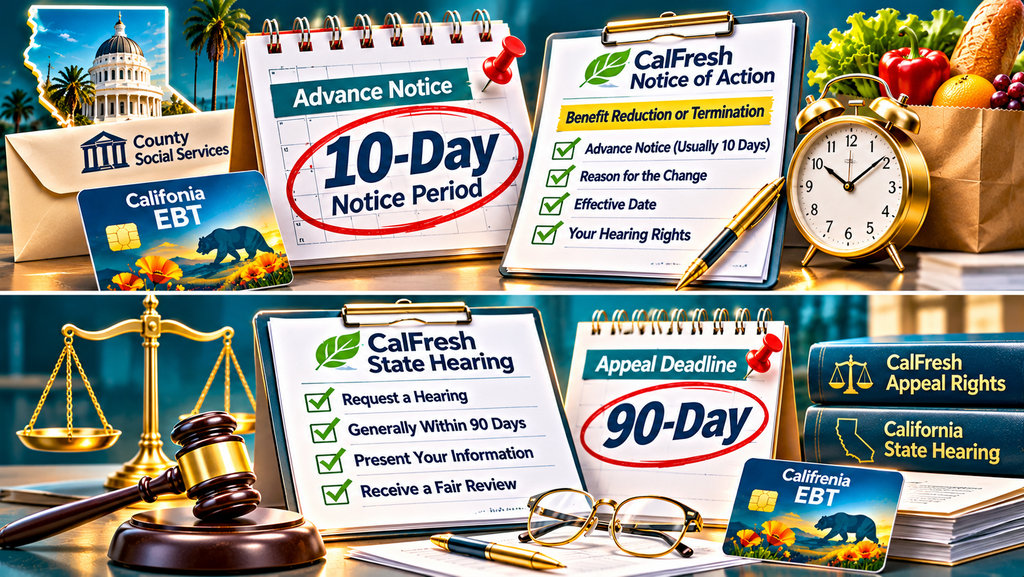
A household that disagrees with an applicable county action may request a state hearing.
This is a formal review process through which the dispute can be examined by an administrative law judge.
The hearing process is separate from ordinary customer service inquiries.
6.1 The general 90-day rule
California generally requires a state hearing request within 90 days after the action or inaction being challenged.
When the recipient received an adequate and language-compliant Notice of Action, the relevant period is generally connected to the date the notice was mailed or given.
The recipient should carefully examine the notice’s hearing instructions rather than assume that the deadline begins when the letter was finally opened.
6.2 Why waiting can be risky
A person may contact the county repeatedly in an effort to resolve an issue informally.
That approach can be useful.
However, a complaint, telephone inquiry, or pending county review does not automatically stop the hearing deadline.
A recipient should keep track of both processes.
For example, a person who requests clarification should still review the hearing deadline in case the issue remains unresolved.
6.3 How to request a hearing
California provides several ways to request a state hearing.
A recipient can use the official online hearing request procedure, submit a written request, or contact the State Hearings Division.
The State Hearings Division telephone number is 800-743-8525.
The California Department of Social Services explains the process on its official State Hearing Requests webpage.
A hearing request should identify the challenged action and explain the disagreement.
A simple explanation can be sufficient to begin the process.
6.4 What if the recipient did not receive an adequate notice?
Special rules may apply when the required notice was missing, inadequate, or not language-compliant.
California also recognizes certain circumstances that may justify considering a late hearing request.
These protections do not mean every late request will automatically be accepted.
The recipient should explain the circumstances, preserve evidence, and request a determination under the applicable rules.
As of the California hearing procedures reviewed for this article, good-cause provisions may allow certain requests after the ordinary 90-day period, including within specified additional limits.
Because these exceptions are fact-specific, prompt filing remains the safest approach.
6.5 A practical hearing request example
Consider the following hypothetical statement:
“I disagree with the reduction of my CalFresh benefits shown on the Notice of Action dated August 5. I believe the county used an incorrect income amount. I am requesting a state hearing and a review of the benefit calculation.”
The household can also explain whether it seeks continued benefits while the hearing is pending.
6.6 Documents to preserve
Useful records may include:
- The original Notice of Action
- The mailing envelope
- Previous benefit notices
- Relevant income records
- Rent and utility documentation
- Applicable medical expense information
- Prior communications with the county
- Evidence supporting the disputed calculation
Organize the documents chronologically.
This can help the recipient present the issue clearly.
6.7 Understanding the purpose of the hearing
A state hearing is intended to review the disputed county action.
It is not limited to proving that the county worker acted in bad faith.
A decision can be incorrect because of a calculation, misunderstanding, or administrative error.
The focus should be on the facts, relevant rules, and appropriate outcome.
Practical takeaway: If you disagree with a county decision, monitor the 90-day hearing period even while seeking an informal correction.
7. Fact 6: Benefits May Continue During a Timely Appeal
One of the most significant protections connected to a CalFresh Notice of Action is the possibility of continued benefits while a hearing is pending.
This is often called Aid Paid Pending.
The protection is valuable, but it has conditions.
7.1 What is Aid Paid Pending?
Aid Paid Pending refers to the continuation of certain benefits while an eligible dispute is awaiting a hearing decision.
For CalFresh, when a household properly requests a hearing within the applicable advance notice period and qualifies for continuation, the previous allotment may continue temporarily.
This protection can prevent an immediate reduction while the disputed action is reviewed.
7.2 Timing is especially important
The ordinary 90-day hearing filing period is not the same as the shorter period relevant to preserving benefits before an adverse action takes effect.
A household may still be allowed to request a hearing after the action becomes effective.
However, filing later may affect eligibility for continued benefits.
This is why the effective date printed on the Notice of Action deserves immediate attention.
7.3 Continuation is not indefinite
For CalFresh, continued benefits generally do not extend beyond the end of the household’s existing certification period merely because a hearing remains pending.
A person who reaches the end of the certification period may still need to complete recertification.
Requesting a hearing does not replace those responsibilities.
7.4 What if the final decision supports the county?
A household that continues receiving benefits during a hearing may become responsible for an overissuance if the final decision upholds the county’s reduction or termination.
The notice should explain this possible financial consequence.
Recipients should understand the risk before making decisions about continued assistance.
This does not mean requesting a hearing is improper.
It means the household should make an informed choice.
7.5 Example involving a disputed reduction
Suppose a household receives $230 monthly and the county proposes reducing the allotment to $165.
The household disputes the calculation and requests a hearing before the adverse action takes effect.
If the applicable continuation requirements are met, the household may continue receiving its previous allotment while the hearing is pending, subject to the certification period and other governing rules.
If the county’s decision is ultimately upheld, the excess assistance may become recoverable.
If the household’s position is upheld, appropriate corrective action may be required.
7.6 Ask specific questions
When requesting a hearing, ask:
“Am I eligible for continued CalFresh benefits while the hearing is pending?”
“What is the deadline for requesting continuation?”
“When does my current certification period end?”
“Could I owe an overissuance if the hearing decision is unfavorable?”
These questions help the household understand the consequences.
7.7 Avoid confusing benefit continuation with restoration
Aid Paid Pending concerns benefits during a pending dispute.
Restoration of lost benefits concerns assistance that should have been provided during an earlier qualifying period.
An active case that has been discontinued for another reason may involve yet another procedure.
These distinctions matter because different deadlines and rules apply.
Comparison Table 2: Important CalFresh Notice Deadlines
| Deadline or Period | General Meaning | Important Limitation |
|---|---|---|
| Advance notice of at least 10 days | Common requirement before certain adverse actions | Regulatory exceptions apply |
| 90 days | General state hearing request period | Specific late-filing rules may apply |
| Before adverse action takes effect | Often important for continued benefits | Eligibility and timely request requirements apply |
| End of certification period | Limits ordinary CalFresh continuation during hearing | Recertification remains necessary |
| Date of corrected determination | May affect benefit correction | Depends on county action and applicable law |
Practical takeaway: A timely hearing request may protect existing benefits, but households should understand both the deadline and possible repayment consequences.
8. Fact 7: Incorrect or Missing Notices Can Be Challenged
Not every county notice is necessarily accurate.
A document may contain incorrect household information, an incomplete calculation, a wrong effective date, or an explanation that does not adequately describe the action.
A household may also discover that an expected notice was never received.
These situations deserve careful review.
8.1 Incorrect income information
Suppose a retiree’s notice lists monthly pension income of $1,200, but the correct pension payment is $850.
The difference could affect the benefit calculation.
The recipient should provide the appropriate income verification and ask the county to explain or correct the calculation.
It is important to establish that the county used the wrong information rather than simply assume the benefit amount must increase.
8.2 Missing medical expense information
A qualifying elderly or disabled household may have medical expenses relevant to the benefit determination.
If a notice appears to omit previously reported and verified allowable expenses, request clarification.
Ask whether the information was received, verified, and considered under the applicable deduction rules.
8.3 Incorrect effective dates
A county may issue a notice using an effective date that the recipient believes conflicts with the governing notice requirements.
The household should identify the mailing date, proposed action date, and applicable advance notice rule.
Keep the original notice and envelope.
If the county cannot adequately explain the timing, the household may wish to challenge the action through a timely hearing request.
8.4 Notices sent to the wrong address
Moving can disrupt benefit correspondence.
For example, a recipient may have reported a new address but continued receiving notices at the former residence.
The household should request a copy of the notice and ask the county to verify its address records.
Document when the new address was reported.
A missing notice may affect the analysis of hearing timeliness or whether the county provided legally adequate notice.
However, the outcome is not automatic and depends on the circumstances.
8.5 Language accessibility matters
California’s public assistance agencies must comply with applicable language access and civil rights requirements.
A recipient with limited English proficiency may request appropriate language assistance.
People with disabilities may also request reasonable accommodations.
If a notice was not understandable because of a language access problem or accessibility barrier, explain the issue promptly.
The adequacy of the notice and any related hearing deadline may need to be reviewed under the applicable rules.
8.6 Contact the county before the deadline expires
A recipient can request an explanation or correction directly from the county.
However, informal review should not be treated as a substitute for preserving hearing rights.
If the deadline is approaching and the issue remains unresolved, a timely hearing request may be important.
8.7 TIPVERO Practical Insight: Check the Decision Before Accepting the Financial Consequence
When a CalFresh Notice of Action arrives, the most useful first step is not simply asking whether benefits will increase or decrease. It is understanding what information the county used and when the decision will take effect.
For older adults living on fixed retirement income, a small monthly reduction may create a meaningful change in available grocery money. However, the size of a reduction alone does not establish that the county made an error.
A practical review should focus on three questions: What changed, what evidence supports the change, and what deadline applies if the recipient disagrees?
This approach helps households respond to the actual issue rather than spend valuable time repeating general complaints.
Keeping the notice, its envelope, and relevant income or expense records together can also make it easier to request clarification or prepare a timely hearing request.
The central goal is to make an informed decision before an administrative deadline passes.
Practical takeaway: An unclear or incorrect notice should be investigated promptly, with documentation and hearing deadlines preserved.
9. Practical Checklist and Frequently Asked Questions
9.1 What to do within the first 24 hours
When a Notice of Action arrives:
- Open and read the entire notice.
- Identify whether the action is an approval, denial, reduction, or discontinuance.
- Write down the mailing date and effective date.
- Review the explanation and calculation.
- Keep the envelope and any attached hearing instructions.
- Contact the county if important information is missing or unclear.
- Check whether a hearing or benefit-continuation deadline requires immediate action.
9.2 Create a simple notice folder
An organized file can reduce stress when multiple county letters arrive.
Keep the newest notice together with previous benefit determinations and relevant supporting documents.
Use the mailing date to organize the papers.
A recipient who prefers electronic records can save secure copies, but should protect personal identifying information.
9.3 Do not discard earlier notices
Earlier notices may help establish when benefits changed or whether the county previously used different information.
For example, comparing the previous and current benefit calculations may reveal a change in reported income or allowed expenses.
The earlier documents may also be relevant to a hearing.
9.4 Confirm the next required action
Before ending a county telephone call, ask:
“What specifically do I need to do?”
“What is the deadline?”
“Will the action still take effect while the county reviews my information?”
“Do I need to request a state hearing to protect my rights?”
Write down the answers and any follow-up instructions.
FAQ 1: What is a CalFresh Notice of Action?
A CalFresh Notice of Action is an official county communication explaining a decision about a household’s food assistance.
It may concern approval, denial, reduction, discontinuance, or another benefit determination.
The notice should provide the information required by the applicable program rules and explain hearing rights when appropriate.
FAQ 2: Does every CalFresh Notice of Action mean my benefits will stop?
No.
Some notices confirm approval, an increase, or a determination that does not change assistance.
Read the specific action and effective date.
A notice announcing a lower benefit amount is different from a notice ending eligibility entirely.
FAQ 3: Does California always have to give 10 days’ notice?
No.
Federal SNAP rules generally require at least 10 days of advance notice for many reductions or terminations during an active certification period.
However, regulatory exceptions exist.
The notice requirements depend on the action and circumstances.
FAQ 4: How long do I have to appeal a CalFresh Notice of Action?
California generally allows 90 days to request a state hearing after the action or inaction being challenged.
The relevant notice date and applicable hearing rules matter.
Certain exceptions may apply to missing, inadequate, language-noncompliant, or otherwise qualifying late requests.
File promptly rather than assume an exception will be granted.
FAQ 5: Can my CalFresh benefits continue while I appeal?
Possibly.
Certain timely hearing requests may qualify for Aid Paid Pending, allowing previous benefits to continue temporarily.
Continuation generally does not extend beyond the current certification period.
An unfavorable decision may result in an obligation to repay an overissuance.
FAQ 6: What should I do if I disagree with the income listed on my notice?
Ask the county for an explanation of the calculation.
Provide appropriate documentation showing the correct income.
Request correction if the information was applied incorrectly.
If you dispute the decision, preserve your hearing rights within the applicable period.
FAQ 7: What happens if I never received the notice?
Contact the county, request a copy, and confirm the address on file.
Keep evidence showing when you updated your address or became aware of the action.
Missing or inadequate required notice may affect hearing timeliness under applicable California rules.
Do not assume that every missed letter automatically cancels the county’s decision.
FAQ 8: Can I request a CalFresh hearing without hiring a lawyer?
Yes.
A household may request a state hearing without retaining private counsel.
The hearing process allows the recipient to explain the disagreement and present relevant evidence.
Free legal assistance may be available, and notice rules may require information about that assistance where applicable.
The California State Hearings Division can provide the official hearing request procedure.
10. Conclusion: Understand the Notice, Protect Your Rights
A CalFresh Notice of Action can affect a household’s food budget, but the letter should not be treated as an unexplained or unchallengeable decision.
It is an official communication that provides information about what the county has determined, why the action is being taken, and what rights may apply.
The seven facts in this guide explain why recipients should carefully examine the type of notice, the reason for the action, the benefit calculation, and the effective date.
They also show why administrative deadlines deserve immediate attention.
Some adverse actions require advance notice. A household may have the right to request a state hearing, and certain timely hearing requests may permit continued benefits while the dispute is pending.
These protections have limits, and the exact rules depend on the situation.
For seniors living alone, understanding official correspondence is an important part of maintaining financial independence.
An unexpected reduction in food assistance can create difficult choices when retirement income is limited and essential expenses continue to rise.
However, the strongest response is based on accurate information rather than fear.
Recipients should review notices promptly, compare calculations with their actual circumstances, document communications, and take action before the applicable deadline.
The most important lesson is simple:
A government notice explains an administrative decision. Understanding that decision is the first step toward protecting your rights and maintaining access to eligible food assistance.
By keeping records, asking specific questions, and using the available review procedures when needed, California households can approach CalFresh notices with greater confidence and clarity.