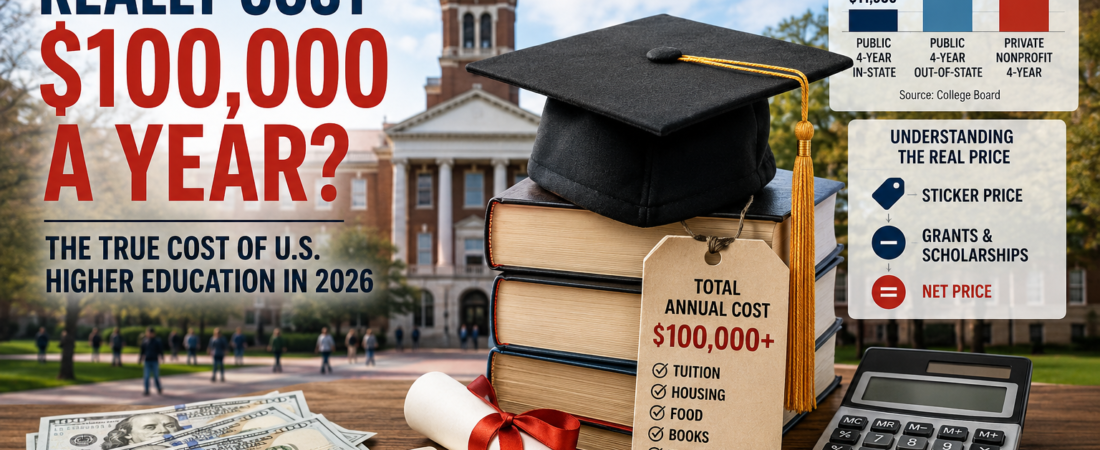
For many American families, the idea of paying $100,000 for a single year of college sounds almost unbelievable.
That is more than many households earn in an entire year. Multiply it by four years, and the theoretical price of a bachelor’s degree can approach $400,000 before considering future increases in tuition, housing, food, transportation, and other expenses.
Yet the $100,000-a-year college has moved from a hypothetical warning to a financial reality at some U.S. universities.
For the 2026–2027 academic year, the University of Southern California estimates the total cost of attendance for an undergraduate living on campus at $103,162. That includes $75,384 in tuition plus fees, housing, food, books and supplies, transportation, and personal expenses.
Vanderbilt University is close to the same threshold. Its estimated mandatory direct costs for 2026–2027 total $96,896. Once estimated books, supplies, personal expenses, transportation, and potentially health insurance are considered, the overall cost can reach or exceed $100,000 for some students.
But those numbers require an important explanation.
They do not mean that every American college now charges $100,000 in tuition. They also do not mean that every student attending an expensive private university actually pays the full advertised price.
Understanding the difference between tuition, total cost of attendance, financial aid, and net price is becoming one of the most important financial lessons for American families preparing for college.
The $100,000 College Year Is Already Here
USC provides one of the clearest examples.
For an undergraduate living on campus during the 2026–2027 academic year, USC estimates the following expenses:
- Tuition: $75,384
- Fees: $1,952
- Housing: $13,510
- Food: $8,442
- Books and supplies: $670
- Transportation: $1,188
- Personal and miscellaneous expenses: $2,016
That brings the estimated total to $103,162.
New students also face an additional $450 fee in their first semester.
This distinction matters because headlines about “$100,000 tuition” can be misleading. USC’s tuition itself is not $100,000. The total estimated annual cost of attending the university while living on campus is more than $100,000.
Vanderbilt offers another useful comparison.
For 2026–2027, Vanderbilt lists undergraduate tuition at $69,822, housing at $15,170, food at $8,520, and a student support fee of $3,384. Mandatory direct costs therefore total $96,896.
The university additionally estimates $1,100 for books, course materials, supplies and equipment and $1,998 for personal expenses. Transportation varies by student.
The result is a college budget that can cross the $100,000 mark depending on transportation, health insurance, and individual circumstances.
Tuition and Cost of Attendance Are Not the Same Thing
This is perhaps the most important point for families reading college price information.
Tuition is what a college charges for instruction.
Cost of Attendance, often abbreviated COA, is a broader estimate of what it may cost a student to attend that institution for an academic year.
A college’s cost of attendance can include:
- Tuition
- Mandatory fees
- Housing
- Meal plans or food
- Books and supplies
- Transportation
- Personal expenses
- Other education-related expenses
Depending on the institution and student, health insurance and additional expenses may also matter.
This means a university charging $70,000 or $75,000 in tuition can have a total annual cost exceeding $100,000.
That distinction also explains why families should be cautious when comparing colleges based only on tuition.
A school with lower tuition in an expensive city could have substantial housing and living expenses. Another institution might charge more tuition but offer significantly more grant aid.
The number that ultimately matters to a family is not necessarily the headline tuition figure.
It is the amount they are actually expected to pay.
Most American Colleges Do Not Cost $100,000 a Year
The $100,000 figure is dramatic, but it should not be mistaken for the typical cost of American higher education.
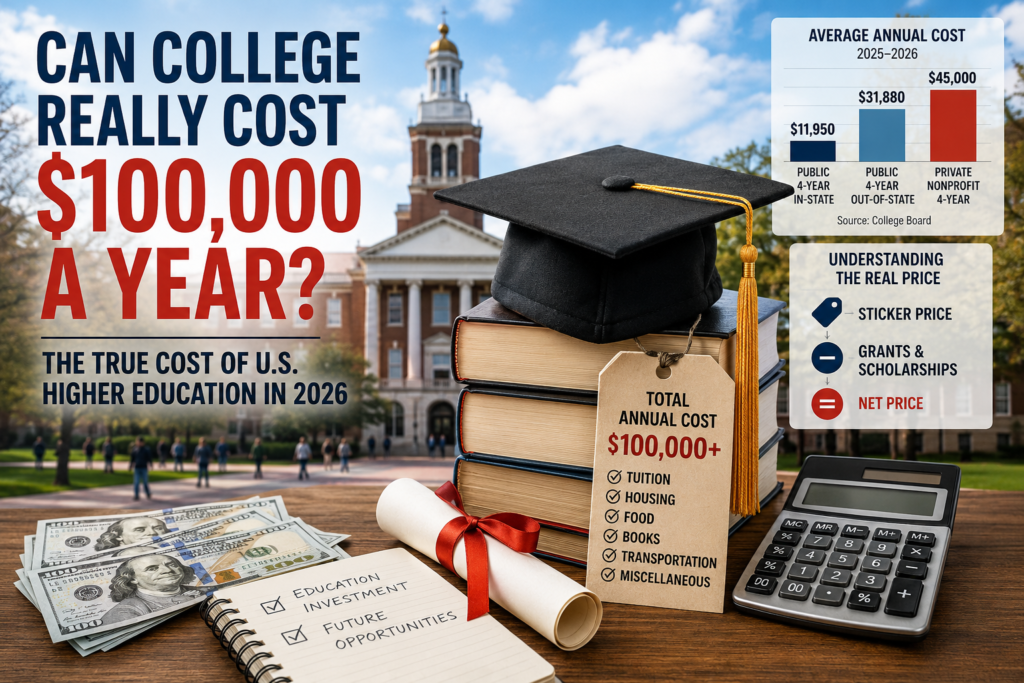
College Board data for 2025–2026 shows average published tuition and fees of approximately:
- $11,950 for public four-year in-state students
- $31,880 for public four-year out-of-state students
- $4,150 for public two-year in-district students
- $45,000 for private nonprofit four-year colleges
When housing, food, books, transportation, and other expenses are included, College Board estimates average annual student budgets of about $30,990 for public four-year in-state students, $50,920 for public four-year out-of-state students, and $65,470 for students attending private nonprofit four-year institutions.
These averages show just how unusual a $100,000 annual budget remains.
But they also show something else: even the average cost of attending college can represent a major financial commitment.
Sticker Price vs. Net Price
Imagine two universities.
College A advertises a total annual cost of $95,000 but provides a student with $55,000 in grants and scholarships.
College B costs $60,000 but offers that same student only $10,000 in grant aid.
At first glance, College B looks much cheaper.
After financial aid, however, College A could actually cost the family less.
This is why families need to understand the difference between sticker price and net price.
The sticker price is the published cost before grants and scholarships.
Net price generally represents what remains after applicable grant and scholarship aid is taken into account.
College Board reports that grant aid substantially reduces tuition costs for many students. For 2025–2026, its estimated average net tuition and fees for first-time, full-time students at private nonprofit four-year institutions was $16,910, far below the sector’s $45,000 average published tuition and fees.
That does not mean every student at a private college pays $16,910. Financial aid varies widely based on the institution, family finances, student eligibility, and other factors.
But it demonstrates why families should never reject a university based solely on its advertised price before examining the financial aid package.
Why Does College Cost So Much Beyond Tuition?
For families unfamiliar with the modern college budget, one surprise is how much money goes toward expenses other than classroom instruction.
Housing
Students need somewhere to live.
At universities in expensive metropolitan areas, housing can easily add five figures to the annual budget.
Living off campus does not automatically solve the problem. Rent, utilities, deposits, furniture, internet service, transportation, and food can make off-campus living expensive as well.
Food
University meal plans can add thousands of dollars per year.
Students living independently still have grocery and dining expenses, so eliminating a meal plan does not eliminate food costs.
Transportation
Transportation costs vary enormously.
A student attending college close to home may have relatively limited travel expenses. A student attending school across the country may need multiple flights every year.
There may also be costs for public transportation, rideshares, parking, fuel, or maintaining a vehicle.
Books and Course Materials
Traditional textbooks are only part of the modern education budget.
Students may need software subscriptions, digital course materials, laboratory equipment, art supplies, specialized calculators, computers, or other program-specific items.
Personal Expenses
Laundry, clothing, mobile phone costs, toiletries, basic household supplies, entertainment, and countless smaller purchases add up over an academic year.
Individually, these expenses may appear minor compared with tuition.
Collectively, they can add thousands of dollars.
What Would Four Years at $100,000 Per Year Mean?
The simplest calculation is alarming:
$100,000 × 4 years = $400,000.
But even that calculation may not tell the entire story.
College costs can increase from year to year.
A student beginning college with a $100,000 estimated annual budget should not automatically assume that the same price will remain unchanged for all four years.
There are also circumstances that can extend the timeline beyond four years.
Changing majors, transferring schools, repeating courses, taking fewer credits, or needing additional semesters can affect the final cost of a degree.
This makes graduation planning a financial issue as well as an academic one.
Finishing on time can have significant financial value.
The Middle-Class College Cost Problem
High college prices create a particularly complicated challenge for many middle-income families.
Lower-income students may qualify for substantial need-based financial aid at institutions with generous aid programs.
High-income families may have more resources available to pay tuition.
Some families in the middle can find themselves in an uncomfortable position: they earn too much to qualify for the level of aid they expected but not enough to comfortably pay tens of thousands of dollars each year.
That can lead families to consider savings, current income, student employment, parent contributions, and borrowing.
This is one reason college planning should begin with a realistic household budget rather than a college ranking.
The question should not simply be:
“Can my child get into this university?”
Families increasingly need to ask:
“Can we afford this university without creating a financial burden that follows us for decades?”
Financial Aid Can Completely Change the Comparison
The existence of $100,000 college budgets does not mean every student at those institutions is writing a $100,000 check.
For example, USC reports that it awarded $904 million in financial aid from all sources during 2024–2025, with 78% of that amount consisting of grants and scholarships.
This matters because grants and scholarships generally do not have to be repaid.
Families evaluating an expensive private university should therefore investigate several forms of assistance:
Need-Based Grants
These are generally based on a family’s financial circumstances.
Merit Scholarships
Some institutions offer scholarships based on academic achievement, leadership, artistic talent, or other qualifications.
Federal and State Aid
Eligible students may qualify for federal or state programs.
Work-Study and Student Employment
Employment can help cover some personal and educational expenses, although students should be realistic about how much they can earn while maintaining their academic responsibilities.
Student Loans
Loans can close funding gaps, but they are fundamentally different from grants and scholarships because borrowed money must be repaid, usually with interest.
Families should avoid treating a loan as if it were a discount.
If a university offers $30,000 in grants and $20,000 in loans, the student has not received $50,000 in free aid.
That distinction is essential.
Student Debt Still Matters
College Board reported that among 2023–2024 bachelor’s degree recipients from public and private nonprofit four-year institutions, 47% graduated with debt.
Among those who borrowed, the average debt was $29,560.
This is important context.
The existence of $100,000 annual college budgets does not mean the typical bachelor’s degree recipient leaves school owing $400,000.
Families use a mixture of grants, scholarships, savings, income, and other resources. Many students also attend substantially less expensive public universities or community colleges.
Still, borrowing decisions can have consequences that continue well after graduation.
Monthly student loan payments compete with rent, car payments, retirement savings, emergency savings, home purchases, and other financial goals.
The true cost of borrowing is therefore not just the amount borrowed. Interest and the effect of monthly payments on future financial flexibility matter too.
Is an Expensive College Worth It?
There is no universal answer.
A college education can provide substantial economic and personal benefits, but price should be evaluated in context.
Families can ask several practical questions:
What will this degree actually cost after grants and scholarships?
How much would the student need to borrow?
What percentage of students graduate?
How long does graduation typically take?
What career opportunities are associated with the student’s intended field?
Are there lower-cost institutions offering a strong program in the same field?
Could the student begin at a community college and transfer?
Would an in-state public university provide a better financial fit?
An expensive university can make financial sense for one student and be a poor financial choice for another.
The decision depends on the aid package, academic program, family resources, career goals, and alternatives available.
Why Families Should Compare Net Price, Not Prestige Alone
For decades, the college admissions conversation has often centered on rankings, reputation, acceptance rates, and campus life.
Cost deserves equal attention.
Suppose a student is accepted by four universities.
Instead of comparing only school names, the family can create a simple four-column comparison showing:
- Total published cost of attendance
- Grants and scholarships
- Expected family contribution and other out-of-pocket costs
- Expected borrowing
Then calculate the approximate four-year cost.
The results may be surprising.
The university with the highest published price could offer the best aid package.
The university that initially appears affordable could become expensive after housing and other costs are added.
College shopping is one of the largest financial decisions many families will ever make. It deserves the same level of comparison that people use when buying a home or making another major long-term investment.
What About International Students?
International students face another layer of complexity.
Financial aid policies for international applicants vary considerably by university.
A financial aid program available to a U.S. citizen or eligible noncitizen may not necessarily be available to an international student.
International families may also need to consider:
- Currency exchange rates
- International airfare
- Visa-related expenses
- Health insurance
- Housing during school breaks
- International banking and transfer costs
- Travel during emergencies
- Limited eligibility for certain U.S. financial aid programs
Exchange rates can make budgeting especially difficult.
Even when a university’s dollar-denominated tuition remains unchanged, the cost to a family paying with another currency can rise significantly if the U.S. dollar strengthens.
International students should therefore evaluate the complete multi-year financial commitment rather than focusing only on first-year tuition.
Ways Families Can Reduce College Costs
A six-figure annual college budget is not the only path to a bachelor’s degree.
Families have several strategies to consider.
Compare Public and Private Universities
In-state public universities can have significantly lower published tuition than private universities.
However, generous private-school financial aid can sometimes narrow the gap, so families should compare actual aid offers rather than assuming public always means cheaper.
Consider Community College
Starting at a community college and transferring to a four-year institution can reduce the cost of the first years of undergraduate education.
Transfer requirements should be planned carefully so credits apply toward the intended bachelor’s degree.
Apply Broadly for Scholarships
Institutional and outside scholarships can reduce the amount families need to pay or borrow.
Understand Housing Choices
Housing can be one of the largest non-tuition expenses.
Students should compare campus housing with realistic off-campus costs rather than comparing dorm prices with rent alone.
Graduate on Time
An additional semester can mean more tuition, more housing, more food, and delayed full-time earnings.
Academic planning can therefore be part of financial planning.
Use Net Price Calculators
Many colleges provide net price calculators that help families estimate potential costs based on financial circumstances.
These estimates are not guarantees, but they can provide a much more useful starting point than sticker price alone.
The Bigger Picture: American College Is Not One Price
The phrase “$100,000-a-year college” makes a powerful headline.
But America’s higher education system includes an enormous range of prices.
At one end are community colleges with relatively low in-district tuition.
There are public universities offering lower tuition to state residents.
There are private colleges with higher published prices but sometimes substantial institutional aid.
And at the upper end, some universities now have total estimated annual budgets reaching or exceeding $100,000.
College Board’s 2025–2026 data makes the contrast clear. Average tuition and fees ranged from $4,150 at public two-year in-district colleges to $45,000 at private nonprofit four-year institutions.
The average total student budget for private nonprofit four-year institutions was $65,470 — expensive, but still far below $100,000.
That is why the most accurate conclusion is not that “college in America now costs $100,000 a year.”
A better conclusion is this:
The most expensive tier of American higher education has entered the $100,000-a-year era, while the actual price students pay continues to vary enormously.
What This Means for Everyday American Families
The rise of six-figure college budgets changes the way families need to think about higher education.
College choice can no longer be separated from long-term household finances.
Parents approaching retirement may need to consider whether using large amounts of retirement savings to fund college is sustainable.
Students need to understand that the size of a financial aid package matters as much as the acceptance letter.
Families need to distinguish grants from loans and sticker price from net price.
And perhaps most importantly, students should understand that choosing a college is not simply about finding the “best” school.
It is about finding the best combination of education, opportunity, affordability, and long-term value.
TIPVERO Bottom Line
Yes, a year of college in the United States can now cost more than $100,000.
USC’s estimated 2026–2027 cost of attendance for an undergraduate living on campus is $103,162. Vanderbilt’s mandatory direct costs are $96,896 before several additional expenses are considered.
But those figures should be understood correctly.
They represent the upper end of American higher education costs, not the typical price of every U.S. college.
And a school’s published price is not necessarily what an individual family will ultimately pay.
For parents and students, the most useful question is therefore not:
“How much is tuition?”
It is:
“After grants and scholarships, how much will this degree actually cost us over four years — and how much debt will we have when it is finished?”
In the era of the $100,000 college year, that may be one of the most important financial questions a family can ask.