
Updated November 12, 2026 | California Food Assistance and Application Guide
Missed CalFresh Phone Interview appointments can create unnecessary stress, especially when a California household is waiting for food assistance to help cover essential groceries. Fortunately, missing an initial interview does not always mean the application has been denied or that the household must immediately start over.
For an older adult living alone, the situation can be particularly confusing. A phone might not ring because an unfamiliar number was automatically blocked. The applicant may have been at a medical appointment, temporarily hospitalized, or unable to answer because of a hearing difficulty. In other cases, the county may have called at an unexpected time.
The important point is that California has procedures for handling missed CalFresh interviews.
Under applicable SNAP and CalFresh rules, a county generally must provide a Notice of Missed Interview when an applicant misses the first scheduled interview. An applicant who contacts the county within the required processing period may receive another opportunity to complete the interview.
However, deadlines matter. So does the difference between an initial application, a recertification interview, and an application that has already been denied.
This guide explains five practical steps for handling a missed telephone appointment in 2026. It also covers what happens when a county worker cannot reach an applicant, how the 30-day processing period works, and how to prepare for the next interview.
The purpose is to help California residents understand the process before a missed appointment becomes a more serious food assistance problem.
Table of Contents
1. Understanding a Missed CalFresh Phone Interview
A CalFresh interview is part of the process used to determine whether an applicant qualifies for food assistance.
During the interview, a county eligibility worker may review household composition, income, expenses, and other information needed to complete the eligibility determination.
Many interviews can be conducted by telephone, although the available arrangements depend on applicable program rules and individual circumstances.
An applicant does not need to assume that a missed telephone call means the entire application has been permanently canceled.
Nevertheless, the applicant should respond promptly.
1.1 Why CalFresh requires an interview
CalFresh is California’s version of the federal Supplemental Nutrition Assistance Program, commonly called SNAP.
The interview gives the applicant an opportunity to clarify the information submitted and allows the county to identify necessary verification.
For example, an individual might report receiving Social Security retirement benefits while also paying rent and certain medical expenses.
The worker may need to confirm the relevant financial circumstances and explain which documentation is required.
Some information can be verified electronically or through other available sources. Counties should follow applicable verification policies rather than automatically requiring every possible document.
An applicant should answer questions accurately and explain when requested information is unavailable.
The interview is not intended to be a test of the applicant’s knowledge of government programs.
1.2 Common reasons applicants miss interviews
There are several practical explanations for a missed appointment.
Unrecognized telephone numbers
County calls may sometimes appear as blocked, unknown, or unfamiliar numbers. A smartphone’s filtering settings may prevent a call from reaching the applicant.
Scheduling confusion
An applicant may misunderstand the date, time, or type of appointment.
Medical appointments
Older adults and people with disabilities may have medical treatments or appointments that conflict with a scheduled call.
Telephone service problems
A disconnected telephone, low battery, weak reception, or malfunctioning voicemail system may prevent communication.
Language or hearing barriers
An applicant might have difficulty understanding a message or participating without interpretation or accommodation.
Unexpected emergencies
Hospitalization, family emergencies, or other events may prevent someone from answering.
The reason for missing the appointment can be relevant when the county evaluates responsibility for a processing delay.
However, applicants should not rely on a particular explanation to automatically excuse every missed interview.
The best immediate response is to contact the county, explain what happened, and request the next available opportunity to complete the interview.
1.3 Initial application versus recertification
A missed interview during an initial application is not necessarily handled in the same way as a missed interview during recertification.
Initial application: The household has applied for CalFresh and has not yet completed the eligibility process.
Recertification: An existing participant is completing requirements to continue receiving benefits for another certification period.
The deadlines, notices, and potential benefit consequences may differ.
This article primarily addresses missed telephone interviews during an initial application, with separate guidance for recertification issues.
1.4 Why acting early protects the application
A household that promptly requests another interview has a better opportunity to resolve missing information while the original application remains under review.
Waiting until after a denial notice arrives may require additional administrative steps.
The key question is not simply whether the telephone appointment was missed.
It is whether the applicant contacts the county and completes the remaining requirements within the applicable deadlines.
Practical takeaway: A missed first interview requires prompt action, but it does not automatically prove that the applicant is ineligible for CalFresh.
2. Step 1: Check Your Notice and Application Status
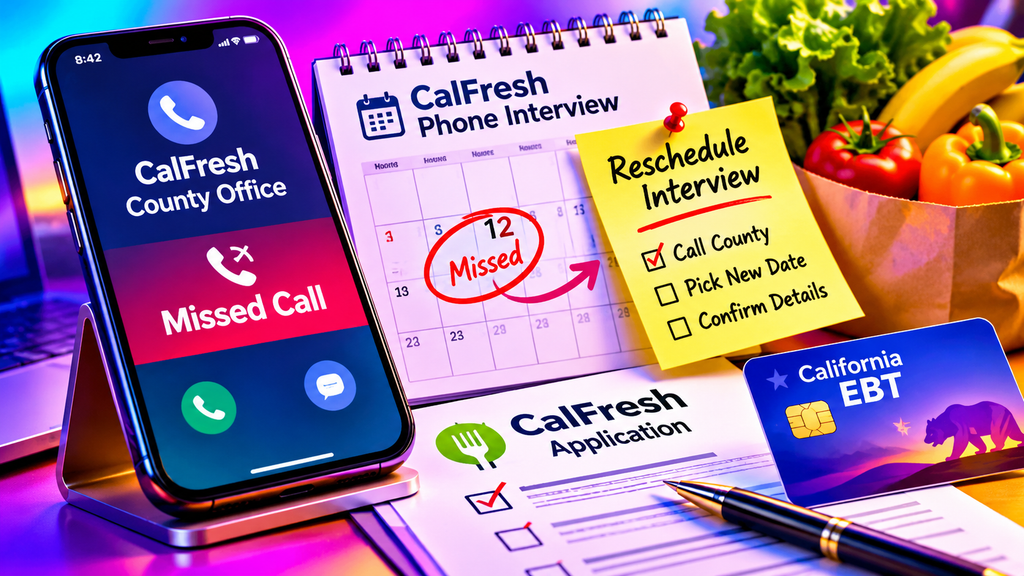
The first response to a missed CalFresh phone interview should be to identify the relevant documents and confirm the application’s actual status.
Do not rely solely on a missed-call notification or an assumption that the application has been canceled.
2.1 Look for the Notice of Missed Interview
California uses Form CF 386, known as the Notice of Missed Interview.
This notice informs the household that the scheduled interview was missed and provides instructions for arranging another appointment.
It generally identifies information such as the case, county worker, and interview completion deadline.
The notice also explains that an interview is necessary to determine eligibility.
Applicants can review the official California Notice of Missed Interview, Form CF 386.
A person who has not received the notice should still contact the county rather than waiting for the mail.
2.2 Identify the original application date
The application filing date is particularly important because the standard 30-day processing period generally runs from that date.
It does not restart simply because a telephone interview was missed.
Consider this hypothetical example:
- Application submitted: September 3
- Initial phone interview scheduled: September 12
- Interview missed: September 12
- Applicant contacts county: September 15
The applicant has contacted the county while the original 30-day processing period is still underway.
The county should evaluate the request for another interview under the applicable missed-interview rules.
The exact final deadline should be confirmed using the applicant’s notice and county records.
2.3 Confirm whether the county actually called
Sometimes applicants believe they missed an interview, but no call appears in their telephone history.
There may be several explanations.
The call might have been blocked by the device, sent to voicemail, or made to a different number listed on the application.
Alternatively, a scheduling or communication problem may have occurred.
Ask the county to verify the telephone number on file and the date and time of the attempted contact.
This is particularly important when the applicant has records suggesting that the county could not reach them because of incorrect contact information.
2.4 Check application information through BenefitsCal
California residents can use BenefitsCal to access supported benefit services, review case information, and submit documentation.
Available functions depend on account access and the case’s status.
Check whether there are notices, outstanding requests, or updated contact details.
A digital account can be useful, but online information should not replace direct communication when a deadline is approaching.
An application may require immediate county contact even when an online status has not yet changed.
2.5 Create a simple case record
Use a notebook or secure digital file to record:
- Application filing date
- Original scheduled interview date
- Date of the missed call
- Date the county was contacted
- Name or identification of the worker, when available
- Rescheduled appointment information
- Any outstanding verification requests
This record can help clarify what happened if the application is subsequently delayed or denied.
For a person who lives alone, a written record also reduces the burden of remembering several administrative dates.
Practical takeaway: Before taking further action, establish exactly which appointment was missed, when the application was filed, and what the county’s records currently show.
3. Step 2: Contact the County and Request Another Interview
After checking the notice, the next step is to contact the responsible county office.
A missed CalFresh phone interview is generally easier to address when the applicant requests another appointment before the standard processing period ends.
3.1 Contact the county as soon as possible
Use the number provided on the interview notice or official county correspondence.
Explain that you missed the initial appointment and want to continue the CalFresh application.
You do not need to provide an elaborate personal explanation before asking for another interview.
A clear request is more useful than a long description that does not identify what action is needed.
For example:
“I recently applied for CalFresh and missed my scheduled telephone interview. I would like to reschedule the interview and continue my application. Could you confirm the next available appointment and the deadline for completing it?”
This communicates the purpose of the call.
3.2 What if nobody answers?
If the county telephone line is busy or the assigned worker is unavailable, follow the county’s available contact procedures.
When voicemail is available, leave an appropriate message identifying yourself and requesting a callback.
Avoid including unnecessary sensitive financial information in a voicemail.
Record the date and time you called.
If possible, use another official method accepted by the county to document the request.
The goal is to create a reliable record that you attempted to schedule the second interview.
3.3 What if the county uses on-demand interviews?
Some county interview arrangements allow applicants to call during an authorized interview window rather than wait for one specifically scheduled outgoing call.
The state’s CF 29B on-demand appointment form explains a system in which applicants are instructed to call within a designated period.
The form describes a two-week window of 10 business days and instructs applicants who cannot complete the interview during that window to contact the county about rescheduling.
An on-demand interview should not be confused with an ordinary appointment in which the county calls the applicant at a specific time.
Read the actual appointment letter to determine who was expected to place the call.
If the instructions were unclear, ask the county to explain the procedure and confirm the next available interview option.
3.4 Check your phone settings
Before the next appointment, make sure the telephone can receive calls from unfamiliar or blocked numbers.
Review settings that may silence unknown callers or automatically filter suspected spam.
Temporarily adjust these settings if necessary and safe to do so.
Keep the phone charged and check that voicemail is functioning.
However, remain cautious about unsolicited calls. If someone requests an EBT PIN, password, or other sensitive credential, end the conversation and contact the county through an independently verified number.
A legitimate eligibility interview should not require the applicant to disclose an EBT PIN.
3.5 Ask for an accessible interview arrangement
Not everyone can reliably participate in a standard telephone appointment.
An applicant with hearing difficulties may require an appropriate communication accommodation.
A person with limited English proficiency may need a qualified interpreter.
Others may need a different interview time because of medical treatment, work schedules, or caregiving obligations.
California provides language access rights, and applicants may request appropriate disability-related accommodations.
When contacting the county, explain the specific assistance needed.
For example:
“I have difficulty hearing telephone conversations and need an accessible way to complete my CalFresh interview.”
Or:
“I would like an interpreter in Korean for my eligibility interview.”
The county should evaluate the request under applicable accessibility and language assistance requirements.
3.6 Ask for the appointment details in writing
After rescheduling, confirm the appointment date, time, method, and contact information.
If written confirmation is available, keep a copy.
Also ask whether any documents should be prepared before the interview.
This reduces the possibility of a second missed appointment caused by incomplete instructions.
Practical takeaway: Contact the county directly, request a specific new appointment, and preserve evidence of your rescheduling request.
4. Step 3: Understand the 30-Day and 60-Day Processing Rules

One of the most important questions after a missed CalFresh phone interview is how much time remains to complete the application.
California’s standard application processing rules contain several different deadlines.
Understanding the difference can help prevent confusion.
4.1 The standard 30-day processing period
For regular CalFresh applications, eligible households that complete the necessary process should generally receive a decision and access to benefits within 30 calendar days of the filing date.
If the first scheduled interview is missed, the county generally must send a Notice of Missed Interview.
Federal SNAP rules also require a second interview opportunity when the household contacts the agency within the applicable 30-day processing period.
The county generally cannot deny the application before the applicable 30-day point solely because the initial interview was missed.
However, this does not mean the county must approve an incomplete application.
Eligibility still must be established.
4.2 The meaning of the 30-day deadline
The 30-day period is not a guaranteed grace period during which the applicant can ignore all requests.
It is the standard period for completing the application determination.
An applicant should respond as early as possible because the county may need time to conduct another interview and evaluate any remaining verification.
Contacting the county on the final day may create avoidable scheduling and processing complications.
A reasonable personal goal is to make the rescheduling request immediately after discovering the missed appointment.
4.3 What happens if the first 30 days end?
The situation can become more complicated after the initial processing period.
Federal and California processing rules recognize certain cases in which an application remains pending during a second 30-day period because additional action is required.
For example, where the applicant timely requested a second interview and the county cannot reasonably arrange it before the end of the initial period, the agency must evaluate the delay under applicable processing rules.
A county’s responsibility for delay is an important issue.
Applicants should not assume that the passage of 30 days automatically means they must abandon the original application.
Similarly, they should not assume that every incomplete application remains active for a full 60 days regardless of the circumstances.
4.4 The second 30-day period is not automatic retroactive eligibility
When a household is responsible for an initial processing delay and later completes the required steps during the following 30 days, the benefits may be calculated from the date the household complies.
This can affect assistance for the original application month.
In contrast, if the county caused the delay, a different benefit-start-date analysis may be required.
For this reason, the applicant should ask the county to identify whether the delay was attributed to the household or the agency.
4.5 Example: A timely request for a second interview
Consider the following hypothetical timeline.
| Event | Date | What It Means |
|---|---|---|
| Application submitted | March 1 | Initial processing period begins |
| First interview scheduled | March 24 | Applicant is expected to participate |
| Interview missed | March 24 | Notice of Missed Interview required |
| Applicant requests second interview | March 26 | Request made within 30-day period |
| Second interview scheduled | April 3 | Timing must be evaluated under county processing rules |
| Eligibility determined | After completed requirements | Benefit start date depends on applicable delay and eligibility rules |
The example illustrates why documenting a timely request matters.
A late appointment caused by county scheduling limitations should not automatically be treated as an applicant’s failure to cooperate.
4.6 The 60-day distinction
Certain application processing rules provide for a second 30-day period when an application cannot be completed during the first 30 days.
Santa Clara County’s public CalFresh processing guidance discusses conditions under which a second interview must be scheduled within 60 days of the original application date.
It also explains that an application may remain pending during the second 30 days, with the benefit-start date depending on who caused the delay.
This is different from the 30-day restoration waiver for an already discontinued ongoing CalFresh case.
The two procedures should not be confused.
4.7 Expedited service is a separate consideration
Some households with extremely limited income or resources may qualify for expedited CalFresh service.
Eligible households are generally entitled to expedited processing within three calendar days under California rules.
A missed interview can interrupt that process, but an applicant who still faces urgent food needs should immediately tell the county.
The county should evaluate the situation under the applicable expedited-service requirements.
A person should never assume that missing an initial appointment permanently removes the possibility of urgent assistance.
Practical takeaway: The 30-day application deadline and the second 30-day processing rules are different from the restoration rules for an existing case. Ask the county which procedure applies to your application.
5. Step 4: Prepare for the Rescheduled Interview
A successful second interview begins with practical preparation.
The goal is not to memorize complex CalFresh regulations. It is to make sure the county can accurately understand the applicant’s circumstances and identify whatever verification is legally required.
5.1 Review the original application
Before the appointment, review the information submitted.
Check that the county has the correct name, contact information, household composition, and reported financial circumstances.
If something has changed since the application was filed, be prepared to explain the change accurately.
For example, an applicant may have recently retired, experienced a reduction in working hours, or moved to a new apartment.
The county may need updated information to determine eligibility correctly.
5.2 Prepare relevant financial information
Depending on the household, useful information may include:
- Social Security retirement income
- Pension income
- Employment earnings
- Self-employment income
- Rent or mortgage-related housing costs
- Utility expenses
- Certain qualifying medical expenses
- Household membership and food purchasing arrangements
These categories do not mean every applicant must submit every listed document.
The county determines which verification is required under the applicable rules.
If the worker requests information that is difficult to obtain, ask whether another acceptable source can be used.
5.3 Understand household composition
CalFresh household rules do not always correspond exactly to the number of people living at one address.
Whether people customarily purchase and prepare food together can affect household determination, subject to mandatory household-composition rules and applicable exceptions.
For example, a person renting a room may have a different food purchasing arrangement from a family sharing all meals and expenses.
The applicant should explain the actual arrangement rather than assume that everyone at the same address automatically forms one CalFresh household.
Accurate household information matters for both eligibility and benefit calculations.
5.4 Older adults should review applicable deductions
For qualifying households that include elderly or disabled members, allowable medical expenses can affect the benefit calculation.
An older adult who pays for prescription medication, medical insurance premiums, or certain other eligible costs should ask whether those expenses are relevant.
Similarly, housing and utility costs may affect the calculation.
The interviewer should apply the current rules to the applicant’s actual circumstances.
Do not assume that every expense automatically creates a deduction or guarantees a higher benefit.
5.5 Allow enough time for the interview
Choose a quiet location with reliable phone reception.
Keep relevant documents nearby, but do not read private information aloud where strangers can hear it.
Have a pen and paper ready.
If the worker provides a list of required documents, record exactly what was requested and the deadline for responding.
When something is unclear, ask the worker to repeat or explain it.
An applicant should understand what action is needed before the conversation ends.
5.6 Confirm what happens after the interview
Before finishing, ask:
“Have I completed the interview requirement?”
“Do you need any additional verification?”
“What is the deadline for submitting the requested information?”
“How will I receive the eligibility decision?”
“Is there anything else I need to do to keep my application moving?”
These questions can prevent a second administrative delay.
Completing the interview is an important milestone, but it does not necessarily mean the application has been approved.
5.7 Protect personal information
Avoid sharing EBT PINs, account passwords, or unnecessary financial credentials.
If a caller claims to represent the county but the request seems suspicious, use the official contact number on the county’s correspondence to verify the situation.
Protecting personal information is particularly important when applicants are expecting calls from unfamiliar numbers.
Practical takeaway: A prepared applicant can help make the rescheduled interview more efficient and reduce the risk of further delays.
6. Step 5: Respond to a Denial or Processing Error

If an applicant receives a denial after a missed CalFresh phone interview, the next step is to identify exactly why the application was denied.
Different reasons may require different responses.
6.1 Read the denial notice carefully
A denial notice should explain the county’s decision and the relevant grounds.
Possible issues include failure to complete an interview, failure to provide required verification, or a determination that the household does not meet eligibility requirements.
These are not interchangeable.
For example, an applicant may have completed the interview but failed to supply a mandatory document.
That situation requires a different analysis from an application denied solely because the first interview was missed.
6.2 Determine whether a timely rescheduling request was recorded
Suppose an applicant missed an interview on April 10 and requested another appointment on April 12.
If the county later denied the application without appropriately addressing the timely request, the applicant should ask for a review.
Evidence might include:
- Telephone records
- Voicemail records
- Written messages
- County contact confirmations
- Appointment notices
- Notes showing the date of the request
These records can help determine whether the county followed the required procedure.
A timely request does not guarantee approval, but it can affect whether a missed-interview denial was proper.
6.3 Distinguish correction from reapplication
If the original application was denied correctly and the applicable processing opportunities have ended, submitting a new application may be necessary.
If the denial was improper, however, the applicant may need corrective action on the original case.
Starting a new application does not automatically resolve a dispute over an earlier decision or preserve the same filing date.
Applicants should ask the county to clarify whether the original application can be corrected or whether reapplication is required.
6.4 Understand state hearing rights
California residents generally have 90 days to request a state hearing to challenge a disputed county action.
A person who believes an application was incorrectly denied may request review through the state’s hearing process.
The California Department of Social Services provides an official State Hearing Request page.
The State Hearings Division can also be reached at 800-743-8525.
An applicant should not assume that an informal request for reconsideration automatically extends the hearing deadline.
6.5 What if the county never called?
If an applicant believes the county did not make the scheduled call, the situation should be documented.
The applicant can ask the county to confirm:
- Which telephone number was used
- When the call was attempted
- Whether a voicemail message was left
- Whether the appointment notice contained accurate instructions
- Whether the county received previous contact updates
A call that never reached the applicant may involve technical or administrative issues rather than an intentional failure to participate.
The county should consider the relevant facts when determining responsibility for the delay.
6.6 What if the applicant cannot reach the county?
Repeated unsuccessful calls should be documented.
If available, use another official county contact method and preserve the submission confirmation.
Explain that you are attempting to complete a pending application within the required period.
When the county’s lack of availability affects a deadline, those records may be important in evaluating whether the delay was caused by the agency.
6.7 Why a written timeline helps
A short timeline can make a disputed decision easier to understand.
For example:
“I filed my CalFresh application on May 2. My telephone interview was scheduled for May 13. I called the county on May 14 and requested another interview. I was unable to complete the appointment before the application was denied. I am requesting a review of my timely rescheduling request and the denial.”
This statement focuses on verifiable facts.
The applicant can attach supporting records and request an explanation.
Practical takeaway: When an application is denied, identify the exact reason and preserve the right to dispute an incorrect decision.
7. Special Considerations for Seniors Living Alone
A missed CalFresh phone interview can present additional challenges for an older adult who manages finances, transportation, medical appointments, and paperwork without regular assistance.
For someone living on a fixed income, even a temporary delay in food assistance can create difficult budgeting decisions.
However, practical planning can reduce the risk of an administrative problem becoming an ongoing disruption.
7.1 Hearing and communication difficulties
A person with hearing loss may have trouble understanding a worker over the telephone.
The applicant should explain the communication difficulty and request an appropriate accommodation.
Depending on the circumstances, an alternative communication arrangement may be possible.
An applicant should not simply ignore an interview because the standard telephone arrangement is inaccessible.
7.2 Limited English proficiency
California provides free language access services for eligible individuals who need interpretation or translated program information.
A person who communicates more comfortably in Korean, Spanish, Chinese, or another language can request appropriate language assistance.
The California Department of Social Services’ Language Access Services page explains these rights.
An applicant should not feel pressured to guess at questions that are not understood.
Accurate communication protects both the applicant and the integrity of the eligibility process.
7.3 Medical emergencies
Older adults may experience unexpected hospitalization or ongoing treatment that interferes with a scheduled call.
If an emergency occurs, contact the county as soon as circumstances allow and explain the situation.
Ask whether the county can provide another appointment or an accommodation.
If the emergency contributed to a processing delay or disputed denial, keep relevant documentation.
However, medical hardship does not automatically erase all deadlines.
The county must evaluate the facts under the applicable rules.
7.4 Authorized representatives and trusted assistance
Some applicants may benefit from assistance provided by an appropriately authorized representative.
The county can explain how a household may designate a representative under applicable program rules.
The applicant should understand what information the representative is permitted to provide and what responsibilities remain with the household.
For privacy, avoid giving broad access to personal financial information without understanding the arrangement.
7.5 Financial consequences of delayed benefits
Consider a hypothetical retiree who receives $1,450 monthly in Social Security retirement income and pays $1,050 in rent.
After utilities, transportation, and medical expenses, the remaining grocery budget may be limited.
If a CalFresh application is delayed because of a missed appointment, that person might need to rely temporarily on savings or emergency food assistance.
This example does not establish the retiree’s CalFresh eligibility or expected monthly allotment.
It demonstrates why application deadlines can have practical consequences.
A delay may create pressure to postpone other essential spending.
The earlier the interview problem is addressed, the sooner the county can complete its eligibility determination.
7.6 Emergency food assistance while waiting
An applicant facing an immediate shortage of food should ask whether expedited CalFresh service is available.
Other community food resources may also provide temporary support.
Using emergency food assistance does not mean the applicant should abandon the pending CalFresh application.
These are separate ways of addressing immediate nutritional needs while eligibility is being determined.
7.7 A simple appointment management system
A written calendar can help an older adult keep track of:
- Application filing dates
- Telephone interview appointments
- County callback requests
- Verification deadlines
- Recertification dates
- Hearing deadlines when relevant
A reminder the day before an appointment can be useful.
Applicants should also update their telephone number and mailing address whenever necessary.
Practical takeaway: Seniors living alone can protect their applications by combining clear communication, accessible interview arrangements, and simple deadline tracking.
8. A Practical Action Plan and Common Mistakes
The following plan summarizes what an applicant should do immediately after discovering a missed CalFresh phone interview.
8.1 The first 24 hours
If possible, contact the county on the same day or the next business day.
Review the appointment notice, application date, and telephone records.
Ask for another interview.
Confirm the county has the correct phone number.
Record the date and method of contact.
8.2 The next several days
Follow up if the county has not confirmed another appointment.
Check for new notices.
Prepare the relevant financial information and ask about any outstanding verification.
If an accommodation or interpreter is needed, request it before the next interview whenever possible.
8.3 Before the application deadline
Review how much time remains in the standard processing period.
If a second interview cannot be scheduled promptly, ask the county how the delay is being recorded and whether the application will remain pending.
Do not assume that an unresolved appointment automatically extends the original deadline.
Comparison Table 1: Five Steps After a Missed Interview
| Step | Recommended Action | Main Purpose |
|---|---|---|
| 1 | Check notices and case status | Identify the appointment and deadline |
| 2 | Contact county and reschedule | Demonstrate continued interest in applying |
| 3 | Review processing deadlines | Protect the original application when possible |
| 4 | Prepare information and verification | Reduce further delays |
| 5 | Review any denial and hearing rights | Correct possible administrative mistakes |
8.4 Five mistakes to avoid
Mistake 1: Assuming the application is automatically canceled
A missed initial appointment does not necessarily mean the application has already been denied.
Mistake 2: Waiting for another county call without taking action
The Notice of Missed Interview generally places responsibility on the applicant to request another appointment.
Mistake 3: Confusing the interview date with the application date
The standard processing period is generally calculated from the filing date, not the date of the missed interview.
Mistake 4: Ignoring verification requests after completing the interview
The interview is only one part of the application process.
Mistake 5: Assuming a county complaint extends hearing deadlines
Formal hearing deadlines must be monitored separately.
8.5 Quick decision guide
| Current Situation | Practical Next Action |
|---|---|
| First interview missed, application still pending | Request another interview immediately |
| County call may have been blocked | Verify contact number and adjust phone settings |
| County cannot schedule promptly | Document the request and ask about processing deadlines |
| Applicant needs language or disability assistance | Request interpretation or accommodation |
| Application denied after timely rescheduling request | Request correction and review hearing rights |
| Applicant has almost no money for food | Ask about expedited CalFresh eligibility |
| Interview missed during recertification | Ask about the separate recertification rules and certification end date |
8.6 TIPVERO Practical Insight: The Most Important Deadline Is the One You Can Document
For applicants, the most valuable action after a missed interview is often not a complicated legal argument. It is creating a clear record that they contacted the county and requested another opportunity within the applicable period.
A telephone log, written confirmation, or dated message can help establish whether the applicant acted promptly.
This matters because a delayed interview may involve different responsibilities depending on whether the household failed to respond or the county could not arrange the appointment.
For older adults who are uncomfortable using online systems, a paper notebook may be sufficient to record important dates and conversations.
The goal is not to create unnecessary paperwork.
It is to make sure an eligible household does not lose an opportunity for assistance because its communication history cannot be reconstructed.
9. Frequently Asked Questions
FAQ 1: What happens if I missed my CalFresh phone interview?
A Missed CalFresh Phone Interview does not automatically mean your application has been permanently denied.
For an initial application, the county generally must issue a Notice of Missed Interview, and applicants who contact the county within the relevant 30-day processing period must be given another interview opportunity under applicable rules.
Contact the county promptly and request a new appointment.
FAQ 2: How many times can I reschedule a CalFresh interview?
There is no universal guarantee of unlimited rescheduling regardless of application status.
The county must follow the rules for providing a second interview after a missed initial appointment when the applicant makes a timely request.
Additional scheduling opportunities depend on timing, the application’s status, and applicable procedures.
Repeated missed appointments can jeopardize an application.
FAQ 3: Can CalFresh deny my application before 30 days because I missed an interview?
Generally, a county cannot deny an initial CalFresh application before the applicable 30-day point solely because the household missed its first scheduled interview.
The county must follow the missed-interview notice and processing requirements.
Other valid eligibility reasons may affect an application, so applicants should review the actual denial notice.
FAQ 4: What if I missed the interview because my phone blocked the call?
Contact the county, confirm the correct telephone number, and request a new appointment.
Check whether the device silences unknown or blocked callers.
Keep any relevant call records.
If the application is delayed or denied, explain the circumstances and ask how the county documented the attempted contact.
FAQ 5: What if I miss the 30-day deadline?
The outcome depends on the application’s status, whether a timely rescheduling request was made, and who caused any processing delay.
Some cases may remain pending during a second 30-day period under applicable application-processing rules.
Other applicants may need to reapply after a valid denial.
Do not assume that every case automatically receives another 30 days.
FAQ 6: Can I request a CalFresh interview in Korean or another language?
Yes. California provides language access services for people who need assistance communicating with public benefit agencies.
Ask the county for a qualified interpreter or appropriate language assistance.
You should not have to depend on an informal or unqualified interpreter when the agency is required to provide language access.
FAQ 7: What if I missed my interview because I was hospitalized?
Contact the county as soon as possible.
Explain the medical circumstances and request another appointment or appropriate accommodation.
If a delay or denial is disputed, preserve relevant documentation.
The county must determine how the applicable processing rules apply to the circumstances.
FAQ 8: Can I appeal if my application was denied after a missed interview?
Yes, you may request a state hearing when you disagree with an applicable county decision.
California generally provides a 90-day hearing request period.
If you contacted the county within the required time but the request was not properly handled, document that fact and ask for a review.
A state hearing is a separate administrative procedure from simply scheduling another interview.
10. Conclusion: Protect Your Application Through Prompt Action
A missed telephone interview can feel discouraging, particularly for someone who depends on a small retirement income or has difficulty navigating government procedures.
However, one missed call should not lead an applicant to assume that food assistance is permanently unavailable.
The most important response is to act promptly and follow the correct application process.
Applicants should identify the original filing date, review any Notice of Missed Interview, and contact the county to request another appointment.
They should understand the difference between the standard 30-day processing period and the circumstances in which an application may remain pending during a second 30-day period.
Preparation also matters.
Having accurate household information, reliable phone access, and relevant documents available can make the rescheduled interview more productive.
For older adults living alone, requesting language assistance or accessibility accommodations may be essential to completing the process successfully.
Finally, a disputed denial should not automatically be treated as the end of the matter. Applicants have the right to request an explanation and may have state hearing rights when they disagree with a county decision.
The five steps in this guide provide a practical framework:
- Check the notice and confirm the application’s status.
- Contact the county and request another interview.
- Understand the processing deadlines and their consequences.
- Prepare carefully for the next appointment.
- Respond promptly if a denial or administrative error occurs.
Reliable access to food assistance begins with accurate eligibility information, but it also depends on timely communication.
A simple record of phone calls, appointment dates, and document submissions can help applicants protect their ability to complete the process.
For California residents facing limited grocery budgets, knowing what to do after a missed appointment is an important part of maintaining financial stability and access to nutritious food.