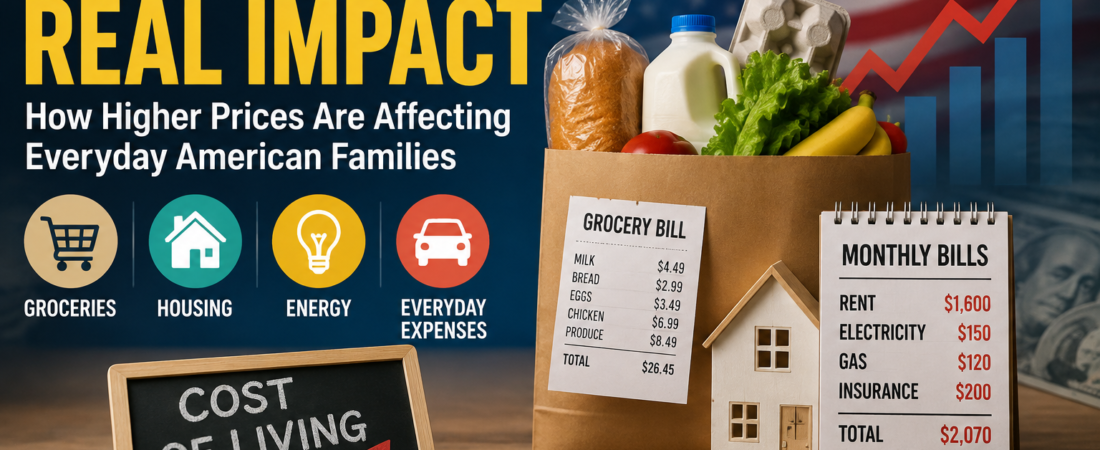
Why Rising Living Costs Matter to American Families

For many American families, the cost of everyday life remains one of the most important financial concerns. Inflation is not simply an economic number reported in the news. It can be felt every time a family buys groceries, fills a gas tank, pays an electricity bill, eats at a restaurant, or considers buying a home.

Recent U.S. government data shows that consumer prices remain higher than they were a year ago. This means many households still need to make careful decisions about where their money goes.

Food Costs Continue to Affect Household Budgets

Food is one of the easiest places to notice changes in the cost of living because families purchase groceries regularly.

According to the U.S. Bureau of Labor Statistics, food prices increased 3.0% over the 12 months ending in June 2026. Food purchased for the home increased 2.7%, while food purchased away from home increased 3.4%.

Even relatively small percentage increases can become noticeable when repeated every week.

For families, this can mean spending more time comparing grocery prices, choosing store brands, buying items on sale, cooking more meals at home, and reducing restaurant visits.

Energy Prices Can Quickly Change a Monthly Budget

Energy costs can have an especially strong impact because transportation and electricity are difficult expenses for many households to avoid.

In June 2026, energy prices were 15.7% higher than a year earlier, according to the Bureau of Labor Statistics. Gasoline prices were up 26.7% over the same period, while electricity prices increased 4.0%.

For people who commute long distances, higher gasoline prices can significantly increase monthly transportation expenses.

Families may respond by combining errands, driving less when possible, comparing gasoline prices, or reconsidering discretionary trips.

Higher electricity costs can also encourage households to pay closer attention to air-conditioning, heating, appliance use, and energy efficiency.

Housing Remains a Major Financial Decision

Housing is usually one of the largest expenses in an American household budget.

For people considering purchasing a home, borrowing costs are also important. Freddie Mac reported that the average 30-year fixed mortgage rate was 6.66% on July 30, 2026.

At rates around this level, monthly mortgage payments can be considerably higher than they would be with a lower interest rate. That can influence how much home a family can afford and whether potential buyers decide to purchase now or wait.

Renters face a different challenge. Housing expenses can consume a large share of monthly income, leaving less money available for savings, transportation, food, health care, and entertainment.

Income Is Growing, but Families Still Have to Prioritize

There are positive signs as well.

The U.S. Bureau of Economic Analysis reported that personal income increased 0.2% in June 2026, while disposable personal income also increased 0.2%. Consumer spending increased 0.3%.

These figures show that Americans continue to earn and spend money, but individual households can experience the economy very differently.

A family whose essential expenses are rising faster than its income may still feel significant financial pressure even when national economic statistics appear relatively stable.

How Families May Adjust Their Everyday Spending

When living costs rise, households often do not eliminate spending completely. Instead, they change priorities.

Some families may cook at home more often. Others may delay purchasing electronics, furniture, or a new vehicle. People may compare insurance policies, cancel subscriptions they rarely use, search for discounts, or postpone vacations.

Small changes across several spending categories can add up over the course of a year.

This is why understanding economic news can be useful even for people who do not closely follow financial markets.

What Consumers Can Do

Families cannot control inflation, mortgage rates, or national energy prices, but they can control some parts of their household finances.

A useful first step is reviewing recurring expenses. Subscriptions, insurance premiums, phone plans, internet services, and other automatic payments can quietly consume a significant amount of money.

Creating a simple monthly budget can also make it easier to see which expenses are essential and which ones can be reduced.

Consumers can also compare prices before large purchases and avoid focusing only on the monthly payment when financing a purchase. Interest rates and the total amount paid over time are equally important.

What This Means for Everyday Life

The most important point is that economic news eventually reaches the household level.

A change in inflation can affect grocery bills. Energy markets can affect gasoline and electricity costs. Interest rates can influence mortgages, car loans, and credit cards. Changes in income can determine how much families are able to save.

Understanding these connections can help people make better everyday decisions.

At TIPVERO, our goal is not simply to report economic numbers. We explain what important developments in the United States mean for ordinary people, families, and their everyday lives.

Sources: U.S. Bureau of Labor Statistics (Consumer Price Index), U.S. Bureau of Economic Analysis (Personal Income and Outlays), and Freddie Mac (Primary Mortgage Market Survey).
Freddie Mac Mortgage Rates