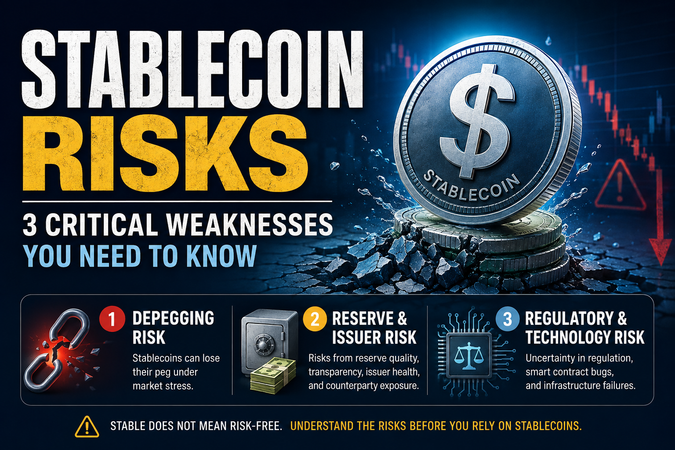
Stablecoin risks are becoming increasingly important as stablecoins move beyond cryptocurrency trading and become more connected to payments, decentralized finance, and the traditional financial system.
At first glance, stablecoins appear simple. A U.S. dollar-denominated stablecoin is generally designed to maintain a value close to $1. This makes it look very different from highly volatile cryptocurrencies such as Bitcoin.
But there is an important misunderstanding hidden inside the word “stable.”
Table of Contents
Stable does not mean guaranteed.
A stablecoin can maintain its intended value only when the financial and technological system supporting it continues to function properly. That system may include reserve assets, banks, custodians, stablecoin issuers, exchanges, blockchain networks, smart contracts, regulators, and the confidence of users.
This issue has become increasingly important as the stablecoin market has expanded. Federal Reserve researchers reported that stablecoin market capitalization increased by about 50% during 2025. The Federal Reserve’s May 2026 Financial Stability Report subsequently placed the market at approximately $320 billion and noted that it remained concentrated among the two largest issuers.
So what could actually go wrong?
This guide explains the three critical stablecoin risks every user should understand:
- Depegging and redemption risk
- Reserve, issuer, and counterparty risk
- Regulatory and technology risk
Understanding these weaknesses is important before treating stablecoins as an alternative to cash or a traditional bank account.
Disclaimer: This article is for educational and informational purposes only. It is not investment, financial, legal, or tax advice.
What Is a Stablecoin?
A stablecoin is a digital asset designed to maintain a relatively stable value compared with a reference asset.
The reference asset is commonly the U.S. dollar.
In simple terms:
1 dollar-denominated stablecoin ≈ $1
That is the target.
However, the mechanisms used to maintain that target vary significantly.
Some stablecoins rely on reserves consisting of cash, bank deposits, Treasury securities, or other financial assets. Other designs may rely on crypto collateral or more complex mechanisms.
This difference matters because the stability of a token depends partly on what supports it and how redemption works.
The Federal Reserve explains that U.S. payment stablecoins covered by the current federal framework are intended to maintain a one-to-one value relative to the dollar and are subject to reserve-related requirements involving relatively safe assets. 연방준비제도
However, even strong reserves cannot eliminate every risk.
1. Depegging Is One of the Biggest Stablecoin Risks
The first major weakness is depegging risk.
What Is a Stablecoin Depeg?
A stablecoin depegs when its market value moves away from the asset it is designed to track.
Imagine a stablecoin designed to maintain:
1 token = $1.00
If it begins trading at $0.99, the deviation may be temporary and relatively small.
But if confidence falls and the token trades at $0.90, $0.80, or lower, the situation becomes far more serious.
This illustrates one of the most important stablecoin risks:
A stablecoin’s peg is a mechanism, not a guarantee.
For the price to remain close to $1, market participants generally need confidence that the token can reliably be converted or redeemed according to its stated terms.
Why Can Stablecoins Lose Their Peg?
Suppose rumors begin circulating that a stablecoin issuer may have financial problems.
Some holders become nervous and begin selling.
The token temporarily falls below $1.
Other users notice the price decline and decide that they also want to leave.
Selling increases.
Redemption requests rise.
Confidence falls further.
This can potentially create dynamics resembling a financial run.
Federal Reserve research published in 2026 found that digital money may face run dynamics even when reserves themselves are safe. The researchers identified interactions between network effects, congestion costs and redemption decisions as potential sources of fragility. 연방준비제도
This is an important lesson.
Safe reserves can reduce risk, but they do not necessarily eliminate every source of instability.
Liquidity Can Become a Problem During Heavy Redemptions
Consider a simplified example.
Suppose a stablecoin issuer has:
$10 billion in stablecoins outstanding
and
$10 billion in reserve assets.
It might appear perfectly backed.
But there is another question:
How quickly can those $10 billion of assets be converted into cash?
If only a small number of users redeem their tokens, the issuer may have little difficulty.
But imagine billions of dollars of redemption requests arriving within a very short period.
The issuer now needs highly liquid assets.
If reserve assets must be sold quickly during market stress, losses or market disruption can potentially occur.
BIS research published in June 2026 highlights this liquidity transformation problem: stablecoin issuers may have demandable liabilities while holding a mixture of cash and less-liquid bonds, creating vulnerability when large redemptions force asset sales. Bank for International Settlements
Key takeaway
Don’t ask only:
“Is this stablecoin backed?”
Also ask:
“What backs it, how liquid are those assets, and what happens when many people redeem simultaneously?”
2. Reserve and Issuer Risk Can Be Hidden
The second major category of stablecoin risks exists behind the digital token itself.
A stablecoin sitting in a crypto wallet may look completely digital.
But many fiat-backed stablecoins rely heavily on traditional financial institutions.
The structure can look something like this:
Stablecoin holder → Stablecoin issuer → Custodian → Bank → Reserve assets
Each component introduces potential dependencies.
Reserve Quality Matters
Not all reserve assets have the same risk characteristics.
Imagine two hypothetical stablecoins.
Stablecoin A
Its reserves consist predominantly of highly liquid, short-duration assets.
Stablecoin B
Its reserves contain complicated or less-liquid financial assets.
Both tokens might trade at $1 during normal market conditions.
But during a severe redemption event, their ability to provide liquidity could be very different.
This is one reason reserve requirements have become a major part of stablecoin regulation.
Federal Reserve Governor Michael Barr noted in March 2026 that the GENIUS Act addresses run risk partly by restricting permissible reserve assets to specified high-quality and highly liquid assets. 연방준비제도
Reserve Transparency Is Important
Stablecoin users should investigate what an issuer actually publishes about its reserves.
Useful questions include:
What assets back the stablecoin?
Where are those assets held?
How frequently are reserve reports published?
Does an independent professional examine the information?
What percentage is held in cash or highly liquid securities?
What are the holder’s actual redemption rights?
These questions are much more informative than simply seeing the phrase:
“Fully backed.”
Attestation and Audit Are Not Necessarily the Same Thing
Crypto users frequently encounter words such as:
Reserve report
Attestation
Audit
They should not automatically be treated as interchangeable.
An attestation may provide assurance about specified information under a defined scope and at a particular time or period.
An audit can involve a broader examination under applicable professional standards.
The important point for consumers is to understand what was actually examined and what conclusion was provided, rather than relying solely on a marketing headline.
Stablecoin Issuer Risk
Another overlooked weakness is the issuer itself.
A stablecoin may have high-quality reserve assets but still depend on an organization to manage those assets, maintain technology, comply with regulations and process redemptions.
This introduces:
Operational risk
Governance risk
Legal risk
Cybersecurity risk
Counterparty risk
Compliance risk
Federal Reserve research in 2026 specifically identified increasingly complex relationships between stablecoin issuers and third-party service providers as a development that could create new financial-stability vulnerabilities. 연방준비제도
Counterparty Risk Can Extend Beyond the Issuer
Suppose your stablecoins are stored on a cryptocurrency exchange.
You are now exposed not only to the stablecoin itself but also to the exchange.
Similarly, if the issuer uses commercial banks or custodians to hold reserve assets, those relationships create additional dependencies.
This produces an important principle:
Stablecoin risk and platform risk are not the same thing.
A stablecoin could remain perfectly pegged while an exchange experiences a problem.
Conversely, an exchange could operate normally while the stablecoin itself loses its peg.
Users should evaluate both.
3. Regulatory and Technology Risks Are Constantly Changing
The third category of stablecoin risks combines financial regulation with blockchain infrastructure.
This area is particularly important in 2026 because the U.S. regulatory environment has changed substantially.
U.S. Stablecoin Regulation Changed After the GENIUS Act
The U.S. regulatory framework for payment stablecoins changed significantly in 2025.
The Federal Reserve reports that the GENIUS Act, signed into law in July 2025, established a federal regulatory framework for payment stablecoins. Among other areas, the framework addresses reserves and redemption, while regulators have continued working on implementing the law’s requirements. 연방준비제도
That means older articles describing the U.S. stablecoin market as simply “unregulated” may now be outdated or incomplete.
At the same time, regulation remains an evolving area.
Federal and state implementation can affect areas including:
- Reserve requirements
- Issuer eligibility
- Redemption rights
- Customer identification
- Anti-money-laundering controls
- Capital and liquidity requirements
- Consumer protections
- Permitted issuer activities
As of August 2026, the BIS also noted substantial differences among jurisdictions regarding which entities may issue stablecoins and what additional activities issuers are permitted to conduct. Bank for International Settlements
This means regulatory risk remains relevant even as regulation becomes more developed.
Blockchain Transactions Introduce Different Risks
Stablecoins operate on blockchain infrastructure.
That creates capabilities traditional payment systems may not provide, but it also creates new risks.
For example, a user might accidentally send stablecoins to an incorrect address.
Depending on the blockchain and circumstances, reversing the transaction could be extremely difficult or impossible.
Users can also face:
Wallet theft
Private-key loss
Phishing
Malicious smart contracts
Network congestion
Blockchain outages
Incorrect network selection
Cross-chain bridge vulnerabilities
The stablecoin itself could remain worth exactly $1 while the user still loses access to the money.
Smart Contract Risk
Stablecoins are widely used in decentralized finance, or DeFi.
A user might deposit stablecoins into:
- Lending protocols
- Decentralized exchanges
- Liquidity pools
- Yield platforms
- Cross-chain bridges
- Other smart-contract applications
Once this happens, the risk profile changes.
Suppose you own 10,000 stablecoins worth approximately $10,000.
You deposit them into a DeFi application promising additional returns.
Even if the stablecoin maintains its $1 peg perfectly, the DeFi protocol could experience a software vulnerability or other failure.
Therefore:
Stablecoin price stability does not guarantee investment-product safety.
This distinction is especially important when high yields are advertised.
Stablecoins Are Not the Same as Bank Deposits
This is one of the most important concepts for beginners.
A wallet showing:
10,000 dollar-denominated stablecoins
may visually feel similar to a banking application showing:
$10,000
But the legal and financial structures are not necessarily the same.
A traditional bank deposit exists within a banking regulatory framework and, where applicable, qualifying deposits may receive deposit-insurance protection subject to the relevant rules and limits.
A stablecoin is a different financial arrangement.
Federal Reserve Governor Barr has emphasized that stablecoins historically have not had deposit insurance or access to central-bank liquidity in the same way insured banking institutions do, making reserve quality and liquidity particularly important. 연방준비제도
Therefore, users should not automatically assume:
1 stablecoin = 1 insured bank dollar
even if the token’s market price is currently exactly $1.
Why Are Stablecoins Popular Despite These Risks?
Stablecoins would not have grown so rapidly if they had no practical advantages.
Their potential uses include:
Crypto trading
Digital payments
Cross-border transfers
DeFi applications
Blockchain settlement
Digital commerce
Moving funds between exchanges
One major attraction is that blockchain networks can operate outside traditional banking hours.
This can make certain transfers faster or more programmable.
BIS officials acknowledge that stablecoins demonstrate some benefits of tokenization, including the potential for faster and programmable payments, while also warning that current designs have structural weaknesses. Bank for International Settlements
So the correct conclusion is not:
“Stablecoins are dangerous.”
Nor is it:
“Stablecoins are completely safe.”
A better question is:
“Does this stablecoin’s benefit justify its particular risks for the way I intend to use it?”
Stablecoin Risks Can Affect Traditional Finance Too
Stablecoins are no longer isolated from traditional financial markets.
Large issuers may hold substantial amounts of short-term government securities and other reserve assets.
This creates connections between crypto markets and traditional money markets.
If a very large stablecoin experienced massive redemption pressure, reserve assets might need to be sold.
BIS research has warned that large-scale redemptions can potentially generate fire-sale dynamics and transmit stress into underlying financial markets. Bank for International Settlements
The Federal Reserve has likewise noted that stablecoin growth could deepen connections between digital assets and traditional finance. 연방준비제도
This means stablecoin risk is increasingly relevant beyond individual crypto traders.
Stablecoins and the U.S. Dollar
Another important development involves the international role of the dollar.
Most stablecoin value is denominated in U.S. dollars.
According to BIS research published in May 2026, approximately 98% of stablecoin value was dollar-denominated. The researchers concluded that wider adoption could reinforce existing currency hierarchies and potentially contribute to digital dollarization in some emerging economies. Bank for International Settlements
This creates both opportunities and policy questions.
For consumers in countries with unstable currencies, dollar-linked digital assets may appear attractive.
But for governments and central banks, widespread foreign-currency stablecoin adoption could affect monetary sovereignty, capital flows and financial stability.
How to Evaluate Stablecoin Risks Before Using One
Before purchasing or transferring a stablecoin, perform some basic research.
1. Identify the Issuer
Find out which organization issues the stablecoin.
Do not rely solely on the token name or logo.
Investigate the issuer’s official disclosures, jurisdiction and regulatory status.
2. Examine the Reserves
Ask what actually backs the token.
Look for information about:
- Cash
- Bank deposits
- Treasury securities
- Other securities
- Crypto assets
- Other reserve holdings
Then consider how liquid those assets are.
3. Understand Redemption
A token trading for approximately $1 on an exchange does not necessarily mean every retail holder can redeem it directly with the issuer for exactly $1.
Read the issuer’s redemption terms.
Check:
Who can redeem?
What is the minimum redemption?
Are fees charged?
How long does redemption take?
Are there geographical restrictions?
4. Evaluate Where You Store It
There is a major difference between:
Self-custody wallet
and
Centralized exchange custody.
With self-custody, you take responsibility for keys and wallet security.
With centralized custody, you depend on another company.
Each model has different risks.
5. Understand the Blockchain
Some stablecoins exist on multiple blockchain networks.
Make sure you understand which network you are using before transferring funds.
Sending tokens using an incompatible network or address can result in serious problems.
6. Be Careful With Stablecoin Yield
A stablecoin may target a $1 value.
That does not mean an investment product promising 8%, 10%, or 15% returns on stablecoins carries the same risk as simply holding the token.
The yield may involve:
- Lending
- Leverage
- Trading
- DeFi protocols
- Exchange activities
- Counterparty exposure
Higher returns generally indicate that additional economic risk is being taken somewhere in the system.
Stablecoin Risk Checklist for Beginners
Before using a stablecoin, ask yourself:
Who issues it?
What backs it?
How liquid are the reserves?
How transparent are reserve disclosures?
Can I redeem directly?
What fees apply?
Where will I store it?
Which blockchain am I using?
Am I interacting with a smart contract or bridge?
Am I earning yield, and where does that yield come from?
What regulations apply where I live?
What happens if the stablecoin loses its peg?
If you cannot answer these questions, more research may be worthwhile before committing significant funds.
The Most Important Stablecoin Misconception
The biggest misunderstanding about stablecoins may be the word stable itself.
Stablecoins are designed to maintain stability.
They are not automatically guaranteed to do so.
Their stability depends on a network of mechanisms:
Reserve quality
Liquidity
Redemption
Issuer governance
Banking relationships
Regulation
Blockchain infrastructure
Market confidence
Weakness in one area can potentially affect the entire arrangement.
This is why the Federal Reserve and BIS increasingly analyze stablecoins not simply as crypto tokens but as financial arrangements with implications for payments and financial stability. 연방준비제도
Global financial risks are often connected. For another example, read our analysis of how the Iran situation can affect global oil prices.
Final Thoughts: Stablecoin Risks Should Not Be Ignored
Understanding Stablecoin Risks is becoming increasingly important as stablecoins become more connected to payments, cryptocurrency markets, and the traditional financial system.
Stablecoins are one of the most important developments in digital finance.
They can make blockchain transactions easier, provide dollar-linked digital value and potentially improve certain payment processes.
But stablecoin risks remain significant.
The three most important weaknesses are:
1. Depegging and redemption risk
A stablecoin can move away from its intended value when confidence falls or redemption pressure becomes severe.
2. Reserve, issuer and counterparty risk
The token’s stability depends on reserve quality, liquidity, transparency, custody arrangements and the organizations supporting it.
3. Regulatory and technology risk
Regulations continue to develop, while wallets, blockchains, exchanges, smart contracts and bridges introduce additional risks.
The key lesson is simple:
Stable is a design goal—not an unconditional promise.
Before using any stablecoin, understand who issues it, what backs it, how redemption works, where your tokens are stored and what additional risks you are accepting.
As stablecoins become more closely connected to global payments and traditional finance, understanding these weaknesses will become increasingly important for everyday users as well as investors.
Frequently Asked Questions About Stablecoin Risks
Are stablecoins completely safe?
No financial asset is completely risk-free. Stablecoins are designed to maintain a stable value, but they can still face depegging, liquidity, issuer, counterparty, regulatory and technology risks.
Can a stablecoin fall below $1?
Yes. A dollar-linked stablecoin can temporarily or, in more severe circumstances, materially deviate from its intended $1 value.
Are stablecoins the same as bank deposits?
No. Stablecoins and bank deposits operate under different legal, technological and regulatory structures. Users should not assume that holding a dollar-linked stablecoin provides the same protections as holding an eligible insured bank deposit.
What should I check before using a stablecoin?
Check the issuer, reserve composition, reserve disclosures, redemption conditions, regulatory status, blockchain network, custody method and any additional platform or smart-contract risks.
What is the biggest stablecoin risk?
There is no single risk applicable to every stablecoin. However, the interaction among redemption pressure, reserve liquidity and confidence is particularly important because deterioration in one area can potentially amplify problems elsewhere.
🔗 External Links to Add in WordPress
For the strongest E-E-A-T signal, use these authoritative sources naturally in the article:
- Federal Reserve — Stablecoins in 2025: Developments and Financial Stability Implications
- Federal Reserve — The Fragility of Perfectly Safe Digital Money
- BIS — Making Stablecoins Stable(r): Can Regulation Help?
- BIS — 2026 Annual Economic Report
These are preferable to filling the article with promotional crypto websites.
🔗 TIPVERO Internal Links
Because I do not want to invent TIPVERO URLs that may not exist, add 2–3 links to real TIPVERO articles once related crypto/finance posts are published.
Use natural anchor text such as:
“Read more about how financial markets affect everyday households.”
“Explore more digital finance guides from TIPVERO.”
“Learn more about inflation, interest rates, and the U.S. economy.”
If you already have a related TIPVERO finance article, use its exact published URL here.