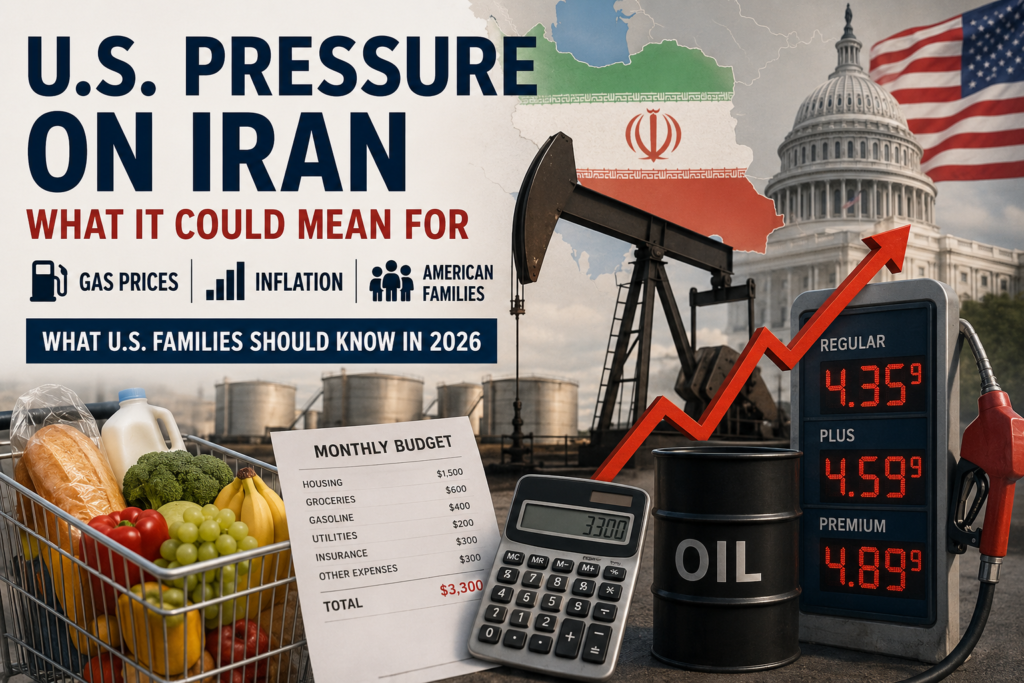
U.S. pressure on Iran is intensifying again in August 2026, and the consequences could reach far beyond Washington and Tehran.
The Trump administration has expanded sanctions targeting Iran’s economic and financial connections while warning countries that continue certain business relationships with Tehran that they could face consequences from the United States.
Iran, meanwhile, has warned that it could retaliate.
For American households, however, the most important question may be much simpler:
Why U.S. Pressure on Iran Could Make Everyday Life More Expensive
The answer is complicated.
Oil prices actually fell after the latest sanctions announcement as traders judged economic pressure to be less threatening to immediate oil supplies than another major military escalation. But tensions around Iran, shipping through the Strait of Hormuz, energy supplies, and possible retaliation mean the risk has not disappeared.
If those risks eventually push energy prices higher, Americans could feel the effects at gas stations, grocery stores, airports, delivery services, and potentially even through the Federal Reserve’s decisions on interest rates.
U.S. pressure on Iran could therefore have consequences far beyond foreign policy.
Here is how the chain could work.
What Changed in the Latest U.S. Pressure on Iran?
The United States announced an expansion of sanctions against Iran in late August as part of a broader attempt to isolate the Iranian economy.
The new measures targeted dozens of Iran-linked individuals, entities, and vessels.
Washington also increased pressure on other countries to reduce financial and commercial connections with Iran.
This matters because sanctions can operate beyond the companies or individuals directly named.
Businesses and financial institutions around the world may reconsider relationships with Iranian counterparties if they believe those relationships could threaten their access to the U.S. financial system.
The objective is to make it increasingly difficult for Iran to obtain revenue and conduct international commerce.
But Iran has indicated that it will not simply accept the pressure.
Iranian officials have warned of retaliation if the country’s interests are threatened.
That creates uncertainty for global markets.
And when Iran is involved, one particular market immediately receives attention:
U.S. pressure on Iran could also influence energy markets if uncertainty continues.
U.S. Pressure on Iran and the Oil Market
Iran matters to energy markets not only because it produces oil.
Its geographic position is also enormously important.
The Strait of Hormuz is one of the world’s most strategically important energy shipping routes. Oil and other energy products from Persian Gulf producers move through this relatively narrow waterway before reaching customers around the world.
That means markets react not only to changes in Iranian oil exports but also to the possibility of disruptions to regional shipping.
A conflict does not have to eliminate global oil production permanently to affect prices.
Even the possibility of delayed shipments, damaged vessels, higher insurance costs, or reduced shipping capacity can influence traders’ expectations.
This is why headlines involving Iran and the Strait of Hormuz frequently move energy markets.
But an important development occurred after the latest U.S. sanctions announcement.
Oil did not surge.
It fell.
Reuters reported on August 25 that oil prices dropped more than 3% to a one-week low as traders largely viewed the latest economic sanctions as posing less immediate danger to oil supplies than further military escalation.
That is important.
It demonstrates why consumers should not assume that every new sanction automatically means gasoline prices will immediately increase.
Oil prices depend on many factors at once.
These include:
- Global supply
- Global demand
- OPEC+ production decisions
- Chinese oil demand
- U.S. production
- Inventories
- Shipping conditions
- Refinery capacity
- Geopolitical risk
- Expectations about future economic growth
A geopolitical event can push prices upward one day while weaker demand expectations push them downward the next.
Why the Strait of Hormuz Matters
The Strait of Hormuz remains one of the biggest risks in this story.
The narrow waterway connects the Persian Gulf with the Gulf of Oman and global shipping routes.
Major energy exporters in the region depend on it.
When shipping through Hormuz becomes less secure, markets can begin pricing in additional risk.
Recent developments demonstrate why traders continue watching the region closely.
An oil tanker was struck near the Strait of Hormuz on August 25 and was reportedly disabled, although the crew was unharmed.
At the same time, diplomatic efforts have continued to reduce tensions.
These competing developments—security incidents on one side and diplomacy on the other—help explain why oil prices can move sharply in both directions.
For American families, the key point is this:
The biggest danger is not necessarily a new sanction itself. It is whether the confrontation eventually disrupts the physical movement of energy.
How Oil Prices Reach American Gas Stations
Crude oil is a major component of gasoline prices.
But the price consumers see at the pump also reflects:
- Refining
- Distribution
- Marketing
- Taxes
- Seasonal fuel requirements
- Regional supply conditions
This means gasoline does not necessarily move dollar-for-dollar with crude oil.
Nevertheless, sustained increases in crude prices generally create upward pressure on gasoline.
Imagine that geopolitical tensions cause global crude prices to remain elevated for several months.
Refiners would be paying more for crude.
Transportation and distribution costs could also rise.
Eventually, much of that additional cost can reach consumers.
For a household that drives frequently, even a relatively small increase per gallon can become noticeable.
Consider a family using 80 gallons of gasoline per month.
A 50-cent increase per gallon would add approximately:
$40 per month
or
$480 per year
to that household’s gasoline spending.
Families with long commutes, multiple vehicles, or larger vehicles could experience a larger impact.
U.S. pressure on Iran could become especially important if tensions begin to disrupt global oil supplies.
Gas Prices Are Only the Beginning
This is where energy prices become an everyday-life story rather than simply a commodities story.
Nearly everything Americans buy must be transported.
Food travels from farms and processing facilities to warehouses and supermarkets.
Consumer products travel through ports, distribution centers, and delivery networks.
Construction materials are transported by truck.
Online purchases arrive at homes using delivery vehicles.
Businesses may use energy directly in manufacturing, refrigeration, heating, and production.
Therefore, higher energy costs can spread through the economy.
The chain can look something like this:
Oil prices rise → transportation costs rise → business costs rise → some consumer prices rise
Not every company immediately passes every additional dollar to customers.
Some businesses absorb higher costs through lower profit margins.
Others increase prices.
The result depends on competition, demand, contracts, and the length of the energy-price increase.
But if energy remains expensive for a prolonged period, businesses face increasing pressure to adjust.
How Higher Energy Costs Could Affect Grocery Prices
Food is particularly sensitive to transportation and energy costs.
Consider the journey of a simple grocery product.
Ingredients may be produced in one state.
They may then travel to a processing facility.
The finished product moves to a distribution center.
Then it is transported again to a supermarket.
Refrigerated products require additional energy throughout parts of that process.
Agriculture itself also depends on fuel, machinery, fertilizers, transportation, and other energy-related inputs.
As a result, prolonged increases in energy costs can contribute to higher food production and distribution expenses.
Consumers may eventually see some of those costs reflected in:
- Meat
- Dairy products
- Produce
- Packaged foods
- Restaurant prices
- Food delivery fees
Again, the relationship is not instantaneous.
A one-day jump in oil prices does not automatically raise supermarket prices tomorrow morning.
The bigger concern is a sustained increase.
For American consumers, U.S. pressure on Iran matters most when it begins affecting global energy markets.
Air Travel Could Become More Expensive
Airlines are another industry heavily exposed to fuel costs.
Jet fuel is a major operating expense.
When fuel costs rise significantly, airlines may attempt to compensate through ticket prices, fees, route adjustments, or other measures.
The actual effect depends on demand and competition.
But families planning vacations, students traveling between college and home, and business travelers can all be affected when aviation fuel becomes more expensive.
This is another reason geopolitical developments thousands of miles away can eventually influence an American household budget.
Delivery and Online Shopping Costs
Americans increasingly rely on delivery networks.
Packages move through enormous logistics systems involving:
- Trucks
- Vans
- Aircraft
- Warehouses
- Distribution centers
Energy prices influence many of those operations.
Large logistics companies may use fuel surcharges or other pricing mechanisms when transportation costs change significantly.
Retailers then decide whether to absorb those costs or pass some of them to customers.
That means an extended oil shock could eventually influence the cost of online shopping and delivery even for consumers who rarely drive.
Could Iran Tensions Affect Inflation?
Potentially—but the duration and magnitude of the energy shock matter enormously.
Inflation measures the rate at which prices across the economy increase.
Energy is an important part of household spending, but its influence extends beyond gasoline and electricity because businesses also consume energy.
If energy prices rise temporarily and then fall, the broader inflation effect may be limited.
If they remain elevated, however, businesses may face higher production and transportation expenses for longer.
That can make inflation more persistent.
This is why economists and central banks pay close attention to energy markets.
Energy shocks can create a difficult situation:
Consumers have less disposable income because gasoline and utilities cost more, while businesses face higher expenses at the same time.
For American households, U.S. pressure on Iran matters because higher energy costs can eventually spread through the broader economy.
What Could This Mean for the Federal Reserve?
The Federal Reserve does not set oil prices.
It also cannot produce more crude oil or reopen a shipping route.
But the Fed is responsible for monetary policy and closely monitors inflation.
If an energy shock causes a temporary jump in prices, policymakers may decide that the effect will fade.
If higher energy costs begin spreading broadly through wages, services, transportation, and consumer expectations, the situation becomes more complicated.
Persistent inflation can make it harder for the Federal Reserve to lower interest rates.
That matters because interest rates affect:
- Mortgages
- Auto loans
- Credit cards
- Business borrowing
- Some student loans
- Savings yields
So the possible chain becomes longer:
Iran tensions → oil risk → higher energy prices → inflation pressure → Fed caution → borrowing costs stay higher
This outcome is not guaranteed.
But it explains why geopolitical energy events matter even to Americans who never follow international politics.
Why Oil Prices Fell After the Latest Sanctions
This deserves emphasis because it prevents a misleading conclusion.
Despite stronger U.S. pressure on Iran, oil prices fell sharply on August 25.
Why?
Markets appear to have interpreted the latest approach as emphasizing economic pressure rather than an immediate expansion of military action.
Reuters reported that traders viewed the sanctions as presenting less immediate danger to oil supplies than military escalation.
Brent crude and U.S. benchmark crude both moved lower.
AP similarly reported falling oil prices as markets assessed the new U.S. pressure campaign.
This tells us something important about financial markets:
Prices react to what investors expected before the news as well as what actually happened.
If traders feared a much more disruptive action and instead received economic sanctions, oil can fall even though the political situation remains tense.
Why Oil Could Still Rise Again
The short-term decline does not eliminate longer-term risks.
Several developments could change the market quickly.
1. Shipping disruption
A significant interruption in the Strait of Hormuz could restrict energy flows.
2. Iranian retaliation
Iran has warned that it may respond to economic pressure.
The form and scale of any response would matter enormously.
3. Tougher enforcement
Sanctions could eventually reduce Iranian oil exports more effectively than markets currently expect.
4. Regional escalation
Additional military conflict involving Iran or neighboring countries could increase the geopolitical risk premium.
5. Stronger global demand
If demand strengthens while supply remains constrained, oil prices could rise independently of sanctions.
Consumers should therefore distinguish between today’s oil price and the broader risk environment.
What American Families Should Watch
Most households do not need to follow every diplomatic announcement.
A few indicators can provide a much clearer picture.
Gasoline prices
This is the most visible measure for consumers.
If national gasoline prices begin rising steadily for several weeks, households that drive frequently will feel the effect quickly.
Brent crude oil
Brent is an important global benchmark.
A sustained move matters more than a single day’s price change.
Strait of Hormuz shipping
Major disruptions would be particularly important because the route is central to global energy transportation.
Inflation reports
Consumers can watch whether energy increases begin appearing more broadly in inflation data.
Federal Reserve communication
If policymakers begin emphasizing energy-driven inflation risks, the issue could affect expectations for interest rates.
What Families Can Do If Energy Costs Rise
Consumers cannot control geopolitics, but they can prepare for volatility.
One useful approach is to avoid redesigning a household budget around one day’s oil-market move.
Instead, monitor trends.
If gasoline prices remain elevated, households can estimate the additional monthly cost based on their actual driving.
For example:
Monthly gallons used × price increase = additional monthly fuel expense
Families can also examine discretionary driving, combine errands, compare fuel prices, and reconsider optional trips when necessary.
For households planning air travel, comparing dates and booking strategies may become more valuable during periods of energy volatility.
Most importantly, avoid assuming that every dramatic headline will permanently change household costs.
Energy markets can reverse quickly.
Another concern surrounding U.S. pressure on Iran is the potential impact on shipping and oil supplies.
What This Means for South Korea
The effects are not limited to the United States.
South Korea imports much of the energy it consumes, making global oil prices particularly important to its economy.
Higher crude prices can increase import costs.
That can affect:
- Gasoline and diesel
- Transportation
- Manufacturing
- Petrochemicals
- Airlines
- Shipping
- Consumer prices
Currency movements can amplify or reduce the effect.
Because international oil is generally priced in U.S. dollars, a weaker Korean won can make imported energy more expensive in local currency terms even when the dollar price of oil does not change dramatically.
This is why developments involving Iran and the Strait of Hormuz matter simultaneously to American and Korean consumers.
The Bigger Economic Picture
The latest U.S. pressure on Iran illustrates how international politics can move through the economy.
A sanction announced in Washington can influence decisions by banks and businesses in Asia, Europe, and the Middle East.
Iran’s response can influence shipping expectations.
Shipping risks can influence oil prices.
Oil can influence gasoline and transportation.
Transportation affects businesses.
Business costs can affect consumer prices.
Inflation can influence the Federal Reserve.
And Federal Reserve decisions influence household borrowing costs.
The complete chain is:
U.S.–Iran policy → energy markets → business costs → consumer inflation → interest rates → household finances
Not every link moves at the same time.
Some may not move at all.
But understanding the chain makes international news much more relevant to everyday life.
H2: U.S. Pressure on Iran — What Should Consumers Expect Next?
For now, Americans should avoid assuming that the latest sanctions will automatically produce another surge in gasoline prices.
The immediate market reaction has actually gone in the opposite direction.
Oil fell after the sanctions announcement.
But uncertainty remains.
Iran has threatened retaliation, shipping conditions around the Strait of Hormuz remain important, and the broader confrontation has not been resolved.
That means there are two reasonable scenarios.
Scenario One: Tensions Ease
Diplomatic progress continues.
Shipping remains relatively stable.
Oil supplies remain available.
Under this scenario, energy prices could stabilize or decline, reducing pressure on U.S. gasoline prices and inflation.
Scenario Two: Tensions Escalate
Shipping becomes more difficult.
Iran retaliates.
Regional conflict expands.
Oil supply expectations deteriorate.
Under this scenario, crude prices could rise again, potentially feeding into gasoline, transportation, and inflation.
Consumers should therefore watch the direction of events rather than treating one day’s price movement as the final answer.
Final Thoughts
U.S. pressure on Iran has entered another important phase in August 2026.
Washington is expanding economic sanctions and warning other countries about maintaining financial relationships with Tehran.
Iran is promising resistance and possible retaliation.
Yet the immediate oil-market reaction demonstrates why this story requires nuance.
Oil prices fell after the latest measures because traders saw economic sanctions as less immediately threatening to supply than another major military escalation.
That is good news for American consumers in the short term.
But the larger risks remain.
The Strait of Hormuz, Iranian retaliation, regional security, global oil demand, and the effectiveness of sanctions could all change the outlook.
For ordinary Americans, the story ultimately comes down to a simple chain:
Oil → gasoline → transportation → prices → inflation → interest rates.
Following that chain can help families understand why a geopolitical confrontation thousands of miles away may eventually affect what they pay at the gas station, supermarket, airport, and even on borrowed money.
The key is not to panic over individual headlines.
It is to understand what would have to happen for those headlines to reach the household budget.
According to Reuters, the latest U.S. sanctions are part of a broader effort to increase economic pressure on Iran.
For another look at rising household costs, read our guide to the true cost of U.S. higher education in 2026.
The economic impact of U.S. pressure on Iran will ultimately depend on how long the current tensions continue.
For that reason, U.S. pressure on Iran remains an important economic issue for American families to watch.
Sources
Reuters — August 25, 2026
Iran vows to retaliate after the United States widens sanctions.
Reuters — August 25, 2026
Oil falls as investors assess the impact of expanded U.S. sanctions against Iran.
Reuters — August 24, 2026
United States broadens sanctions pressure while warning countries about financial ties with Iran.
Associated Press — August 24–25, 2026
Coverage of the new U.S. sanctions campaign, Iran’s response, global markets, and oil prices.
Yonhap News Agency — August 25, 2026
Coverage of the expanded U.S. economic sanctions campaign against Iran.