Updated: November 19, 2026 | California Food Assistance Guide
CalFresh Food Loss After a Power Outage can create an immediate financial emergency for California households already struggling to afford groceries. When electricity stops working, refrigerated food may become unsafe, frozen groceries may thaw, and a family’s limited monthly food budget can disappear within hours.
For someone living on a fixed income, the consequences can be particularly serious. Losing a refrigerator full of groceries may mean having to choose between purchasing replacement food and paying for transportation, medication, utilities, or another necessary household expense.
Fortunately, California allows eligible CalFresh households to request replacement benefits when qualifying food purchased with CalFresh is destroyed because of a household misfortune or disaster.
A prolonged power outage may qualify.
However, replacement benefits are not automatically guaranteed in every situation. Households generally must report the loss promptly, provide a signed statement, and follow the applicable county procedures.
This guide explains five practical steps to protect your food, document your loss, request replacement benefits, and respond if your claim is delayed or denied.
It also explains the difference between individual food replacement and disaster-related assistance, the importance of food safety, and special considerations for seniors living alone.
Table of Contents
Understanding CalFresh Food Loss After a Power Outage
CalFresh is California’s version of the federal Supplemental Nutrition Assistance Program, commonly called SNAP.
Eligible households receive monthly food benefits through an Electronic Benefits Transfer (EBT) card. These benefits can be used to purchase eligible groceries at participating stores.
When a household experiences an unexpected emergency that destroys food purchased with these benefits, a replacement may be available.
The federal regulation governing replacement issuances is 7 CFR § 274.6. It allows replacement of food purchased with SNAP benefits when that food is destroyed in a qualifying household misfortune.
California implements this process through its county welfare departments and the Replacement or Disaster Supplement Affidavit, known as Form CF 303.
What Counts as a Household Misfortune?
A household misfortune is an event that causes food loss and may qualify under the replacement rules.
Examples that may qualify include:
- An extended power outage that causes refrigerated food to spoil.
- A refrigerator or freezer malfunction resulting in food destruction.
- A residential fire that destroys stored groceries.
- A flood that contaminates or destroys food.
- Certain other unexpected household emergencies.
The specific facts matter. Not every spoiled item or routine storage problem automatically qualifies.
For example, California has previously clarified that a refrigerator failure requiring a replacement part can qualify as a household misfortune, while some ordinary preventable food-storage problems may not.
County officials evaluate the circumstances under the applicable rules.
Who Can Request Replacement Benefits?
The most direct situation involves a household that already receives CalFresh and loses food purchased with those benefits.
The household must be able to describe the event, identify when the loss occurred, and provide the required signed statement.
Replacement benefits are different from a new CalFresh application. They are intended to restore eligible benefits associated with food that was destroyed.
A person who does not currently receive CalFresh generally cannot use the ordinary replacement process to recover food purchased before receiving CalFresh. However, that person may qualify for regular CalFresh or special disaster assistance if the applicable requirements are met.
Understanding this distinction prevents confusion during an already stressful emergency.
Step 1: Protect Your Food and Check for Spoilage

The first priority after a power outage is food safety.
A household should never keep potentially unsafe food solely because replacing it would be expensive.
Foodborne illness can create additional expenses, missed work, hospitalization, and serious health risks, especially for older adults and people with existing medical vulnerabilities.
How Long Can Food Stay Safe Without Electricity?
According to federal food safety guidance, a refrigerator generally keeps food safe for approximately four hours during a power outage if its door remains closed.
A full freezer may maintain safe temperatures for approximately 48 hours. A half-full freezer generally maintains safe temperatures for about 24 hours, provided the door remains closed.
These are approximate guidelines, not guarantees that every food item remains safe for those exact periods.
Actual safety depends on temperatures, appliance conditions, how frequently doors were opened, and the condition of individual foods.
Table 1: Food Safety After a Power Outage
| Food Storage Situation | General Safety Guideline | Recommended Action |
|---|---|---|
| Refrigerator, unopened | Approximately 4 hours | Keep the door closed and check food temperatures |
| Full freezer, unopened | Approximately 48 hours | Check temperature and ice crystals before deciding |
| Half-full freezer, unopened | Approximately 24 hours | Evaluate thawed foods carefully |
| Perishable food above 40°F for over 2 hours | Potentially unsafe | Discard affected food |
| Thawed frozen food containing ice crystals | May remain safe | Evaluate whether it can be cooked or refrozen |
| Uncertain temperature history | Cannot reliably confirm safety | Follow official food-specific safety guidance |
Source: FDA and FoodSafety.gov emergency food safety recommendations.
The safest approach is to use a refrigerator or freezer thermometer whenever possible.
A person should not rely on smell, appearance, or taste to determine whether potentially dangerous bacteria have developed.
Which Foods Need Special Attention?
Foods that require refrigeration deserve careful evaluation.
Examples include milk, eggs, poultry, fish, raw meat, cooked leftovers, soft cheeses, and prepared meals.
Some foods are particularly vulnerable when their temperature rises above safe limits.
Other items, such as unopened shelf-stable canned foods and many dry goods, may remain usable when properly stored and uncontaminated.
A power outage does not automatically make every item in the kitchen unsafe.
The distinction matters because the replacement request should reflect food actually lost rather than the entire value of every grocery in the home.
What Should You Do While the Power Is Out?
Keep refrigerator and freezer doors closed as much as possible.
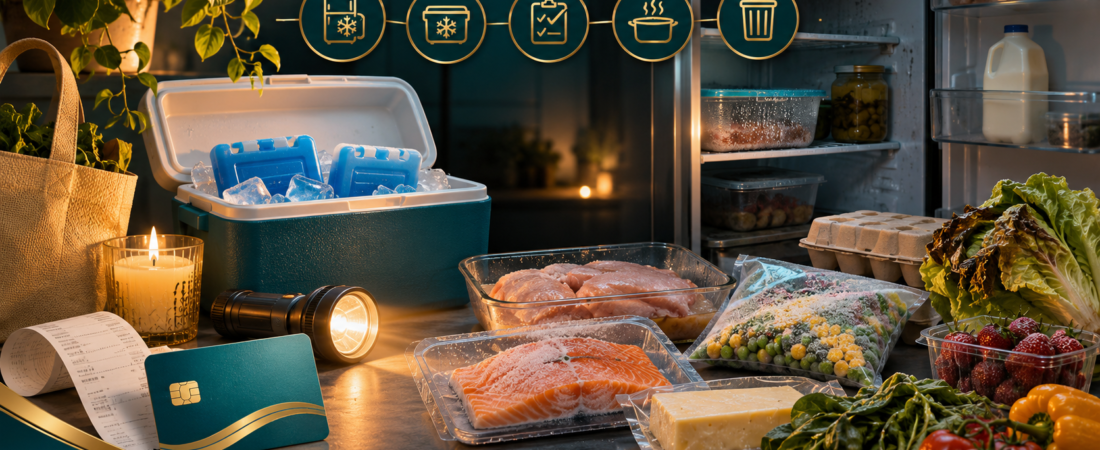
If the outage is expected to last longer, move appropriate food into a cooler with sufficient ice or frozen gel packs while maintaining safe temperatures.
Record the time the electricity stopped and, when possible, the time service returned.
If the utility company provides an outage notification, save it.
Once electricity is restored, check temperatures and inspect food using official safety guidance.
For detailed instructions, consult the FDA’s Food and Water Safety During Power Outages and Floods.
Practical Insight: Do not taste questionable food to decide whether it is safe. If food must be discarded, take photographs or make a short inventory first, provided doing so will not delay necessary cleanup or create a health hazard.
Step 2: Document Food Loss and Calculate Your Loss

After addressing food safety, the next priority is creating an accurate record.
A household does not need an elaborate accounting system. A simple written list, a few photographs, and a clear explanation of the outage can help organize the request.
The goal is to describe what happened truthfully and consistently.
Record the Power Outage
Write down the date and approximate starting time of the outage.
If possible, record when electricity returned.
Also identify the event that caused the outage, if known.
For example, the electricity may have stopped during a storm, wildfire-related emergency, equipment failure, or other utility disruption.
Do not guess about the cause when it has not been confirmed.
If available, preserve utility messages, outage maps, text alerts, or notices from a landlord or building manager.
These records may help establish the timing and circumstances of the loss.
Create a Food Loss Inventory
List foods that became unsafe or were destroyed.
Include quantities and reasonable estimated values.
For example:
| Food Item | Quantity Lost | Estimated Value |
|---|---|---|
| Chicken | 2 packages | $18 |
| Milk | 2 cartons | $10 |
| Eggs | 1 carton | $6 |
| Frozen vegetables | 4 bags | $16 |
| Fish | 2 packages | $24 |
| Prepared leftovers | Several containers | $15 |
| Cheese and refrigerated items | Assorted | $21 |
| Total Estimated Loss | $110 |
This is an illustrative example, not a guaranteed replacement amount or an official benefit calculation.
A household may use receipts when available, but the absence of every original grocery receipt should not prevent it from reporting a genuine loss.
The important information includes what was lost, why it was lost, and the approximate value.
Because the request concerns food purchased with CalFresh benefits, the household should make a reasonable effort to identify the portion attributable to those benefits.
How to Estimate Food Values Without Receipts
Many households do not save every grocery receipt.
This is especially common when groceries are purchased over several weeks or when cash and CalFresh benefits are used during different shopping trips.
If receipts are missing, estimate values conservatively using remembered purchase prices or comparable current store prices.
Do not inflate the amount to compensate for unrelated financial hardship.
Suppose a household purchased two packages of chicken for approximately $9 each, three frozen meals costing around $5 each, and several dairy products worth a combined $18.
A reasonable estimate would be based on those actual quantities and approximate prices.
The purpose is to reconstruct the loss, not create a new grocery budget.
Should You Take Pictures?
Photographs can be useful supporting records.
They may show a refrigerator containing spoiled food, thawed freezer products, damaged packaging, or the general effects of a prolonged outage.
However, photographs do not replace the signed affidavit required by the program.
Nor should anyone leave spoiled food sitting in the home merely to obtain better pictures.
Write down the facts promptly, clean the affected area safely, and preserve any existing documentation.
Practical Insight: Create a short note on your phone labeled “Power Outage Food Loss.” Record the date, outage times, food list, estimated values, and county contact details. This one record can reduce confusion during follow-up calls.
Step 3: Report Your Food Loss to Your County
Reporting CalFresh Food Loss After a Power Outage promptly is one of the most important parts of the process.
For ordinary individual replacement requests, federal rules generally require reporting the loss within 10 days after the food was destroyed.
Some disasters receive approved reporting extensions, but households should never assume an extension applies without confirming the specific announcement.
Why the 10-Day Reporting Deadline Matters
The first deadline concerns notifying the county that food was destroyed.
This report may be made orally or in writing under federal replacement rules.
The county then needs the signed statement required to process the replacement.
A household that delays reporting risks losing eligibility for replacement benefits even when the underlying food loss was genuine.
Consider a hypothetical situation.
A power outage destroys groceries on November 5. The household should act promptly rather than waiting until the next regular CalFresh deposit.
Reporting as soon as the loss is discovered creates a clearer record and provides time to complete the remaining paperwork.
This example does not change the official deadline or account for a disaster-specific extension.
How to Contact Your County
California’s Department of Social Services directs affected CalFresh recipients to their local county welfare office.
Households can reach the CalFresh information line at 1-877-847-3663 (FOOD) for assistance connecting with local services.
County offices may provide instructions for submitting replacement requests through accepted channels.
The available submission methods can vary by county.
Some households may receive instructions to submit documents online, by mail, by fax, or in person.
Ask the county which method is accepted for your case and how to confirm receipt.
What Should You Say When Reporting?
Keep the explanation straightforward.
For example:
“My household receives CalFresh benefits. We experienced a power outage on November 5, and food purchased with CalFresh benefits spoiled. I would like to report the food loss and request replacement benefits. Please tell me how to submit Form CF 303.”
This statement identifies the program, the event, and the requested action.
You can then provide additional details when the county asks for them.
Questions to Ask the County
Before ending the conversation, confirm the following:
- Was my food loss report recorded?
- What date was my report received?
- Where should I submit Form CF 303?
- Is additional documentation needed?
- Does a disaster-related extension apply to my area?
- How can I confirm that my signed form was received?
Write down the date of the conversation and any reference number provided.
If the county gives instructions by telephone, repeat the important details to verify that you understood them correctly.
Practical Insight: Reporting the loss and submitting the affidavit are related but separate responsibilities. Do not assume that calling the county automatically completes the entire replacement process.
Step 4: Complete and Submit Form CF 303

California uses Form CF 303, Replacement or Disaster Supplement Affidavit, for eligible replacement and disaster supplement requests.
This official form allows the household to describe the qualifying event and attest that the information is accurate.
The California Department of Social Services makes the form available online.
Download the official California CF 303 form.
What Information Does Form CF 303 Require?
The form contains sections for identifying the household and describing the reason replacement benefits are requested.
Relevant information includes the household’s name, contact information, the applicable type of loss, and an explanation of what happened.
For a power-outage food loss request, select the section concerning food destroyed in a household misfortune or disaster.
Describe the event and the timing.
For example:
“An extended electricity outage affected our home on November 5. Food stored in our refrigerator and freezer became unsafe because refrigeration was interrupted. We discarded the spoiled food and are requesting replacement CalFresh benefits.”
Only use dates and details that accurately describe your situation.
The household member or appropriate representative must sign and date the form.
The Second Important Deadline
The federal rule generally requires the signed household statement or affidavit to be received within 10 days after the loss was reported.
California’s CF 303 also warns that the form must be submitted within 10 days of the reported food loss or the household may not qualify for replacement benefits.
This is distinct from the initial deadline for reporting the loss.
In other words, making the first telephone call on time is not enough if the required signed statement is not submitted within the applicable period.
For that reason, submitting the form as soon as possible is preferable to waiting until the final day.
How to Avoid Form Errors
Make sure the household identification information matches the CalFresh case.
Describe the outage clearly enough that the county can understand the event.
Check that the appropriate replacement category is selected.
Read the declaration before signing.
Do not sign a statement containing information you know is inaccurate.
Finally, keep a copy of the completed form.
If you submit the document electronically, save the submission confirmation when available.
If you mail it, preserve any mailing receipt or tracking information you have.
If you deliver it in person, ask whether the office can provide a dated receipt.
What If You Cannot Complete the Form Alone?
A person may need help because of limited mobility, vision difficulties, language barriers, or unfamiliarity with paperwork.
California’s form allows a responsible household member or representative to sign as appropriate.
Ask the county what assistance or accommodations are available and whether someone may help prepare the statement.
The important goal is to submit a truthful, complete document through an accepted method.
Practical Insight: The strongest application is not necessarily the longest one. A short, accurate event description, a properly completed form, and timely submission are more useful than an emotional explanation that leaves out essential facts.
Step 5: Follow Up on Your Replacement Benefits
Submitting the paperwork is a major step, but households should also monitor the outcome.
County staff may review the reported loss, determine whether it qualifies, and calculate the appropriate replacement amount.
The household may be contacted for clarification.
How Long Does Replacement Take?
Federal regulations generally require the state agency to provide eligible replacement benefits within 10 days after the report of loss, or within two working days after receiving the signed household statement, whichever is later.
Actual processing can depend on when the required statement is received and whether the county needs to establish the facts of the loss.
If you have not received a response, contact the county rather than assuming the claim has been denied.
Ask whether the request is complete, whether additional information is needed, and whether benefits have been authorized.
How Are Approved Benefits Delivered?
Approved CalFresh replacement benefits are generally issued through the household’s EBT account.
The household can check its benefit balance and transaction history through authorized EBT account services.
Do not assume that the appearance of a new deposit means every dollar of the reported loss has been approved.
Review any county explanation of the amount awarded.
If the amount differs from your estimate, ask how it was calculated.
What If the Request Is Denied?
A denial does not necessarily mean that every aspect of the household’s account was misunderstood.
The county may determine that the loss was not qualifying, that applicable deadlines were missed, or that required information was incomplete.
Request an explanation of the decision.
Review the notice carefully and compare its stated reason with your records.
If you believe the county made an error, you may have the right to request a state hearing.
California’s CF 303 includes hearing rights information, and the state’s hearing process generally allows a request within 90 days after the relevant notice, subject to applicable rules.
Do not ignore the deadline listed in an official notice.
Practical Insight: Keep a simple claim log containing the initial report date, affidavit submission date, county contacts, benefit deposits, and written decisions. This is particularly helpful if the case requires several conversations.
How Much CalFresh Food Replacement Can You Receive?
One of the most common misunderstandings involves the amount of replacement assistance.
The federal replacement rule generally limits an individual household misfortune replacement to the value of food actually lost, up to one month’s applicable allotment, subject to specific regulatory exceptions.
That means the county does not automatically provide an additional full month’s benefits to every household that reports a power outage.
Example 1: Loss Below the Monthly Allotment
Suppose a household’s applicable monthly CalFresh allotment is $220 and it reports $95 in qualifying food loss.
If the entire $95 loss is verified or otherwise accepted under the applicable procedures, the potential replacement would generally be $95, not $220.
The replacement reflects the qualifying food loss.
Example 2: Loss Above the Monthly Allotment
Suppose another household has an applicable monthly allotment of $180 but loses $260 in qualifying groceries purchased with benefits.
The ordinary replacement cap would generally limit the replacement to $180, even though the household’s estimated loss is higher.
Specific regulatory exceptions and disaster-related rules may change the outcome in certain circumstances.
Why the Calculation Matters
Many households purchase food using a combination of CalFresh benefits and personal funds.
For example, a person might use CalFresh for eligible groceries while paying cash for other household needs.
When reporting a food loss, distinguish the eligible food purchased with CalFresh from unrelated expenses.
Replacement benefits do not ordinarily reimburse the cost of electricity, appliance repairs, hotel stays, or other emergency expenditures.
They address qualifying food losses under the SNAP replacement rules.
This distinction helps the household maintain realistic expectations.
CalFresh Replacement Benefits vs. Disaster CalFresh
Individual food replacement and Disaster CalFresh are related to emergencies, but they are not the same program.
Understanding the difference is especially important during major California wildfires, floods, earthquakes, and widespread power outages.
Table 2: Comparing CalFresh Emergency Assistance Programs
| Feature | Individual Food Replacement | Disaster CalFresh |
|---|---|---|
| Main purpose | Replace qualifying food purchased with existing benefits | Provide temporary food assistance after an approved disaster |
| Typical applicant | Existing CalFresh household | Disaster-affected household meeting D-CalFresh criteria |
| Trigger | Qualifying household misfortune or disaster | Authorized disaster assistance operation |
| Basic documentation | Timely report and signed loss statement | Documentation and eligibility requirements for the disaster operation |
| Benefit calculation | Qualifying loss subject to replacement limits | Disaster program rules |
| Availability | Ordinary replacement rules | Only when an applicable disaster program is authorized |
What Is Disaster CalFresh?
Disaster CalFresh, also known as D-CalFresh or D-SNAP, provides temporary food assistance to households affected by qualifying disasters.
It operates under disaster-specific authorization and eligibility requirements.
A person who does not ordinarily receive CalFresh may sometimes qualify for D-CalFresh during an authorized disaster operation.
However, a declared emergency does not automatically mean D-CalFresh is operating in every affected community.
The program must be authorized for the applicable disaster and area.
What Is an Automated Mass Replacement?
In some widespread disasters, California may receive approval to issue replacement benefits automatically to certain affected CalFresh households.
This is different from an individual household submitting Form CF 303.
Automated replacements may be based on approved geographic or benefit criteria.
A household should confirm whether an automatic replacement applies and whether a separate individual request is necessary for additional qualifying loss.
Can Reporting Deadlines Be Extended?
Yes, certain disasters may receive an approved timely reporting waiver.
California explains that such waivers can extend the normal 10-day reporting period, often to a deadline established for a particular disaster.
The extended period is not universal.
A household must check the announcement applying to its county, ZIP code, and disaster event.
See the California Department of Social Services CalFresh Disaster Response page for current disaster-related program information.
Special Considerations for Seniors Living Alone
For older Californians living independently, food loss can create difficulties beyond the price of replacement groceries.
A person who depends on a fixed monthly income may have little room for unexpected expenses.
Transportation limitations can make shopping difficult, while mobility challenges can complicate removing spoiled food or visiting a county office.
These circumstances make advance planning especially valuable.
Fixed Income and Limited Grocery Flexibility
Consider a hypothetical 68-year-old California resident who lives alone and receives a modest monthly CalFresh benefit.
The resident shops carefully, using discounts and preparing meals at home to make groceries last.
After a prolonged power outage, meat, milk, vegetables, and prepared meals become unsafe.
Replacing those items with personal funds may disrupt an already limited budget.
The resident may need transportation to the store and assistance disposing of spoiled groceries.
Even a relatively small loss can affect several weeks of meal planning.
This example illustrates the financial vulnerability of a fixed-income household. It is not presented as a real person’s experience or an official benefit determination.
Medication and Medical Nutrition Needs
Some older adults depend on refrigerated medical supplies, temperature-sensitive medications, or particular foods required by a medical condition.
A food replacement claim does not cover every medical or medication-related loss.
During a power outage, separate medical storage instructions may be necessary.
For medicines affected by temperature changes, follow the product’s storage guidance and obtain timely advice about safe use or replacement.
Do not assume that a medical item is safe because the refrigerator becomes cold again.
Transportation and Accessibility
A senior who does not drive may find it difficult to reach a county office or grocery store following an emergency.
The household can ask the county which remote submission methods are available.
It may also request assistance with communication, language access, or disability-related accommodations.
When a trusted person helps with forms or communications, keep personal account information secure and confirm any authorization requirements.
Protecting Independence
An effective emergency plan should reduce the number of decisions that must be made under pressure.
Keep essential telephone numbers, emergency contacts, and program information in one accessible location.
Maintain a basic shelf-stable food supply when financially possible.
Choose foods that are easy to prepare and suitable for your dietary needs.
For readers seeking broader benefit guidance, TIPVERO’s article CalFresh for Seniors in California: 7 Essential Tips explains general CalFresh topics for older residents.
Common Mistakes That Can Delay Replacement Benefits
Households facing an unexpected outage are often dealing with several problems simultaneously.
The following mistakes can create avoidable complications.
Mistake 1: Waiting Too Long to Report the Loss
The ordinary 10-day reporting rule is important.
A household should not wait for the next benefit deposit or for every supporting document to become available before making its initial report.
Mistake 2: Forgetting the Signed Affidavit
The initial report and the signed CF 303 are not interchangeable.
A household may report promptly but still fail to complete the required statement.
Keep track of both deadlines.
Mistake 3: Reporting the Entire Grocery Budget
A monthly food budget is not the same as the value of food actually destroyed.
Estimate the qualifying loss rather than simply requesting the maximum possible benefit.
Mistake 4: Discarding Every Record
Photographs, outage alerts, receipts, and food inventories can help explain what happened.
Although the specific evidence needed may differ, a household benefits from maintaining a clear account of the event.
Mistake 5: Assuming Every Power Outage Qualifies
A brief interruption that leaves food safe does not necessarily create an eligible food loss.
Replacement requires qualifying destruction of food under the applicable rules.
Mistake 6: Confusing Food Replacement With Stolen EBT Benefits
Spoiled food after a power outage and unauthorized EBT transactions involve different circumstances.
California’s CF 303 includes different sections for different types of replacement requests.
Select the category that accurately matches the problem.
Mistake 7: Ignoring County Requests
If the county asks for additional necessary information, respond promptly and keep a record of the response.
For general document-submission problems, TIPVERO’s CalFresh Missing Verification guide provides additional information on organizing and responding to county verification requests.
Practical Insight: A Realistic Household Recovery Plan
A useful food-loss guide should help people act under real financial pressure, not simply repeat benefit rules.
The most practical approach is to divide recovery into immediate safety needs, administrative requirements, and longer-term household stability.
The First 24 Hours
The first day should focus on health and preserving essential information.
Keep refrigerator and freezer doors closed during the outage.
Once it becomes necessary to assess food, use safe temperature guidance rather than appearance or smell.
Make an initial list of groceries that were destroyed.
Save the utility company’s outage notice if available.
If qualifying food loss has occurred, contact the county promptly instead of postponing the report.
If food is urgently needed, ask about local emergency food distribution resources while the replacement request is pending.
The Next Several Days
Complete the CF 303 and submit it through the county’s accepted method.
Preserve proof of submission.
Review the estimated loss for accuracy.
Separate food replacement needs from other emergency expenses.
For example, spoiled groceries belong in the food-loss documentation, while a damaged refrigerator, temporary transportation, and lodging expenses may require other resources.
This separation improves clarity and prevents unrealistic expectations about what CalFresh can replace.
A Hypothetical Recovery Scenario
Imagine a 72-year-old resident living alone in Los Angeles County.
The person receives CalFresh and purchases groceries twice each month.
During a severe weather event, electricity stops working for an extended period.
The refrigerator contains milk, eggs, fresh vegetables, and cooked meals. The freezer contains chicken and frozen vegetables.
When power returns, the resident checks available temperature information and follows food safety recommendations.
Several items must be discarded.
The resident makes a handwritten list and estimates that the qualifying food loss is $120.
The resident contacts the county promptly, reports the outage, and asks how to submit CF 303.
After completing the form, the resident keeps a copy and records the submission date.
While waiting for the county’s determination, the resident contacts a community food distribution program for temporary groceries.
This scenario does not guarantee approval or a particular benefit amount.
It demonstrates an organized response that protects safety, preserves documentation, and addresses immediate needs.
What Makes a Stronger Practical Response?
A stronger response relies on five principles.
Accuracy: Report only what happened and the food that was actually lost.
Timeliness: Act before the reporting and affidavit deadlines expire.
Documentation: Keep records organized, even if they are simple.
Safety: Never continue eating unsafe food to avoid financial loss.
Follow-through: Check the county’s response and address unanswered questions.
These principles are useful beyond CalFresh.
They also help households manage insurance claims, utility emergencies, and other unexpected financial disruptions.
How to Prepare for Future Power Outages
Emergency preparation does not require expensive equipment.
A small number of inexpensive supplies and organized records can reduce food waste and financial stress.
Keep a Basic Emergency Food Supply
When possible, maintain several days of shelf-stable food suited to your household.
Examples include canned beans, tuna, peanut butter, shelf-stable milk, crackers, and other foods that do not require refrigeration before opening.
Select items you normally eat so that supplies can be rotated instead of wasted.
A manual can opener may also be useful.
Use Appliance Thermometers
A refrigerator thermometer and freezer thermometer can provide valuable information during and after an outage.
The recommended refrigerator temperature is 40°F or below, while freezer storage should generally be maintained at 0°F or below.
Temperature records support safer decisions when electricity returns.
Prepare for Communication Interruptions
Keep important phone numbers on paper as well as on your phone.
Charge essential devices when a severe weather event is expected.
If possible, maintain a portable battery pack for emergency communications.
Store the county contact number in an easy-to-find place.
Organize Important Documents
Keep CalFresh case information, county contact details, and copies of important notices together in a secure location.
Avoid writing sensitive EBT card PINs on easily accessible documents.
A separate emergency folder can contain blank paper, a pen, and copies of non-sensitive instructions.
Make a Simple Monthly Grocery Record
A detailed inventory is not necessary for most households.
However, keeping recent grocery receipts or a simple monthly purchase list may make it easier to estimate food loss following an emergency.
This habit can also help with budgeting.
Build a Small Support Network
People living alone may benefit from an arrangement with a neighbor, friend, or family member who can check on them during prolonged outages.
The goal is not to surrender independence.
It is to make sure someone can help if communication, mobility, or transportation becomes difficult.
Frequently Asked Questions
1. Can I Receive CalFresh Replacement Benefits After a Power Outage?
Yes, potentially. A current CalFresh household may qualify when food purchased with CalFresh benefits is destroyed because of a qualifying household misfortune, including certain prolonged power outages.
The county reviews the circumstances and applies the relevant replacement rules. A power outage alone does not guarantee a replacement.
2. How Quickly Must I Report CalFresh Food Loss After a Power Outage?
Under ordinary individual replacement rules, the household generally must report the qualifying loss within 10 days of the food being destroyed.
A disaster-specific timely reporting waiver may establish a different deadline for an affected area. Report promptly rather than assuming an extension applies.
3. Do I Have to Complete Form CF 303?
California generally requires the signed CF 303 for this type of replacement request.
The form identifies the household, allows the applicant to describe the misfortune, and contains the required declaration.
It ordinarily must be submitted within 10 days after reporting the loss.
4. Can I Apply Without Grocery Receipts?
You should still report a genuine qualifying loss even if you do not possess every original grocery receipt.
Create a truthful inventory and reasonable estimate of the food destroyed.
Ask the county whether additional evidence is necessary for your particular circumstances.
Missing receipts should not be treated as permission to guess or exaggerate the loss.
5. Will CalFresh Replace All the Food in My Refrigerator?
Not necessarily.
The replacement generally concerns qualifying food purchased with CalFresh benefits that was actually destroyed.
Under ordinary replacement rules, the amount is generally limited to the qualifying loss, up to one month’s applicable allotment, subject to regulatory exceptions.
Food that remained safe does not become an eligible loss merely because electricity stopped working.
6. Can I Request Replacement Benefits if Only My Home Lost Power?
Potentially, yes.
A qualifying household misfortune does not always require a countywide disaster.
For example, a refrigerator malfunction may qualify when it causes the destruction of food purchased with benefits.
The county must evaluate the facts under applicable rules.
7. What Should I Do if My CalFresh Food Replacement Is Denied?
Read the county’s explanation carefully.
Check whether the decision concerns the timing of the report, the signed statement, the nature of the loss, or another eligibility issue.
If you disagree with the decision, review the state hearing instructions and applicable deadline.
TIPVERO’s CalFresh Notice of Action: 7 Important Facts provides additional background on understanding county notices.
8. Can Seniors Living Alone Get Help With a Food Loss Request?
Yes. Older adults can ask the county about available application assistance, accessible communication options, language services, and authorized representation where appropriate.
A trusted person may be able to help organize documents or communicate with the county, subject to the relevant authorization requirements.
Seniors should also consider emergency grocery resources if replacement processing leaves an immediate food shortage.
Final Thoughts
CalFresh Food Loss After a Power Outage is more than an administrative inconvenience. For many California households, it can interrupt access to meals, create financial pressure, and threaten the stability of an already limited grocery budget.
The most effective response begins with protecting health and understanding what food is safe.
Next, households should document the qualifying loss, report it to their county promptly, complete the required signed statement, and monitor the decision.
These five actions provide a practical framework for responding to a household emergency without becoming overwhelmed by paperwork.
For older adults living independently, preparation and organization can be especially valuable.
Keeping emergency supplies, county contact information, and a basic grocery record can make a difficult situation easier to manage.
The central message is simple: an unexpected power outage may destroy groceries, but eligible CalFresh recipients have an established process for requesting replacement benefits.
Understanding that process before a crisis occurs can help protect both food security and financial independence.
This article provides general educational information about California CalFresh replacement procedures. Eligibility, benefit amounts, disaster waivers, and county determinations depend on the facts and applicable rules.
Official Government References