Updated: November 4, 2026
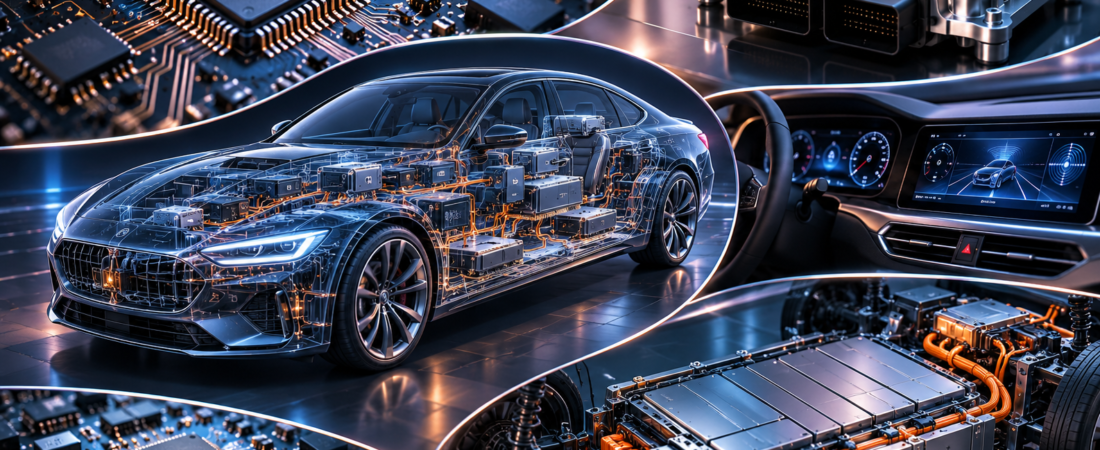
Computer Chips in Modern Cars are essential to nearly everything a vehicle does, from starting the engine and activating airbags to controlling electric batteries, displaying navigation maps, and helping drivers avoid accidents.
But how many computer chips are actually hidden inside an ordinary automobile?
The answer may surprise you. Industry estimates commonly place the number between 1,000 and 3,000 semiconductor devices in a modern vehicle, depending on the model, technology, and counting method. The Alliance for Automotive Innovation reported in August 2025 that the average car contained more than 1,700 semiconductor chips.
Electric vehicles, luxury cars, and models equipped with advanced driver-assistance technology can contain even more electronic components.
For American drivers, understanding automotive semiconductors is about more than technology. These tiny components influence vehicle prices, repair costs, safety features, manufacturing delays, and the future of transportation.
This guide explains how many computer chips modern cars need, where they are located, why electric vehicles depend on them, and what happens when the global supply of automotive semiconductors is disrupted.
Table of Contents
- How Many Computer Chips Are in a Modern Car?
- Seven Important Facts About Automotive Computer Chips
- Where Are Computer Chips Located Inside a Car?
- Gasoline Cars vs. Hybrid Cars vs. Electric Vehicles
- Why Do Electric Vehicles Need More Semiconductor Technology?
- How Computer Chips Affect Car Prices and Repairs
- What Happened During the Global Automotive Chip Shortage?
- Which Countries and Companies Manufacture Automotive Chips?
- Will Cars Need Even More Computer Chips in the Future?
- Frequently Asked Questions
- Conclusion
1. How Many Computer Chips Are in a Modern Car?
Most drivers imagine that a car contains one main computer controlling everything.
In reality, modern vehicles contain numerous electronic control systems, sensors, processors, memory devices, and power-management components.
These electronic systems communicate to operate the vehicle safely and efficiently.
1.1 The Typical Number of Chips in a Car
According to semiconductor manufacturer Polar Semiconductor, modern automobiles commonly contain approximately 1,000 to 3,000 semiconductor chips.
Micron Technology provides another useful benchmark, estimating approximately 1,400 to 1,500 chips in an average modern vehicle, with some vehicles reaching 3,500.
In August 2025, the Alliance for Automotive Innovation stated that the average car contained more than 1,700 semiconductor chips.
These figures are industry estimates, not exact counts for every vehicle sold in 2026.
A basic gasoline-powered sedan and a luxury electric SUV can have dramatically different electronic systems.
The way manufacturers define a semiconductor chip also influences the total. Some estimates include individual power semiconductor devices, while others focus on integrated circuits or specific types of processors.
The important takeaway is that a modern automobile relies on hundreds to thousands of semiconductor components, not just one computer.
The growing number of Computer Chips in Modern Cars reflects the increasing complexity of automotive technology. Even relatively affordable vehicles rely on semiconductor components for essential safety, performance, and comfort features.
1.2 What Counts as a Computer Chip?
A semiconductor device is an electronic component built using materials such as silicon.
Different devices perform different functions.
Microcontrollers execute instructions. Memory chips store information. Power semiconductors control electricity. Sensors measure physical conditions, while communication chips transmit data.
A vehicle may also contain individual transistors and diodes that perform essential functions but are not computers in the everyday sense.
This distinction explains why published counts sometimes disagree.
Counting only complex processors produces a much smaller number than counting all semiconductor devices.
2. Seven Important Facts About Automotive Computer Chips
Understanding Computer Chips in Modern Cars becomes easier when their most important functions are examined separately.
2.1 Fact 1: The Engine Depends on Electronic Control
Gasoline-powered engines use an engine control module to manage critical functions.
The system monitors information from sensors and adjusts fuel injection, ignition timing, and other operating conditions.
Semiconductor components help process signals and control engine performance.
Without properly functioning electronics, a modern engine may run inefficiently, enter a reduced-power mode, or fail to start.
2.2 Fact 2: Airbags and Braking Systems Need Chips
Modern safety systems depend on rapid electronic decisions.
Airbag control systems monitor sensors to determine when deployment is necessary.
Anti-lock braking systems process wheel-speed information to help prevent wheel lockup during hard braking.
Electronic stability control monitors vehicle behavior and can intervene to help maintain stability.
These functions require reliable sensors, processing components, and electrical control circuits.
2.3 Fact 3: Modern Cars Contain Multiple Electronic Computers
A vehicle generally contains several electronic control units, commonly called ECUs.
Each ECU is a module that may include a microcontroller, memory, power circuitry, and communication components.
Some ECUs manage the engine or transmission. Others control body electronics, climate systems, lighting, or safety functions.
Newer vehicles increasingly combine multiple functions into centralized or zonal computing architectures.
These designs can reduce the number of separate control modules without necessarily reducing the total number of semiconductor devices.
Computer Chips in Modern Cars communicate through sophisticated electronic networks, allowing different control modules to exchange information and coordinate important vehicle functions.
2.4 Fact 4: Entertainment Systems Need Advanced Processors
Modern dashboards often include touchscreens, navigation, smartphone connectivity, voice recognition, cameras, and digital instrument displays.
Such systems require processors, graphics hardware, memory, and wireless communication components.
Higher-resolution screens and more sophisticated interfaces may increase computing requirements.
Convenience technology has become an important reason vehicles contain more electronics than earlier generations.
2.5 Fact 5: Electric Vehicles Need Specialized Power Chips
Electric vehicles depend heavily on power semiconductors.
These devices help regulate electricity traveling between the battery, electric motor, charging equipment, and supporting systems.
Silicon carbide technology is particularly important in some advanced electric powertrains because it can improve power-conversion efficiency.
The specific semiconductor requirements depend on the vehicle’s electrical architecture.
2.6 Fact 6: Driver-Assistance Features Require Real-Time Computing
Automatic emergency braking, adaptive cruise control, blind-spot monitoring, and lane-keeping assistance use electronic systems to interpret information.
Cameras, radar, and other sensors generate signals that computing hardware must process.
More advanced systems may require powerful processors designed for artificial intelligence.
However, driver-assistance features do not automatically make a vehicle self-driving.
Drivers must follow the limitations and supervision requirements of their particular vehicle.
2.7 Fact 7: One Missing Chip Can Delay an Entire Vehicle
A manufacturer cannot always substitute one semiconductor for another.
Automotive chips must meet strict requirements related to reliability, temperature tolerance, electrical behavior, and compatibility.
If an essential component is unavailable, an otherwise completed vehicle may not be ready for sale.
This became a major problem during the global semiconductor shortage of 2021–2022.
3. 3. Where Are Computer Chips in Modern Cars Located?
Automotive semiconductors are distributed throughout the vehicle.
Many are hidden inside electronic modules, sensors, and control circuits.
3.1 Major Automotive Systems That Use Chips

| Vehicle system | Semiconductor functions | Everyday benefit |
|---|---|---|
| Engine and transmission | Control and monitoring | Performance and efficiency |
| Airbags and braking | Sensors and safety processing | Passenger protection |
| Infotainment | Graphics, memory, connectivity | Navigation and entertainment |
| Climate control | Temperature sensing and control | Passenger comfort |
| Lighting | Power regulation and control | Visibility and safety |
| Electric powertrain | Motor control and power conversion | Electric propulsion |
| Battery management | Voltage, temperature, and charging control | Battery protection |
| Driver assistance | Sensor processing and computing | Collision warnings and assistance |
A single system can use several kinds of semiconductors.
For example, an electronic braking system may require a controller, memory, sensors, and power-management devices.
As a result, the number of electronic modules is not the same as the total number of chips.
Understanding the location of Computer Chips in Modern Cars helps drivers appreciate how semiconductor technology supports engines, braking systems, climate control, and digital entertainment.
3.2 Why Automotive Chips Are Different From Ordinary Computer Chips
Cars operate under conditions that can be difficult for electronics.
Components may face heat, cold, vibration, electrical interference, moisture, and long periods of operation.
Automotive-grade semiconductor products are designed and qualified for the conditions relevant to their applications.
Many undergo testing associated with automotive reliability standards, including AEC-Q100 for integrated circuits.
This is one reason an automaker cannot simply replace every unavailable automotive chip with an ordinary consumer-electronics component.
4. Gasoline Cars vs. Hybrid Cars vs. Electric Vehicles
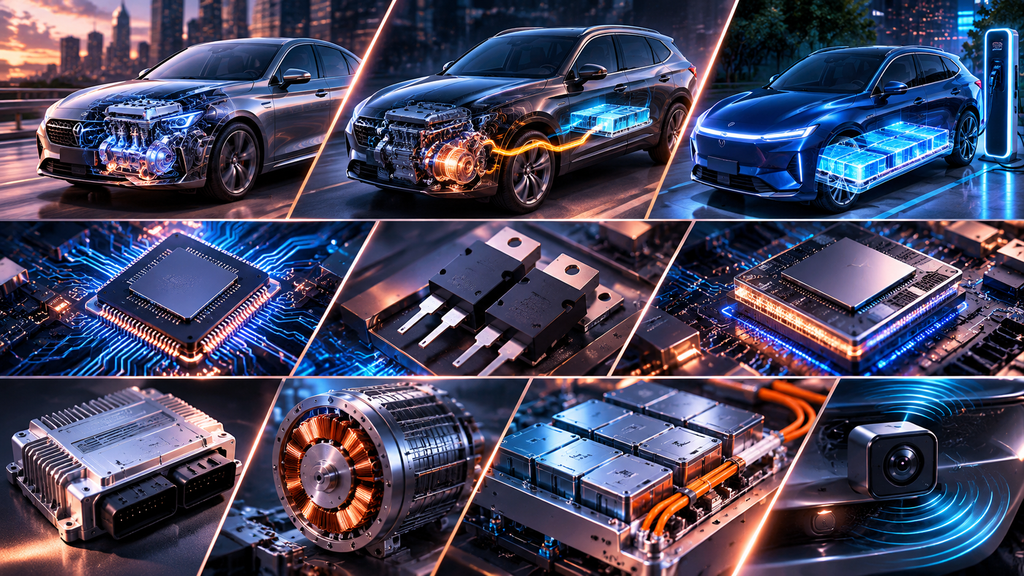
Different vehicle powertrains require different semiconductor technologies.
A traditional gasoline engine needs electronic control for fuel delivery, emissions, and transmission operation.
A hybrid combines combustion-engine electronics with additional electrical propulsion and battery-control systems.
A battery-electric vehicle eliminates the gasoline engine but introduces extensive high-voltage power electronics.
4.1 Comparing Semiconductor Requirements
| Vehicle type | Main semiconductor requirements | Typical complexity |
|---|---|---|
| Gasoline vehicle | Engine, transmission, safety, entertainment | Moderate to high |
| Hybrid vehicle | Combustion engine, electric motor, battery, safety | High |
| Battery-electric vehicle | Battery management, inverter, charging, safety | High to very high |
| Advanced automated-driving vehicle | Sensors, AI processors, memory, networking | Potentially very high |
Note: These categories describe engineering complexity, not a standardized chip-count ranking. Actual device counts depend on equipment, architecture, and counting methods.
A feature-rich gasoline luxury car can contain more semiconductor devices than a relatively simple electric vehicle.
4.2 Do Electric Cars Always Have More Chips?
Not necessarily in every comparison.
Electric vehicles generally need more sophisticated power electronics and battery-management systems than conventional gasoline vehicles.
However, some manufacturers consolidate multiple computing functions into fewer controllers.
Therefore, the exact number of chips depends on the engineering design.
Semiconductor manufacturer Infineon stated in 2026 that some modern electric vehicles can contain up to 8,000 semiconductor chips.
That is an upper-end industry example rather than an average that applies to every electric vehicle.
The number of Computer Chips in Modern Cars depends on the type of powertrain, the sophistication of electronic systems, and the vehicle manufacturer’s design choices.
5. Why Do Electric Vehicles Need More Semiconductor Technology?
Electric vehicles rely on electronics to regulate high-voltage electrical systems.
This creates additional semiconductor requirements beyond those found in many conventional vehicles.
5.1 Battery Management Systems
An electric vehicle’s battery management system monitors conditions such as voltage, current, and temperature.
It helps protect the battery against unsafe operating conditions and supports efficient operation.
Semiconductors enable monitoring, communication, and control functions throughout the battery system.
5.2 Power Inverters and Electric Motors
Electric motors and battery systems operate using different electrical requirements.
A traction inverter converts direct-current electricity from the battery into the electrical output needed by the motor.
Power semiconductor devices perform the high-speed switching required for this conversion.
Efficient switching can reduce wasted electricity and improve vehicle performance.
5.3 Electric Vehicle Charging Systems
Charging technology also depends on semiconductor components.
Onboard chargers, DC-DC converters, and charging-control systems regulate electrical power and communicate with charging equipment.
More advanced charging capabilities can require sophisticated power electronics.
For American consumers, these technologies can influence charging performance, driving efficiency, and long-term vehicle ownership costs.
Computer Chips in Modern Cars are especially important in electric vehicles because power-management components regulate electricity flowing between batteries, motors, and charging systems.
6. How Computer Chips Affect Car Prices and Repairs
The economic importance of Computer Chips in Modern Cars becomes especially clear when consumers purchase or repair a vehicle.
6.1 Semiconductor Costs Are Part of Vehicle Prices
Automotive semiconductor content represents a meaningful part of vehicle manufacturing costs.
According to a 2025 S&P Global Mobility analysis, the estimated global average semiconductor content per vehicle was expected to reach approximately $1,014 in 2025.
The analysis estimated a higher average of approximately $1,154 for U.S. vehicles.
These figures describe semiconductor component value, not a separate retail fee charged to consumers.
Vehicle prices also reflect manufacturing, labor, research, software, distribution, and many other expenses.
6.2 Why Electronic Repairs Can Be Expensive
Repairing a modern vehicle sometimes involves more than replacing a mechanical component.
Technicians may need to diagnose electronic faults, replace a control module, update software, or calibrate sensors.
For example, repairing a damaged camera or radar system may require precise alignment after installation.
The total repair bill can include specialized labor and calibration equipment, not just the replacement semiconductor.
When Computer Chips in Modern Cars fail, repairs may require specialized diagnostic equipment, software programming, or replacement electronic control modules.
6.3 Are Older Cars Cheaper to Repair?
Older vehicles often have fewer electronic features than newer models, but that does not guarantee inexpensive repairs.
Aging vehicles can face mechanical wear, limited parts availability, and labor-intensive repairs.
Newer cars may offer better diagnostics and advanced safety features, while introducing additional electronic components.
For used-car buyers, maintenance history, actual condition, parts availability, and repair estimates matter more than the number of chips alone.
7. What Happened During the Global Automotive Chip Shortage?
The semiconductor shortage demonstrated how dependent vehicle production has become on global electronics manufacturing.
7.1 Why the 2021–2022 Shortage Happened
During the COVID-19 pandemic, automotive production and semiconductor demand changed rapidly.
Factory disruptions, shifts in consumer-electronics demand, and limited manufacturing capacity created supply problems.
Automakers faced difficulty obtaining certain essential chips.
Microcontrollers were particularly important because they support many vehicle-control functions.
A September 28, 2026 Federal Reserve study found that shortages contributed to a cumulative U.S. vehicle production shortfall exceeding two million vehicles during 2021–2022, compared with its modeled baseline.
7.2 How the Shortage Affected American Consumers
Production delays reduced the supply of new vehicles.
Some manufacturers temporarily omitted selected convenience features or prioritized higher-priced models.
Reduced new-car availability also contributed to pressure in the used-vehicle market.
For consumers, the shortage demonstrated that the availability of inexpensive electronic components can influence the price and delivery time of an entire automobile.
7.3 Could Another Chip Shortage Happen?
Supply-chain disruptions remain possible.
Semiconductor manufacturing requires expensive facilities, specialized materials, complex equipment, and international coordination.
Automakers also depend on both advanced computing chips and mature semiconductor technologies.
Greater supply-chain diversification, long-term supplier relationships, and improved inventory planning may reduce risks.
However, no global manufacturing network is completely immune to disruption.
The global semiconductor shortage revealed how dependent automobile manufacturers have become on Computer Chips in Modern Cars, particularly for safety-critical and essential electronic systems.
8. Which Countries and Companies Manufacture Automotive Chips?

Automotive semiconductor manufacturing is an international business.
Design, wafer fabrication, assembly, testing, and vehicle integration may take place in different countries.
8.1 Important Automotive Semiconductor Companies
Major companies involved in automotive semiconductor technology include:
- Infineon Technologies
- NXP Semiconductors
- STMicroelectronics
- Texas Instruments
- Renesas Electronics
- onsemi
- Bosch
These companies supply different combinations of microcontrollers, power semiconductors, sensors, and other components.
Not all of them manufacture every chip they design.
8.2 Why South Korea Matters
South Korea is an important part of the global semiconductor supply chain.
Samsung Electronics and SK hynix are major suppliers of memory technology.
Memory chips support information processing and storage in many modern electronic systems, including automotive applications.
As vehicles adopt more sophisticated computing platforms, memory requirements may become increasingly important.
For readers interested in the wider semiconductor industry, TIPVERO also explores the differences between RAM, storage, and advanced memory chips.
8.3 Why American Semiconductor Manufacturing Matters
The United States has significant semiconductor design expertise and manufacturing capabilities.
Domestic manufacturing investment can support supply-chain resilience.
Nevertheless, a reliable automotive semiconductor supply requires multiple chip types, packaging services, testing facilities, materials, and suppliers.
Building only the most advanced processor factories would not solve every automotive semiconductor supply problem.
Many essential automotive components use established manufacturing technologies.
9. Will Cars Need Even More Computer Chips in the Future?
The role of Computer Chips in Modern Cars is likely to evolve as vehicles become more connected, electrified, and software-driven.
9.1 Artificial Intelligence and Driver Assistance
AI processors are becoming important in advanced driver-assistance and vehicle perception systems.
These systems process information from cameras and other sensors.
Greater computing capability may support more sophisticated detection and assistance features.
However, technological progress does not eliminate the need for rigorous safety testing or driver supervision where required.
9.2 Software-Defined Vehicles
Traditional automobiles often rely on many separate control modules.
Software-defined vehicle architectures increasingly coordinate functions through more centralized computing platforms.
This can simplify some aspects of vehicle electronics and enable software updates.
At the same time, central computers may require more advanced processors and memory.
Consequently, future vehicles may use fewer individual control modules but more powerful semiconductor systems.
9.3 The Growing Importance of Semiconductor Efficiency
Automotive chip development is not only about increasing processing power.
Energy efficiency, safety, security, reliability, and cost are equally important.
Electric vehicles benefit from efficient power conversion, while connected vehicles need secure communications.
The future of automotive electronics will depend on balancing performance with affordability and long-term reliability.
For American drivers, this evolution could affect the features available in new vehicles, maintenance procedures, and overall ownership costs.
As artificial intelligence, advanced sensors, and centralized computing become more common, Computer Chips in Modern Cars will continue to influence vehicle performance, reliability, and manufacturing costs.
10. Frequently Asked Questions
FAQ 1: How many computer chips are inside a modern car?
Common industry estimates range from approximately 1,000 to 3,000 semiconductor devices, although the number varies by vehicle and counting method. Some high-end vehicles contain more.
FAQ 2: Does a modern car have only one computer?
No. Most modern vehicles use multiple electronic control modules, sensors, and semiconductor systems. Newer designs may consolidate some functions into centralized computers.
FAQ 3: Do electric cars have more chips than gasoline cars?
Electric vehicles generally require additional battery-management and power-conversion electronics. However, a particular vehicle’s total chip count depends on its design and features.
FAQ 4: How many chips are inside a Tesla?
There is no single verified number for every Tesla model and configuration. Semiconductor content varies with the vehicle generation, battery system, and installed computing hardware.
FAQ 5: Why do car engines need computer chips?
Electronic control systems use semiconductor devices to monitor sensors and regulate fuel delivery, ignition, emissions, and other engine functions.
FAQ 6: Can one missing computer chip stop a car from being manufactured?
Yes. A missing essential semiconductor can prevent an electronic system from functioning or meeting production requirements, delaying vehicle completion.
FAQ 7: Are car computer chips expensive?
Individual components vary widely in price. Some are inexpensive, while advanced processors and specialized automotive devices cost much more. Repair costs also depend on the complete electronic module and labor.
FAQ 8: Are automotive chips different from smartphone chips?
Many automotive semiconductors have additional requirements for durability, reliability, temperature tolerance, and long-term availability. Their functions also differ from those of typical smartphone processors.
FAQ 9: Will future cars contain more AI chips?
Many advanced vehicles are expected to use increasingly capable AI processing hardware. However, centralized architectures mean total semiconductor counts may not rise proportionally with computing performance.
FAQ 10: Why are computer chips important to car prices?
Semiconductors contribute to manufacturing costs and enable important vehicle features. Supply shortages can also restrict vehicle production, affecting inventory and market prices.
11. Conclusion: Why Computer Chips Matter More Than Ever
Computer Chips in Modern Cars have transformed automobiles from primarily mechanical machines into sophisticated electronic systems.
Depending on vehicle design and counting methods, modern cars can contain thousands of semiconductor devices performing essential tasks.
These components control engines, braking, airbags, entertainment systems, electric motors, charging equipment, and driver-assistance technology.
They also influence vehicle manufacturing costs, repair complexity, and supply-chain reliability.
The automotive semiconductor shortage of 2021–2022 demonstrated how disruptions in the global chip industry can affect American drivers and vehicle prices.
As electric vehicles and advanced computing technologies continue to develop, automotive semiconductors will remain central to transportation innovation.
For consumers, understanding these tiny electronic components provides a clearer picture of why modern cars are becoming more capable, more complex, and increasingly connected to the global technology economy.