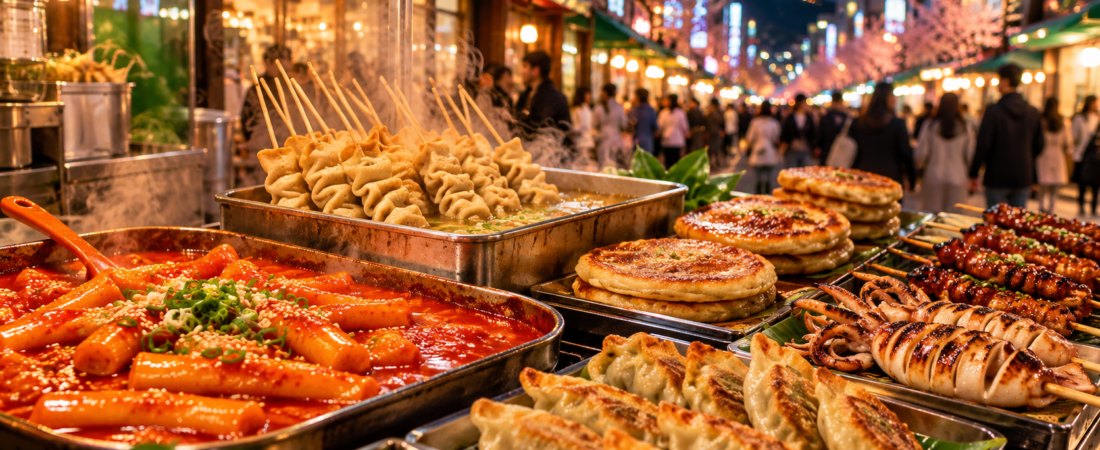
When the sun goes down in Seoul, Myeongdong night food becomes one of the most exciting reasons to explore the neighborhood.
Why Myeongdong Night Food Feels Different After Dark
During the day, Myeongdong is known for shopping, cosmetics, cafés, and busy pedestrian streets. But after dark, the atmosphere changes. Store signs glow above the sidewalks, food aromas drift between the crowds, grills begin sizzling, and visitors start moving from one snack stand to another.
For first-time travelers to South Korea, eating in Myeongdong at night can be an easy introduction to Korean food. You do not necessarily need a reservation, a complicated menu, or advanced Korean language skills. Many foods are prepared where you can see them, which makes choosing something much easier.
For first-time visitors, Myeongdong night food offers an easy way to experience several Korean flavors in one evening.
But with so many choices, another question quickly appears:
What is actually worth eating in Myeongdong at night?
This guide explains some of the best foods to try, what they taste like, how adventurous they are for beginners, and how to plan a simple evening food walk through Myeongdong.
If this is your first visit, start with our guide to What to Eat in Myeongdong: 15 Korean Foods First-Time Visitors Should Try.
Why Myeongdong Feels Different After Dark
Myeongdong is already one of Seoul’s busiest visitor districts, but nighttime gives the area a different personality.
Instead of simply walking between shops, travelers tend to slow down and follow the smell of food.
You may hear oil bubbling from a frying station, see steam rising from a pot of fish cakes, or watch seafood being grilled directly in front of you.
That sensory experience is one reason exploring Myeongdong night food can be more memorable than simply sitting down for a single restaurant meal.
You can taste one small dish, continue walking, shop for a while, and then try something completely different.
It turns dinner into an experience rather than a single stop.
What Time Should You Visit Myeongdong?
There is no single opening time for every food stand or business in Myeongdong.
Individual vendors and restaurants operate on different schedules, so availability can change depending on the day, season, weather, and crowd size.
For most visitors, arriving sometime around the early evening works well because you can experience the transition from daytime shopping to Myeongdong’s illuminated nighttime atmosphere.
Rather than planning your evening around one particular vendor, think of Myeongdong as a flexible food walk.
See what looks fresh, watch what is being cooked, and choose a few dishes that interest you.
https://english.visitseoul.net/shopping/Myeongdong_/68?utm_source=chatgpt.com
1. Tteokbokki: The Classic Spicy Night Snack
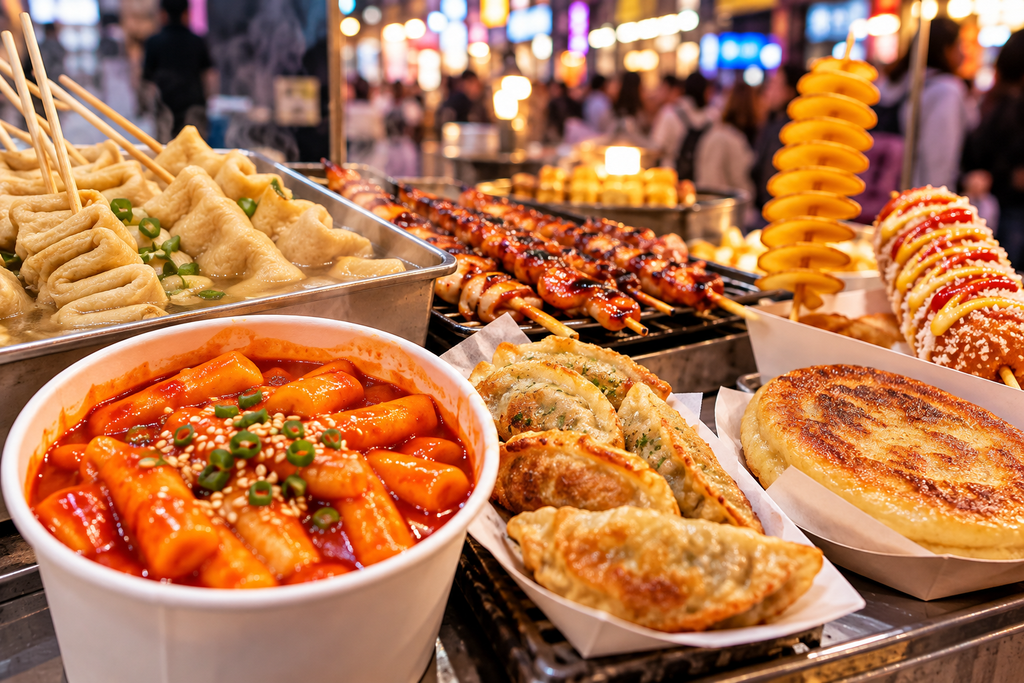
If there is one food that immediately looks like Korean street food, it might be tteokbokki.
Tteokbokki consists mainly of chewy rice cakes cooked in a thick red sauce.
The color can look extremely spicy to someone trying Korean food for the first time, but the flavor is usually more complicated than simply hot.
You may taste:
- sweetness
- chili
- savory seasoning
- garlic
- slightly smoky flavors
The texture is also important.
Korean rice cakes are dense and chewy, so eating tteokbokki feels completely different from eating noodles or pasta.
Is Tteokbokki Good for Beginners?
Yes, especially if you already enjoy spicy foods.
However, spice levels can vary.
If you have a low tolerance for chili, start with a small portion and share it with someone rather than ordering a large serving.
Eating tteokbokki with fish cake can also help balance the intense sauce.
2. Eomuk: Warm Korean Fish Cake on a Cool Night
Next to a pot of tteokbokki, you will often see another familiar Korean snack: eomuk, or fish cake.
Fish cake is usually folded onto wooden skewers and served warm.
Its flavor is mild, salty, and savory.
For travelers who feel nervous about trying unfamiliar Korean foods, eomuk is one of the easiest places to begin.
It does not have the intense spice of tteokbokki, and the soft texture is familiar enough for many international visitors.
On a cool Seoul evening, a warm skewer of fish cake can be surprisingly comforting.
3. Hotteok: One of the Best Sweet Foods After Dark
Not every Myeongdong food needs to be spicy.
If you prefer dessert, look for hotteok.
Hotteok is a Korean filled pancake traditionally associated with cooler weather.
A typical sweet version contains ingredients such as sugar, cinnamon, seeds, or nuts inside a fried or griddled dough.
The outside can become crisp while the inside remains soft and extremely hot.
One Important Hotteok Tip
Do not bite into it immediately.
Fresh hotteok can contain very hot melted sugar inside.
Give it a moment to cool before taking your first bite.
Hotteok is especially enjoyable later in the evening when you want something warm and sweet after several savory snacks.
4. Gimbap: The Reliable Choice When You Need Something Familiar
Street food is fun, but sometimes you need something a little more substantial.
That is where gimbap becomes useful.
Gimbap usually consists of rice and fillings rolled in dried seaweed and sliced into bite-sized pieces.
Possible fillings include:
- egg
- vegetables
- pickled radish
- meat
- tuna
- imitation crab
- spinach
It is portable, mild, and easy to share.
For visitors who are still adjusting to Korean flavors, gimbap can also act as a comfortable food between stronger dishes.
You might eat several spicy rice cakes, take a break with gimbap, and then continue exploring.
5. Mandu: Korean Dumplings for a Filling Evening Snack
Another beginner-friendly option is mandu, Korean dumplings.
Depending on the vendor or restaurant, mandu may be steamed, boiled, or fried.
Fillings can include pork, vegetables, tofu, kimchi, or glass noodles.
Fried mandu has a crispy exterior, while steamed mandu tends to be softer and lighter.
If you are traveling with people who have different food preferences, dumplings are often an easy dish to share.
They are also filling enough to prevent a street-food evening from becoming nothing but tiny snacks.
6. Grilled Seafood: When Myeongdong Gets More Adventurous
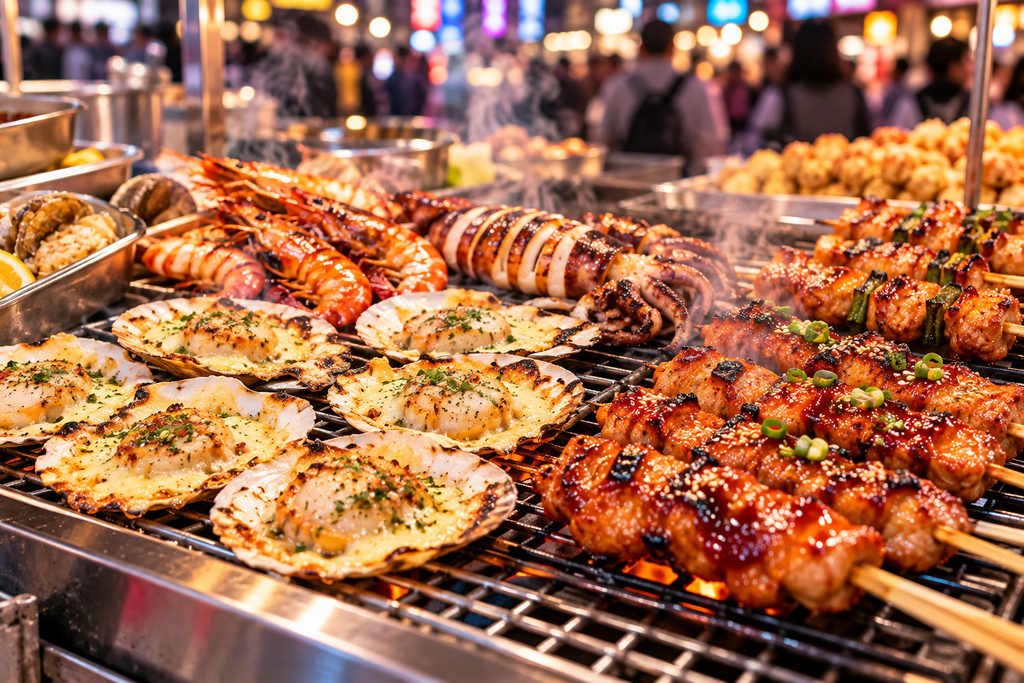
Walk farther through Myeongdong at night and you may notice seafood being cooked directly over grills.
This is where the experience becomes more adventurous.
Depending on the vendors operating that evening, you may encounter items such as:
- scallops
- shrimp
- squid
- octopus
- shellfish
Cheese-topped grilled scallops are particularly visually dramatic because they combine seafood with melted cheese and are often finished directly in front of customers.
For someone who enjoys seafood, grilled dishes can be one of the highlights of a Myeongdong evening.
Korea Tourism Organization content has also highlighted items such as cheese scallops, butter shrimp, lamb skewers, and tornado potatoes among foods visitors can encounter in Myeongdong.
7. Grilled Squid: A Very Korean Nighttime Flavor
Grilled squid is common enough in Korea that its smell may eventually remind you of nighttime streets, markets, festivals, and casual drinking culture.
It has a chewy texture and a smoky, slightly sweet flavor when grilled.
This is not always the easiest food for someone who dislikes chewy seafood.
But if you enjoy calamari or grilled octopus, it may be worth trying.
Rather than buying a large portion immediately, sharing one serving allows everyone in your group to taste it.
8. Korean Fried Chicken: When Street Snacks Are Not Enough
Eventually, tiny snacks may stop being enough.
That is the perfect moment for Korean fried chicken.
Korean fried chicken has become internationally famous because of its crisp texture and wide variety of sauces.
You may find versions such as:
- original crispy
- sweet and spicy
- soy garlic
- honey
- spicy chili
- cheese-seasoned chicken
Fried chicken works particularly well as the second half of a Myeongdong evening.
You can explore street snacks first and then sit down somewhere for chicken when you want a more substantial meal.
Chimaek
You may also hear the Korean expression chimaek.
It combines the words for chicken and beer.
The combination is deeply associated with casual Korean nightlife and social eating.
Even if you do not drink alcohol, Korean fried chicken itself is worth experiencing.
9. Korean Corn Dogs: A Fun First-Time Food
Korean-style corn dogs became famous internationally through Korean entertainment and social media.
Unlike a traditional American corn dog, Korean versions can contain combinations such as:
- sausage
- mozzarella
- sausage and cheese
- potato-covered batter
- sweet coatings
Some are even sprinkled lightly with sugar before sauces are added.
The sweet-salty combination can sound strange until you try it.
For younger travelers, families, or anyone looking for an easy Instagram-friendly snack, Korean corn dogs are one of the most approachable choices.
10. Tornado Potato: More About Fun Than Tradition
A tornado potato is exactly what it looks like: a whole potato cut into a spiral, stretched along a skewer, fried, and seasoned.
It is not necessarily the food you should choose if you only have one opportunity to experience Korean cuisine.
But as part of a night wandering through Myeongdong, it can be fun.
It is crispy, easy to carry, and ideal for sharing.
Think of it as a snack between more distinctly Korean foods such as tteokbokki, eomuk, or hotteok.
11. Dakkochi: Korean Chicken Skewers
Dakkochi means chicken skewers.
Pieces of chicken are grilled on sticks and usually coated with sauce.
Flavors may range from mild soy-based seasoning to sweet-spicy chili sauces.
Dakkochi is a smart choice when you want protein without sitting down for a full meal.
It is also easy to eat while walking.
For visitors concerned about Korean food being overwhelmingly spicy, ask about the milder sauce options when available.
12. Bungeoppang: A Sweet Ending to the Night
If you visit Korea during cooler weather, you may encounter bungeoppang.
These fish-shaped pastries traditionally contain sweet red bean paste, although modern versions may use other fillings.
Despite their fish shape, traditional bungeoppang does not contain fish.
The shape comes from the mold used to cook the pastry.
The crisp outside and warm filling make bungeoppang one of Korea’s classic cold-weather snacks.
It is an excellent final bite before heading back to your hotel.
13. Ramyeon: Korea’s Ultimate Late-Night Comfort Food
At some point during a trip to Korea, you should experience Korean instant ramyeon late at night.
It is inexpensive, fast, hot, and comforting.
Convenience stores throughout Korea make this experience surprisingly easy.
Some stores provide hot water or cooking stations where customers can prepare instant noodles and eat them immediately.
After walking through Myeongdong for hours, a steaming bowl of ramyeon can feel more satisfying than an expensive restaurant dinner.
Add a drink, triangle gimbap, boiled egg, or another convenience-store snack and you have one of the simplest Korean late-night meals possible.
14. Korean BBQ for a Full Nighttime Meal
Street food does not have to be your entire dinner.
If you are extremely hungry, consider using street food as an appetizer and finishing your evening with Korean BBQ.
A typical Korean BBQ experience may include grilled meat accompanied by:
- lettuce
- garlic
- dipping sauces
- kimchi
- pickled vegetables
- other banchan
The meal is interactive because much of the food is cooked at the table.
For first-time travelers, it also introduces an important part of Korean dining culture: eating multiple dishes together instead of treating every side dish as a separate course.
If you have never tried Korean BBQ before, read our Korean BBQ for Beginners: What to Order and How to Eat It guide before your visit.
15. Convenience Store Dessert for the Walk Home
After spicy food, grilled food, fried food, and hot snacks, something cold can be refreshing.
Korean convenience stores offer an enormous variety of desserts and drinks.
Consider trying:
- Korean ice cream
- flavored milk
- yogurt drinks
- fruit beverages
- coffee
- packaged pastries
This creates a surprisingly satisfying ending to a Myeongdong evening.
Instead of ordering one large dessert at a café, everyone can choose something different and compare favorites.
How to Build the Perfect Myeongdong Night Food Walk
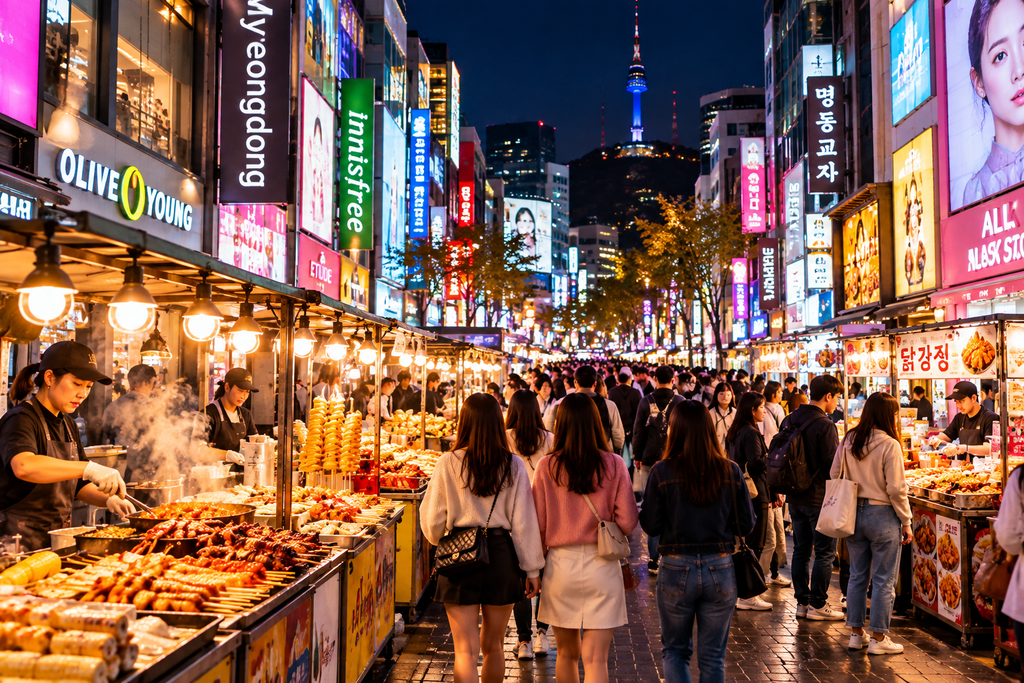
Trying everything you see is tempting.
It is also one of the fastest ways to become full before you discover the food you actually wanted.
A better strategy is to divide the evening into stages.
Stop 1: Begin With Something Small
Start with one classic Korean street food.
Choose:
tteokbokki, eomuk, or mandu.
Do not order several dishes immediately.
Walk for another 10 or 15 minutes before deciding what comes next.
Stop 2: Try Something You Have Never Eaten
Now choose one more adventurous food.
This could be:
- grilled scallops
- squid
- dakkochi
- another seafood skewer
Sharing is useful here.
Instead of each person buying the same food, buy one serving and taste it together.
Stop 3: Add Something Sweet
After salty or spicy foods, try:
hotteok, bungeoppang, or another Korean dessert.
The contrast keeps your taste buds interested.
Stop 4: Decide Whether You Need a Real Dinner
Ask yourself how hungry you actually are.
If snacks were enough, continue exploring.
If not, sit down for something more substantial such as:
- Korean BBQ
- fried chicken
- noodles
- bibimbap
- stew
One long-running Myeongdong restaurant listed by Seoul’s official tourism guide serves items such as gimbap, tteokbokki, mandu, and noodles, showing that visitors do not have to rely exclusively on outdoor vendors for these classic casual foods.
Stop 5: Finish With a Convenience Store Snack
Before returning to your hotel, visit a Korean convenience store.
Choose one unfamiliar drink, ice cream, or snack.
It is inexpensive and gives you another small piece of everyday Korean food culture.
What Should First-Time Visitors Try First?
If this is your first trip to South Korea, you do not need to choose the most unusual food.
Start with approachable flavors.
Beginner Level
Try:
- gimbap
- mandu
- Korean fried chicken
- corn dogs
- hotteok
- dakkochi
These foods tend to contain familiar ingredients and textures.
Intermediate Level
Next try:
- tteokbokki
- eomuk
- grilled squid
- stronger Korean sauces
These dishes introduce textures and flavors that may be less familiar.
Adventurous Level
Depending on what is available, adventurous eaters can explore:
- unusual seafood
- marinated raw dishes at restaurants
- stronger fermented flavors
- spicy dishes with higher heat levels
You do not need to prove anything by choosing the most unfamiliar food.
The goal is to enjoy Korean cuisine.
Cash or Card in Myeongdong?
Korea is highly card-friendly, particularly in established stores and restaurants.
Street vendors, however, can operate differently.
Payment methods may vary from vendor to vendor.
For that reason, carrying some Korean won can still be convenient when exploring street food.
Before ordering, look for displayed payment information or ask the vendor.
Also check the price before ordering rather than assuming every street-food item will be inexpensive.
Myeongdong is one of Seoul’s most famous tourist districts, so prices can differ significantly depending on the product and vendor.
Night Food Etiquette in Myeongdong
Myeongdong can become crowded, so a little awareness makes eating more enjoyable.
Do Not Block the Vendor
After receiving your food, move away from the ordering area when possible so the next customer can order.
Use Trash Bins Provided by Vendors
Public trash bins are less common in Seoul than many visitors expect.
Some vendors provide places to dispose of skewers, cups, or plates.
Use them whenever available.
Share When Possible
Sharing allows you to experience many more foods without becoming full too early.
For two people, buying one serving of several different foods is often more enjoyable than buying two identical servings.
Watch the Heat
Freshly fried or grilled street foods can be extremely hot.
Hotteok, melted cheese, sauces, and grilled seafood deserve particular caution.
What to Skip When You Are Already Full
The hardest part of a Myeongdong food walk is knowing when to stop.
When you see another beautiful food stall, it is easy to think:
“One more.”
But if you are already full, save it for another day.
You do not have to eat 15 foods in one night.
In fact, four or five carefully chosen foods can create a better experience than rushing through a huge checklist.
Quality matters more than quantity.
Is Myeongdong Street Food Expensive?
Myeongdong should not automatically be treated as the cheapest place to eat in Seoul.
It is a major tourism and shopping district.
Street food prices can therefore be different from those in residential neighborhoods or traditional markets.
Instead of asking whether every item is cheap, ask:
Is this something I genuinely want to experience?
A food can still be worthwhile even when it is not the cheapest version available in Seoul.
You are paying partly for convenience and location.
If you want to compare individual street foods in more detail, read our Myeongdong Street Food Guide: What’s Worth Trying and What to Skip.Myeongdong Street Food Guide: What’s Worth Trying and What to Skip
Myeongdong Street Food vs. Traditional Markets
Myeongdong and Seoul’s traditional markets offer different experiences.
Traditional markets can provide a deeper look at everyday market culture and regional foods.
Myeongdong offers convenience.
You can combine:
- food
- shopping
- cosmetics
- cafés
- subway access
- nightlife
in one compact area.
For a first-time visitor with limited time in Seoul, that convenience has real value.
For travelers focused primarily on food, however, exploring places such as Gwangjang Market or neighborhood markets later in the trip can reveal a different side of Seoul.
A Simple 3-Hour Myeongdong Night Itinerary
If you want an easy plan, try this.
6:00 PM — Arrive in Myeongdong
Walk through the main shopping streets and see which vendors are operating.
Do not buy the first thing you see.
Look around first.
6:30 PM — First Street-Food Round
Choose one savory food:
- tteokbokki
- eomuk
- mandu
7:00 PM — Shopping Break
Browse Korean skincare, clothing, souvenirs, or cafés.
This gives your stomach time to recover before round two.
7:45 PM — Second Food Round
Choose something different:
- seafood
- dakkochi
- Korean corn dog
8:15 PM — Sweet Snack
Try hotteok or another dessert.
8:45 PM — Decide on Dinner
Still hungry?
Have fried chicken, Korean BBQ, noodles, bibimbap, or stew.
Already full?
Keep walking instead.
9:30 PM — Convenience Store Finale
Choose a Korean drink or ice cream before returning to your hotel.
That is more than enough food for one memorable evening.
Final Thoughts: Myeongdong Is Best Experienced One Bite at a Time
The best part of Myeongdong night food is not finding one legendary dish.
It is the variety.
One minute you may be eating spicy tteokbokki beside a steaming pot of fish cakes.
Twenty minutes later, you could be watching seafood cook over a grill.
Then you might finish the evening holding a warm hotteok while neon signs glow above the street.
That constant change is what makes Myeongdong entertaining after dark.
For first-time visitors to Seoul, it offers an accessible way to explore Korean food without committing to an elaborate restaurant meal.
Start small.
Share dishes.
Try one food that feels familiar and another that feels adventurous.
And most importantly, leave enough room for whatever delicious thing you discover around the next corner.
Frequently Asked Questions About Myeongdong Night Food
Is Myeongdong good for street food at night?
Yes. Myeongdong is one of Seoul’s best-known visitor districts for combining evening shopping with casual street food. Food availability and vendor schedules can vary, so the experience may be different from one evening to another.
What food should I try first in Myeongdong?
For a first visit, tteokbokki, eomuk, mandu, gimbap, hotteok, or Korean fried chicken are approachable choices.
Is Myeongdong street food very spicy?
Not all of it. Tteokbokki can be spicy, but foods such as gimbap, mandu, hotteok, corn dogs, fish cake, and many grilled items may be much milder.
Can I eat dinner entirely from street food?
Yes, although portions can vary. Sharing several dishes allows you to create an informal dinner while tasting more foods.
Is Myeongdong food expensive?
Prices vary. Because Myeongdong is a major tourist and shopping district, visitors should check displayed prices before ordering rather than assuming street food will always be inexpensive.
What time is best for visiting Myeongdong?
Early evening is a practical starting point if you want to combine shopping, dinner, and the nighttime atmosphere. Individual shops, restaurants, and food vendors can have different operating hours.
How do I get to Myeongdong?
Myeongdong Station on Seoul Subway Line 4 provides convenient access to the district. The official Seoul tourism guide lists Exits 5–10 for the Myeongdong shopping area.
Is Myeongdong worth visiting if I already visited Gwangjang Market?
Yes. The experiences are different. Gwangjang Market emphasizes traditional market culture, while Myeongdong combines food with shopping, cosmetics, cafés, and one of Seoul’s busiest tourist districts.