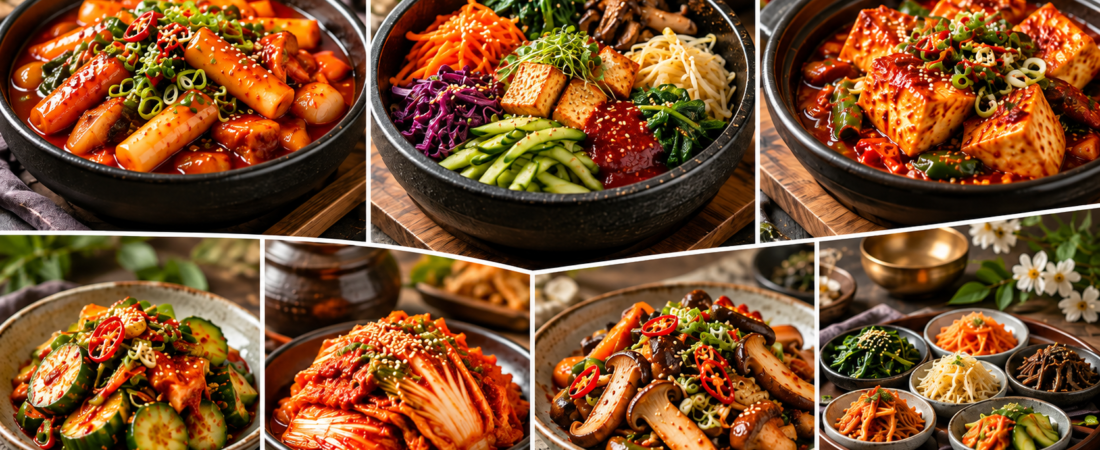
Korean food is famous for its bold flavors, colorful vegetables, fermented seasonings, and unforgettable spicy dishes. For vegetarian travelers, however, finding a delicious Korean meal can be more complicated than choosing something that looks vegetable-based.
The good news is that there are many spicy Korean foods vegetarians can enjoy, from chewy rice cakes and vegetable bibimbap to spicy tofu and flavorful Korean pancakes. With a few ingredient checks and simple ordering phrases, vegetarians can explore Korean cuisine without giving up the exciting flavors that make it special.
One important detail is that not every vegetable-based Korean dish is automatically vegetarian. Fish sauce, anchovy broth, fermented shrimp, meat stock, and fish cakes sometimes appear in meals that otherwise look completely plant-based.
This guide introduces 12 delicious Korean dishes that can be prepared for vegetarians, explains their typical ingredients, compares their spice levels, and provides practical Korean phrases you can use when ordering.
Whether you are visiting Seoul for the first time, exploring Korean restaurants in the United States, or preparing Korean food at home, this guide will help you make more informed and confident choices.
Best Vegetarian Foods to Try in South Korea for First-Time VisitorsBest Vegetarian Foods in South Korea for First-Time Visitors
Why Spicy Korean Food Is Worth Exploring for Vegetarians
Korean cooking uses a remarkable variety of plant-based ingredients. Cabbage, radish, mushrooms, tofu, spinach, soybean sprouts, zucchini, eggplant, sweet potatoes, and seaweed all appear in traditional meals.
Many dishes get their flavor from fermented sauces, garlic, sesame oil, vegetables, and chili peppers rather than from meat alone.
Two particularly important ingredients are gochujang, a fermented Korean chili paste, and gochugaru, Korean red pepper flakes.
Gochujang often brings sweetness, saltiness, and a rich fermented flavor to dishes such as tteokbokki and bibimbap. Gochugaru provides chili flavor and color, making it especially useful in seasoned vegetables and spicy soups.
Neither ingredient should be assumed suitable for every dietary restriction without checking its label. Commercial sauces may contain additional ingredients, and restaurant dishes can include animal-based seasonings independently of the chili paste.
The key distinction is between a dish that contains vegetables and a dish that contains only vegetarian ingredients.
For example, a bowl of spicy tofu soup might look like a vegetarian meal, but the kitchen could have prepared its broth with anchovies or seafood. Similarly, a spicy rice cake dish may contain fish cakes even though rice cakes are its primary ingredient.
Understanding these differences opens the door to enjoying Korean food while respecting your dietary preferences.
12 Spicy Korean Foods Vegetarians Can Enjoy
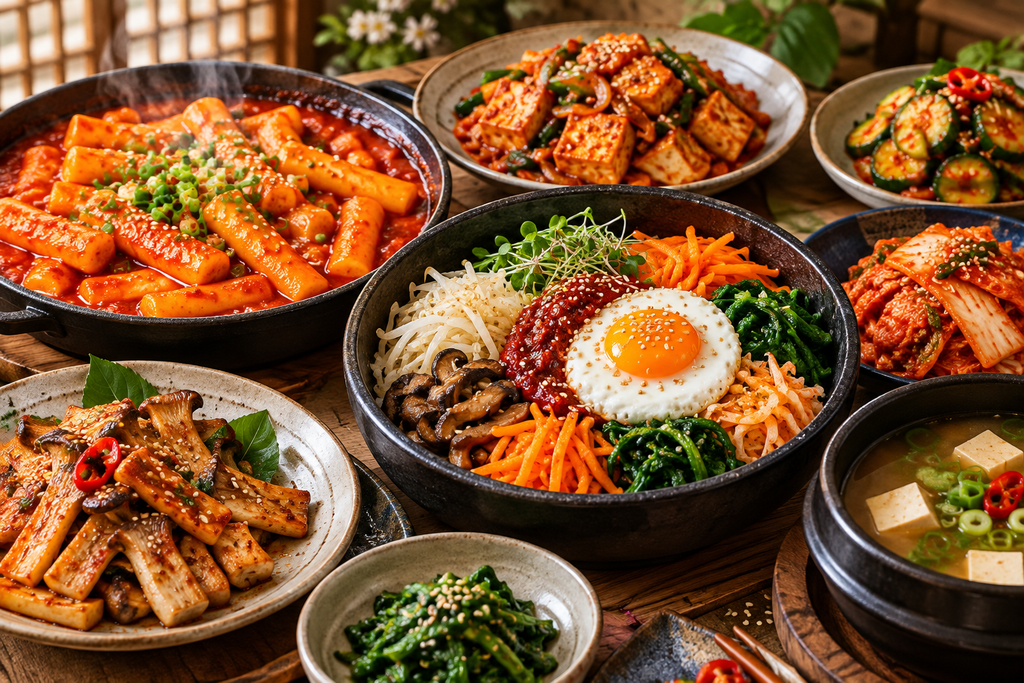
1. Vegetarian Tteokbokki (채식 떡볶이) — Spicy Korean Rice Cakes
Tteokbokki is one of Korea’s best-known street foods. Its signature feature is a collection of chewy cylindrical rice cakes coated in a glossy, sweet, spicy sauce.
Traditional street-style tteokbokki often combines rice cakes with gochujang, gochugaru, sugar, cabbage, and green onions. Some versions use fish cakes, anchovy stock, or seafood-based seasonings.
For a vegetarian version, replace fish cakes with mushrooms, cabbage, or extra rice cakes. Use vegetable stock or water instead of anchovy broth and select a suitable gochujang.
The combination of soft rice cakes, spicy sauce, and vegetables makes vegetarian tteokbokki a particularly satisfying choice for anyone who enjoys Korean street food.
Typical spice level: Medium to very hot, depending on the recipe.
Vegetarian ordering tip: Ask the server whether the sauce contains fish cake, anchovy broth, or seafood seasoning.
Best for: Street-food lovers and travelers who enjoy chewy textures and sweet-spicy flavors.
If you prepare tteokbokki at home, try adding sliced shiitake mushrooms, green onions, and tofu for variety.
2. Spicy Vegetable Bibimbap (매운 채소 비빔밥)
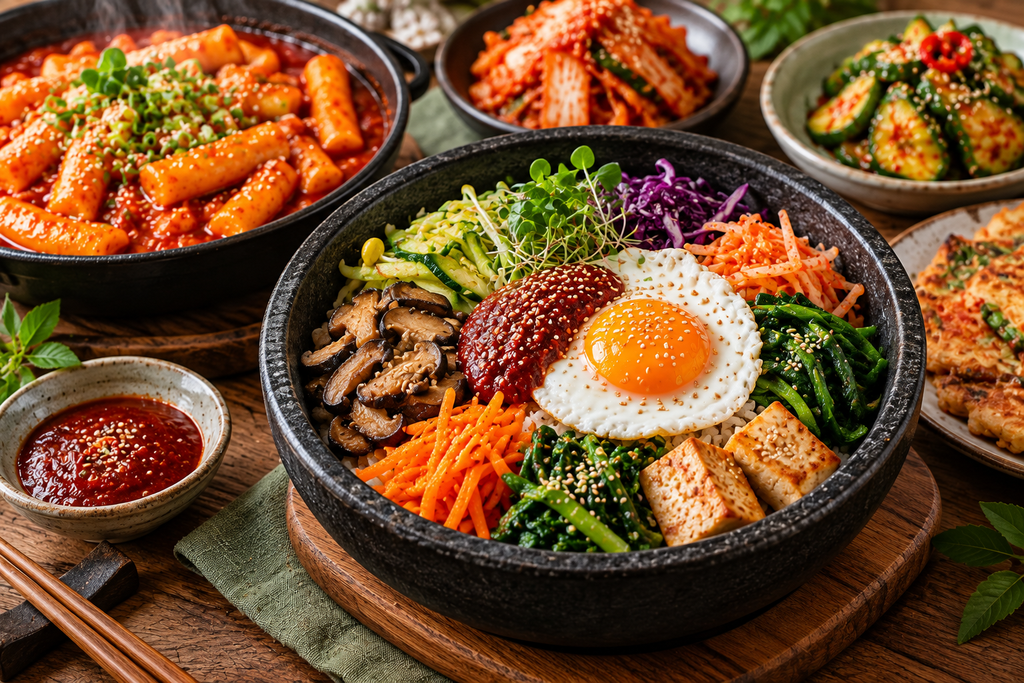
Bibimbap is one of the most flexible Korean meals for vegetarians. Its name means mixed rice, and the dish usually features warm rice topped with several separately prepared ingredients.
Common vegetable toppings include spinach, carrots, soybean sprouts, zucchini, mushrooms, and radish.
A spoonful of gochujang turns the combination into a flavorful, spicy meal.
Standard bibimbap may also include beef and an egg. Vegetarians who eat eggs may choose to keep the egg, while vegans should request the dish without both meat and egg.
Be sure to ask whether any vegetable toppings or accompanying soup contain seafood-based seasoning.
For an extra satisfying version, add grilled tofu or more mushrooms. The combination of warm rice, crisp vegetables, sesame oil, and spicy sauce makes bibimbap an excellent introduction to Korean food.
Typical spice level: Mild to hot, depending on how much sauce you add.
Vegetarian ordering tip: Request no beef and no egg if vegan, and ask whether the vegetables and sauces contain fish sauce.
Best for: First-time visitors and travelers who prefer customizable meals.
A major advantage of bibimbap is that you can control the spice level by adding gochujang gradually.
3. Spicy Braised Tofu (두부조림, Dubu Jorim)
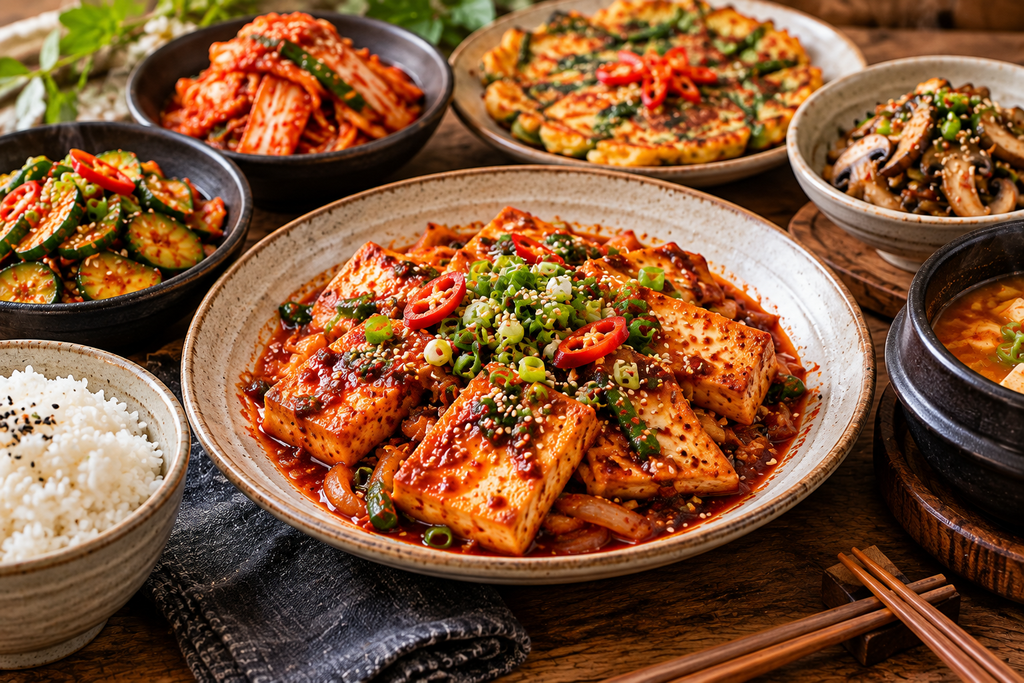
Dubu jorim is a Korean tofu dish prepared by gently braising or pan-cooking tofu in a savory sauce.
The sauce commonly includes soy sauce, gochugaru, garlic, green onions, and sesame oil. Some recipes also use sugar or other sweeteners to balance the heat.
Unlike certain tofu stews, dubu jorim can be relatively straightforward to prepare without animal products. However, restaurant versions still require ingredient verification.
The tofu absorbs the seasoning while maintaining a soft interior. It is especially delicious with steamed rice because the rice balances the salty, spicy sauce.
For a complete vegetarian meal, pair it with spinach namul, cucumber salad, and a verified vegetarian kimchi.
Typical spice level: Mild to medium-hot.
Vegetarian ordering tip: Confirm that the seasoning sauce contains no fish sauce, seafood extract, or meat stock.
Best for: Tofu lovers and home cooks who want a flavorful main dish.
Firm tofu generally holds its shape better during braising, making it a practical option for beginners.
4. Spicy Cucumber Salad (오이무침, Oi Muchim)
Oi muchim is a refreshing Korean cucumber side dish that combines crisp vegetables with a spicy, tangy seasoning.
It is commonly prepared with sliced cucumbers, gochugaru, vinegar, garlic, sesame oil, and sesame seeds. Some variations add green onions or a small amount of sugar.
The result is crunchy, bright, and pleasantly spicy.
Vegetarian versions are easy to make, although some restaurant recipes include fish sauce. Always confirm the seasoning if you follow a strict vegetarian or vegan diet.
Unlike heavier Korean dishes, cucumber salad feels light and refreshing. It pairs particularly well with rice, spicy tofu, and vegetable pancakes.
Typical spice level: Mild to medium.
Vegetarian ordering tip: Ask whether the cucumber seasoning contains fish sauce.
Best for: Travelers seeking a refreshing side dish.
At home, you can prepare a simple version with cucumber, rice vinegar, gochugaru, soy sauce, and toasted sesame seeds.
5. Spicy Stir-Fried Mushrooms (매운 버섯볶음)
Mushrooms are an excellent ingredient for Korean vegetarian cooking because they provide a satisfying texture and absorb seasoning beautifully.
Popular varieties include oyster mushrooms, shiitake mushrooms, and king oyster mushrooms.
A spicy Korean mushroom stir-fry can feature gochujang or gochugaru, garlic, onions, soy sauce, and sesame oil.
King oyster mushrooms work particularly well when sliced into thick pieces and seared until lightly browned.
The finished dish has a savory, spicy flavor and can be served over rice or alongside other Korean vegetable dishes.
Restaurant mushroom stir-fries are not necessarily vegetarian, however. Oyster sauce, meat stock, or seafood-based seasoning may be added.
Typical spice level: Mild to hot.
Vegetarian ordering tip: Ask for a version without oyster sauce, meat stock, or fish sauce.
Best for: Mushroom lovers and people who enjoy savory flavors.
A homemade variation using mushrooms, cabbage, and tofu can become a filling meal rather than a simple side dish.
6. Vegetarian Kimchi (채식김치)
Kimchi is probably Korea’s most internationally recognized fermented vegetable food.
Napa cabbage kimchi is typically seasoned with Korean chili flakes, garlic, ginger, radish, and other flavoring ingredients.
However, traditional kimchi frequently contains fish sauce or fermented salted shrimp. This means that a vegetable-based appearance does not guarantee a vegetarian recipe.
Fortunately, vegetarian kimchi can be made using vegetable broth, mushrooms, soy-based seasonings, or other plant-based umami ingredients.
Vegetarian kimchi offers the signature combination of spicy, tangy, salty, and fermented flavors without requiring seafood ingredients.
It can be eaten as a side dish, added to rice bowls, or used in vegetarian kimchi fried rice.
Typical spice level: Mild to hot.
Vegetarian ordering tip: Look for labels such as “vegan kimchi” or “채식김치,” and still check the ingredient list.
Best for: Fermented-food enthusiasts and anyone exploring traditional Korean flavors.
Remember that vegetarian kimchi and regular kimchi may look nearly identical. Ingredient verification matters more than appearance.
7. Spicy Vegetable Pancakes (매운 야채전)
Korean vegetable pancakes are a delicious option when you want something crispy and savory.
They can be prepared with zucchini, carrots, onions, green onions, mushrooms, and a flour-based batter.
For a spicy version, add chopped Korean chili peppers or gochugaru directly to the batter.
The outside becomes golden and crisp while the vegetables remain tender.
Some Korean pancakes contain eggs, seafood, or seafood-based seasonings. Prepackaged pancake mixes may also vary in their ingredients.
Vegans should ask whether the batter contains eggs and whether the restaurant can prepare a version without animal products.
A dipping sauce made with soy sauce, vinegar, sesame seeds, and chili flakes complements the pancake without requiring meat-based ingredients.
Typical spice level: Mild to medium.
Vegetarian ordering tip: Confirm that the batter and toppings contain no egg or seafood if vegan.
Best for: Sharing with friends or enjoying as a savory snack.
Vegetable pancakes are particularly enjoyable with a bowl of rice and several Korean side dishes.
8. Spicy Soybean Sprouts (매운 콩나물무침)
Kongnamul muchim is a common Korean side dish made from soybean sprouts.
Its spicy variation combines blanched sprouts with gochugaru, garlic, sesame oil, and other seasonings.
The sprouts remain pleasantly crunchy and have a mild, nutty flavor that pairs well with chili.
When made without seafood seasoning, spicy soybean sprouts can be an appealing vegan-friendly addition to a Korean meal.
However, some kitchens use fish sauce or other animal-derived ingredients, so checking is essential.
Soybean sprouts are frequently served as part of a larger assortment of banchan, the small side dishes that accompany Korean meals.
Typical spice level: Mild to medium.
Vegetarian ordering tip: Ask if the soybean sprouts contain fish sauce or seafood seasoning.
Best for: Adding vegetable variety to a meal.
You can also mix spicy soybean sprouts into plain rice with tofu, mushrooms, and gochujang to create a quick vegetarian rice bowl.
9. Spicy Radish Salad (무생채, Musaengchae)
Musaengchae is a seasoned Korean radish dish with a crunchy texture and lively flavor.
Thin strips of radish are mixed with chili flakes, garlic, vinegar, and seasonings.
Depending on the recipe, the finished salad can taste tangy, mildly sweet, salty, and spicy.
Some versions are naturally plant-based, while others use fish sauce or salted seafood seasonings.
A vegetarian version can rely on salt, soy sauce, or another plant-based seasoning instead.
Because it is crisp and refreshing, musaengchae works well next to warm rice dishes and spicy tofu.
Typical spice level: Mild to medium-hot.
Vegetarian ordering tip: Check the dressing for fish sauce and salted shrimp.
Best for: Travelers who enjoy crunchy, spicy vegetables.
It is also an excellent topping for a homemade vegetarian bibimbap bowl.
10. Vegetarian Kimchi Fried Rice (채식 김치볶음밥)
Kimchi fried rice is a popular Korean comfort food known for its bold, tangy flavor.
It is commonly made by stir-frying cooked rice with chopped kimchi, oil, and additional seasonings.
Some versions include pork, bacon, ham, eggs, butter, or other animal-derived ingredients.
To make a vegetarian version, start with verified vegetarian kimchi and use mushrooms, tofu, onions, or other vegetables instead of meat.
Add a little gochujang for extra spice if the kimchi alone does not provide enough heat.
For a vegan version, avoid eggs, dairy butter, and sauces containing animal products.
Vegetarian kimchi fried rice is especially useful for home cooking because leftover rice works well.
Typical spice level: Medium to hot.
Vegetarian ordering tip: Confirm the kimchi ingredients and request no meat, egg, or animal-based stock.
Best for: Comfort-food lovers and budget-conscious home cooks.
A serving of pan-fried tofu on top can make the meal more substantial.
11. Spicy Cold Noodles (비빔국수, Bibim Guksu)
Bibim guksu is a Korean cold noodle dish tossed in a spicy, sweet, and tangy sauce.
Its sauce often combines gochujang, vinegar, sugar, sesame oil, and other seasonings.
The noodles may be topped with cucumber, vegetables, sesame seeds, and sometimes boiled egg.
Meat-based broth, fish sauce, or other animal ingredients can appear in certain recipes, so bibim guksu should not automatically be treated as vegetarian.
For a plant-based version, choose appropriate noodles, a vegan seasoning sauce, and fresh vegetables.
The combination of chilled noodles and spicy sauce makes this dish particularly refreshing during warm weather.
Typical spice level: Medium to hot.
Vegetarian ordering tip: Ask whether the noodles, sauce, and toppings contain meat, seafood, eggs, or animal-derived broth.
Best for: Summer meals and fans of tangy noodle dishes.
If you are sensitive to heat, ask for less spicy sauce or request some of it on the side.
12. Vegetarian Spicy Soft Tofu Stew (채식 순두부찌개)
Sundubu jjigae is a bubbling Korean stew featuring soft tofu in a seasoned broth.
Its rich red appearance comes from chili-based seasonings, and the stew is often served hot in an earthenware bowl.
Traditional restaurant versions frequently contain seafood, meat, anchovy broth, or eggs.
A vegetarian version requires more than simply leaving out visible meat. The entire broth and seasoning base must be free from animal ingredients.
A suitable homemade version can use vegetable or kelp broth, soft tofu, mushrooms, zucchini, onions, and chili flakes.
The resulting stew remains warm, rich, and flavorful, especially when served with steamed rice.
Because the broth is central to the dish, this is one of the meals where explaining your dietary restrictions clearly is especially important.
Typical spice level: Medium to very hot.
Vegetarian ordering tip: Ask whether the restaurant can prepare the stew using vegetable broth without meat, seafood, fish sauce, shrimp paste, or egg if vegan.
Best for: Cold-weather meals and people who enjoy comforting spicy soups.
If the restaurant cannot confirm the broth ingredients, choose another verified vegetarian dish.
Spicy Korean Vegetarian Food Comparison Chart
The following chart helps you compare the dishes by spice level, typical dietary concerns, and the changes needed to make them vegetarian or vegan.
Spice levels are approximate. Recipes and restaurants vary substantially.
| Korean Dish | Approximate Spice Level | Main Ingredients | What Vegetarians Should Check |
|---|---|---|---|
| Tteokbokki | Medium–Very Hot | Rice cakes, chili sauce, cabbage | Fish cakes, anchovy broth |
| Vegetable Bibimbap | Mild–Hot | Rice, vegetables, gochujang | Beef, egg, fish sauce |
| Dubu Jorim | Mild–Medium | Tofu, soy sauce, chili | Fish sauce, seafood seasoning |
| Oi Muchim | Mild–Medium | Cucumber, chili flakes, vinegar | Fish sauce |
| Spicy Mushrooms | Mild–Hot | Mushrooms, vegetables, chili | Oyster sauce, meat stock |
| Vegetarian Kimchi | Mild–Hot | Cabbage, chili, radish | Fish sauce, salted shrimp |
| Vegetable Pancakes | Mild–Medium | Flour, vegetables, chili | Egg, seafood, batter ingredients |
| Soybean Sprouts | Mild–Medium | Sprouts, chili flakes, sesame oil | Fish sauce |
| Musaengchae | Mild–Medium | Radish, chili, vinegar | Fish sauce, salted shrimp |
| Kimchi Fried Rice | Medium–Hot | Rice, kimchi, vegetables | Kimchi seasoning, meat, egg |
| Bibim Guksu | Medium–Hot | Noodles, chili sauce, cucumber | Broth, fish sauce, egg |
| Spicy Sundubu | Medium–Very Hot | Soft tofu, chili broth, vegetables | Seafood, anchovy broth, egg |
Important: Every dish in the comparison chart is a potential vegetarian option, not a guarantee that a standard restaurant serving is vegetarian.
Hidden Animal Ingredients in Korean Food
One of the biggest challenges for vegetarian travelers is identifying animal products in dishes that appear to contain only vegetables.
Learning the most common hidden ingredients can make ordering easier.
Anchovy Broth (멸치육수)
Anchovy broth is frequently used as a flavorful foundation in Korean soups, sauces, and street-food dishes.
Even when there are no visible fish pieces, the broth may contain anchovy extract.
For strict vegetarians and vegans, request vegetable broth or water instead.
Fish Sauce (액젓)
Fish sauce is a salty fermented seasoning sometimes used in kimchi, side dishes, sauces, and soups.
Its flavor may be difficult to identify after it is mixed into a dish.
Ask about fish sauce specifically rather than only asking whether a meal contains fish.
Salted Fermented Shrimp (새우젓)
Saeujeot is an ingredient used in certain kimchi recipes, stews, and other Korean dishes.
It contains shrimp and is therefore unsuitable for vegetarians who avoid seafood.
Fish Cakes (어묵)
Fish cakes are common in Korean street food and may appear in tteokbokki.
They can resemble tofu or other processed foods, making them easy to overlook.
Ask whether fish cakes are included before ordering.
Meat and Bone Stock (고기육수, 사골육수)
Beef, pork, chicken, or bone stock can be used in dishes even when the final serving has no visible pieces of meat.
Clear soups and red stews can both contain animal-derived broths.
Oyster Sauce (굴소스)
Oyster sauce is another ingredient that may appear in vegetable or mushroom stir-fries.
It is seafood-based unless a vegetarian replacement is specifically used.
Eggs and Dairy
Some vegetarians consume eggs and dairy, but vegans do not.
Bibimbap, vegetable pancakes, noodles, and tofu stews may include eggs. Cheese tteokbokki and some modern Korean dishes may contain dairy.
Explain your dietary restrictions clearly to avoid misunderstandings.
Essential Korean Phrases for Ordering Vegetarian Food
Knowing a few Korean expressions can make dining in Korea more comfortable.
You do not need to speak fluent Korean. Showing a written sentence to restaurant staff can be particularly helpful when communicating detailed dietary restrictions.
1. I am vegetarian.
Korean: 저는 채식주의자예요.
Romanization: Jeoneun chaesikjuuijayeyo.
English meaning: I am vegetarian.
2. I am vegan.
Korean: 저는 비건이에요.
Romanization: Jeoneun bigeon-ieyo.
English meaning: I am vegan.
3. Please do not add meat or seafood.
Korean: 고기와 해산물은 넣지 말아 주세요.
Romanization: Gogiwa haesan-mureun neochi mara juseyo.
English meaning: Please do not add meat or seafood.
4. Does this contain fish sauce?
Korean: 이 음식에 액젓이 들어가나요?
Romanization: I eumsige aekjeosi deureoganayo?
English meaning: Does this dish contain fish sauce?
5. Does the broth contain anchovies?
Korean: 육수에 멸치가 들어가나요?
Romanization: Yuksue myeolchiga deureoganayo?
English meaning: Does the broth contain anchovies?
6. Please make it without eggs.
Korean: 계란은 빼 주세요.
Romanization: Gyeraneun ppae juseyo.
English meaning: Please leave out the eggs.
7. Can you prepare it with vegetable broth?
Korean: 채소 육수로 만들어 주실 수 있나요?
Romanization: Chaeso yuksuro mandeureo jusil su innayo?
English meaning: Could you make it with vegetable broth?
8. Does this dish contain shrimp paste or salted shrimp?
Korean: 이 음식에 새우젓이 들어가나요?
Romanization: I eumsige saeujeosi deureoganayo?
English meaning: Does this dish contain salted fermented shrimp?
9. Please make it less spicy.
Korean: 덜 맵게 해 주세요.
Romanization: Deol maepge hae juseyo.
English meaning: Please make it less spicy.
10. Can you make this dish vegan?
Korean: 이 음식을 비건으로 만들어 주실 수 있나요?
Romanization: I eumsigeul bigeoneuro mandeureo jusil su innayo?
English meaning: Can you make this dish vegan?
A Helpful Vegetarian Restaurant Message
If you want to explain your dietary restrictions clearly, save the following Korean message on your phone:
저는 채식주의자입니다. 고기, 생선, 해산물, 멸치육수, 액젓, 새우젓이 들어간 음식은 먹지 않습니다. 이런 재료 없이 만들 수 있나요?
Translation:
“I am vegetarian. I do not eat food containing meat, fish, seafood, anchovy broth, fish sauce, or salted shrimp. Can this be prepared without these ingredients?”
Vegans should also add:
계란, 우유, 치즈 등 동물성 재료도 먹지 않습니다.
“I also do not eat animal-derived ingredients such as eggs, milk, or cheese.”
Remember that restaurant staff may not be able to change an already prepared broth or sauce. If the ingredients cannot be confirmed, order a different dish.
Where to Find Spicy Vegetarian Korean Food
Korean Traditional Restaurants
Traditional Korean restaurants commonly serve rice, vegetables, tofu, and side dishes.
This can provide several opportunities for vegetarian eating, but it is still necessary to ask about broths and seasonings.
Bibimbap is often a convenient starting point because the visible meat and egg can sometimes be omitted.
However, make sure sauces and prepared vegetable toppings are also suitable for your diet.
Korean Street-Food Markets
Korean street-food markets provide an exciting opportunity to explore tteokbokki, pancakes, noodles, and snacks.
The biggest challenge is that sauces and broths may be prepared in advance.
Ask vendors about fish cakes and anchovy broth before purchasing rice cakes.
If the vendor cannot change the recipe, look for another snack rather than assuming that removing the fish cake is sufficient.
Vegan and Vegetarian Restaurants
Restaurants specializing in plant-based meals can make dietary planning easier.
Some offer vegan versions of familiar Korean favorites, such as kimchi fried rice, bibimbap, tofu dishes, and tteokbokki.
Check whether the menu identifies dishes as vegan or vegetarian rather than relying on their appearance.
Dedicated vegan restaurants may also make it easier to explore Korean flavors without repeatedly requesting substitutions.
Korean Temple Food Restaurants
Korean Buddhist temple cuisine is an especially interesting choice for vegetarian visitors.
It traditionally emphasizes vegetables, mushrooms, grains, fermented seasonings, and ingredients such as kelp.
Temple cooking is often more subtle than the fiery street foods introduced in this guide. Its appeal lies in carefully balanced natural flavors.
For travelers who want both a spicy street-food experience and a traditional plant-focused meal, trying these two different styles of Korean cuisine offers a broader appreciation of Korean food culture.
Temple restaurants may follow different recipes, so vegan visitors should still check specific ingredients.
How to Make Korean Vegetarian Dishes Spicier at Home
Cooking Korean food at home gives you greater control over ingredients and chili levels.
You can create spicy vegetarian meals with relatively simple pantry staples.
Start With Korean Chili Flakes
Gochugaru provides the red color and characteristic chili flavor found in many Korean dishes.
Add a small amount initially and adjust after tasting.
Different brands and types can vary in heat.
Use Gochujang for Sweet-Spicy Flavor
Gochujang works particularly well in rice cakes, rice bowls, and stir-fried vegetables.
Because it has a concentrated taste, begin with a modest amount and add more gradually.
Check the label for ingredients that may conflict with your diet.
Add Mushrooms for Savory Flavor
Mushrooms help develop savory depth without meat.
Dried shiitake mushrooms can also be used to prepare vegetable broth.
For a simple broth, simmer mushrooms with kelp and vegetables, then strain before using.
Use Tofu for a More Satisfying Meal
Tofu pairs well with spicy Korean sauces.
Firm tofu works well for braising and stir-frying, while soft tofu is ideal for soups and stews.
The texture you choose can dramatically change the character of a dish.
Balance Heat With Rice and Vegetables
A very spicy sauce does not always need to be diluted.
Serving it with plain rice, cucumber, tofu, or other lightly seasoned vegetables can create a more balanced meal.
This is particularly useful when preparing several Korean dishes for guests with different spice preferences.
A Simple One-Day Vegetarian Korean Meal Plan
If you are new to Korean cuisine, you do not need to try every dish at once.
A simple food plan can introduce several different flavors and textures throughout the day.
Lunch: Vegetable Bibimbap
Start with rice topped with spinach, carrots, mushrooms, zucchini, and tofu.
Add a small amount of verified vegetarian gochujang.
Serve with spicy cucumber salad for additional freshness.
Afternoon Snack: Vegetarian Tteokbokki
Enjoy chewy rice cakes in a sweet-spicy chili sauce.
Choose a preparation without fish cakes or anchovy broth.
For extra vegetables, add cabbage and mushrooms.
Dinner: Spicy Braised Tofu With Rice
Prepare tofu in a chili-soy sauce and serve alongside steamed rice.
Add spicy soybean sprouts, radish salad, and verified vegetarian kimchi.
This provides an enjoyable combination of warm, spicy, crunchy, and fermented flavors.
Optional Weekend Meal: Vegan Soft Tofu Stew
On a cooler day, prepare a comforting bowl of soft tofu stew with mushrooms and vegetable broth.
Serve it with rice and vegetable side dishes.
This meal is a good example of how Korean comfort food can be adapted to vegetarian cooking.
Vegetarian vs. Vegan Korean Food: What Is the Difference?
Vegetarian and vegan diets can overlap, but they are not identical.
Many vegetarians avoid meat, fish, and seafood while continuing to eat eggs or dairy products.
Vegans avoid animal-derived foods, including eggs and dairy.
These differences matter when ordering Korean dishes.
A vegetarian bibimbap might contain an egg, whereas a vegan version would not.
A cheese tteokbokki might be suitable for some vegetarians but not for vegans, provided its broth and sauce contain no fish ingredients.
Similarly, a vegetable pancake prepared with eggs might be vegetarian but not vegan.
For strict vegan diets, it is important to verify all ingredients, including sauces, stocks, toppings, and cooking mixes.
Instead of simply asking whether a meal has vegetables, explain which animal products you do not eat.
Common Mistakes Vegetarian Travelers Should Avoid
Assuming Kimchi Is Always Vegan
Kimchi is vegetable-based but frequently contains fermented seafood.
Choose verified vegetarian kimchi whenever possible.
Removing Meat Without Checking the Broth
A restaurant may remove visible meat while continuing to use meat or anchovy stock.
Ask about the broth separately.
Assuming Fish Cakes Are Made From Vegetables
Fish cakes commonly contain processed fish.
They are not a vegetarian alternative to meat.
Confusing Spicy Food With Vegetarian Food
Chili paste does not make a dish vegetarian.
Spicy Korean dishes can still contain pork, seafood, fish sauce, or other animal ingredients.
Forgetting About Side Dishes
Korean meals often include several banchan.
Some side dishes are vegetarian, but others contain seafood seasoning or animal-based sauces.
Confirm individual dishes instead of assuming that every side dish is safe.
Expecting Every Restaurant to Customize Prepared Sauces
Some Korean restaurants prepare large batches of broth or seasoning before customers arrive.
In those cases, removing an ingredient at the table does not make the finished dish vegetarian.
Choose another item if a suitable modification is not possible.
Frequently Asked Questions About Spicy Korean Vegetarian Food
1. What are the best spicy Korean foods vegetarians can enjoy?
Vegetarian tteokbokki, vegetable bibimbap, spicy braised tofu, spicy cucumber salad, mushroom stir-fries, and vegetarian kimchi are excellent choices when prepared without animal-derived ingredients.
Bibimbap and dubu jorim are particularly good starting points because they can be customized relatively easily.
2. Is traditional Korean tteokbokki vegetarian?
Not necessarily. Traditional tteokbokki often includes fish cakes or anchovy-based broth.
A vegetarian version requires suitable rice cakes, sauce, and broth without fish or meat ingredients.
3. Is Korean kimchi vegan?
Some kimchi is vegan, but many traditional recipes contain fish sauce or salted fermented shrimp.
Look for verified vegan kimchi and read the ingredient list carefully.
4. Is gochujang vegetarian?
Many gochujang products are made using plant-based ingredients, but recipes and commercial formulations vary.
Check the specific product label, especially if you are vegan or have additional dietary restrictions.
5. Can vegetarians eat Korean street food?
Yes, but they should confirm ingredients before ordering.
Vegetarian versions of tteokbokki, vegetable pancakes, and other snacks are possible. Standard street-food preparations may include seafood, eggs, or animal-based broth.
6. Is spicy Korean tofu soup vegetarian?
Regular sundubu jjigae is not automatically vegetarian.
It often contains seafood, meat, eggs, or anchovy stock. A vegetarian version must use an appropriate broth and seasoning base.
7. What is the easiest Korean vegetarian dish for beginners?
Vegetable bibimbap is an accessible choice because it combines familiar ingredients such as rice and vegetables with Korean sauces.
You can add chili paste according to your spice tolerance.
8. How can I ask for vegetarian food in Korean?
Say “저는 채식주의자예요” (Jeoneun chaesikjuuijayeyo), meaning “I am vegetarian.”
For strict dietary needs, also specify that you cannot eat fish sauce, anchovy broth, salted shrimp, meat, or seafood.
9. Are Korean vegetable side dishes always vegetarian?
No. Some vegetable side dishes use fish sauce, seafood seasoning, or other animal-derived ingredients.
Ask about the seasoning rather than judging only by appearance.
10. Can I enjoy spicy Korean food without eating eggs or dairy?
Yes. Many dishes can be made vegan with suitable substitutions.
Tofu, vegetables, mushrooms, rice, and plant-based chili sauces provide plenty of options.
Always check prepared sauces, soups, and restaurant recipes before eating.
Final Thoughts: Enjoy Spicy Korean Food With Confidence
Exploring Korean food as a vegetarian can be a delicious experience when you understand the ingredients behind each dish.
From sweet-spicy tteokbokki and colorful bibimbap to braised tofu, crunchy cucumber salad, and plant-based kimchi, there are many spicy Korean foods vegetarians can enjoy.
The most important habit is to verify sauces, broths, and fermented seasonings rather than judging a dish by appearance alone.
Learning a few Korean ordering phrases also makes it easier to communicate your dietary preferences, whether you are visiting a busy Seoul market or dining at a neighborhood restaurant.
Korean cuisine offers a wide range of vegetables, fermented flavors, satisfying textures, and adjustable spice levels. With informed choices and thoughtful substitutions, vegetarian travelers can experience many of the flavors that make Korean food memorable.
Start with a dish that sounds appealing, confirm its ingredients, and discover your own favorite Korean flavors.
Explore more Korean food and travel guides at TIPVERO.