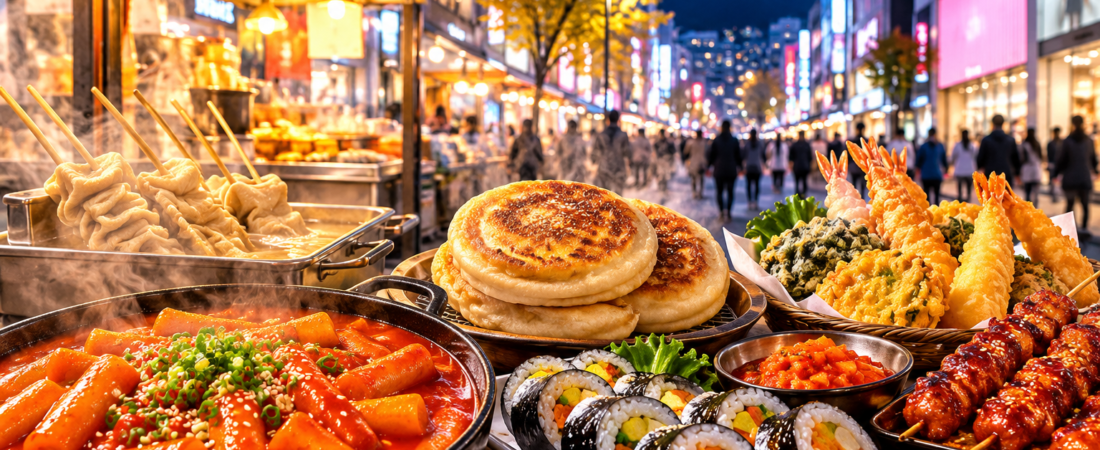
If you are wondering what to eat in Myeongdong on your first trip to Seoul, you may quickly discover that choosing where to begin is harder than finding food.
Walk through Myeongdong in the evening and you can encounter busy pedestrian streets, restaurants tucked into upper floors, small Korean snack shops, cafés, and rows of street-food vendors.
Myeongdong is one of Seoul’s best-known shopping districts and is particularly convenient for international travelers. The official Seoul tourism guide lists Myeongdong Station on Subway Line 4, particularly Exits 5 through 10, as a convenient way to reach the district. Visit Seoul
But there is an important point first-time visitors should understand:
Myeongdong food is not limited to street food.
Some of the neighborhood’s most interesting meals are found inside long-established restaurants and small bunsik shops.
So rather than simply buying whatever looks most unusual from the first food cart you see, use Myeongdong as an introduction to several different sides of Korean food.
Here are 15 Korean foods first-time visitors should consider trying in Myeongdong.
1. Tteokbokki — Spicy Korean Rice Cakes
If you want to begin with one of Korea’s most recognizable street foods, start with tteokbokki (떡볶이).
Tteokbokki consists primarily of chewy rice cakes cooked in a thick red sauce typically made with gochujang and other seasonings.
The first thing many visitors notice is the bright red color.
That can make the dish look extremely spicy.
However, sweetness is also an important part of many tteokbokki sauces. Depending on the restaurant or stall, the flavor can range from mildly sweet and spicy to genuinely hot.
The texture is equally important.
Korean rice cakes are chewy rather than soft like ordinary pasta. That distinctive texture is part of the experience.
For a more traditional snack-shop experience, tteokbokki can also be found at established Myeongdong bunsik restaurants. Seoul’s official tourism site, for example, lists Myeonghwadang as a long-running Myeongdong restaurant serving tteokbokki along with gimbap, mandu and noodles. Visit Seoul
Beginner tip: Try one portion before ordering several spicy dishes at once.
2. Kalguksu — Korean Knife-Cut Noodles
Street food receives much of the attention in Myeongdong, but one of the neighborhood’s signature meals is actually a bowl of noodles.
Kalguksu (칼국수) literally refers to knife-cut noodles.
The noodles are served in a warm savory broth and make an excellent choice if you want something more substantial than street snacks.
One of the best-known places associated with this dish is Myeongdong Kyoja.
It specializes in kalguksu and mandu and has become closely associated with eating in Myeongdong. The official Seoul tourism guide specifically points visitors toward Myeongdong Kyoja for authentic kalguksu. Visit Seoul
For someone unfamiliar with Korean cuisine, kalguksu is also a relatively approachable introduction because it doesn’t depend on extreme spice or unfamiliar raw ingredients.
It is warm, filling and comforting.
3. Mandu — Korean Dumplings
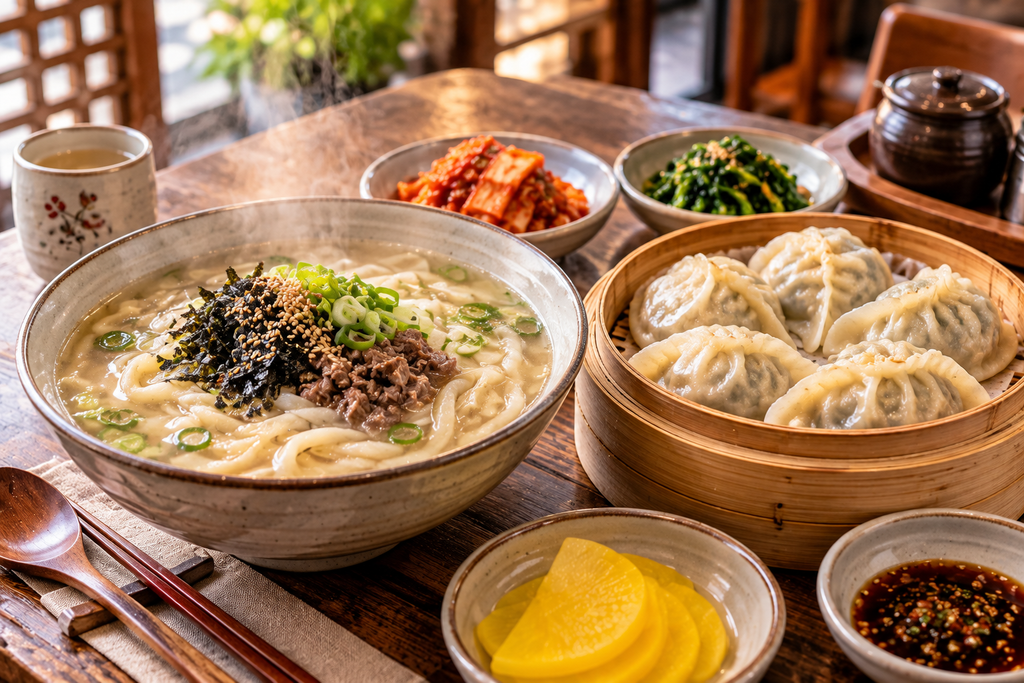
While eating kalguksu, add mandu (만두) to your table.
Mandu are Korean dumplings made with thin wrappers surrounding fillings that can include pork, vegetables, tofu, garlic and other seasonings.
They may be steamed, boiled or fried depending on the style.
Large steamed mandu are particularly satisfying alongside noodle soup because you get two contrasting textures: soft noodles in broth and substantial dumplings.
If two people are eating together, sharing dumplings is an easy way to sample another Korean dish without ordering an entirely separate meal.
This is also one reason kalguksu and mandu make such a good combination for first-time visitors.
4. Gimbap — Korea’s Convenient Rice Roll
Gimbap (김밥) is one of Korea’s most practical everyday foods.
Rice and fillings are rolled inside dried seaweed and sliced into small pieces.
Common fillings include vegetables, egg, pickled radish and meat, although countless variations exist.
People sometimes compare gimbap with Japanese sushi because of its appearance, but the flavor and cultural role are different.
Gimbap is usually treated as an inexpensive everyday meal or snack rather than primarily as a raw-fish dish.
For an interesting local variation, Myeongdong also has Chungmu gimbap.
The official Seoul tourism guide lists Myeongdong Chungmu Gimbap as a restaurant that has operated in the neighborhood for more than 40 years, serving its simple rice rolls with spicy seasoned squid and pickled radish. Visit Seoul
That makes it worth trying if ordinary gimbap is already familiar to you.
5. Eomuk — Korean Fish Cake
On a cool Seoul evening, look for steaming containers of eomuk (어묵).
Eomuk is Korean fish cake, commonly folded onto skewers and warmed in broth.
The texture is springy and soft, while the flavor is savory but generally mild.
For travelers worried about Korean spice levels, this can be one of the easiest street foods to try.
Vendors often serve the hot broth along with the fish cake.
During Seoul’s colder months, standing beside a street stall with a hot cup of broth is as much a part of the experience as the food itself.
6. Hotteok — Sweet Korean Pancake
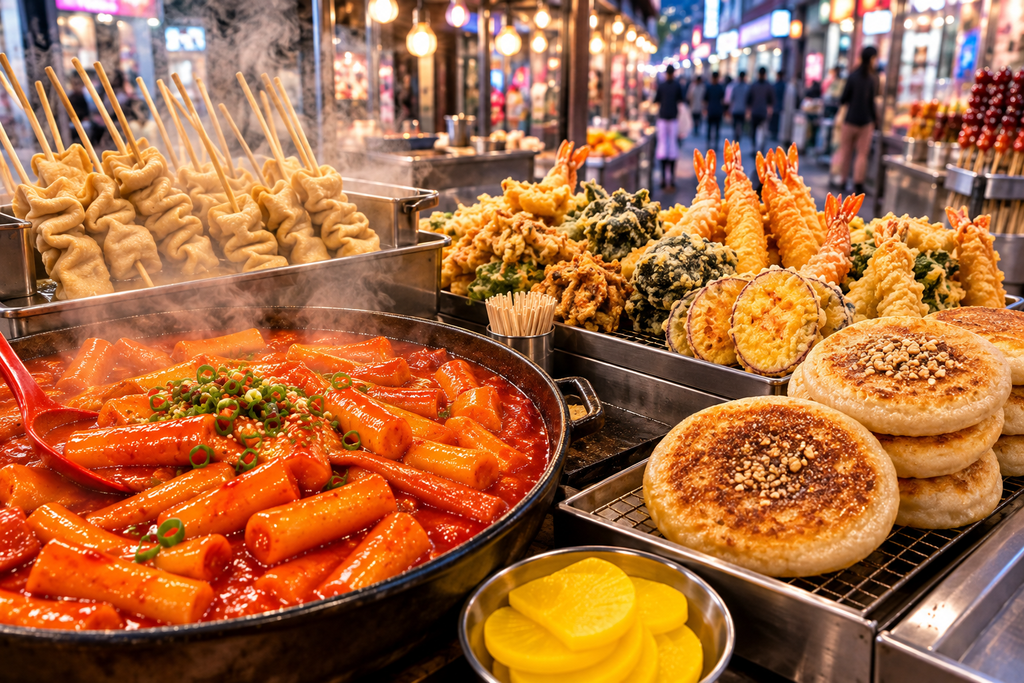
After several savory dishes, try hotteok (호떡).
Hotteok is a filled Korean pancake commonly associated with street food.
Traditional versions contain a sweet mixture that may include brown sugar, cinnamon and nuts.
When freshly cooked, the outside becomes slightly crisp while the inside remains chewy and the sugar filling becomes hot and syrupy.
Be careful with the first bite—the filling can be extremely hot.
Hotteok is particularly satisfying during autumn and winter, but it is popular enough that travelers look for it throughout the year.
7. Korean Fried Chicken
Korean fried chicken has become internationally famous, but eating it in Seoul is still worth experiencing.
What distinguishes many Korean versions is the combination of a very crisp exterior with sauces and seasonings.
You may see:
Original fried chicken — crispy and relatively simple.
Yangnyeom chicken — coated in a sweet and spicy red sauce.
Soy garlic chicken — savory, sweet and garlicky.
Instead of ordering the largest portion immediately, look for smaller portions or share with another traveler. Myeongdong has so many other foods that filling up on your first stop defeats the purpose of a food crawl.
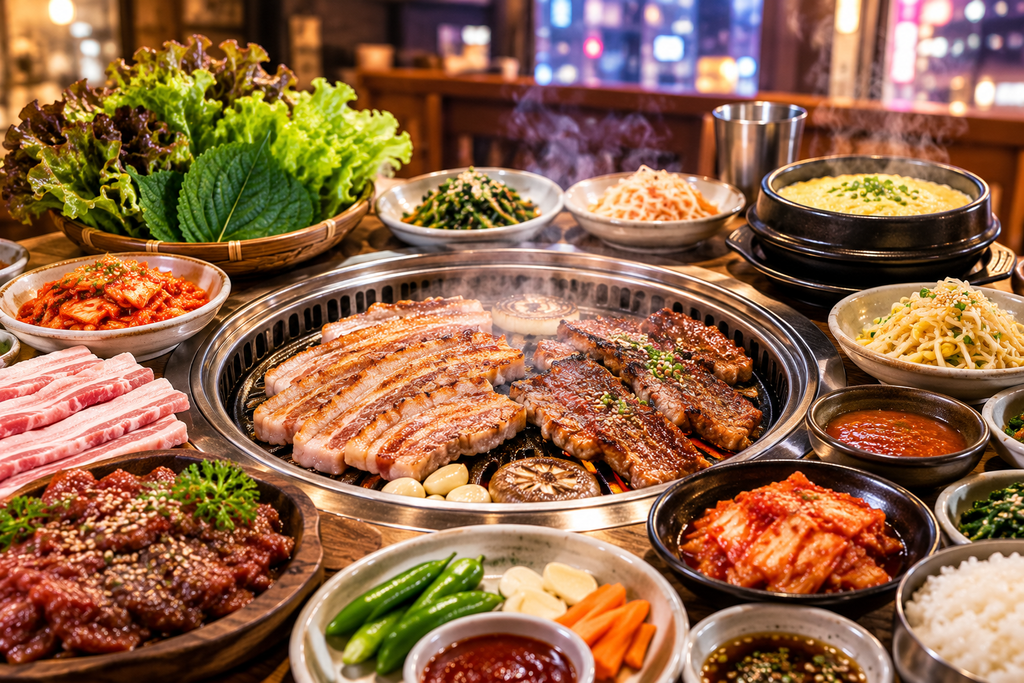
8. Korean BBQ — Samgyeopsal or Galbi
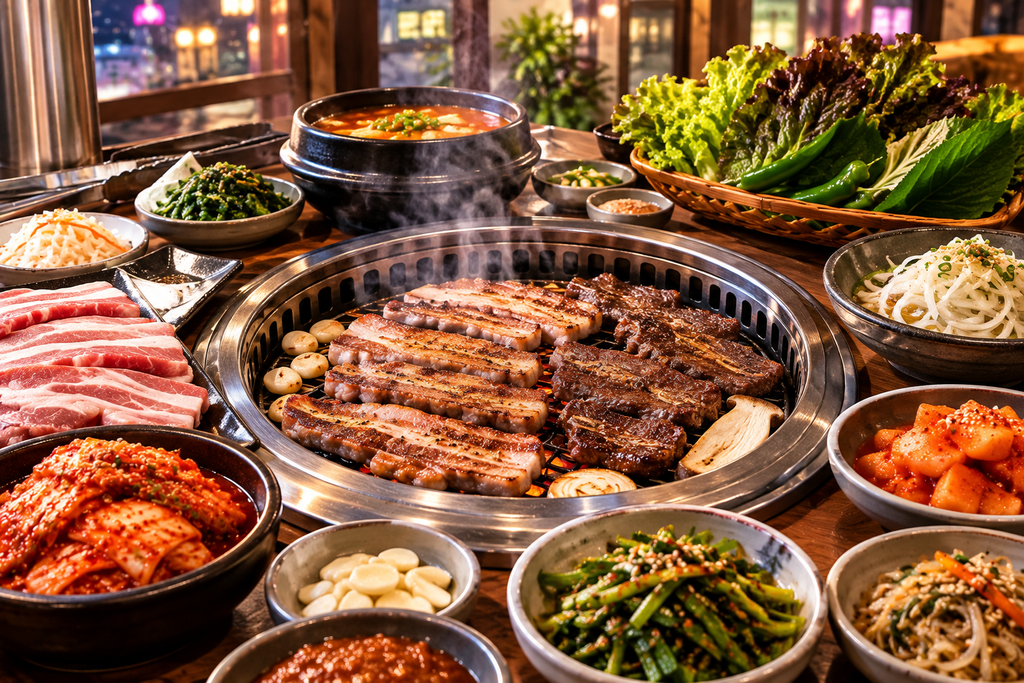
If street food represents one side of Korean dining culture, Korean BBQ represents another.
Two useful terms to recognize are:
Samgyeopsal (삼겹살) — thick slices of pork belly.
Galbi (갈비) — ribs, often marinated.
The meat is grilled at the table and eaten with side dishes, sauces and vegetables.
A common method is to put meat into a lettuce or perilla leaf, add a little ssamjang, garlic or another accompaniment, fold everything together and eat it as a wrap called ssam.
Myeongdong has many BBQ restaurants, including Wangbijip Myeongdong Main store, where staff-assisted table grilling can make the process easier for visitors unfamiliar with Korean BBQ.
Don’t worry about memorizing elaborate eating rules. Korean BBQ is fundamentally a shared meal.
9. Bulgogi — Sweet-Savory Marinated Beef
If pork belly feels too fatty or you prefer a milder flavor, bulgogi (불고기) is an excellent alternative.
Thin slices of beef are marinated in a mixture commonly containing soy sauce, garlic and sweet ingredients before being cooked.
Compared with spicy dishes such as tteokbokki, bulgogi is mild.
That makes it particularly useful for families or travelers who want to experience Korean flavors without much heat.
Bulgogi can appear in restaurants as a main dish, BBQ item, rice bowl or part of a set meal.
10. Dakkochi — Korean Chicken Skewers
Dakkochi (닭꼬치) literally means chicken skewer.
Pieces of chicken are grilled on a stick and coated with sauce or seasoning.
Depending on the vendor, you may find spicy, sweet-spicy or soy-based versions.
This is one of the most convenient foods for a Myeongdong street-food walk because you don’t need to sit down for a full meal.
Eat it while walking, continue shopping, and then move on to another snack.
That grazing style is part of what makes the evening street-food experience at Myeongdong Night Market appealing to first-time visitors.
11. Twigim — Korean-Style Fried Snacks
Twigim (튀김) is a broad category of battered and fried foods.
You may encounter shrimp, squid, sweet potato, vegetables, dumplings and other ingredients.
A particularly Korean way to enjoy twigim is alongside tteokbokki.
Dip a crispy fried piece into the spicy-sweet tteokbokki sauce.
The contrast between crispy batter and thick sauce is excellent.
This combination also gives visitors a better sense of bunsik, Korea’s casual snack-food culture, rather than treating each food as an isolated tourist attraction.
12. Bindaetteok — Mung Bean Pancake
Bindaetteok (빈대떡) is a savory Korean pancake traditionally made from ground mung beans.
The texture is completely different from an American breakfast pancake.
It is savory, hearty and often crisp around the edges.
Various versions can contain vegetables, kimchi or meat.
Bindaetteok is more strongly associated with traditional markets such as Gwangjang Market than with Myeongdong itself, so availability in Myeongdong varies.
That distinction is useful for travelers: not every famous Korean street food originates in Myeongdong.
If you see a freshly cooked version while exploring the area, however, it is worth considering.
13. Bibimbap — Mixed Rice Bowl
If you want several Korean flavors in one bowl, try bibimbap (비빔밥).
Bibimbap typically combines rice with vegetables and other toppings, often with egg and gochujang.
You mix the ingredients together before eating.
The result combines different textures and flavors in nearly every bite.
Bibimbap is particularly useful for first-time visitors because it introduces Korean vegetables and seasoning without requiring you to understand a large menu.
It is widely available around Myeongdong. The official Seoul tourism site, for example, lists bibimbap among the everyday Korean dishes available at Myeongdong Busanjib. Visit Seoul
14. Bungeoppang — Fish-Shaped Pastry
Don’t let the shape confuse you.
Bungeoppang (붕어빵) looks like a fish, but traditional versions do not contain fish.
It is a warm pastry commonly filled with sweet red bean paste. Modern versions may use custard, cream or other fillings.
Bungeoppang is especially associated with colder weather.
If you’re visiting Seoul during late autumn or winter and see it being cooked fresh, eat it while it is still warm.
It is inexpensive, simple and very Korean.
15. Bingsu — Korean Shaved Ice
Finish your Myeongdong food tour with bingsu (빙수).
Bingsu is Korean shaved ice, usually served as a dessert large enough to share.
Traditional patbingsu contains sweet red beans, while modern cafés offer versions topped with mango, strawberries, matcha, chocolate, condensed milk or other ingredients.
The texture of modern Korean shaved ice can be extraordinarily fine—closer to fluffy snow than crushed ice.
After eating spicy tteokbokki or hot grilled meat, cold bingsu makes an excellent final stop.
Street Food vs. Restaurants in Myeongdong
First-time travelers often make one mistake: they arrive hungry and attempt to eat everything at the street stalls.
A better strategy is to divide your experience.
Use street stalls for foods such as tteokbokki, eomuk, hotteok, chicken skewers and desserts.
Then sit down for foods that benefit from a restaurant setting, such as kalguksu, mandu, bibimbap and Korean BBQ.
Myeongdong’s evening street-food scene is concentrated around its pedestrian shopping streets and becomes particularly lively later in the day. Myeongdong Shopping Street
Because vendors and operating patterns can change, don’t build your entire itinerary around one specific street cart.
Think in terms of foods, rather than individual vendors.
How Much Should You Eat?
The easiest mistake is ordering too much.
If you want to experience several foods, don’t treat every stop as a complete meal.
A simple strategy for two people could be:
Start with one tteokbokki or eomuk snack.
Share one hotteok.
Have kalguksu and mandu as your main meal.
Walk and shop for an hour.
Try one additional street snack.
Finish with bingsu.
This gives you a much broader experience than eating a huge meal at the first restaurant you encounter.
When Is the Best Time to Visit Myeongdong for Food?
Myeongdong is active throughout the day, but the atmosphere changes after the afternoon as the shopping streets become busier and street-food activity increases.
If street food is your main goal, late afternoon into evening is generally more interesting than early morning.
Restaurant schedules vary, so check the restaurant you want to visit before going.
The official Seoul tourism guide lists Myeongdong itself as open daily while noting that individual store hours vary. Visit Seoul
Is Myeongdong Street Food Expensive?
Myeongdong is primarily a major tourist and shopping district, not a budget food market.
That distinction matters.
Some visitors find street-food pricing higher than in less tourist-oriented areas of Seoul. The convenience is what you are paying for: dozens of foods, shops and attractions concentrated within a compact and highly accessible district.
So I would not recommend judging Korean food prices—or Korean street-food culture generally—based only on Myeongdong.
Later in this TIPVERO series, we’ll compare Myeongdong with places such as Gwangjang Market, Jongno, Insadong, Hongdae, Gangnam and Seongsu.
What Should a First-Time Visitor Try First?
If you can only choose five foods from this list, create a balanced experience rather than choosing five similar snacks.
Try:
Tteokbokki for classic Korean street-food flavor.
Kalguksu for Korean comfort food.
Mandu for an approachable shared dish.
Korean BBQ for the social dining experience.
Hotteok or bingsu for dessert.
Together they show several completely different sides of Korean food culture.
A Simple First-Time Myeongdong Food Route
Start near Myeongdong Station on Subway Line 4 and walk into the central shopping streets. The official Seoul guide specifically identifies station Exits 5–10 for accessing Myeongdong. Visit Seoul
Explore the shopping streets first rather than immediately buying several foods.
Then choose one small street snack.
Continue toward the central pedestrian area and have a proper meal—kalguksu and mandu are excellent possibilities.
Afterward, return to the shopping streets as the evening atmosphere develops.
Try another snack and finish at a café with dessert.
This approach turns dinner into a two- or three-hour Myeongdong experience rather than a 20-minute meal.
Tips Before Eating Street Food in Myeongdong
Bring a little patience. Myeongdong can become extremely crowded.
Don’t buy five foods simultaneously. Hot street food tastes much better immediately after it is prepared.
Look at the displayed price before ordering.
If you have food allergies, don’t assume you know every ingredient simply from looking at a dish. Sauces, broths and fillings can contain ingredients that aren’t visually obvious.
And remember that Myeongdong is only the beginning.
The neighborhood provides an accessible introduction to Korean food, but Seoul’s food culture changes dramatically from one neighborhood to another.
FAQ: Eating in Myeongdong
What food is Myeongdong famous for?
Myeongdong is known to travelers for its concentrated street-food scene, but the neighborhood also has established restaurants serving foods such as kalguksu, mandu, gimbap, tteokbokki and Korean BBQ. Myeongdong Kyoja is particularly associated with kalguksu and dumplings. Visit Seoul
Is Myeongdong good for first-time visitors to Korea?
Yes. The district combines shopping, restaurants, cafés and street food in a relatively compact area and is easily reached by subway. That makes it particularly convenient for travelers who have just arrived in Seoul.
What is the best Korean food for someone who doesn’t like spicy food?
Kalguksu, mandu, bulgogi, gimbap and many types of Korean BBQ can all be good starting points. However, sauces and recipes vary, so ask before ordering if you need to avoid spicy ingredients completely.
Is tteokbokki very spicy?
It depends on the recipe. Many versions balance spice with sweetness, while others can be considerably hotter. The bright red appearance alone does not tell you exactly how spicy it will be.
What time should I visit Myeongdong for street food?
Late afternoon and evening generally provide more of the street-food atmosphere associated with Myeongdong. Individual vendor schedules can change, so avoid relying on a single stall.
Can I eat Korean food in Myeongdong if I need halal food?
There are halal-oriented options in the district. Seoul’s official tourism guide currently lists Myeongdong Busanjib as serving dishes including bibimbap under halal standards, and Myeongdongjeong as offering traditional Korean course meals using halal meat. Visit Seoul
Is Myeongdong food expensive?
Prices vary significantly. Myeongdong is a heavily visited tourist and shopping district, so some food can cost more than comparable items elsewhere in Seoul. Check displayed prices before ordering, especially when sampling multiple street foods.
Final Thoughts
Deciding what to eat in Myeongdong becomes much easier when you stop thinking of the neighborhood as simply a street-food market.
Use it instead as your first introduction to Korean food.
Try chewy tteokbokki from a casual snack shop. Sit down for steaming kalguksu and mandu. Experience Korean BBQ around a table. Eat hotteok while exploring the shopping streets, and end the evening with a bowl of cold bingsu.
Then move beyond Myeongdong.
Seoul’s neighborhoods have their own food personalities, and that’s exactly what the TIPVERO Korea Food by Region series will explore next.